

Have you ever seen the word pars in a sentence and thought, “Wait, is that just par with an extra letter, or does it mean something completely different?” It’s a fair question, because pars is one of those small words that quietly wanders between several fields.
You might see it while reading about golf, come across it in a medical text, or notice it inside an anatomical phrase such as pars lateralis. Same spelling, different neighborhood.
The short answer is that pars can mean different things depending on where you meet it. In golf, pars is commonly the plural of par. In medical and anatomical language, however, pars comes from Latin and means “part.”
Cambridge Dictionary lists the specialized medical pronunciation as /pɑːrz/ in American English and gives partes as its plural form in the Latin-derived medical sense.
So, what does pars mean exactly? Well, that depends on the sentence holding it. A golf writer might say that a player made several pars during a round,
while an anatomy textbook might describe a particular pars of a muscle. The word looks identical, but its job has changed a little bit, which is where the fun begins.
What Does Pars Mean in Simple English?
The easiest way to understand pars is to separate its two major meanings instead of trying to squeeze everything into one definition.
First, in ordinary English and especially in golf, pars is the plural of par. If one golfer makes a par on one hole and then makes par on another hole, they have made two pars. Dictionary sources explicitly list “pars” as the plural form of par.
Second, in medical or anatomical terminology, pars is a Latin-derived noun meaning “part.” Its plural in that specialized usage is partes, which can look rather strange if you have only encountered English plurals before. Cambridge describes it as a Latin word meaning “part” that is used in medical names and descriptions.
Here are some quick examples to make the distinction less slippery:
- In golf: “She recorded five pars during the final round.”
- In golf: “The player finished with nine pars and two birdies.”
- In golf: “He needed a couple of pars on the back nine to stay competitive.”
- In anatomy: “The muscle contains a named pars or section.”
- In medical terminology: pars can identify a particular part of an anatomical structure.
- In Latin-derived terminology, pars essentially carries the idea of a part or portion.
- The medical plural is partes, not normally “parses,” which is a useful little distinction to remember.
- The pronunciation may also change slightly depending on which sense you are reading, so context is doing more work than it first appears.
That is the core of the pars meaning. Simple, yes, but the details become much more interesting once golf clubs and Latin grammar enter the room.
What Does Pars Mean in Golf?
If you found pars while reading a golf article, tournament report, leaderboard, or sports story, the answer is probably very straightforward: pars means more than one par.
In golf, par is the number of strokes a skilled golfer is expected to need to complete a particular hole or a whole course under normal playing conditions. Cambridge defines golf par as the expected number of times a good player should need to hit the ball to complete a hole or all the holes.
For example, imagine a golfer plays a par-4 hole in four strokes. That is one par. If the golfer does the same thing on six different holes, the scorecard contains six pars. Nothing mysterious is happening; pars is simply the plural form.
A few golf examples make it easier to hear how the word works naturally:
- “The player made four pars during the front nine.”
- “She followed two birdies with three steady pars.”
- “A string of pars kept him close to the leader.”
- “He finished the back nine with four pars.”
- “The round included three birdies, twelve pars, and three bogeys.”
- “Those late pars helped the player make the cut.”
- “He reached even par after collecting several pars.”
- “The golfer was happy with the gritty pars on a windy afternoon.”
Notice something important here: pars does not mean “good score” by itself. A par is a specific scoring result relative to the hole’s designated standard. Whether a sequence of pars is impressive depends on the course, conditions, the player, and the situation. Golf has a funny way of making a perfectly ordinary word feel dramatic.
Par, Pars, Birdies, and Bogeys

To understand pars, it helps to place the word next to a few familiar golf terms.
A birdie means finishing a hole one stroke under par. A bogey means finishing one stroke over par. A par means finishing at the expected score. These three words often appear together in golf reports because they tell the reader how a player moved around the course.
Consider a par-4 hole. Finishing in four strokes is par. Finishing in three is a birdie. Finishing in five is a bogey. Suddenly the word pars becomes almost boring, but in golf boring can actually be very valuable.
For instance:
- A birdie is one under par.
- A par is even with the hole’s standard.
- A bogey is one over par.
- Several pars can stabilize a difficult round.
- A player can have 18 pars in an 18-hole round.
- A player can also mix pars with birdies and bogeys.
- “Even par” means the player’s total score is level with the stated par.
- “Under par” means the player has used fewer strokes than the total par.
This is why sports articles might say a golfer “carded six birdies and nine pars.” It sounds dramatic because it is describing the shape of the round, not because pars has a secret second golf definition.
What Does Pars Mean When You See It in Golf News?
Golf journalism has a particular fondness for the word pars, especially when describing how a player survives a difficult stretch of holes. You may encounter the term in coverage of the PGA Tour, the Ryder Cup, the US Ryder Cup, or events such as the Genesis Invitational.
A sports report could describe a player making several pars on the back nine after struggling on the front nine. Another report might describe “gritty pars” when weather conditions, wind, or course difficulty make ordinary scoring much harder. That little adjective, gritty, is doing some heavy lifting there.
Here are some realistic-style golf sentences:
- “Three straight pars settled the player after an early bogey.”
- “He recovered with a birdie and two pars.”
- “The difficult wind made those pars feel more valuable than usual.”
- “She stayed in contention with steady pars on the back nine.”
- “The player finished the round at 19-under after another birdie and two pars.”
- “A run of pars kept the scorecard from becoming messy.”
- “The field struggled, and even routine pars became useful.”
- “He needed two pars to finish the round without dropping another shot.”
The exact numbers in a golf story matter, but the grammatical role of pars does not change. It is still the plural of par.
A headline might say that a golfer “mixed birdies with pars,” while another might say that the player “recorded 18 pars.” Both are simply talking about multiple instances of the same golf score. It’s not a new scoring category hiding in plain sight.
What Does Pars Mean in Latin and Medical Terminology?
Now we leave the golf course and enter a much older linguistic world.
In specialized medical terminology, pars is a Latin word meaning “part.” It is used in anatomical names and descriptions to identify a particular portion or division of something. Cambridge specifically identifies pars as a Latin word meaning “part” used in medical names and descriptions.
This explains why medical words containing pars can look intimidating even when their basic idea is fairly simple. If you see pars in an anatomical name, you can often think “part of.” Of course, you should not automatically translate every medical word this way and assume you understand the whole structure, because anatomy likes to keep a few surprises in reserve.
The Latin grammatical relationship is useful too:
- pars is a Latin-derived noun meaning “part.”
- partes is its plural form in the medical terminology sense.
- The basic idea is a section, portion, or part of a larger structure.
- Medical terminology often preserves Latin words because anatomical naming developed through long traditions of classical language.
- An anatomical structure may contain several named parts.
- pars can therefore appear inside a longer anatomical phrase.
- The meaning is different from golf pars, even though the spelling is identical.
- Context tells you which meaning is intended.
This is also why searching for “pars definition” can sometimes produce apparently conflicting answers. One dictionary result may lead you toward golf, while another may lead you toward medicine. Neither source necessarily got confused. The word genuinely has multiple uses.
Pars in Prescriptions: What Does It Mean?
There is another specialized use worth knowing. In dictionary terminology, pars can appear in the context of prescriptions, where it means “a part.” Dictionary.com lists pars as a noun whose plural is partes, with the specialized sense “a part” in prescriptions, and gives its origin as Latin.
This does not mean that seeing the word pars on a modern prescription automatically tells you what medication to take or how much to use. Quite the opposite: medical abbreviations and prescription instructions should be interpreted by a qualified pharmacist or healthcare professional when there is any uncertainty.
The linguistic point is simpler than the medical one:
- pars can mean “a part” in specialized prescription terminology.
- partes is the corresponding plural.
- The word comes from Latin.
- The meaning is about a portion or part.
- It is a medical-language usage rather than everyday conversational English.
- It is not the same meaning as golf pars.
- Modern prescriptions may use different conventions and abbreviations.
- You should never guess medication instructions from a Latin term alone.
That last point is important, because etymology is fascinating but it is not a substitute for professional medical guidance. A dictionary can explain a word; it cannot safely tell you how to use a medicine.
Pars Pronunciation: Is It “Parz” or Something Else?
The pronunciation of pars can also cause a little hesitation.
In American English, the golf plural is commonly pronounced approximately pahrz, represented phonetically as /pɑrz/. Dictionary.com gives the American pronunciation as [pahrz] / pɑrz /.
So if someone says “pars” in a golf discussion, you can generally hear it as “parz,” with the final sound of the word cars. It is not normally pronounced like “parse” with a separate “s” sound.
In medical Latin-derived usage, dictionaries may give a different pronunciation. Cambridge lists pars in the specialized medical sense as /pɑːrz/ in US pronunciation, while its plural partes is pronounced roughly /ˈpɑːr.tiːz/ in US English.
Here are the pronunciation clues in a more memorable form:
- pars in American English: roughly “pahrz”
- Phonetic representation: pɑrz
- A pronunciation spelling you may see: pahrz
- Golf pars sounds like “parz.”
- Medical pars may be presented with a Latin-derived pronunciation.
- partes is pronounced differently from English “parts.”
- The surrounding sentence helps identify the intended sense.
- If you’re unsure, a dictionary audio guide is safer than guessing from spelling.
English pronunciation, bless it, is not always interested in making life convenient.
Pars and Anatomy: What Does Pars Lateralis Mean?
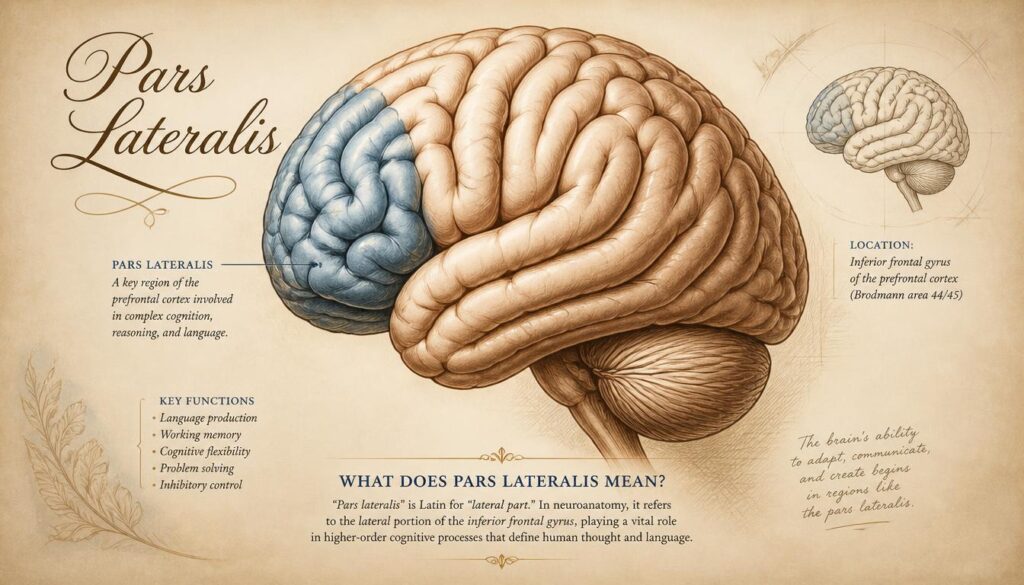
One of the most interesting places you may encounter pars is in anatomy.
The phrase pars lateralis contains the Latin word pars, meaning “part.” Lateralis relates to the side or lateral position. So a phrase such as pars lateralis generally identifies a lateral or outer part of an anatomical structure.
A particularly useful example involves the frontalis, a muscle associated with movements of the forehead and eyebrows. Anatomical terminology can divide structures into named portions, and that is where pars becomes useful: it tells you that you’re looking at a particular part rather than necessarily the entire structure.
Think of the anatomy meaning like a label on a map. If the whole muscle is a city, pars lateralis is telling you which neighborhood you’re looking at. Not a perfect analogy, perhaps, but it works surprisingly well.
Some useful anatomy-related examples are:
- pars lateralis a named lateral part.
- frontalis a forehead muscle.
- A pars can identify a subdivision of a larger anatomical structure.
- Anatomical names frequently preserve Latin terminology.
- The word pars means “part” in this setting.
- The plural partes can refer to multiple parts.
- Anatomy uses these labels to distinguish structures precisely.
- Terms involving pars should be read in their complete anatomical context.
You may occasionally see anatomy discussed alongside facial expressions, forehead movement, or raising the eyebrows. That does not mean pars itself means eyebrow. It means that pars can be part of the formal name for a particular anatomical subdivision.
Why Does the Same Word Have So Many Meanings?
This is where etymology becomes surprisingly useful.
Words travel. They migrate from one language to another, settle into specialized fields, get shortened, acquire technical meanings, and sometimes remain almost unchanged for centuries. Pars is a nice example of that linguistic wandering.
The Latin word pars meant “part.” Medical and anatomical terminology retained that form because Latin became deeply embedded in scientific naming traditions. Meanwhile, English par developed another sense connected with equality or a standard, eventually becoming especially familiar through golf. Dictionary.com traces the English golf/standard sense of par to Latin par, meaning “matching” or “equal.”
So the relationship looks something like this:
pars → Latin “part” → medical/anatomical terminology
while separately:
par → “equal/standard” → golf → pars
That distinction is worth remembering because the two words are related in appearance but not simply one meaning with an extra letter. The golf plural pars is the ordinary plural of par, whereas medical pars is the Latin-derived word meaning “part.” Dictionaries list these as distinct uses.
Pars vs. Par: The Difference at a Glance
If you only remember one thing from this article, remember this: pars does not have one universal definition.
In golf, the relationship is grammatical. One par, several pars.
In anatomy or specialized medical terminology, pars is itself the Latin-derived word meaning “part,” and partes is the plural form. That is a completely different grammatical story.
A quick comparison helps:
- par — singular golf score.
- pars — plural of par in golf.
- pars — Latin-derived medical/anatomical noun meaning “part.”
- partes — plural of medical Latin-derived pars.
- birdie — one stroke under par.
- bogey — one stroke over par.
- even par — total score equal to the course or hole’s par.
- pars lateralis — an anatomical phrase identifying a lateral part.
This is why the search phrase “what does pars mean in golf” has a much simpler answer than “what does pars mean in anatomy.” The first is mostly a matter of golf scoring. The second is a matter of Latin-derived anatomical terminology.
How Pars Appears in Real Sentences
Sometimes the fastest way to learn a word is not by memorizing a dictionary definition but by seeing how it behaves in actual sentences. Words reveal themselves when they have to do some work.
Here are several golf-style examples:
- “The player made five pars before reaching the turn.”
- “Two late pars kept her score at even par.”
- “His round included four birdies and eleven pars.”
- “The difficult back nine produced several gritty pars.”
- “She needed a par on the final hole to stay under par.”
- “The player followed a bogey with three consecutive pars.”
- “Those early pars gave him confidence before the tougher holes.”
- “The leaderboard showed a mixture of birdies, bogeys, and pars.”
Now compare those with anatomy-style examples:
- “The structure is divided into several named partes.”
- “The anatomical description identifies a particular pars.”
- “The pars lateralis describes a lateral part of the structure.”
- “The frontalis contains anatomically described regions.”
- “The term is derived from Latin.”
- “The word pars means ‘part’ in this medical context.”
- “The anatomical noun should be interpreted as part of the complete term.”
- “Several partes may be described within a larger anatomical structure.”
The sentences look completely different because the word has entered two different worlds. Language does that all the time, quietly and without asking permission.
Pars in Golf Journalism and Sports Writing

If you’re reading coverage from the BBC, the Los Angeles Times, Barron’s, or The Wall Street Journal, you may encounter pars in golf reporting when a writer is describing a player’s scorecard. Sports journalism likes compact language, so “six pars and three birdies” can communicate a lot in only a few words.
A golf story might discuss a player surviving difficult golf conditions, fighting through wind, or making crucial pars late in a round. In tournament coverage, the word can become especially important because pars often tell the story between the spectacular moments.
A birdie gets attention. A bogey causes concern. A par sometimes just sits there looking ordinary.
But twelve ordinary pars can be exactly what a player needs.
This is particularly true when a course is difficult. A player who repeatedly avoids mistakes may gain ground even without producing a flood of birdies. Golf analytics can therefore look beyond the flashy highlights and examine how consistently a player performs across different holes and conditions.
That is why phrases such as “gritty pars,” “steady pars,” and “crucial pars” sound natural in sports writing. The noun stays the same, but the adjective tells us why those particular pars mattered.
Does Pars Mean “Average” in Golf?
Not exactly, and this is a subtle point worth clearing up.
The word par has meanings associated with equality, normality, or a standard. In golf, however, par specifically refers to the established score for a hole or course. Cambridge describes it as the expected number of strokes a good player should require.
So when a golfer makes par, the golfer has matched that standard.
If a player finishes a par-4 hole in four strokes, they made par. If they finish in three, they made a birdie. If they finish in five, they made a bogey.
The interesting part is that “under par” is good in golf, while “below par” can mean something negative in everyday English. This is one of those tiny language oddities that makes golf vocabulary feel slightly mischievous.
You might say:
- “The golfer is three under par.”
- “The golfer made three birdies and several pars.”
- “The team performed below par.”
The first sentence is praise in golf. The third generally is not praise at all. Same word, different context, different emotional temperature.
Is Pars Always a Plural Word?
No. This is another useful distinction.
When pars means the plural of golf par, yes, it is a plural form. One par, two pars, ten pars.
But when pars appears as the Latin-derived medical term meaning “part,” it is a singular noun in that terminology. Its plural is partes. Cambridge explicitly gives “partes” as the plural in this specialized medical sense.
That means the sentence structure can tell you what kind of pars you’re looking at.
If you read:
“The golfer made eight pars.”
you are seeing the plural of golf par.
If you read:
“The anatomical pars is located…”
you are likely seeing the Latin-derived noun meaning “part.”
And if you encounter:
“The partes…”
you are probably in the medical/anatomical terminology world, where Latin grammatical forms are being preserved.
It is a small grammatical detail, but it prevents a surprisingly large amount of confusion.
What Does Pars Mean in One Sentence?

If you need the quickest possible answer, here it is:
Pars has two important meanings: in golf, it is the plural of par, while in medical and anatomical terminology it is a Latin noun meaning “part,” with partes as its plural.
That is the whole puzzle in a single sentence, more or less.
If you saw pars beside words like birdie, bogey, score, round, hole, player, or back nine, think golf. If you saw it beside words such as anatomy, muscle, frontalis, pars lateralis, or medical descriptions, think Latin “part.”
Context is the little flashlight here. Use it.
Frequently Asked questions
pars meaning
“Pars” is the plural form of “par.” It can refer to scores in golf that match the expected number of strokes for a hole.
pars def
“Pars” is defined as the plural of “par.” In golf, it refers to multiple holes where a player scores par.
define pars
Pars means more than one “par.” In golf, a par is the standard number of strokes expected to complete a hole.
what does pars mean
“Pars” means multiple scores of par in golf. The term can also have specialized meanings in medical and anatomical terminology.
what is pars
Pars is the plural of “par,” commonly used in golf to describe holes completed at the standard score. It is also used in terms such as “pars lateralis.”
Final Thoughts: The Small Word With Several Lives
The question “what does pars mean?” sounds like it should have a tiny dictionary answer, but the word turns out to be rather more interesting.
In golf, pars is simply the plural of par, describing multiple holes where a golfer matches the expected score. In medical and anatomical terminology, pars comes from Latin and means “part,” while partes is its plural.
That difference explains almost every confusing search result you are likely to encounter.
If you’re watching the PGA Tour, reading about the Ryder Cup, following a tournament such as the Genesis Invitational, or studying a golf scorecard, pars almost certainly means multiple pars.
If you’re reading about frontalis, pars lateralis, anatomical structures, or old-style prescriptions, the Latin-derived meaning is much more likely.
And pronunciation? In American English, golf pars is approximately pɑrz, or “pahrz.”
So the next time the word appears, don’t let the extra “s” throw you off. Ask what neighborhood the word is living in. On a golf course, it probably means several holes played to par.
In anatomy, it probably points toward a part of something. In linguistic terms, it is a neat little reminder that words don’t always stay in one job for their entire lives.
Sometimes a word is a golfer’s scorecard.
Sometimes it is a piece of Latin anatomy.
And sometimes, rather wonderfully, it is both.