
There is a funny little moment that happens on the internet all the time. Someone posts something important, amusing, useful, or mildly dramatic, and a few days later another person arrives like they have just discovered a hidden room in the house. Then comes the familiar phrase: ICYMI.
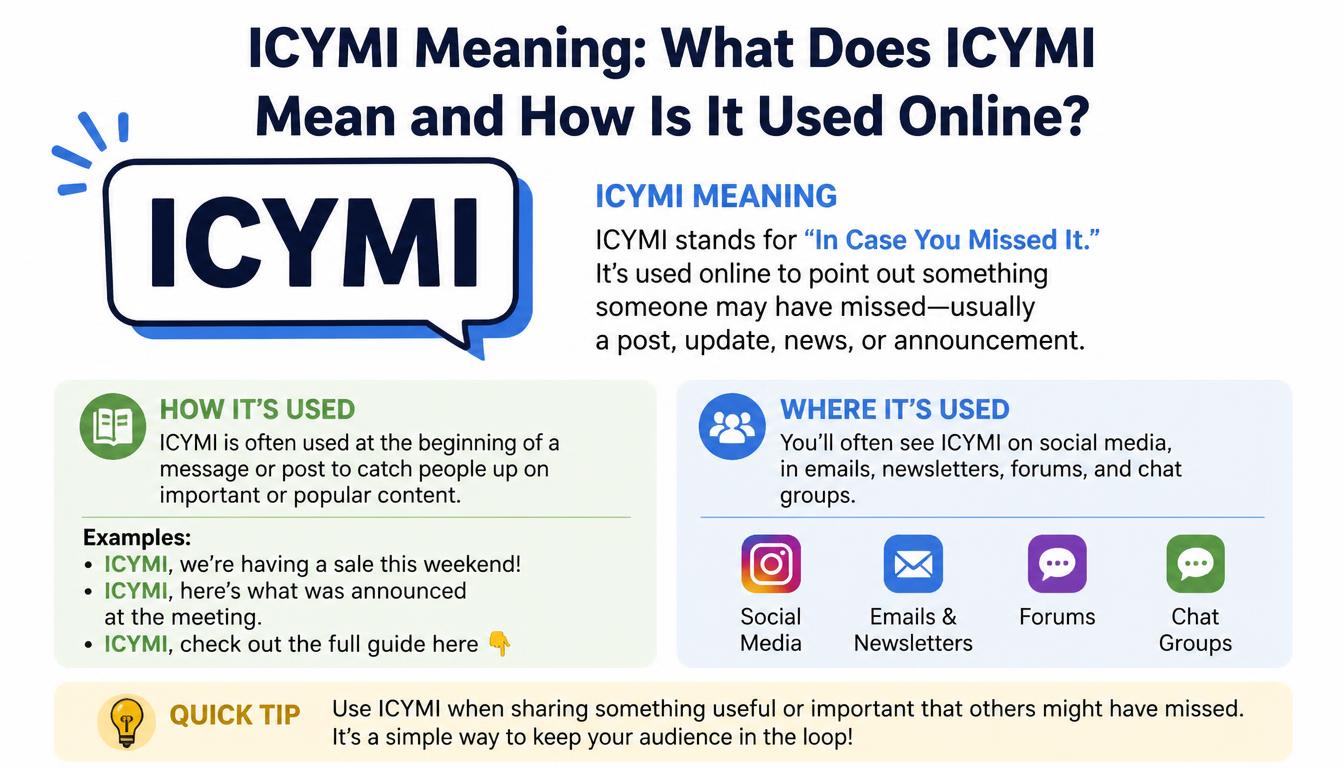
It looks almost secret-code-ish at first. Four letters, no vowels behaving normally, and absolutely no explanation offered. Yet ICYMI meaning is actually very simple: “In case you missed it.” It is a compact way of pointing someone toward something that was shared or published earlier.
You may have seen ICYMI in a social media post, a news headline, an email subject line, a newsletter, or a caption. It can be serious, playful, promotional, or just helpful. And honestly, that flexibility is probably a big reason the abbreviation has survived the rapid-fire world of online language.
ICYMI Meaning in Simple Words
So, what does ICYMI mean?
It means “in case you missed it.” When somebody uses it, they are usually bringing an older piece of information back into your field of vision. Maybe it was a news story you didn’t see, a video you forgot about, an announcement posted last week, or even a funny photo that deserves another moment in the sunlight.
For example:
- ICYMI: Our office will be closed on Monday.
- ICYMI: The new episode is now available.
- ICYMI: We launched our summer collection yesterday.
- ICYMI: Here are the photos from Saturday’s event.
- ICYMI: This article explains the whole situation.
The phrase has a gentle quality to it. It doesn’t necessarily say, “You missed this.” That can sound like a tiny accusation. Instead, “in case you missed it” leaves the door open. Maybe you were busy. Maybe your phone was hiding under a cushion. Maybe the internet produced 4,000 other things that day. Happens.
Why ICYMI Became So Popular
Online communication rewards brevity in a way ordinary conversation doesn’t always. A person may write a whole paragraph to a friend, but a social platform often encourages a sharper, smaller style of writing.
ICYMI abbreviation fits that environment almost suspiciously well.
It lets a writer say, “Here is something from earlier that you might want to see,” without spending another twelve words saying exactly that. Merriam-Webster describes ICYMI as an abbreviation used especially to draw attention to something previously published or posted online. It has appeared in social media, headlines, and traditional media copy as well.
The hashtag version, #ICYMI, is especially useful because hashtags turn language into little searchable signposts. On social media, someone can attach #ICYMI to an older article, announcement, video, photograph, or discussion and give it a second chance to be noticed.
That second chance matters. The internet is a place where excellent content can disappear in roughly the time it takes to make tea.
Is ICYMI an Acronym or an Initialism?
This is where the language gets slightly nerdy, but in a good way.
People often call ICYMI an acronym, and in everyday conversation that isn’t a shocking mistake. But technically, ICYMI is an initialism. An initialism is an abbreviation formed from the initial letters of words, with the letters generally pronounced individually. Merriam-Webster specifically notes that ICYMI is not normally pronounced as a single word, so it fits the more precise category of initialism.
Think about the difference like this:
- ICYMI → “I-C-Y-M-I” → initialism
- FBI → “F-B-I” → initialism
- NASA → commonly pronounced as a word → acronym
- SCUBA → pronounced as a word → acronym
Of course, real language refuses to sit perfectly inside neat boxes. People frequently use “acronym” as a broad label for these shortened forms, and dictionaries acknowledge that common usage. So if somebody says “ICYMI acronym,” you don’t need to dramatically throw a dictionary at them. They know what they mean.
ICYMI Meaning on Social Media
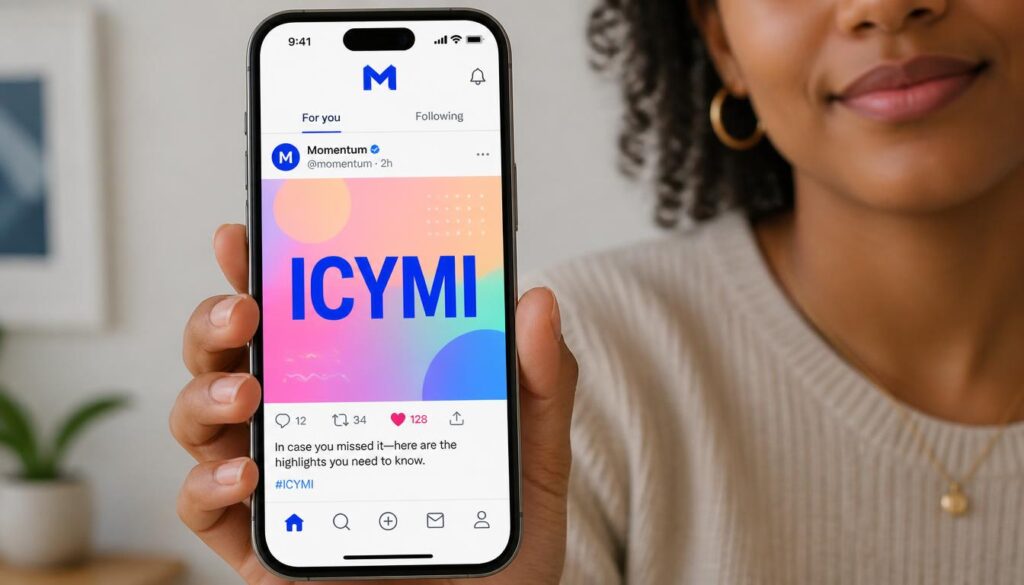
On social media, ICYMI is often used as a little bridge between yesterday’s content and today’s audience.
Imagine a company posts a major announcement at 9 a.m. The post gets some attention, but by evening it has vanished beneath memes, photographs, arguments, advertisements, and someone’s surprisingly detailed opinion about air fryers.
The next morning, the company posts:
ICYMI: We’re opening our new store this Friday.
That’s not really new information. It is content discovery. The message is saying, “This already happened, but here’s another opportunity to see it.”
You will also find the abbreviation in:
- Twitter posts and reposts
- Instagram captions
- Facebook updates
- LinkedIn posts
- Newsletters
- Blog articles
- News roundups
- Email campaigns
- Online community announcements
The important thing isn’t the platform. The important thing is that the information already existed somewhere and the writer is resurfacing it.
When Should You Use ICYMI?
The best use of ICYMI is when the information is worth bringing back.
That sounds obvious, but it is actually useful advice. If every sentence begins with ICYMI, the phrase stops feeling like a helpful signpost and starts feeling like a traffic cone in the middle of the internet.
Here are some situations where it works naturally:
- Sharing an important announcement people may have overlooked.
- Reposting a popular article.
- Reminding followers about an event.
- Bringing attention to an earlier achievement.
- Sharing a useful resource again.
- Highlighting an older video that has become relevant.
- Summarizing something discussed previously.
- Reminding customers about a deadline.
- Reintroducing a popular product or service.
- Bringing a previous conversation back into focus.
In other words, ICYMI is most effective when there is a real reason someone might have missed the information.
ICYMI Examples for Everyday Communication
Sometimes you don’t need a clever caption. You just need something that sounds like a human being wrote it.
Here are some ready-to-use examples:
- ICYMI, our little one took her first steps yesterday!
- ICYMI, the family reunion photos are finally here.
- ICYMI, we’re moving into our new home next month.
- ICYMI, the recipe everyone asked for is now on the blog.
- ICYMI, tickets for the school play are available now.
- ICYMI, Grandma turned 80, and yes, she danced the whole evening.
- ICYMI, our team finally brought home the trophy!
- ICYMI, we welcomed a beautiful new member to the family.
- ICYMI, that “quick coffee” somehow became a three-hour conversation.
- ICYMI, Saturday’s wedding was every bit as beautiful as we’d hoped.
Notice that ICYMI doesn’t force a particular mood. It can carry excitement, humor, affection, urgency, or simple information.
That’s one reason online shorthand can be more expressive than it first appears.
ICYMI Has a Different Personality in News and Marketing
A news organization might use ICYMI to collect stories readers may have overlooked:
ICYMI: Five things you need to know from yesterday.
A business might use it differently:
ICYMI: Our summer sale ends tonight.
A friend may use it almost jokingly:
ICYMI: I somehow managed to burn toast again.
Same four letters, three completely different personalities.
That is an important lesson about digital communication: meaning does not come only from the abbreviation itself. Context, audience, punctuation, surrounding words, and platform all shape the feeling.
A colon after ICYMI can make something look editorial. A casual lowercase “icymi” can feel more like a text message. A hashtag can make it feel distinctly social-media-ish. Tiny choices, surprisingly loud results.
ICYMI Meaning and the Evolution of Internet Language
Internet language changes because people are constantly looking for quicker and more expressive ways to communicate.
Words such as “LOL,” “FYI,” “TBH,” and “ICYMI” are examples of how written communication can become compressed without necessarily becoming less meaningful.
The strange part is that these forms sometimes begin as practical shortcuts and eventually become recognizable pieces of culture. An internet abbreviation can move from casual posts into professional communication, journalism, newsletters, and advertising.
That movement tells us something interesting about language: people don’t merely use language; they keep remodeling it.
And sometimes they remodel it with absolutely no permission from anybody.
A Small Detour: ICYMI and Other Strange Internet Words
Once you start looking at ICYMI, you quickly notice that online language is full of other compact creations. Some are abbreviations. Some are neologisms. Some are jokes that somehow became vocabulary.
One famous example is mansplaining.
Mansplaining generally refers to a man explaining something to someone, especially a woman, in a condescending manner while assuming that he knows more about the subject than the other person. Merriam-Webster records mansplain as a verb and gives 2008 as its first known use in the defined sense.
The word is closely associated with the discussion sparked by writer Rebecca Solnit and her 2008 essay Men Explain Things to Me, although Solnit did not coin the word “mansplain” herself. Merriam-Webster’s discussion of the term connects the word’s history with that essay and with the broader linguistic development of “-splain.”
So why mention this in an article about ICYMI? Because both are little examples of how modern language develops. One compresses a phrase into four initials; the other takes part of an existing word and turns it into a productive piece of new vocabulary.
From Splain to New Words
The splain in mansplain comes from an informal rendering of “explain.” Merriam-Webster notes that “splain” predates “mansplain” and has appeared in informal speech and writing for much longer.
Once mansplain became widely recognized, speakers began playing with the -splain suffix and creating additional forms.
You may encounter terms such as:
- leftsplaining
- whitesplaining
- straight-splaining
- potluck-splaining
- splain-splaining
Some of these are serious criticisms of condescending explanation, while others are deliberately playful. That’s the fun and slightly unruly nature of word formation: once people recognize a pattern, they start using it elsewhere.
Linguists sometimes talk about pieces like this as productive elements or liberated affixes. Basically, a word gets chopped up, one piece escapes, and suddenly it has a new life. Language is weirdly good at that.
Why Mansplaining Is Different From Simply Explaining
It is worth making one distinction clear, because the terms aren’t interchangeable.
A person explaining something is not automatically mansplaining. The important idea involves condescension and an assumption of superior knowledge, particularly in a gendered context. Merriam-Webster describes mansplaining as explaining to a woman in a condescending way while assuming she lacks knowledge of the subject.
That difference matters in real communication.
Helpful explanation says, “Would you like me to explain?”
Condescending explanation says, in effect, “Clearly you don’t understand this, so allow me to rescue you from your own ignorance.”
The words may be similar. The social situation isn’t.
ICYMI and the Joy of Small Language Games
Another entertaining corner of language is the Tom Swifty, a form of wordplay involving a quotation followed by an adverb that creates a pun or secondary joke.
For example:
“The thermostat is set too high,” said Tom heatedly.
The joke works because “heatedly” describes both the manner of speaking and the temperature-related situation. Merriam-Webster attributes the term Tom Swifty to wordplay writer Willard Espy, and connects its name with the Tom Swift adventure books associated with Edward Stratemeyer and Victor Appleton.
This may seem far away from ICYMI, but it really isn’t. Both belong to the larger world of playful, economical language.
One turns a long phrase into a handful of letters.
Another turns an ordinary adverb into the punchline.
Both remind us that language isn’t merely a container for information. Sometimes the container itself is half the fun.
Tom Swifty Examples for People Who Like Wordplay
If you’re collecting Tom Swifties, here are a few original examples:
- “I lost my map,” said Tom directionlessly.
- “This soup needs salt,” said Tom seasonably.
- “I can’t find my shoes,” said Tom solemnly.
- “The garden looks beautiful,” said Tom flourishingly.
- “I dropped the cake,” said Tom crumbly.
Okay, that last one is stretching the rules a little. But wordplay has never been famous for respecting the fence.
The important linguistic feature is the relationship between the quotation and the adverb. The adverb does double duty, creating the little punchline.
Common Mistakes People Make With ICYMI
Even a four-letter abbreviation can be used awkwardly.
One common mistake is using ICYMI for information that isn’t actually old. If you’re announcing something for the first time, “ICYMI” can confuse readers because the phrase suggests the information was already available.
Another issue is using it in every post. If your audience sees ICYMI five times a day, it becomes less like a helpful reminder and more like background wallpaper.
A third mistake is assuming that everyone understands internet shorthand. Professional or mixed-age audiences may appreciate writing out “In case you missed it” at least occasionally.
And then there’s the spelling. ICYMI is usually written in capital letters because each letter represents the initial of a word, although lowercase versions appear in casual online communication too.
ICYMI vs. “In Case You Missed It”
Which one should you use?
It depends on the room you’re walking into.
ICYMI is shorter, casual, recognizable, and particularly suited to social media, newsletters, and digital content.
In case you missed it is warmer and clearer for audiences who may not be familiar with internet terminology.
Compare:
ICYMI: Registration closes Friday.
with:
In case you missed it, registration closes Friday.
The second version sounds more conversational. The first feels quicker and more headline-like.
Neither is automatically better. Good writing is often about knowing which little door your reader is most likely to open.
How to Use ICYMI Without Sounding Robotic
The trick is to let the content do most of the work.
Instead of:
ICYMI: Important update regarding our previously mentioned announcement.
Try:
ICYMI: We’re opening the doors this Saturday!
Instead of:
ICYMI: Please note the following information.
Try:
ICYMI: Here’s the schedule for next week’s event.
And sometimes, just be funny:
ICYMI: Yes, we really did eat the entire cake.
The abbreviation should feel like a small signpost, not like a corporate uniform.
ICYMI in Professional Writing

There was a time when internet abbreviations looked too casual for professional communication. That line has become much blurrier now.
A marketing team might write:
ICYMI: Our annual report is now available.
A university newsletter might say:
ICYMI: Applications for the fall program close next week.
A media outlet might publish:
ICYMI: The biggest stories from this week’s coverage.
Still, context matters. A legal contract probably doesn’t need ICYMI wandering around its paragraphs wearing sunglasses.
For formal documents, spelling out the phrase is generally clearer. For newsletters, internal updates, social posts, and digital marketing, the abbreviation can be perfectly natural.
How to Remember the ICYMI Definition
If you keep forgetting ICYMI meaning, remember this tiny formula:
ICYMI = In Case You Missed It = “Here is something from earlier you may want to see.”
That’s really all there is to it.
It is not a secret acronym for some complicated internet phenomenon. It doesn’t carry a hidden insult. It doesn’t mean “you definitely missed this.” It simply points toward information that has already appeared.
The tone can change, but the basic function stays remarkably stable.
Why Four Letters Can Say So Much
There is something oddly beautiful about abbreviations.
Four letters can carry an entire social gesture: “I know you’re busy, I know the internet is noisy, and I thought you might appreciate seeing this.”
That’s more than simple shortening. It’s information sharing with a little bit of consideration built into it.
Someone might use ICYMI to bring back an important article. Someone else might use it to resurrect an old photograph. Another person may use it before a ridiculous joke that deserved a second life.
The information changes. The tiny linguistic invitation remains.
Final Thoughts on ICYMI Meaning
So, what does ICYMI mean? Quite simply, it means “in case you missed it.” It is an abbreviation, more precisely an initialism, commonly used to direct attention toward something previously posted, published, or shared online.
But the interesting part isn’t just the definition. ICYMI is a small snapshot of how modern language works. Digital communication encourages shorter forms, social media spreads them quickly, and everyday speakers decide which ones are worth keeping.
From ICYMI to mansplain, from -splain word formation to Tom Swifty wordplay, language keeps finding new ways to make old ideas smaller, sharper, stranger, and sometimes much funnier.
And maybe that’s the best thing to remember about internet terminology: don’t be intimidated by the capital letters. Most of these expressions are just ordinary human thoughts wearing tiny digital costumes.
So the next time you see ICYMI in a caption or headline, you won’t have to wonder anymore. You already know.
And, well, ICYMI, language itself is always changing. It’s just usually doing it when we’re not looking.