
Sometimes a word feels more complicated than the idea hiding inside it. Dichotomy is one of those words. You may meet it in a psychology book, a classroom discussion, an article about politics, or even a casual conversation where somebody says, “There’s a strange dichotomy between what he says and what he actually does.” And for a second, your brain goes, okay… what exactly does that mean?
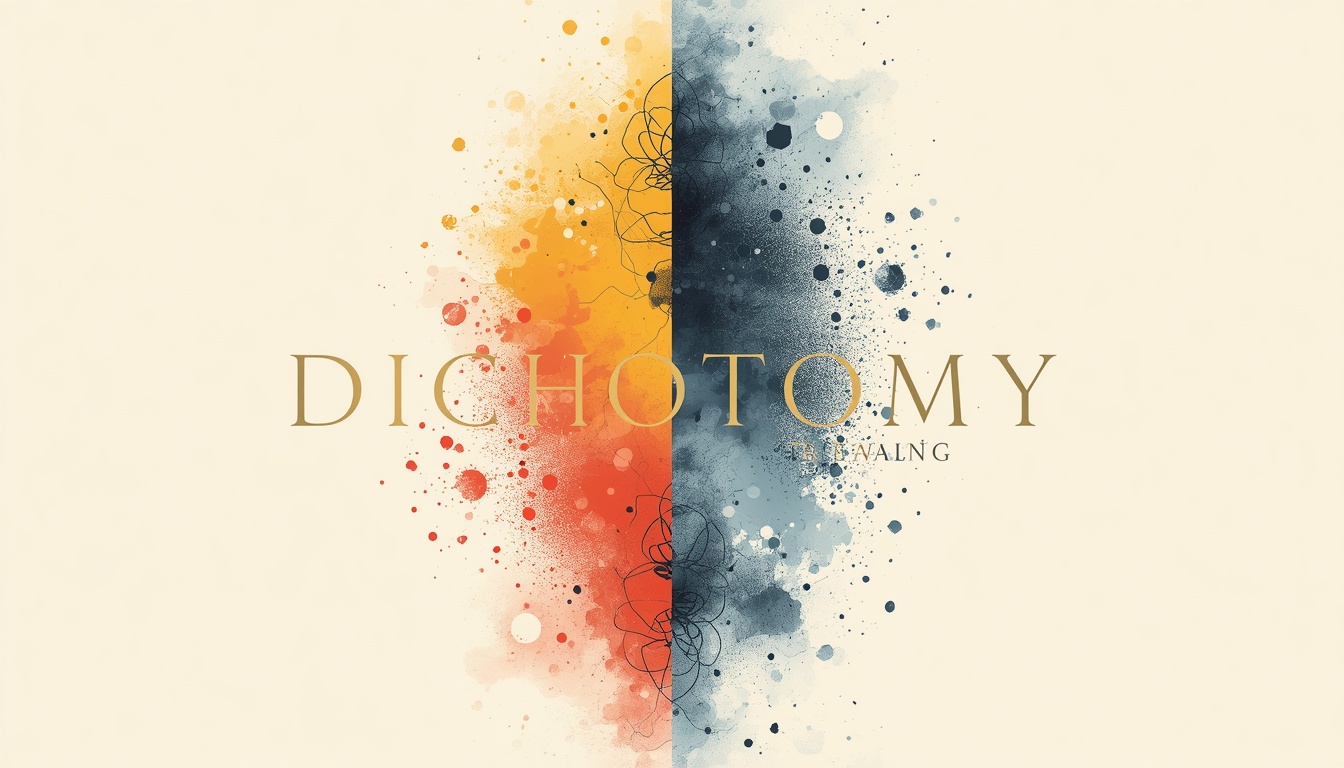
The dichotomy meaning becomes much easier when you strip away the academic coat it often wears. At its heart, a dichotomy is a division into two parts, groups, ideas, or possibilities that are noticeably different or opposed to each other.
Think of theory and practice. Good and evil. Public and private. Nature and nurture. These pairs can be discussed as contrasting sides of something larger, though not every pair is a perfect or mutually exclusive dichotomy.
The word also has more specialized meanings in logic, biology, botany, and astronomy, which is where things get surprisingly interesting. So, rather than memorizing one stiff dictionary line, let’s actually understand what dichotomy means, how it works, and when the word makes sense.
What Is a Dichotomy?
A simple dichotomy definition is: the division of something into two distinct parts or groups, particularly when those parts are contrasting, opposing, or mutually exclusive.
In everyday English, though, people often use dichotomy more loosely to describe a strong contrast between two things.
For example:
- There is a dichotomy between his cheerful personality and his deeply serious writing.
- The debate created a dichotomy between theory and practice.
- The story explores the old dichotomy of good and evil.
- Researchers questioned the traditional nature vs. nurture dichotomy.
- Her life revealed a strange dichotomy between personal freedom and professional responsibility.
- The argument presented success and failure as two completely separate possibilities.
- The novel builds its tension around a dichotomy between tradition and modernity.
- The discussion created two sharply opposed groups, even though many people actually stood somewhere between them.
So when someone asks what is a dichotomy, imagine one thing being separated conceptually into two sides. Sometimes those sides really are exclusive. Other times, humans have simply decided to talk about them that way, which is an important little difference.
Dichotomy Meaning in Simple English
The dichotomy meaning in English can be reduced to a very ordinary idea: a split between two different or opposite things.
Suppose two friends are talking about careers. One says you should follow passion, while another says financial security matters most. Treating those as two opposing paths creates a kind of dichotomy: passion versus security.
A dichotomy often involves a sharp contrast, rather than a tiny difference. Blue and slightly darker blue isn’t much of a dichotomy. Freedom and control, however, can create a much clearer conceptual opposition.
Here are a few simple ways to understand the word:
- A dichotomy is a division into two parts.
- It may describe two opposing groups.
- It can refer to two contrasting ideas.
- In stricter contexts, the categories may be mutually exclusive.
- It can describe a strong distinction between two concepts.
- Sometimes it represents two possible alternatives.
- A supposed dichotomy can be misleading when more than two possible options actually exist.
- The adjective related to dichotomy is dichotomous.
In short, the meaning of dichotomy revolves around two-ness: two sides, two branches, two categories, two positions, or two strongly contrasted concepts.
What Does Dichotomy Mean in Everyday Life?
You don’t need philosophy books or a university lecture to find dichotomies. Everyday life is kinda packed with them, although some are more genuine than others.
We constantly organize messy realities into pairs because pairs are easy to understand. Right or wrong. Introvert or extrovert. Winner or loser. Work or life. Traditional or modern. Logical or emotional.
Some everyday examples include:
- Work and personal life: People often discuss these as two competing parts of life.
- Head and heart: Decisions are sometimes described as a struggle between reason and emotion.
- Old and new: Technology discussions regularly contrast traditional methods with modern ones.
- Success and failure: Society sometimes presents these as two clear outcomes, despite reality having plenty in between.
- Public and private: A person can behave very differently in public compared with private settings.
- Freedom and security: Political and social debates may frame these values as competing priorities.
- Individual and society: Philosophical conversations frequently explore tension between personal desires and collective responsibility.
- Optimism and pessimism: These attitudes are commonly presented as opposite ways of viewing circumstances.
The useful thing to remember is that a dichotomy doesn’t always mean reality itself has only two boxes. Sometimes the binary division exists mainly in the way we’re describing reality.
And that tiny distinction becomes extremely important when we get to the false dichotomy fallacy.
Dichotomy Meaning Through Easy Examples
A word becomes much friendlier once you see it walking around inside actual sentences. Definitions can feel frozen; examples make them breathe a bit.
Consider the dichotomy between theory and practice. A theory might sound brilliant on paper, yet applying it in real life exposes complications nobody expected. The contrast between the elegant theory and messy reality can be described as a dichotomy.
Here are more dichotomy examples:
- The film examines the dichotomy between wealth and poverty.
- His personality shows a fascinating dichotomy between confidence and vulnerability.
- The debate emphasized the dichotomy between theory and practice.
- The novel explores the traditional dichotomy between good and evil.
- Modern psychology often questions an overly simple nature vs nurture dichotomy.
- The speaker rejected the dichotomy between career success and family happiness.
- Her paintings explore the dichotomy between chaos and order.
- The discussion revealed a sharp dichotomy between traditional and progressive viewpoints.
- The character represents seemingly contradictory qualities: strength and tenderness.
- The policy debate was framed around two competing alternatives.
Notice something? The word frequently appears in the pattern “dichotomy between X and Y.” That’s probably the easiest structure to remember when you’re learning how to use it.
Dichotomy in a Sentence
Using dichotomy in a sentence naturally is easier when the two sides are clearly named. If readers can’t identify the contrast, “dichotomy” can sound like somebody brought a giant academic word to a tiny picnic.
Here are natural examples:
- The book explores the dichotomy between freedom and responsibility.
- She noticed a strange dichotomy between his words and his actions.
- The traditional dichotomy between work and leisure has become less clear for remote workers.
- Their argument depended on a dichotomy between success and failure.
- The professor challenged the supposed dichotomy between science and art.
- The movie presents a dramatic dichotomy between good and evil.
- There is an interesting dichotomy between the company’s friendly image and its strict internal culture.
- Researchers have questioned whether the left-right dichotomy accurately represents how the brain functions.
- The debate created an artificial dichotomy between two choices that weren’t actually the only possibilities.
- His writing highlights the dichotomy between what society expects and what individuals personally desire.
You can also use the plural, dichotomies, when discussing several divisions: “The author challenges traditional dichotomies such as reason versus emotion and nature versus culture.”
True Dichotomy: When There Really Are Two Sides
A true dichotomy is more precise than a casual contrast. It divides possibilities into two categories in such a way that the relevant cases fall into one category or the other.
Imagine dividing whole numbers into even and odd numbers. Within that framework, a whole number can’t simply wander off and declare itself something else. It belongs to one of those categories.
A true dichotomy may involve:
- Two genuinely exclusive categories
- A complete division into two groups
- Two alternatives that cover the relevant possibilities
- Categories that don’t overlap within the defined system
- A meaningful separation into two
- Clearly established boundaries
- A logical rather than merely emotional contrast
- Two sides whose definitions determine where something belongs
This stricter understanding matters because everyday speech sometimes calls almost any contrast a dichotomy. Formal logic is less relaxed about it, and rightly so.
False Dichotomy Meaning
A false dichotomy occurs when a situation is presented as having only two choices even though additional reasonable possibilities exist.
This is also called a false dichotomy fallacy, false dilemma, or either-or fallacy. It’s a logical fallacy because it artificially squeezes a complicated situation into two boxes.
Imagine someone saying:
“You either become extremely wealthy, or you’re a failure.”
That sounds dramatic, sure, but it’s obviously an oversimplification. A person can live comfortably, pursue meaningful work, prioritize family, build a modest business, change careers, or define success in fifty other ways.
More examples of a false dichotomy include:
- “Either you agree with everything I say, or you’re against me.”
- “You must choose career success or a happy family.”
- “Either this plan works perfectly, or it is completely useless.”
- “People are either intelligent or unintelligent.”
- “You’re either naturally talented or you’ll never become good.”
- “Technology is either good for society or bad for society.”
- “You can be practical or creative, but not both.”
- “Either tradition is correct, or everything modern is better.”
- “You’re either confident or shy.”
- “There are only winners and losers.”
In each case, the supposed mutually exclusive choices hide other possibilities, combinations, degrees, or circumstances.
Dichotomy vs False Dichotomy
The difference between a genuine dichotomy and a false dichotomy comes down to whether the two-way division accurately represents the available possibilities.
A dichotomy can be a useful classification or contrast. A false dichotomy creates a false choice between two alternatives when reality offers more.
Suppose somebody asks whether a whole number is odd or even. That’s a meaningful two-way classification.
Now suppose somebody says every person is either completely selfish or completely selfless. Humans don’t behave that neatly. Motivation exists on a tangled spectrum, and people can act generously in one situation and selfishly in another.
You can test a supposed dichotomy by asking:
- Are these really the only two possibilities?
- Could both things be partly true?
- Could something belong somewhere between them?
- Are there alternative options being ignored?
- Does the division oversimplify a complex situation?
- Are the categories actually mutually exclusive?
- Is the speaker using a binary way of thinking where a spectrum would make more sense?
- Would adding a third possibility destroy the argument?
Those questions are surprisingly useful in everyday conversations, not just logic classrooms.
Famous Dichotomies: Good and Evil, Theory and Practice, Nature and Nurture
Human beings have been thinking in contrasts for a very long time. Some dichotomies become so familiar that we barely notice we’re using them.
The dichotomy between good and evil appears in religion, mythology, literature, movies, and moral philosophy. Stories often create heroes and villains around this opposition. Real human behavior, of course, tends to be muddier around the edges.
Another common example is theory and practice. Something may work theoretically but struggle when introduced into unpredictable real-world conditions. Teachers, engineers, entrepreneurs, scientists, and policymakers bump into this distinction constantly.
Then there is the famous nature vs. nurture discussion. Are human traits shaped by genetics or environment? Modern thinking generally recognizes complex interaction rather than treating nature and nurture as completely independent enemies standing in separate corners.
These examples teach an important lesson: a dichotomy can be intellectually useful without necessarily describing an absolute separation.
The Left-Right Dichotomy and the Human Brain
You’ve probably heard claims that some people are “left-brained” while others are “right-brained.” Traditionally, the left hemisphere has sometimes been associated with language and certain analytical functions, while the right hemisphere has been associated with some visual-spatial abilities and other functions.
But the popular left-right dichotomy can become an oversimplification when it’s turned into the claim that a person simply uses one half of the brain as their dominant personality machine.
The brain’s hemispheres do show functional specialization, but they also communicate extensively and cooperate across countless activities. Language, creativity, reasoning, emotion, and perception can’t be neatly stuffed into two completely independent drawers.
This is another nice example of why dichotomies need careful handling. A contrast can help us understand something, yet pushing that contrast too far can distort the thing we’re trying to understand.
Dichotomy Pronunciation and Plural Form
The standard English pronunciation of dichotomy is commonly represented approximately as “dye-KOT-uh-mee,” with the main stress falling on the second syllable.
Break it down roughly like this:
di-CHOT-o-my
The exact sound varies a little with accent, obviously, so hearing it spoken can help if pronunciation matters for a presentation or conversation.
The plural of dichotomy is dichotomies, not “dichotomys.”
Examples:
- One dichotomy
- Two dichotomies
- Several social dichotomies
- Traditional philosophical dichotomies
- Artificial dichotomies
The adjective is dichotomous, meaning divided or dividing into two parts.
Dichotomy Synonyms and Related Words
There isn’t one dichotomy synonym that works perfectly in every sentence because the word carries slightly different shades depending on context. Still, several related terms can help.
Useful dichotomy synonyms and related concepts include:
- Division — separation into parts or groups
- Distinction — a recognized difference between things
- Separation — the act or state of keeping things apart
- Contrast — a noticeable difference
- Opposition — a relationship involving opposing positions
- Bifurcation — division or splitting into two branches
- Binary division — classification into two categories
- Two-way division — separation into two paths or groups
- Oppositeness — the quality of being opposed
- Differentiation — recognizing or creating differences
Bifurcation is particularly close in situations involving physical or conceptual branching. But it isn’t interchangeable everywhere. You wouldn’t normally replace every mention of a philosophical dichotomy with “bifurcation” unless you wanted the sentence to sound oddly botanical at breakfast.
An opposite concept depends on context. Words suggesting unity, continuity, integration, combination, or a spectrum may function somewhat like dichotomy antonyms, but there isn’t one universal antonym.
Dichotomy Etymology and Word Origin
The dichotomy etymology tells us a lot about why the word means what it does.
English “dichotomy” came through New Latin dichotomia, which traces back to Greek dichotomía and related forms such as dichótomos, carrying the basic idea of cutting or dividing into two.
That ancient linguistic skeleton is still visible in the modern meaning. A dichotomy essentially takes something and conceptually “cuts” it into two.
The word has a long intellectual history, appearing in scholarly, scientific, philosophical, and logical contexts. English use dates back centuries, with 1588 commonly cited as an early known use.
So despite sounding like a word invented specifically to terrify students before an exam, it’s been hanging around for a very long while.
Dichotomy in Biology and Botany
In biology and particularly botanical descriptions, dichotomy can describe branching into two parts.
Imagine a plant stem reaching a point where it divides into two branches. Each branch might divide again, producing repeated bifurcation. This pattern can be called dichotomous branching.
Instead of thinking about opposing ideas, here we’re dealing with a physical branching structure.
Related ideas include:
- A main axis dividing into two branches
- Two diverging branches
- Repeated branching patterns
- Bifurcation of structures
- Dichotomous growth
- Branching systems
- Dividing ancestral lines in certain classification contexts
- A dichotomous key used for identification
A dichotomous key is especially familiar in biology education. At each step, the user chooses between two contrasting characteristics, gradually narrowing possibilities until an organism or object can be identified.
It’s basically a decision tree that keeps asking, “this or that?” until you arrive somewhere useful.
Dichotomy in Astronomy
The word has a specialized use in astronomy too, and this meaning is quite different from everyday philosophical usage.
In astronomical terminology, dichotomy can describe the condition when half of an object’s visible disk appears illuminated. The idea is essentially a bisection of the illuminated appearance.
This can arise when discussing the phase of the Moon or an inferior planet such as Mercury or Venus.
Here, “dichotomy” isn’t an argument between two ideas. Nobody has asked Venus to choose between good and evil. Instead, the term relates to the appearance of the illuminated disk, with approximately half appearing lit.
It’s a lovely reminder that one word can travel from logic to plants to planets without changing its fundamental idea of “two.”
Dichotomy, Bifurcation, Trichotomy, and Paradox
Several words live near dichotomy semantically, but they shouldn’t be tossed into sentences as though they’re identical twins.
A bifurcation is a division into two branches or parts. It often emphasizes the act or point of splitting. In mathematics, science, anatomy, and botany, this term can be especially useful.
A trichotomy, by contrast, involves division into three parts or categories rather than two. The prefix gives the game away: “tri” points toward three.
A paradox is different again. It describes a statement, situation, or idea that appears contradictory or produces an unexpected logical tension. A paradox may involve opposing concepts, but that doesn’t automatically make it a dichotomy.
Consider the difference:
- Dichotomy: division into two contrasting categories.
- Bifurcation: splitting into two branches or paths.
- Trichotomy: division into three categories.
- Paradox: an apparently contradictory or puzzling proposition or situation.
Knowing these distinctions prevents an impressive-sounding vocabulary from becoming an impressive-looking mess.
Dichotomy for Kids: An Extremely Simple Explanation
If you were explaining dichotomy for kids, you could say:
“A dichotomy is when something is divided into two different groups or sides.”
Imagine a box of shapes. You separate everything into circles and non-circles. You’ve made a two-part division based on one characteristic.
Other easy examples might include:
- Indoor and outdoor
- Awake and asleep
- Fiction and nonfiction
- On and off
- Present and absent
- Pass and fail in a strictly defined test
- Living and nonliving in a basic classroom classification
- Two branches created when one path splits
But children should also learn that not everything fits neatly into two opposing boxes. Some things exist on spectrums, have multiple categories, or combine characteristics from both sides.
That’s actually a valuable lesson for adults too, maybe even more so.
Why Dichotomies Can Be Useful
Dichotomies simplify information. When we’re facing a complicated subject, creating a clear distinction between two concepts can make patterns easier to recognize.
A researcher might distinguish theory from practice. A writer may contrast freedom with control. A philosopher might investigate reason and emotion. A teacher could compare fact and opinion.
Useful dichotomies can:
- Clarify complicated concepts
- Highlight meaningful differences
- Organize information
- Create analytical categories
- Reveal contradictory characteristics
- Make arguments easier to examine
- Show tension between opposing ideas
- Help structure decisions
- Support classification systems
- Make abstract ideas easier to discuss
But simplification always comes with a warning label nobody sees until later: reality might be more complicated.
That’s why good critical thinking doesn’t merely ask, “What are the two sides?” It also asks, “Are there really only two?”
Why Binary Thinking Can Become Misleading
A binary way of thinking treats situations as if they have only two states: right or wrong, success or failure, friend or enemy, smart or stupid.
Sometimes binary categories are appropriate. Your light switch may genuinely be on or off, depending on the system. But human behavior, social questions, relationships, abilities, and beliefs rarely behave like tidy switches.
Consider intelligence. Calling everyone either “smart” or “not smart” ignores different abilities, experiences, education, creativity, memory, practical judgment, and dozens of other factors.
The same problem appears when we turn complex debates into two sharply opposed groups. Nuance disappears, middle positions become invisible, and alternative explanations get kicked quietly out the door.
Recognizing a false dichotomy is therefore more than vocabulary practice. It’s a practical critical-thinking skill.
How to Recognize a Dichotomy in Writing
When reading an essay, article, speech, or argument, watch for language that creates two contrasting sides.
Common signals include:
- Either/or
- In contrast
- On the other hand
- Whereas
- Rather than
- Opposed to
- Unlike
- Two sides
- Divided between
- X versus Y
Then ask what relationship exists between those sides.
Are they merely contrasting concepts? Are they genuinely mutually exclusive? Is the author showing a useful differentiation, or creating an artificial separation?
For example:
“Students must either attend university or accept an unsuccessful future.”
That’s not simply a dichotomy; it’s likely a false dichotomy, because vocational education, entrepreneurship, apprenticeships, self-employment, skilled trades, and other paths exist.
Once you start noticing these patterns, you’ll probably see false either-or choices everywhere. They hide in advertisements, debates, arguments, social media posts, and yep, occasionally inside our own thinking too.
How to Use the Word Dichotomy Naturally
The safest structure is usually:
“a dichotomy between X and Y.”
For example:
“There is a noticeable dichotomy between the company’s public image and its internal culture.”
You can also write:
“The novel creates a dichotomy of innocence and experience.”
Or:
“The traditional dichotomy is becoming less useful.”
Try not to use the word merely because two things are different. A cat and a refrigerator are different, but calling them a profound dichotomy would be… ambitious.
Use “dichotomy” when the two elements form a meaningful division, opposition, classification, or conceptual contrast.
Quick Answers About Dichotomy Meaning
What does dichotomy mean?
Dichotomy means a division or distinction between two parts, groups, or concepts, especially when they’re strongly contrasting or opposed.
What is a simple definition of dichotomy?
A simple definition of dichotomy is “a division into two different or contrasting parts.”
What is an example of a dichotomy?
The contrast between theory and practice is a common example. An idea may work theoretically but behave differently when applied in real situations.
What is a false dichotomy?
A false dichotomy presents only two alternatives even though additional valid possibilities exist. It’s a common logical fallacy.
What is the plural of dichotomy?
The dichotomy plural is dichotomies.
What is a synonym for dichotomy?
Depending on context, a dichotomy synonym may include division, distinction, contrast, separation, opposition, or bifurcation.
Read more: https://ytmeaning.com/razzmatazz-meaning/
What does dichotomous mean?
Dichotomous means involving or characterized by division into two parts, categories, or branches.
Is dichotomy the same as paradox?
No. A dichotomy concerns a two-part division or contrast, while a paradox involves an apparently contradictory or puzzling statement, idea, or situation.
Is every either-or choice a dichotomy?
Not necessarily. If other legitimate possibilities exist, presenting only two alternatives may create a false dichotomy instead.
Dichotomy Meaning
Dichotomy means a division or contrast between two things, groups, or ideas that are very different or opposite to each other.
Dichotomy Definition
A dichotomy is a separation of something into two distinct, contrasting, or mutually exclusive parts or categories.
Dichotomies
Dichotomies are divisions or contrasts between two opposing groups, ideas, qualities, or choices.
Define Dichotomy
To define dichotomy simply, it is the division of something into two clearly different or opposite parts.
Dicomity
Dicomity is often a misspelling of “dichotomy,” which refers to a division or strong contrast between two opposing things.
Final Thoughts on Dichotomy Meaning
The dichotomy meaning is much simpler than the word first appears. A dichotomy is fundamentally a division into two, usually involving two contrasting, opposing, or clearly distinguished parts.
You can see dichotomies in philosophy, psychology, literature, logic, biology, botany, and even astronomy. Sometimes they describe opposing concepts such as good and evil or theory and practice. Elsewhere, they describe branching into two parts or specialized scientific conditions.
The bigger lesson, though, sits beyond vocabulary. Two categories can make a complicated world easier to understand, but easy doesn’t always mean accurate. Whenever somebody offers only two choices, it’s worth quietly checking whether a third, fourth, or fifth option is hiding behind the curtain.
Understand the distinction, notice the contrast, but don’t let every complicated thing get squeezed into two boxes. That’s where knowing what dichotomy really means becomes useful not only for English, but for thinking a little more clearly too.
I kept the article centered on the word’s meaning, examples, usage, false dichotomy, pronunciation, etymology, synonyms, and scientific contexts rather than the unrelated baby-girl instructions embedded in the template.