
If you have recently wandered into TikTok comments, YouTube Shorts, Reddit threads, or a group chat where everyone appears to speak fluent internet, you may have seen one strangely tiny word doing a surprising amount of work: huzz.
At first glance, “huzz” looks almost innocent. It could be a typo. It could be someone’s nickname. You might even look at it and think, surely this means husband? That last guess is actually pretty common, but it is usually not what the person means.
In current online slang, huzz generally refers to women or girls, especially in phrases such as “the huzz” or “doing it for the huzz.” It is an internet-mangled spelling associated with “hoes”, although its tone can range from joking and unserious to objectifying or disrespectful depending
on who says it, who is being discussed, and the situation. Merriam-Webster currently defines it as online slang for “women” and traces its popularity to social-media culture.
And there is the interesting bit: slang rarely stays in one little box. Once huzz escaped its original internet circles, people began using it more loosely for a girl, a crush, an attractive woman, or even someone they simply find interesting. Language online does this constantly.
A word starts somewhere, gets repeated thousands of times, gets misunderstood a little, becomes a meme, and suddenly everybody is using it differently. Funny, messy, very internet.
What Does Huzz Mean?
The simplest huzz meaning is a slang term for women or girls.
More specifically, the word is generally understood as a stylized version of “hoes,” itself a slang term historically used to refer to women in a derogatory or sexualized way.
Merriam-Webster describes huzz as a playful online form of that word, while other explanations of the slang note that it can be used in a joking or insulting manner.
For example, someone might write:
- “Bro is trying to impress the huzz.”
- “He really changed his whole outfit for the huzz.”
- “Where are the huzz at?”
- “He got all that confidence for the huzz.”
The exact emotional flavor changes from sentence to sentence. Sometimes the speaker is clearly making a joke. Sometimes it means “girls” in a casual way. Sometimes it carries the original insulting edge of “hoes.” So, unlike a normal dictionary word, huzz does not have one perfectly fixed emotional setting.
That is important because internet slang is often less about literal definitions and more about social signals. A person may use the word because it sounds funny, because their friends use it, because they saw it in a viral video, or because the deliberately weird spelling makes the sentence feel more like a meme.
Huzz Meaning on TikTok and Social Media
On TikTok and similar platforms, huzz became particularly visible in jokes about dating, attraction, confidence, fashion, and trying to impress women.
One common pattern is the phrase “for the huzz.” It usually means doing something to impress girls or attract their attention.
Imagine a guy who normally wears the same old hoodie every day suddenly buying a sharp outfit, fixing his hair, putting on cologne and acting like he has discovered diplomacy. A friend might comment:
“Bro did all that for the huzz.”
The joke isn’t necessarily that he literally has a group of women waiting for him. It is the exaggerated idea that a person has suddenly upgraded themselves because attractive people are around.
This usage fits into the wider style of Gen Z slang and Gen Alpha slang, where deliberately distorted spellings are part of the humor.
The strange spelling is almost the point. If someone simply wrote “girls,” the joke disappears. “Huzz,” meanwhile, sounds like it escaped from a badly translated internet dictionary and decided to stay.
The term has also appeared alongside other “-uzz” constructions, including bruzz, which can refer to boys or male friends, and other playful formations that imitate the same linguistic pattern.
Where Did the Word Huzz Come From?
The origin of huzz is not as ancient or mysterious as the spelling makes it look.
Current dictionary and media explanations generally connect the modern slang term to an altered spelling of “hoes.” Merriam-Webster reports that the word was popularized through social-media culture and credits a connection to YouTuber and streamer Kai Cenat, with the term reportedly appearing in his online circle around 2023.
Other explanations likewise connect its spread with Black creators, streamers, and online communities before it moved into wider TikTok culture.
This is worth handling carefully, because saying one person “invented” internet slang can oversimplify how language actually develops. A creator may popularize a term without being the first human being to say it. Someone says it in a stream, somebody clips the moment, another person repeats it, then thousands of viewers copy it ironically, and suddenly the word has a life of its own.
That is probably a better way to understand the huzz origin: not as a single clean birth certificate, but as a piece of internet language that gained momentum through creators, streaming culture, memes, and social-media repetition.
Why Is “Huzz” Spelled That Way?

This is where internet language gets wonderfully weird.
Why not simply write “hoes”?
Because changing the spelling changes the feeling.
Online communities constantly modify words to make them funnier, less direct, more searchable, more meme-like, or sometimes less likely to trigger automated moderation systems.
This broader practice is often called algospeak, where users alter words to navigate platform filters and moderation systems.
Linguist and author Adam Aleksic has discussed terms such as “huzz” as examples of how social-media language can be reshaped by algorithms and online culture.
There is also a purely comedic reason.
“Huzz” looks absurd.
And internet humor has a special fondness for absurdity. A normal word becomes funnier when it is misspelled on purpose, especially if thousands of people agree that the misspelling is now the correct spelling of the joke.
It is similar to the way online communities deliberately bend pronunciation, spelling, and grammar until the altered version becomes recognizable within the group. The mistake becomes the language.
Is Huzz the Same as “Hoes”?
Not exactly, even though the two are closely connected.
The huzz definition is generally derived from “hoes,” but online speakers may use the newer word with a softer, more playful meaning.
Some young users use it simply to mean girls, women, or people they are attracted to. Others understand the original derogatory association and use it specifically because that edge makes the joke work.
So you cannot always translate:
huzz = hoes
and stop there.
Context matters.
If someone writes “the huzz” underneath a deliberately ridiculous dating meme, it may be nothing more than a joke. If someone uses it to describe women they do not know in a demeaning way, the same word can sound disrespectful.
That is one of the central rules of modern slang: meaning and attitude are not always the same thing.
Read more: https://ytmeaning.com/purl-meaning/
Is Huzz a Bad Word?
It can be.
It is not usually treated like a formal swear word, but that does not mean everyone will find it harmless. Since the term is associated with “hoes,” it can carry a derogatory meaning toward women.
Some young people use huzz almost affectionately or ironically, while others use it as a deliberately funny replacement for a more offensive expression.
Parents.com, for example, notes that children and teenagers may encounter the term in ways ranging from slang for women to a more innocent reference to someone they like.
That difference can create a funny little generational trap.
A teenager says, “I’m going out with the huzz.”
An adult hears it and thinks, That sounds terrible.
The teenager may hear it as an ordinary meme phrase.
Neither interpretation is automatically universal. Slang belongs to communities, and the same expression can feel harmless to one group and rude to another.
If you are unsure, especially around someone you do not know well, using girl, woman, friend, crush, or another ordinary word is much safer. There is no medal for successfully inserting every TikTok expression into a conversation.
Does Huzz Mean “Husband”?
This is one of the most entertaining misunderstandings surrounding the word.
Because huzz visually resembles a shortened version of “husband,” some people naturally assume that it means boyfriend, husband, or romantic partner.
That interpretation does occur in some online communities, especially where users have independently assigned their own meaning to the word. Recent discussions among internet users show that people do encounter huzz as a term for a crush or attractive person, while others insist that its original slang meaning comes from “hoes.”
So if someone says:
“That’s my huzz.”
You should not automatically assume they mean “that’s my husband.”
Depending on the community, they could mean a girl they like, a romantic interest, or simply be using the established meme slang. Context is doing a lot of heavy lifting here.
This is why searching a slang word and expecting one permanent definition can be misleading. Internet vocabulary changes faster than printed dictionaries can comfortably chase it.
How Do People Use Huzz in a Sentence?
Most uses are informal and intentionally playful.
Here are some natural examples:
- “Bro bought new shoes for the huzz.”
- “He’s trying way too hard to impress the huzz.”
- “The huzz are gonna love this outfit.”
- “He finally got some confidence around the huzz.”
- “Why did bro start acting different when the huzz arrived?”
- “He is absolutely doing that for the huzz.”
- “My guy has been preparing for the huzz all week.”
- “No way he said that in front of the huzz.”
Notice something about these examples: the word is rarely carrying the whole sentence.
Instead, it adds a meme-like attitude.
That is a major feature of internet slang. Words such as “bruh,” “rizz,” “unc,” and “huzz” can sometimes communicate social mood as much as literal information.
The Washington Post has described contemporary youth slang as a rapidly evolving digital language shaped by memes, social platforms, humor, identity, and community.
What Does “For the Huzz” Mean?

If you have searched what does huzz mean because you keep seeing “for the huzz,” this is probably the phrase that caused the confusion.
“For the huzz” generally means for the purpose of impressing girls or attracting women.
It can be sincere, but it is usually humorous.
Someone buys expensive cologne?
“For the huzz.”
Someone suddenly learns how to cook?
“For the huzz.”
Someone starts going to the gym after years of refusing to move from the sofa?
“For the huzz.”
The phrase works because it exaggerates romantic motivation. It turns an ordinary self-improvement decision into a tiny heroic quest.
Of course, real life is more complicated. People exercise, dress well, cook, study, work, and improve themselves for plenty of reasons that have nothing to do with dating. The meme simply picks one reason and turns it up to eleven.
Huzz, Bruzz, and the “-Uzz” Family
Once huzz became recognizable, the ending itself became part of the joke.
Online slang communities started creating similar forms, including bruzz, generally referring to a male friend or group of boys. Other playful terms have appeared in the same ecosystem, although their exact meanings can vary by community and time.
This is not unusual in language.
Once speakers recognize a pattern, they can reuse that pattern creatively. It is almost like discovering a linguistic Lego brick.
Someone sees:
huzz → women
and then thinks:
bruzz → bros
The language becomes productive. People can make new forms because everyone understands the joke behind the structure.
Some of these terms disappear almost as quickly as they arrive. Others stick around. Nobody really knows which will survive, which is part of the fun and also why trying to keep a complete dictionary of internet slang is basically an unpaid full-time job.
Why Does Internet Slang Change So Quickly?
The rise of huzz illustrates something bigger about modern communication.
For most of history, new slang spread through neighborhoods, workplaces, schools, music, newspapers, television, and face-to-face conversation.
Today, a teenager in one country can watch a streamer in another country use a phrase, repeat it in a comment, and see thousands of people copy it before dinner.
Social media compresses linguistic change.
TikTok, YouTube, Twitch, Reddit, Discord, Instagram, and other platforms allow slang to move between communities at extraordinary speed. A phrase can start as an inside joke and become recognizable internationally within months.
The Washington Post has noted how platforms and online communities contribute to the rapid evolution and global spread of youth vocabulary.
That is why huzz meaning may look slightly different depending on where you encountered it.
A streamer might use it one way.
A TikTok commenter might use it another.
A teenager may use it ironically.
Someone else may genuinely think it means “crush.”
And a person who has never encountered the slang may stare at the screen wondering why everyone suddenly seems to be talking about furniture.
Is Huzz Appropriate to Use?
This depends heavily on the audience.
Among friends who already use the slang, huzz may function as harmless meme language. In a professional email, school assignment, job interview, formal speech, or conversation with someone who dislikes derogatory language, it is a poor choice.
The bigger issue is not simply whether the word is “allowed.” It is whether the person you are talking about would appreciate being described that way.
Because huzz has roots in a term used to sexualize or insult women, it can sound objectifying even when the speaker intends it as a joke.
A useful rule is surprisingly simple:
If you know the context and the people, you can judge the slang. If you do not know the context, choose clearer language.
Nobody has ever suffered because they said “girls” instead of “huzz.”
Huzz Meaning in Different Online Contexts
The word can take on slightly different shades depending on where you see it.
In dating memes: it usually refers to girls or women someone wants to impress.
In TikTok comments: it may be a humorous collective noun for women.
In group chats: friends may use it ironically or exaggerate its meaning for comedy.
In gaming and streamer communities: it may appear alongside other fast-moving Gen Z and Gen Alpha expressions.
In conversations about slang: people sometimes use it simply because they are discussing the word itself.
And occasionally, somebody uses it to mean something completely different.
That is not necessarily evidence that one side is “wrong.” Slang is decentralized. There is no little committee sitting in a basement approving definitions every Thursday.
What Makes Huzz Different From Older Slang?
Older slang often had time to settle into recognizable meanings.
Internet slang doesn’t always get that luxury.
A word can become popular because it is funny before people even agree on exactly what it means. The spelling itself can become a cultural reference. The sound becomes recognizable. Eventually, people who never saw the original source begin using the term anyway.
This is particularly visible with Gen Alpha slang, where words can emerge through memes, gaming culture, streaming personalities, short-form video, and algorithm-driven communities.
The result is language that can feel nonsensical from the outside but perfectly understandable from inside the group.
And honestly, that’s nothing new.
Every generation has had slang that made the previous generation wonder what on earth was happening. The difference today is that the previous generation can watch it happen in real time on their phones.
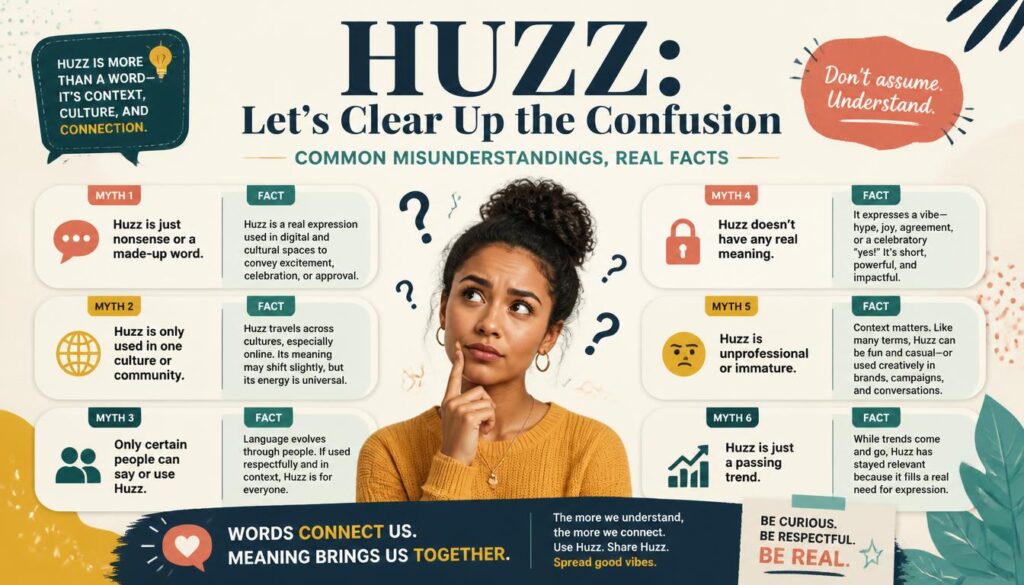
Common Misunderstandings About Huzz
There are several misconceptions worth clearing up.
Huzz does not universally mean husband. Some people interpret it that way, but the widely documented slang meaning is connected to women and “hoes.”
Huzz is not always affectionate. It can be playful, but it may also sound disrespectful depending on the speaker and context.
Huzz is not a formal English word. It belongs primarily to informal internet and social-media language.
There is not one perfectly fixed definition. Different online communities may use the term differently.
It is not necessarily meaningless. Like much slang, it carries social information about humor, group identity, tone, and online culture.
That last point matters. Calling every new internet expression “nonsense” misses how language actually works. Slang can be silly and meaningful at the same time.
How to Understand Slang Without Feeling Lost
If you keep encountering words such as huzz, rizz, bruzz, aura, unc, or other rapidly changing expressions, you do not need to memorize an entire encyclopedia.
Instead, look at the sentence around the word.
Ask yourself:
- Who is being described?
- Is the speaker joking?
- Is the word being used positively or negatively?
- What words appear beside it?
- Is it part of a meme?
- Does the same community use the word repeatedly?
Context often gives you more information than a dictionary definition.
For example, if you see “bro bought a Lamborghini for the huzz,” you can probably understand the joke without knowing every detail of the word’s history. The surrounding sentence tells you that huzz refers to women the person wants to impress.
That is how native speakers learn slang too, really. Nobody receives a ceremonial PDF when a new word enters the culture.
Frequently Asked questions
What does “huzz” mean?
“Huzz” is internet slang generally used to refer to girls or women. It is commonly associated with a playful variation of the word “hoes.”
Where did the word “huzz” come from?
“Huzz” is believed to have grown through online creator and streamer culture, becoming especially popular on platforms like TikTok and YouTube.
Is “huzz” a bad word?
It can be considered offensive or disrespectful because of its connection to “hoes.” Its tone depends heavily on the context and the people using it.
What does “for the huzz” mean?
“For the huzz” usually means doing something to impress girls or women. It is often used humorously in memes and social-media posts.
Can “huzz” mean husband?
Sometimes people jokingly interpret “huzz” as a short form of “husband,” but its more commonly documented slang meaning refers to women or girls.
Final Thoughts on the Huzz Meaning
So, what does huzz mean?
In its most widely documented current slang sense, huzz is an internet term referring to women or girls, derived from a stylized version of “hoes.” It became prominent through online creator and streamer culture and spread especially
strongly across TikTok and other social platforms. Merriam-Webster identifies it as online slang and connects its popularization with Kai Cenat’s online sphere around 2023.
But the story does not end with that dictionary-style definition.
People have adapted the word. Some use it jokingly for girls they want to impress. Some use it to mean a crush or attractive person. Others use it more closely to its original derogatory sense.
And some users have even interpreted it as a playful shortening of “husband,” which shows just how quickly internet slang can detach from its original meaning.
That messy evolution is actually the most interesting part.
Huzz is not just a strange four-letter internet word. It is a small example of how modern language travels: from creators to clips, from clips to memes, from memes to comments, and from comments into everyday speech.
A spelling gets changed, people laugh, someone copies it, somebody misunderstands it, and eventually the new meaning becomes real.
Language has always belonged to the people using it.
The internet just gave those people a much, much bigger room to play in.
And yes, if somebody tells you they are “doing it for the huzz,” you now know what they probably mean. Whether you should say it yourself, however, is another question entirely.