
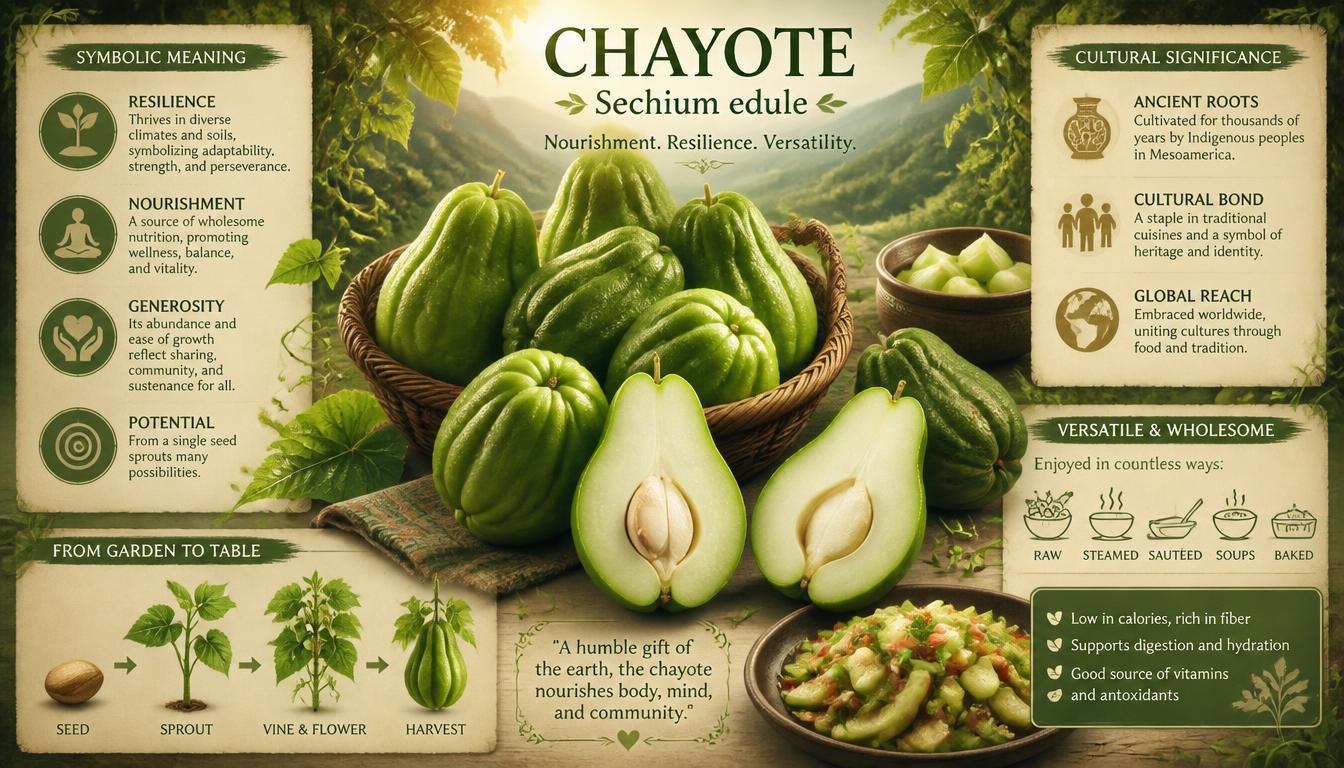

If you have ever walked through a grocery store and noticed a strange green, pear-shaped produce item, you may have wondered what exactly it was called. That little vegetable-like fruit is chayote, a name that can sound unfamiliar the first time you hear it. Its shape is simple, but the word behind it has an interesting history.
The chayote meaning refers to an edible, pear-shaped fruit that grows on a climbing vine. It is commonly treated as a vegetable in cooking, even though botanically it is a fruit. That small difference makes chayote one of those foods that quietly confuses people, but in a rather harmless way.
What Is Chayote?
Chayote is the name of an edible fruit produced by the plant Sechium edule. The plant belongs to the gourd family, which also includes familiar foods such as cucumbers, pumpkins, melons, and squash. It grows as an annual vine and produces green, firm fruits.
In everyday cooking, chayote vegetable is probably the description you will hear most often. People boil it, sauté it, bake it, add it to soups, or combine it with other vegetables. So while botanists call it a fruit, the kitchen usually gives it a vegetable’s job.
The fruit is often pale or medium green and has a somewhat wrinkled or ridged surface. Some varieties have a smoother appearance, while others may have small spines. Inside, there is usually a single flat seed, which can also be eaten when prepared properly.
Chayote Meaning and Definition
The simple chayote definition is an edible fruit of a tropical vine belonging to the gourd family. It is commonly grown in warm climates and used as a vegetable in many cuisines. In other words, if someone asks, “what does chayote mean?”, they are usually asking about this edible plant and its fruit.
The chayote meaning can therefore be explained in two ways. From a botanical point of view, chayote is a fruit. From a culinary point of view, it is a tropical vegetable used much like squash or other mild vegetables. Both descriptions can be correct, depending on the context.
A dictionary-style explanation may describe chayote as a pear-shaped fruit of a tropical vine. That wording is useful because its appearance gives a pretty good clue about what you are looking at. It looks somewhat like a wrinkled green pear, though its taste is much more vegetable-like.
Is Chayote a Fruit or Vegetable?
One of the most common questions about chayote fruit is whether it should be called a fruit or a vegetable. The answer depends on whether you are talking about botany or cooking, and this is where things get a little interesting.
Botanically, chayote is a fruit because it develops from the flowering part of the plant and contains a seed. However, people generally prepare it as a vegetable, just like tomatoes, cucumbers, and some types of squash.
So, is chayote a fruit or vegetable? Technically, it is a fruit. In the kitchen, however, calling it a vegetable is completely normal. Nobody is likely to stop a dinner conversation and start a botanical argument over it, thankfully.
Chayote Squash Meaning
Chayote squash is simply another common name for chayote. The word “squash” is often added because chayote is prepared and eaten in ways that are similar to other squash varieties.
When someone searches for chayote squash definition, they are generally looking for the same food as chayote. It is not a completely different plant or a separate species. The terms can usually be used interchangeably when discussing cooking and food.
The texture of cooked chayote is mild and slightly crisp when it is not overcooked. Its flavor is fairly subtle, which makes it useful in many recipes. It can take on the flavors of herbs, spices, sauces, and other ingredients without trying to dominate the whole dish.
Chayote Plant and Scientific Name
The chayote plant has the scientific name Sechium edule. It belongs to the gourd family, scientifically known as Cucurbitaceae. The plant grows as a climbing vine and can spread across supports, fences, or trellises.
The vine produces the familiar pear-shaped fruits that are called chayotes. In suitable warm conditions, the plant can grow vigorously, so gardeners often give it plenty of room and something sturdy to climb.
The scientific name Sechium edule is useful when you need to distinguish chayote from other plants with similar common names. Common names can change from one region to another, while scientific names provide a more consistent botanical identity.
Other Names for Chayote
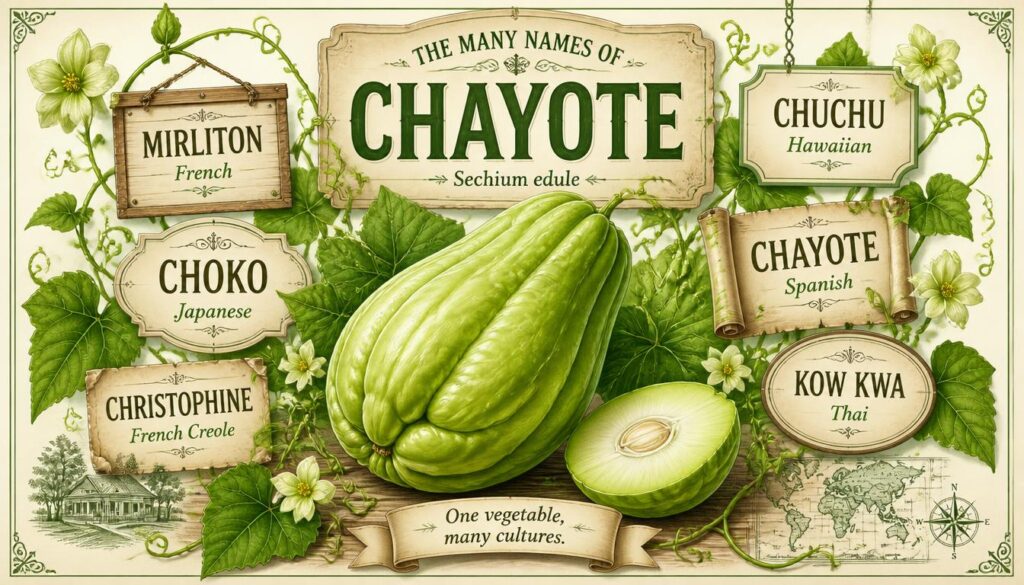
Chayote has several names around the world, which can make the food seem more mysterious than it really is. Two notable alternative names are christophene and mirliton.
The name christophene is especially associated with some Caribbean regions. Mirliton is commonly associated with Louisiana and other areas where different cultural food traditions have influenced local vocabulary.
You may also see the plural form chayotes when someone is talking about more than one fruit. So if a recipe says to prepare two chayotes, it simply means two individual chayote fruits. Nothing complicated hiding there.
Chayote Pronunciation
The chayote pronunciation can be confusing because the spelling does not immediately tell an English speaker how to say it. A common English pronunciation is approximately “chah-YOH-tee.”
If you are wondering how to pronounce chayote, try breaking the word into three syllables: cha-YO-te. The middle syllable usually receives the strongest emphasis, although pronunciation can vary slightly depending on the speaker and region.
Knowing the pronunciation can make conversations about food much easier. It is especially helpful if you are shopping for tropical vegetables, talking about recipes, or reading a menu where chayote appears.
Where Does the Word Chayote Come From?
The chayote origin is closely connected with Spanish and Nahuatl languages. The English word ultimately traces back through Spanish to the Nahuatl word chayohtli.
Nahuatl was spoken by Indigenous peoples of central Mexico and remains an important language with living speakers today. The history of the word shows how food names can travel between languages as plants and culinary traditions move between regions.
The Spanish form of the word eventually became the source for the English term “chayote.” It is a nice little example of how a single food can carry a piece of linguistic history with it, even when sitting quietly in a supermarket basket.
Chayote Word History
The chayote word history is more interesting than its simple appearance suggests. The term entered English through Spanish, with its deeper roots connected to Nahuatl chayohtli.
Some dictionary references give 1887 as the first known use of “chayote” in English. That does not mean the fruit itself suddenly appeared in that year. Obviously, people had been growing and eating it long before English dictionaries recorded the word.
This distinction matters when discussing chayote first known use. A word’s first recorded appearance in English is not necessarily the beginning of the food, plant, or cultural tradition itself. Language records often arrive much later than everyday human use.
Chayote as a Tropical Vegetable
Although the botanical classification calls chayote a fruit, it is widely used among tropical vegetables. Its mild flavor makes it flexible, especially in dishes where stronger ingredients provide most of the seasoning.
Fresh chayote can be found in some grocery stores, farmers’ markets, and specialty produce sections. Availability depends heavily on the region and season, though, so it may be much easier to find in warm-climate areas.
Compared with stronger-tasting produce, chayote is rather quiet on the plate. It does not usually demand attention. Instead, it works alongside ingredients such as carrots, herbs, onions, and spices, which is probably one reason cooks keep finding uses for it.
How Chayote Is Used in Cooking
Cooking chayote can be surprisingly simple. The fruit may be peeled or prepared with its skin depending on the variety and recipe, then sliced, chopped, boiled, steamed, sautéed, or cooked in other ways.
One popular use is adding chayote to soup. Its mild taste allows it to absorb some of the flavor of the broth while still providing its own texture. It can also be cooked with carrots, potatoes, meat, herbs, or other vegetables.
People may also use chayote in salads, stir-fries, vegetable dishes, and family recipes passed down through generations. There is no single “correct” way of eating chayote, which is part of its charm really.
What Does Chayote Taste Like?
The flavor of chayote is mild, fresh, and slightly crisp when raw. Some people compare its taste or texture to a mixture of cucumber and mild squash, though comparisons are never perfectly exact.
Cooked chayote tends to become softer while retaining some structure. Because its natural flavor is not very strong, it works well with garlic, onions, herbs, spices, sauces, and other ingredients.
This mild personality also explains why chayote dishes can taste very different from one another. The same fruit can appear in a simple soup one day and a strongly seasoned vegetable dish the next.
Chayote in a Sentence
Understanding a word becomes easier when you see it being used naturally. Here are a few chayote sentence examples that show how the word works in everyday English.
- I bought a fresh chayote from the grocery store.
- The recipe calls for one large chayote squash.
- We added chopped chayote to the soup with carrots.
- My grandmother grows chayote on a vine in her garden.
- Have you ever tried eating chayote vegetable with garlic and onions?
- The market sells several kinds of tropical produce, including chayotes.
- I learned that chayote is botanically a fruit, although people cook it as a vegetable.
- This recipe uses chayote fruit instead of ordinary squash.
These examples show that chayote used in a sentence is normally straightforward. The word can refer to the fruit itself, the food prepared from it, or sometimes the plant depending on the context.
Chayote Meaning in English
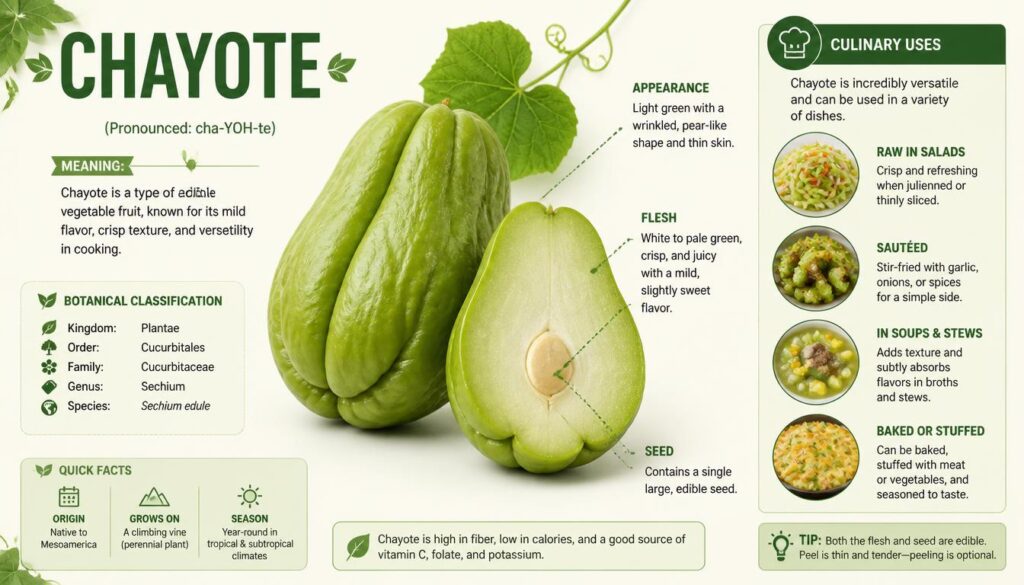
The chayote meaning in English is essentially the name of an edible fruit from the vine Sechium edule. English does not have a separate everyday word that completely replaces “chayote,” so the borrowed name is normally used as it is.
If you search for what is chayote or what is a chayote, you will usually find descriptions referring to a pear-shaped edible fruit related to squash and other gourds.
Its meaning is therefore quite literal in modern English. Chayote is simply the established English name for this particular food. The fascinating part is not a hidden definition, but the journey the word took from Nahuatl through Spanish and into English.
Chayote Gourd and Gourd Family
The term chayote gourd is another way of emphasizing its relationship with the gourd family. Chayote belongs to the same broad botanical family as cucumbers, melons, pumpkins, and many types of squash.
The fruit’s shape and climbing growth habit fit comfortably within that family. The annual vine can grow vigorously, producing edible fruit that people harvest for cooking.
Calling chayote an edible gourd is therefore understandable, although “chayote” or “chayote squash” is generally more specific. Names overlap in food language quite often, and chayote has collected several of them along the way.
Chayote Compared With Familiar Produce
If you have never tasted chayote, comparing it with familiar produce can make the idea easier to understand. Its mild character can remind some people of cucumber, zucchini, or other soft-flavored vegetables.
It is not exactly the same as any of these, though. Chayote vegetable has its own texture and subtle flavor, especially when cooked carefully. Think of those comparisons as a helpful starting point rather than a strict description.
It can also sit comfortably beside foods such as green banana, sweet potatoes, and carrots in various meals. These foods are quite different botanically, but they can share the same cooking space without any trouble.
Read more: https://ytmeaning.com/akeem-meaning/
Is Chayote Edible?
Yes, chayote is an edible fruit and is commonly prepared as food. Different parts of the plant have also been used in various culinary traditions, although preparation methods can differ by region.
The fruit itself is the part most people mean when they talk about eating chayote. It can be prepared in numerous ways, from simple cooked vegetable dishes to soups and more elaborate recipes.
As with any unfamiliar produce, it is sensible to follow a reliable recipe and prepare it appropriately. A strange-looking fruit does not necessarily require strange cooking; chayote is actually fairly approachable once you know what it is.
How to Understand the Word Chayote Easily
The easiest way to remember the chayote definition is to connect three ideas: a pear-shaped fruit, a climbing vine, and a vegetable used in cooking. Once those three pieces are together, the word becomes much less mysterious.
You can also remember its scientific identity: Sechium edule. If you see chayote, christophene, mirliton, or chayote squash in a food-related context, there is a good chance the writer is talking about this same edible plant.
And perhaps the most useful thing to remember is that calling it a vegetable is perfectly normal in everyday conversation. Botanists may call it a fruit, cooks may call it a vegetable, and both can walk away from the conversation happy.
Frequently Asked questions
What is chayote?
Chayote is an edible, pear-shaped fruit produced by the tropical vine Sechium edule. It belongs to the gourd family and is usually cooked and eaten as a vegetable.
What does chayote mean?
The chayote meaning is the name of an edible fruit commonly used as a vegetable. The word entered English through Spanish and ultimately comes from Nahuatl.
Is chayote a fruit or vegetable?
Botanically, chayote is a fruit because it develops from a flower and contains a seed. In cooking, however, it is generally treated as a vegetable.
What is another name for chayote?
Two well-known alternative names are christophene and mirliton. The exact name used can vary by region and culinary tradition.
What is chayote squash?
Chayote squash is another common name for chayote. It refers to the same pear-shaped edible fruit from Sechium edule.
What is the scientific name of chayote?
The chayote scientific name is Sechium edule. It belongs to the Cucurbitaceae, or gourd, family.
How do you pronounce chayote?
A common English chayote pronunciation is approximately “chah-YOH-tee.” Regional pronunciation can vary slightly.
Where does the word chayote come from?
The word comes into English through Spanish and ultimately traces to the Nahuatl word chayohtli.
Is chayote edible?
Yes. The chayote fruit is edible and is commonly cooked in soups, vegetable dishes, salads, and other recipes.
What family does chayote belong to?
Chayote belongs to the gourd family, Cucurbitaceae. It is related to cucumbers, pumpkins, melons, and squash.
Final Thoughts on Chayote Meaning
The chayote meaning is simple on the surface but surprisingly rich when you look closer. Chayote is an edible, pear-shaped fruit from the vine Sechium edule, belonging to the gourd family and commonly prepared as a tropical vegetable.
Its alternative names, including christophene and mirliton, reveal how the food has traveled across cultures and languages. Its name itself carries a small piece of history, moving from Nahuatl through Spanish before becoming familiar in English.
So the next time you see a curious green chayote sitting among the produce, it does not have to look like a mystery anymore. It is a fruit botanically, a vegetable in the kitchen, and a word with a rather long journey behind it. Sometimes, even an ordinary piece of produce has a surprisingly good story to tell.