

If you have spent enough time on TikTok, Instagram, or other social media platforms, you have probably seen strange numbers that seem completely harmless at first. 304 is one of those numbers. It looks like an ordinary three-digit number, but online it can carry a very different message.
The 304 meaning is usually connected to the word “hoe,” a slang term historically used as an insult toward a woman considered sexually promiscuous. The connection comes from an old-school calculator trick: when 304 is typed into a calculator and turned upside down, the digits can resemble the word “hoe.”
That simple bit of calculator spelling eventually became an example of internet slang, allowing people to communicate something without typing the actual word. On TikTok especially, 304 meaning on TikTok can depend heavily on the video, caption, comment, or community where it appears.
It is worth understanding the term before using it, though. What began as playful secret code or number-based slang can also become a derogatory term, particularly when it is directed at a real person.
What Does 304 Mean?
So, what does 304 mean in slang? In most online contexts, 304 is a coded way of referring to “hoe.” The term can describe a woman in a sexually derogatory way, although some online communities use it more casually or humorously.
The meaning is not connected to the number 304 itself. Instead, it comes from the visual appearance of the digits when viewed upside down on a calculator. It’s basically a little piece of old internet culture that found a new home on modern social platforms.
Depending on the context, someone might use 304 slang in a joke, meme, caption, comment, or video. Sometimes the person using it may not even intend the strongest insulting meaning.
Still, the word behind the code has a sexual and insulting history, so context matters quite a lot.
304 Meaning on TikTok
The 304 meaning TikTok users usually refer to is the same calculator-based slang meaning. TikTok helped make the number more visible because creators constantly develop new ways to discuss subjects that might attract content moderation or simply feel too direct to say openly.
Instead of writing an explicit or insulting word, users may write “304.” This makes it function like a codeword, euphemism, or piece of coded language.
You might see the number in a caption such as “304 behavior,” in a comment, or as part of a hashtag. Sometimes it appears alongside other forms of TikTok slang, memes, jokes, or references to dating and sexuality.
The important thing is that TikTok does not give the number one universal meaning in every situation. A creator might use it jokingly, critically, ironically, or as an insult.
Why Does 304 Mean “Hoe”?
The answer goes back to the classic upside-down calculator trick.
When 304 is entered into certain calculators and the calculator is turned upside down, the shapes of the numbers can resemble letters. The result has traditionally been interpreted as “hoe.”
This is known as calculator spelling, where numbers are used because they visually resemble letters when rotated. Before smartphones and modern social media, this kind of numerical wordplay was already popular among students and internet users.
The connection between 304 and “hoe” therefore isn’t a modern invention created entirely by TikTok. TikTok helped revive and spread an older form of numerical slang.
It’s a funny little example of how old internet habits can suddenly walk back into popular culture wearing completely new clothes.
304 Calculator Meaning Explained
The 304 calculator meaning is probably the easiest part of the slang to understand.
The digits are entered into a calculator, then the calculator is turned upside down. Depending on the calculator’s font and display, the numbers can be interpreted as letters forming “hoe.”
This belongs to the broader tradition of numbers as letters, similar to other forms of leetspeak and numerical wordplay.
The trick itself isn’t sexual. The sexual meaning comes from the word that the numbers are intended to represent.
That distinction matters because someone seeing “304” outside social media might naturally think it is simply a number, while someone familiar with online slang may immediately understand the hidden reference.
304 Slang Meaning in Everyday Online Conversations
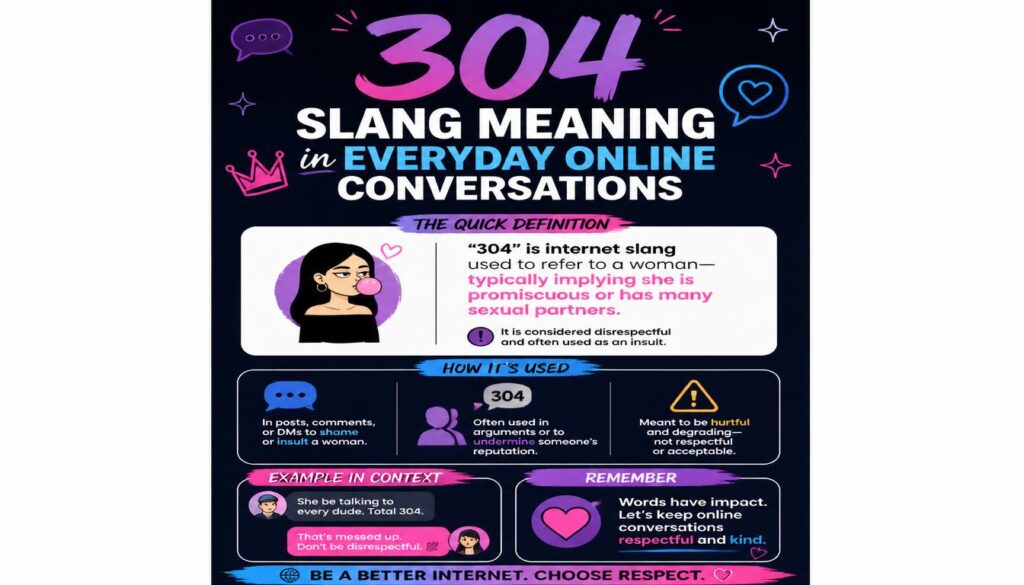
The 304 slang meaning can change slightly depending on how people use it.
For example, “304 behavior” may be used to describe behavior that someone considers sexually provocative. A creator might also use the number in a meme about dating, relationships, nightlife, clothing, or online personalities.
Some users use the word jokingly about themselves. Others use it as an insult against somebody else. Those two situations are very different.
When a person voluntarily uses the term for themselves, it may be part of their humor, identity, or online persona. When somebody applies it to another person without consent, it can become sexual shaming, slut-shaming, or harassment.
So, understanding the word doesn’t mean every use should be treated as equally harmless.
What Is 304Tok?
304Tok generally refers to TikTok content and online communities where the term 304 is used as part of the conversation.
You may encounter #304tok, videos discussing dating or sexuality, jokes about relationships, or creators using the number as a coded expression.
Some discussions associated with 304tok can involve sex work, adult entertainment, dating experiences, provocative content, or advice about making money online. However, the hashtag should not be treated as representing one single community or viewpoint.
A hashtag is simply a label people attach to content. Different creators can use the same hashtag for very different reasons.
For that reason, what is 304tok cannot be reduced to one particular type of person or lifestyle.
304 Culture and TikTok Culture
The idea of 304 culture is closely connected to the broader habit of turning sensitive subjects into internet code.
Social media users regularly invent euphemisms for words related to sexuality, relationships, money, appearance, and other taboo topics. Some are created because users want to joke around, while others emerge because platforms have strict moderation rules.
TikTok culture is especially good at spreading unusual expressions quickly. A term can appear in a handful of videos one week and suddenly become recognizable to millions of users.
That’s partly why older slang such as 304 can feel new to younger audiences. The technology changed, the platform changed, but the basic wordplay stayed surprisingly similar.
Is 304 a Bad Word?
Whether 304 is a bad word depends on how it is used, but the safest answer is that it can definitely be offensive.
The number itself is obviously not offensive. If someone says “304 pages” or refers to a product numbered 304, there is no slang meaning involved.
The problem appears when 304 is deliberately used as a replacement for “hoe” to describe a person.
In that situation, it can function as a derogatory term, particularly when directed at a woman because of her perceived sexual behavior or appearance.
If you’re unsure whether someone will understand the joke, it’s better not to use the term toward another person.
Is 304 a Misogynistic Term?
The term can be misogynistic when it is used to degrade or shame women.
Calling someone a 304 based on clothing, dating choices, sexual expression, or assumptions about their private life can reinforce harmful gender stereotypes.
The issue becomes even more complicated when the term is used against women who simply appear attractive or post a thirst trap. A social-media photograph does not provide enough information to make assumptions about somebody’s sexuality or personal behavior.
This is where online slang can stop being harmless wordplay and become sexual shaming.
Not every person using 304 intends to promote sexism, but the history and common usage of the underlying insult are still worth knowing.
304 and Sex Work
Another context where the term may appear is discussion surrounding sex work or the adult entertainment industry.
Some online communities may use 304 as a self-referential term, while other people use it negatively toward sex workers. Those uses should not be confused.
A person working in adult entertainment, for example, should not automatically be described with a derogatory slang term. Sex work and sexual behavior are complicated subjects, and reducing someone’s entire identity to an insult is rarely accurate.
Similarly, someone who dresses provocatively or openly discusses sexuality is not automatically a sex worker.
The internet loves shortcuts, but real people are usually more complicated than a three-digit code.
304 and Bisexual Women

The term can also appear in conversations involving bisexual women and sexuality.
Historically, bisexual people have faced stereotypes suggesting that their sexual orientation means they are automatically more sexually available or promiscuous. Those assumptions are inaccurate.
Using 304 to label bisexual women can therefore reinforce both sexual and bisexual stereotypes.
A person’s sexuality does not determine their character, relationships, or sexual choices. That’s an important distinction when discussing 304 behavior or similar slang online.
304, Thirst Traps, and Sexual Expression
Modern social media contains plenty of thirst traps, fashion posts, dance videos, dating content, and discussions about sexual expression.
Because of this, users sometimes attach slang such as 304 to people who post provocative photographs or videos.
But appearance and behavior shouldn’t automatically be treated as proof of someone’s private life.
Someone can wear revealing clothing, make a confident video, discuss dating, or express their sexuality without fitting the label being implied by the slang.
This is one reason the term can become problematic when used casually. What looks like a joke to one person may feel like online harassment or humiliation to another.
Why Do People Use 304 Instead of Saying the Word?
There are several reasons people use a secret code like 304.
First, coded language can make a statement feel humorous. Turning a serious or offensive word into a number creates a kind of inside joke.
Second, users may believe that coded language is less likely to attract attention from automated moderation systems. Social platforms use different systems and policies, and users often experiment with euphemisms when discussing restricted or sensitive subjects.
Third, internet communities naturally create their own vocabulary. Once a term becomes popular, people may use it simply because other users recognize it.
This is common across modern slang. Words such as rizz, gyatt, and other viral expressions can spread because they become part of a shared online language.
How 304 Is Used on Social Media
The term may appear in several forms across social media platforms:
- “304 behavior” can refer to behavior someone considers sexually provocative, though it can be insulting.
- “304 girl” may be used as a slang label for a woman, usually with a sexual implication.
- “304 code” refers to the numerical disguise itself.
- “304tok” identifies content where the slang and related topics appear.
- “304 meaning” is often searched by people who have encountered the number and don’t understand the reference.
- Creators may place the number in captions to make a joke less direct.
- Users may put it in comments as a reaction to a video.
- Some people use it ironically or self-referentially rather than as an insult.
The surrounding words are often more informative than the number itself.
Is 304 Always About Women?
No. Although the slang is frequently associated with women, it can be used in jokes or insults involving different people.
However, its traditional meaning is strongly associated with calling a woman a “hoe,” which is why many uses carry a gendered element.
Someone describing themselves as a 304 may be reclaiming or joking about the term. Someone directing the same label at a stranger is doing something quite different.
That difference between self-expression and derogatory language is easy to overlook when slang travels quickly online.
Read more: https://ytmeaning.com/chayote-meaning/
Where Did 304 Come From?
The slang origin of 304 is rooted in calculator wordplay rather than TikTok itself.
Upside-down calculator spelling became popular decades ago. People discovered that certain numbers could visually resemble letters when rotated, allowing them to create hidden words.
The 304-to-“hoe” connection eventually became part of internet slang and later appeared on social media platforms.
TikTok didn’t necessarily invent the expression. Instead, it gave an older numerical code a much larger and younger audience.
This is a recurring pattern with internet terminology: old jokes don’t always disappear. Sometimes they just wait for a new platform to bring them back.
Should You Use the Term 304?
If you’re using 304 as an explanation of slang, there is generally no issue. For example, saying “304 is internet slang for hoe” is simply describing the term.
Using it to insult another person is different.
Because the underlying word is commonly derogatory, using 304 toward someone can contribute to sexism, slut-shaming, harassment, or humiliation.
If you’re creating content, consider your audience too. A coded term may seem funny to one group but offensive or confusing to another.
Knowing the meaning gives you more control over the language you use. You don’t have to avoid every piece of slang; you simply need to understand what you’re actually saying.
Common Questions About 304 Meaning
What does 304 mean?
In internet slang, 304 is commonly a coded reference to “hoe,” based on upside-down calculator spelling. It can be used humorously, ironically, or as a derogatory label.
What does 304 mean on TikTok?
On TikTok, 304 generally has the same slang meaning and may appear in captions, comments, hashtags, and videos discussing dating, sexuality, or provocative online content.
Why does 304 mean hoe?
The connection comes from turning the number 304 upside down on a calculator. The shapes of the digits can resemble the letters in “hoe.”
Is 304 a derogatory term?
It can be. When used to label another person, especially a woman, it may function as a sexist or sexually derogatory insult.
What is 304Tok?
304Tok generally refers to TikTok content and communities where the term 304 and related discussions about sexuality, dating, sex work, or online culture appear.
Is 304 always offensive?
Not necessarily. The number itself is neutral, and some people use the slang jokingly or about themselves. However, directing it at another person can easily become offensive.
Where did 304 slang come from?
The slang is associated with older upside-down calculator wordplay. Social media, particularly TikTok, helped spread the expression to a newer generation of users.
How to Understand 304 in Context
When you see 304 online slang, don’t immediately assume you know exactly what the person means.
Look at the surrounding caption, comments, hashtags, and video. A creator might be explaining the term, making a joke, using it about themselves, or insulting someone.
For example, a search such as “what does 304 mean” usually comes from someone who encountered the number without understanding the hidden reference.
Context is what turns three ordinary digits into slang.
Final Thoughts on 304 Meaning
The 304 meaning is a surprisingly good example of how language evolves online. What looks like an ordinary number can become a secret code, thanks to an old calculator trick and the creativity of internet communities.
Today, 304 meaning on TikTok is generally associated with the slang word “hoe,” and it can appear in 304tok, comments, captions, memes, and conversations involving sexuality or online culture.
At the same time, understanding the term means understanding its uncomfortable side too. When 304 is used against someone, particularly a woman, it can become a misogynistic insult, sexual stereotype, or form of online shaming.
So the next time you see “304” on TikTok or Instagram, don’t just look at the number. Look at the context, the speaker, and the intention behind it.
Three digits can carry a whole little piece of internet history—and sometimes, a meaning far heavier than the number itself.