
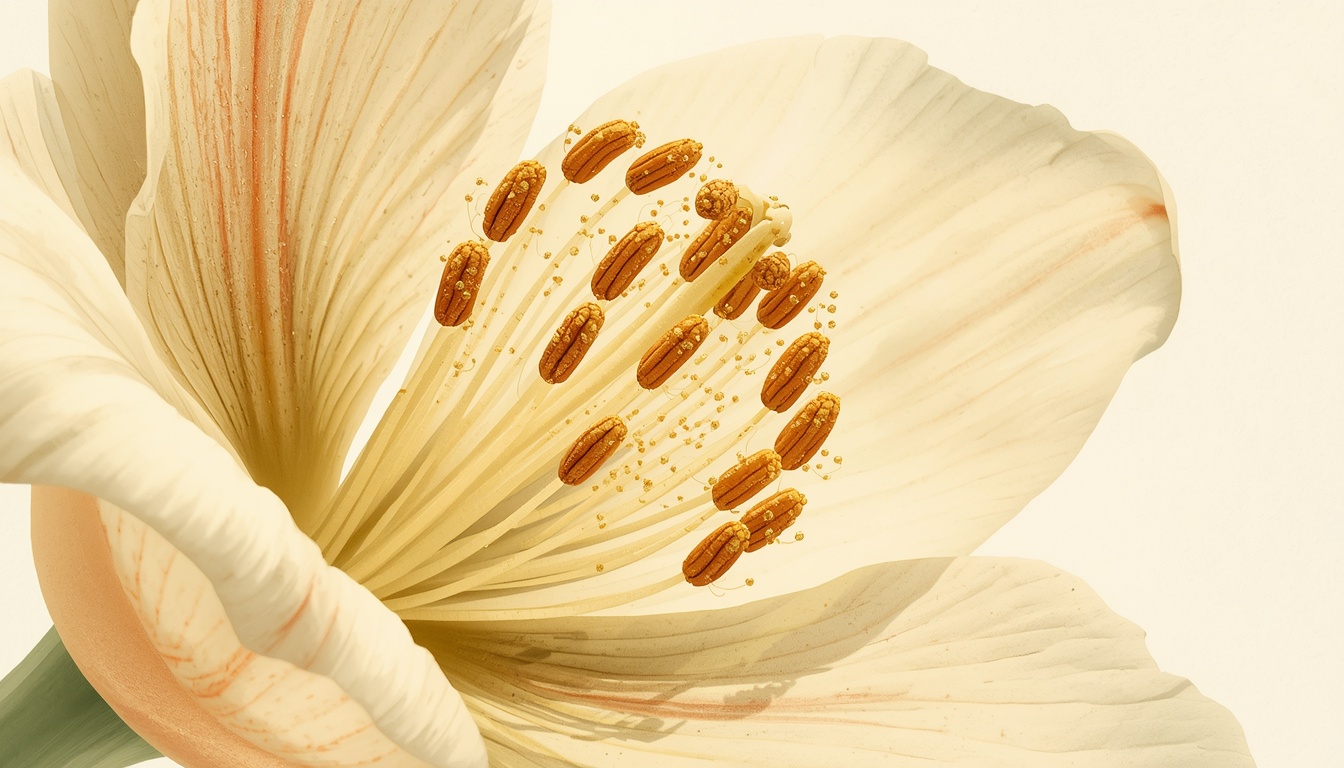

Have you ever looked closely at a flower and wondered how such a delicate, beautiful structure manages to reproduce? Behind its colourful petals and pleasant fragrance lies a fascinating biological system, with each tiny part performing an important job. One of these parts is called the anther. Although it may look like a small, ordinary structure, it plays a major role in plant reproduction.
Understanding the anther meaning is an important step towards learning about flower anatomy, pollen production, and the natural process of pollination. It is a botanical term that refers to the pollen-producing part of a flower’s male reproductive structure. Without it, many flowering plants would struggle to reproduce naturally.
The interesting thing is that anthers are often so small that we barely notice them when admiring a flower. Yet they are responsible for producing and releasing the pollen grains that help plants create seeds.
In this guide, we’ll explore the meaning of anther, its definition, pronunciation, structure, function, and relationship with other flower parts. We’ll also look at how pollen travels from an anther to a stigma and why this tiny botanical structure matters so much in the natural world.
What Is the Anther Meaning?
The word anther refers to the pollen-producing part of a flower. It is generally found at the tip of a slender stalk called the filament, which together with the anther forms the male reproductive organ known as the stamen.
In simpler words, an anther is the small structure in a flower where pollen grains are produced, developed, and eventually released. These pollen grains carry the male reproductive cells needed for fertilization.
If you gently examine a flower, you may notice several thin stalk-like structures surrounding its central reproductive parts. At the end of these stalks, there are often small, rounded or elongated structures. Those are the anthers.
The meaning of anther is therefore closely connected with pollen formation and plant reproduction. It is not simply another decorative part of a flower; it has a specific biological responsibility.
For example, when a bee visits a sunflower, pollen may stick to its body after contact with the anthers. As the bee moves to another flower, some of that pollen can reach a receptive stigma, helping pollination take place.
Anther Definition in Botanical Terms
The scientific anther definition describes it as the terminal, pollen-producing portion of the stamen in a flowering plant.
A stamen usually consists of two main parts:
- Anther: The upper portion responsible for producing and releasing pollen grains.
- Filament: The slender stalk that supports the anther and positions it for pollen dispersal.
Together, these structures form the male reproductive organ of a typical flower.
In botanical terminology, the anther is also described as a pollen-bearing structure. It contains specialised tissues where pollen develops inside microscopic chambers called pollen sacs or microsporangia.
Once pollen grains mature, the anther usually opens through small openings called stomia, allowing the pollen to escape. The exact method of opening varies among plant species.
One important point to remember is that anthers are not identical in every flower. Their shape, size, position, colour, and method of pollen release can differ considerably.
Anther Pronunciation and Word Origin
Learning the correct pronunciation makes botanical vocabulary easier to understand and remember.
Anther pronunciation: AN-thur.
It is commonly pronounced as /ˈæn.θər/ in English. The first syllable sounds similar to the beginning of the word “answer,” although the ending is different.
Anther noun: The word is used as a noun because it names a particular structure of a flower.
The word has an interesting linguistic background, too. It comes through New Latin anthera, which is associated with Greek anthēra, meaning a flowering or blooming part. The Greek word is related to anthos, meaning flower.
This connection with the Greek word for flower makes sense when we consider how closely the anther is connected to the reproductive life of flowering plants.
The word has been part of botanical vocabulary for centuries, and its use in English dictionaries is recorded in historical references dating back to the eighteenth century.
Anther in a Flower: Where Is It Located?
When studying anther in a flower, its location is one of the easiest things to understand.
The anther is usually positioned at the top of the filament. The filament holds it in place and allows the pollen to be exposed to visiting insects or moving air.
<em>Imagine a tiny lamp sitting on top of a narrow pole.</em> The pole represents the filament, while the lamp represents the anther. This simple comparison helps explain the relationship between these two flower parts.
In a typical flower, several stamens may surround the female reproductive structure, known as the pistil or carpel.
The anthers are often positioned in a way that makes pollen transfer easier. Depending on the flower, they may face inward, outward, or in different directions.
For example:
- In lilies, the anthers are usually large and clearly visible.
- In hibiscus flowers, the stamens are arranged in a prominent column.
- In sunflowers, numerous tiny flowers within the flower head contain their own reproductive structures.
- In grasses, anthers often hang outside the flower, making pollen available to the wind.
These differences show how flower morphology is adapted to different methods of pollination.
Anther Structure: Understanding Its Main Parts
The anther structure is more complex than its small size might suggest. Although it appears to be a simple pollen-filled tip, it contains specialised tissues that support pollen development.
Most typical flowering-plant anthers are described as bilobed, meaning they have two main lobes.
<em>Each lobe generally contains two pollen sacs, giving a typical anther four microsporangia.</em> These chambers are the places where pollen grains develop.
The main structural features include:
- Anther lobes: The two main sections of a typical anther.
- Pollen sacs: Chambers in which pollen grains develop.
- Microsporangia: The technical botanical name for the pollen-producing chambers.
- Connective tissue: Tissue that joins the two anther lobes.
- Vascular tissue: Supplies nutrients and supports the development of the anther.
- Endothecium: A specialised layer involved in anther opening and pollen release.
Inside the pollen sacs, specialised cells called microspore mother cells undergo meiosis. This process produces haploid microspores, which develop into pollen grains.
As these grains mature, the anther prepares to release them into the surrounding environment.
The structure is quite remarkable when you think about it. Such a small part of a flower contains several layers of specialised cells, each contributing to successful reproduction.
Anther Function: Why Is It Important?
The main anther function is to produce and release pollen grains. However, its importance extends beyond simply storing pollen.
It is directly involved in the early stages of sexual reproduction in flowering plants.
Here are the major functions of an anther.
Pollen Production
The primary responsibility of the anther is pollen formation. Specialised cells inside its pollen sacs undergo meiosis to produce microspores.
These microspores eventually develop into mature pollen grains, which contain the male gametophyte.
Pollen Storage
Before pollen is released, it remains inside the anther’s pollen sacs. These chambers protect developing pollen and provide an environment for its maturation.
Pollen Release
When pollen becomes mature, the anther opens through a process known as dehiscence.
This allows pollen grains to escape and become available for transfer through insects, wind, or other pollinating agents.
Supporting Plant Reproduction
The pollen produced by anthers carries the male reproductive cells. When pollen reaches a compatible stigma, it can germinate and form a pollen tube.
The pollen tube grows towards the ovule, allowing the male gametes to reach the female reproductive cells.
Supporting Genetic Diversity
Through sexual reproduction and cross-pollination, pollen from one flower can contribute genetic material to another flower.
This process supports genetic variation among plant offspring, which is important for adaptation and long-term survival.
Anther and Stamen: What Is the Difference?
The terms anther and stamen are sometimes used interchangeably by beginners, but they do not mean the same thing.
The stamen is the complete male reproductive organ of a typical flower, while the anther is only one part of it.
Think of the stamen as a complete unit and the anther as its pollen-producing tip.
| Feature | Anther | Stamen |
|---|---|---|
| Meaning | Pollen-producing structure | Male reproductive organ |
| Structure | Usually consists of two lobes | Usually includes anther and filament |
| Main role | Produces and releases pollen | Supports pollen production and dispersal |
| Location | Usually at the tip of the filament | Found among the flower’s reproductive parts |
| Function | Pollen formation and release | Male reproductive activity |
The relationship is straightforward: the anther is a part of the stamen, just as a leaf is a part of a plant.
Remembering this difference will help you answer many basic questions about flower anatomy.
Anther and Stigma: Understanding Their Relationship
The anther and stigma perform different but complementary roles in plant reproduction.
The anther produces pollen, whereas the stigma is the receptive surface of the female reproductive structure.
The stigma is usually located at the top of the pistil. Its surface may be sticky or specially adapted to capture pollen grains.
When pollen from a compatible flower lands on the stigma, pollination has occurred.
The pollen grain may then germinate and produce a pollen tube, which grows through the style towards an ovule inside the ovary.
This eventually makes fertilization possible.
Here is a simple comparison:
- Anther: Produces pollen grains.
- Stigma: Receives pollen grains.
- Filament: Supports the anther.
- Style: Connects the stigma with the ovary.
- Ovary: Contains ovules.
- Ovule: Contains the female reproductive structures and develops into a seed after fertilization.
The relationship between the anther and stigma is essential to understanding the reproductive system of flowering plants.
How Does Pollen Move from Anther to Stigma?
Pollen transfer is one of nature’s most interesting processes. A pollen grain must travel from the anther to a compatible stigma before fertilization can occur.
This movement is known as pollination.
There are several ways in which pollen can travel.
Insect Pollination
<em>Insects are among the most familiar pollinating agents.</em> Bees, butterflies, moths, and other insects visit flowers to collect nectar or pollen.
When a bee lands on a flower, pollen grains may attach to its legs, wings, or hairy body.
As it visits another flower, some pollen may rub off onto the stigma.
Bees are especially effective because their bodies can carry considerable amounts of pollen between flowers.
Wind Pollination
Not every flower depends on insects.
Some plants, including many grasses and cereal crops, use wind to transport pollen.
Their anthers are often positioned outside the flower, allowing lightweight pollen grains to become airborne.
The wind carries these grains through the environment, and some eventually land on suitable stigmas.
Water Pollination
Certain aquatic plants use water currents to transport pollen.
Although less common than insect and wind pollination, this method is another fascinating example of how plants adapt their reproductive systems to their surroundings.
Manual Pollination
Gardeners and agricultural workers sometimes transfer pollen manually when natural pollination is limited or when controlled breeding is required.
A small paintbrush or cotton swab can be used to collect pollen from a mature anther and gently place it on a receptive stigma.
This technique is particularly useful in plant breeding, greenhouse cultivation, and scientific experiments.
Different Types of Anthers in Flowers
Anthers can vary significantly in appearance and arrangement. Botanists classify them according to characteristics such as attachment, orientation, and opening patterns.
Some common types include:
Basifixed Anther
A basifixed anther is attached to the filament at its base. This arrangement provides a relatively stable connection.
Dorsifixed Anther
A dorsifixed anther is attached to the filament through its back surface.
Depending on the arrangement, it may be capable of moving more freely.
Versatile Anther
A versatile anther is attached in a way that allows it to swing or move around its attachment point.
This arrangement can help release pollen into the air.
Adnate Anther
An adnate anther is attached to the filament along much of its length rather than at a single point.
Introrse Anther
An introrse anther opens towards the centre of the flower.
Extrorse Anther
An extrorse anther opens away from the centre of the flower.
These classifications help botanists describe flower morphology and understand how different plants release pollen.
What Does an Anther Produce?
One of the most frequently asked questions about flower anatomy is: what does an anther produce?
The simple answer is pollen grains.
However, understanding what happens inside the anther makes the answer even more interesting.
Within the pollen sacs, microspore mother cells undergo meiosis. Each mother cell generally produces four haploid microspores.
These microspores develop into pollen grains through a process called microgametogenesis.
A mature pollen grain is not simply a tiny piece of yellow dust. It is a specialised structure containing the male gametophyte, which participates in fertilization.
Depending on the plant species, pollen grains can have different shapes, sizes, surface patterns, and colours.
Some are smooth, while others have spikes, ridges, or elaborate surface textures that can be observed using a microscope.
Why Are Anthers Important for Plant Reproduction?
Anthers are essential because they initiate the male side of sexual reproduction in flowering plants.
Without successful pollen production and release, fertilization cannot occur through the usual sexual reproductive process.
Their importance becomes even more noticeable when we consider agriculture and food production.
Many crops depend on pollination to produce fruits and seeds. Apples, pumpkins, almonds, cucumbers, and numerous other plants benefit from effective pollen transfer.
In many cases, insects carry pollen from one flower to another. In other crops, wind plays a major role.
Anthers also contribute to plant breeding. Scientists and agricultural researchers study pollen development, fertility, and compatibility to develop improved plant varieties.
So, although an anther is tiny, its role reaches far beyond the individual flower. It contributes to ecosystems, food production, biodiversity, and the continuation of plant species.
How to Identify an Anther During Flower Dissection
If you are studying botany or preparing for a biology practical, identifying an anther is a useful activity.
You can examine a common flower, such as a lily or hibiscus, and observe its reproductive structures.
Follow these simple steps:
- Choose a fresh, fully opened flower.
- Carefully remove some petals to expose the reproductive parts.
- Look for the slender filaments surrounding the central pistil.
- Examine the tips of these filaments.
- Identify the small structures attached to their ends as anthers.
- Observe their colour, shape, and position.
- If available, use a magnifying glass to examine their surface more closely.
You may notice fine powder on the anthers. This is often pollen.
For a closer scientific examination, a microscope can help reveal individual pollen grains and their surface features.
Avoid crushing the structures during observation, as doing so can make it difficult to understand their natural arrangement.
How to Collect Pollen from an Anther
Pollen collection is useful in gardening, plant breeding, and educational experiments.
A simple collection method involves using a clean, dry paintbrush or cotton swab.
First, select an anther that has reached maturity and is releasing pollen. Gently touch the brush against its surface to collect some of the grains.
Next, transfer the pollen to a clean container or directly onto the receptive stigma of a compatible flower, depending on the purpose of the experiment.
A few practical points are worth remembering:
- Collect pollen when the anther is mature and dry.
- Use clean equipment to avoid contamination.
- Avoid excessive handling of delicate flower parts.
- Label collected pollen if working with multiple plant varieties.
- Follow suitable storage conditions for the particular plant species.
Pollen viability differs between plants, so not every collected sample will remain capable of fertilization for the same length of time.
Common Questions About Anther Meaning
Is an Anther a Male or Female Part of a Flower?
An anther is part of the male reproductive structure of a typical flowering plant. It produces pollen grains that carry male reproductive cells.
What Is Another Name for Anther?
There is no universally accepted everyday alternative name for anther. It is commonly described as the pollen-producing part or pollen-bearing tip of the stamen.
Is the Anther Part of the Stamen?
Yes. The anther and filament are the two principal parts of a typical stamen.
Does Every Flower Have an Anther?
Many flowering plants have anthers, but their presence and development depend on the flower’s reproductive arrangement. Male flowers and bisexual flowers typically have functional stamens, while female flowers may lack functional anthers.
What Is the Difference Between Pollen and Anther?
An anther is a physical structure of the flower, while pollen consists of microscopic reproductive grains produced inside that structure.
In simple terms, the anther produces pollen; they are not the same thing.
How Does an Anther Open?
An anther generally opens through a process called dehiscence. Depending on the species, it may split along specialised regions to release mature pollen grains.
Can an Anther Be Seen Without a Microscope?
Yes. Most mature anthers can be seen with the naked eye, especially in flowers such as lilies and hibiscus. However, their internal structure and individual pollen grains usually require magnification.
What Is the Botanical Adjective for Anther?
The term antheral is associated with the anther in botanical language. It is a specialised word used when describing characteristics or features related to this structure.
Read Articul: https://ytmeaning.com/endeavour-meaning/
Easy Ways to Remember the Meaning of Anther
Botanical terminology can sometimes feel confusing, especially when several flower parts have similar-sounding names.
A simple memory trick can make things easier.
Think of the word anther whenever you see pollen-producing structures at the tips of flower stalks.
Remember these three basic relationships:
- Anther = Produces pollen.
- Filament = Supports the anther.
- Stigma = Receives pollen.
You can also remember the sequence of sexual reproduction:
Anther → Pollen → Stigma → Pollen Tube → Ovule → Fertilization
This sequence provides a simple overview of how pollen travels and contributes to seed formation.
For students, drawing a labelled flower diagram is another useful method. Marking the anther, filament, stigma, style, and ovary makes the relationship between the different flower parts much easier to understand.
Conclusion: The Small Structure Behind a Remarkable Natural Process
The anther meaning may be explained in just a few words: it is the pollen-producing part of a flower’s male reproductive organ. But its biological importance is much greater than this short definition suggests.
From pollen formation and release to pollination and fertilization, the anther plays an essential role in the reproductive life of flowering plants.
Its relationship with the stamen, filament, stigma, and other flower parts shows just how carefully organised plant reproduction really is.
The next time you admire a sunflower, rose, lily, or any other flower, take a moment to look at its tiny reproductive structures. You might be surprised by how much activity takes place in something so small.
Nature has a wonderful way of hiding remarkable processes inside ordinary-looking things, and the anther is a perfect example.
Whether you’re a student learning flower anatomy, a gardening enthusiast, or simply curious about botanical terminology, understanding the anther gives you a better appreciation of how plants reproduce and how life continues from one generation to another.