
The English language has a funny way of making one small word carry several different stories. The word bow is a perfect example. You might hear someone say, “The actor took a bow,” see a pretty ribbon bow tied around a birthday present, or read about the bow of a ship. The spelling stays exactly the same, but the pronunciation and meaning can change quite a bit.
So, what is the actual bow meaning? It depends on the situation in which the word appears. Sometimes it describes a person bending their head or body to show respect. In other situations, it refers to a decorative knot, an archery weapon, the front part of a boat, or an accessory used to play a violin.
Understanding these meanings makes everyday English easier to follow. It also helps you recognize how context, pronunciation, and grammar work together. Let’s explore the different definitions, expressions, examples, and uses of this interesting word without making things unnecessarily complicated.
What Does Bow Mean?
The word bow has several meanings in English, and it can function as both a noun and a verb. Its meaning changes according to pronunciation and context.
As a verb, it commonly means to bend your head or body forward, usually to show respect, express gratitude, or greet somebody. For example, a performer may bow after receiving applause from an audience.
As a noun, it can describe that bending movement itself. However, it also refers to a ribbon decoration, a weapon used for shooting arrows, the front part of a ship, or a long accessory used with string instruments.
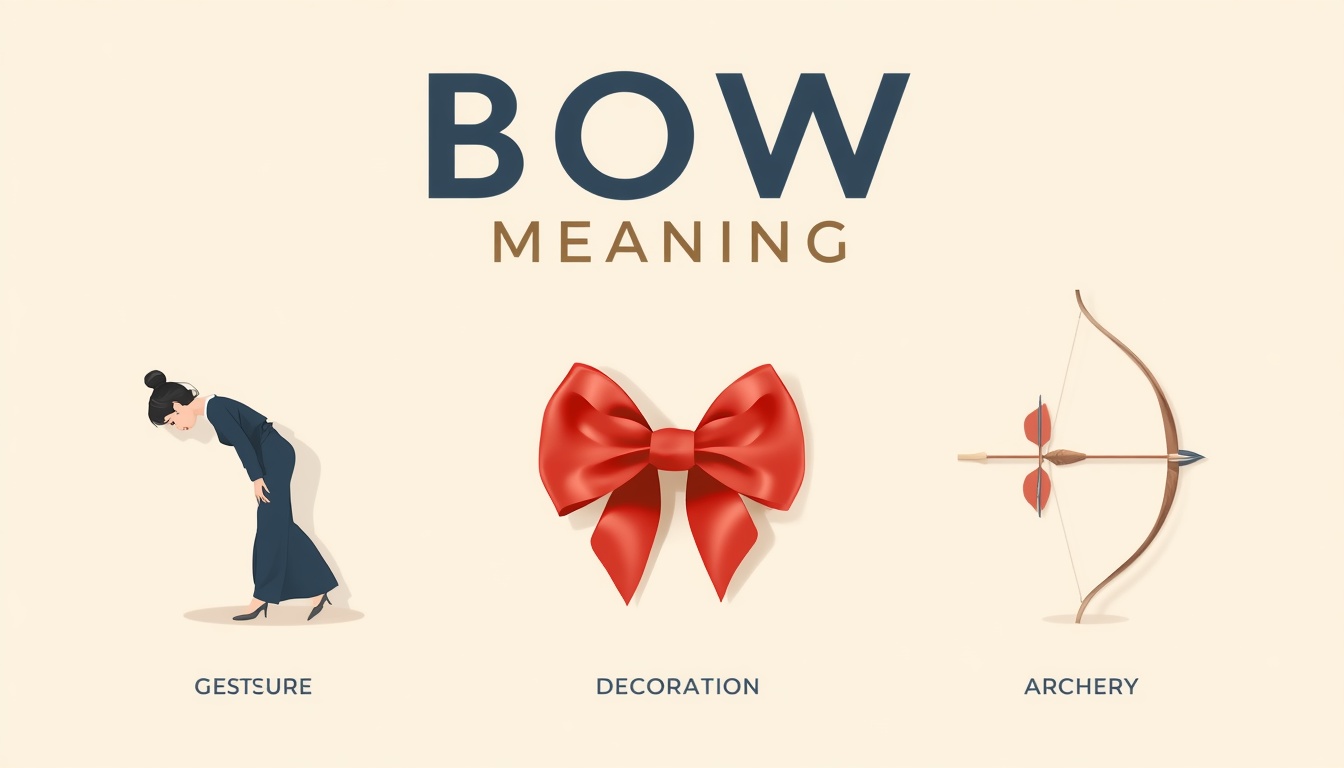
Here are the main meanings:
- Bow (gesture): Bending your head or body forward to show respect or appreciation.
- Bow (ship): The front part of a boat or ship.
- Bow (knot): A decorative knot with two curved parts and two loose ends.
- Bow (weapon): An instrument used to shoot arrows.
- Bow (music): A long, narrow wooden accessory with stretched hair, used to play string instruments.
Although these meanings seem unrelated at first, they all belong to the same English word. Learning them individually is the easiest way to remember them.
Bow Meaning as a Verb
When used as a verb, bow usually describes the action of bending your head or body forward. It is a familiar gesture in formal ceremonies, religious gatherings, performances, and certain cultural traditions.
Imagine attending a graduation ceremony. When someone receives an award and slightly lowers their head to acknowledge the audience, that person is bowing. It is a simple movement, but it can communicate respect, appreciation, or humility.
Consider these examples:
- The students bowed politely before the ceremony began.
- The performer bowed after the audience applauded.
- We bowed our heads during the prayer.
- She bowed to the Queen as a sign of respect.
- The children bowed their heads in shame.
The verb can be used in both transitive and intransitive forms. An intransitive example is “He bowed politely.” A transitive example is “She bowed her head.”
Bow to Someone
To bow to someone means to bend your head or body forward as a sign of respect, courtesy, or recognition.
In some cultures, this gesture is an ordinary part of greeting people. In others, it is mainly associated with formal situations, traditional ceremonies, or interactions with important guests.
Examples include:
- They bowed to the King when he entered the room.
- The visitors bowed to the Princess.
- He bowed respectfully to his teacher.
- She bowed to the audience before leaving the stage.
- The children bowed to their grandparents during the celebration.
- The musicians bowed to the conductor.
- Everyone bowed politely as the ceremony came to an end.
Bowing does not always suggest that someone is inferior to another person. Quite often, it is simply a traditional way of expressing appreciation and good manners.
Bow Down
The expression bow down can describe physically bending your body toward the ground. It can also suggest submission, obedience, or accepting another person’s authority.
For instance, someone might bow down before a king in a historical story. In everyday language, the expression can also describe giving in to pressure or acknowledging that something is beyond your control.
Examples:
- The knight bowed down before the King.
- The visitors bowed down during the traditional ceremony.
- He refused to bow down to unfair demands.
- Sometimes people bow down to pressure even when they disagree.
- The worshippers bowed down in prayer.
- She would never bow down to intimidation.
- The people bowed down before their ruler.
The exact meaning depends on the sentence. It may describe a physical action or a figurative decision to submit.
Bow Out
To bow out means to withdraw from an activity, competition, position, or responsibility. It is often used when someone decides to leave gracefully rather than continue.
For example, a singer might bow out of a competition because of personal circumstances. A manager may also bow out of a project after completing their responsibilities.
Examples:
- He decided to bow out of the competition.
- The actor bowed out of the production.
- She politely bowed out of the discussion.
- After many successful years, the director decided to bow out.
- The team had to bow out because of an injury.
- I think it’s time for me to bow out.
- He bowed out of the agreement without creating unnecessary conflict.
This expression is especially useful in conversational English because it describes leaving or withdrawing without making a dramatic announcement.
Bow Your Head
The expression bow your head means to lower your head, often to express respect, sadness, shame, gratitude, or devotion.
You may hear it during religious prayers, memorial services, moments of silence, or emotional gatherings. Sometimes the gesture communicates feelings that are difficult to put into words.
Examples:
- We bowed our heads in prayer.
- Everyone bowed their heads to remember the victims.
- He stood quietly with his head bowed.
- The children bowed their heads in shame.
- She bowed her head to express gratitude.
- The congregation bowed their heads during the service.
- He lowered his head in silent contemplation.
A bowed head can therefore communicate several emotions. The surrounding situation helps us understand what the gesture represents.
Bow Meaning as a Noun
As a noun, bow has several distinct definitions. The most common include a respectful gesture, a decorative ribbon knot, a ship’s front section, an archery weapon, and a musical accessory.
This is why understanding the bow definition requires more than memorizing a single explanation. The word can describe completely different objects and actions.
Bow as a Gesture
A bow is the movement of bending your head or body forward, usually to communicate respect, gratitude, or appreciation.
It is common in theatrical performances, traditional greetings, and formal ceremonies. After a successful performance, actors, dancers, and musicians may return to the stage to take a bow.
For example:
- The audience gave the dancers a standing ovation, and they took a bow.
- The singer returned to the stage for another bow.
- The guests offered a respectful bow to the royal family.
- The troupe’s artistic director took a bow with the performers.
- The young musician received applause and gave a shy bow.
- A deep bow marked the beginning of the traditional ceremony.
- The performers took their final bow before the curtain closed.
The phrase take a bow is particularly popular in English. It means acknowledging applause or appreciation after doing something successfully.
Bow as the Front Part of a Ship
In nautical terminology, the bow of a ship refers to its front part. It is the section designed to move forward through the water.
The opposite end is called the stern, which refers to the rear part of the vessel. These terms are important in boating, sailing, navigation, and marine engineering.
For example:
- The captain stood near the bow of the ship.
- The passengers gathered at the front of the boat.
- A strong wave crashed against the bow.
- The crew inspected the ship’s bow before departure.
- The youngest rower occupied the bow seat.
- The boat moved forward as the bow wave formed.
- The sailors watched the water from the front deck.
In rowing, the word also has a specific meaning. The bow seat is the rowing position closest to the front of the boat, and the person sitting there may also be called the bow.
It is a useful distinction because the word can describe a physical part of a vessel as well as a position occupied by a crew member.
Bow as a Decorative Knot
A decorative bow is a knot made from ribbon or another flexible material. It usually has two curved loops and two loose ends.
You have probably seen one on birthday presents, wedding decorations, gift boxes, clothing, hair accessories, and shoelaces. It is a small detail, but it can make an ordinary object look more attractive.
For example:
- She tied a beautiful red bow around the present.
- The little girl’s dress had a pink ribbon bow.
- He decorated the gift box with a golden bow.
- Her hair was held back with a pretty bow.
- The shoelaces were tied into neat bows.
- A double-loop bow decorated the wedding invitation.
- The florist added a decorative bow to the bouquet.
A ribbon bow is not just limited to gift wrapping. It is also used in fashion, crafts, packaging, and special celebrations.
Bow as an Archery Weapon
Another meaning refers to a weapon used for shooting arrows. A traditional bow and arrow consists of a curved piece of material and a tightly stretched string called a bowstring.
When the string is drawn backward and released, it transfers stored energy to the arrow, allowing it to travel forward.
Bows have been used historically for hunting, warfare, and sporting competitions. Today, archery is also practiced as a recreational activity and competitive sport.
Common examples include:
- Recurve bow: A bow with tips that curve away from the archer.
- Longbow: A long traditional bow, often associated with historical archery.
- Crossbow: A bow-like weapon mounted horizontally on a stock.
Other related terms include:
- Archery equipment
- Wooden bow
- Fibreglass bow
- Bowstring
- Arrow shooting
- Target archery
- Olympic archery competitions
- Traditional bow and arrow
Example sentences:
- He learned to use a bow and arrow at an archery club.
- The athlete practiced with a recurve bow.
- The museum displayed a traditional longbow.
- The arrow had been released from a wooden bow.
- Archery competitions require concentration and accuracy.
These examples show how the meaning changes completely when the conversation involves sport, equipment, or historical weapons.
Bow in Music
In music, a bow is a long, thin accessory used to play instruments with strings, particularly the violin, viola, cello, and double bass.
It is traditionally made using a wooden stick with horsehair stretched between its ends. When the bow moves across the musical strings, friction creates vibrations that produce sound.
A violin bow is one of the most recognizable examples. Its movement, pressure, and speed can influence the tone and expression of a musical performance.
Some useful musical terms include:
- Violin bow: The accessory used to play a violin.
- Horsehair: Hair traditionally used along the bow.
- Bowing technique: The way a musician moves the bow across the strings.
- Bow pressure: The amount of pressure applied to the strings.
- Bow speed: How quickly the bow moves.
- Bow force: The force applied during performance.
- Timbre: The distinctive quality or character of a musical sound.
- Bridge: The part of a string instrument that supports the strings.
Example sentences:
- The violinist carefully adjusted her bow.
- He practiced different bowing techniques.
- The musician used gentle bow pressure to create a softer tone.
- The cello produces sound when the bow moves across its strings.
- The teacher demonstrated how to hold a violin bow.
There is also a technique called pizzicato, in which musicians pluck the strings with their fingers instead of using a bow.
In classical music, the relationship between bow speed, bow pressure, articulation, and finger position can make a remarkable difference to the final sound. A skilled musician understands these small details, even when the audience only hears the beautiful result.
Bow Pronunciation in British and American English
One of the most interesting things about this word is that it has two different pronunciations.
The spelling alone does not tell you which sound to use. You need to consider its meaning.
Here is a simple comparison:
| Meaning | British pronunciation | American pronunciation |
|---|---|---|
| Bending gesture | /baʊ/ | /baʊ/ |
| Decorative knot | /bəʊ/ | /boʊ/ |
| Archery weapon | /bəʊ/ | /boʊ/ |
| Musical accessory | /bəʊ/ | /boʊ/ |
The gesture meaning rhymes with “cow,” while the knot, weapon, and musical meanings sound like “go” in British and American English.
For example:
- “The actor took a bow.” The word rhymes with “cow.”
- “She tied a bow around the gift.” The word rhymes with “go.”
This distinction is important for anyone learning English pronunciation. Two words can have identical spelling but different sounds and meanings.
The term for words that share spelling but have different pronunciations and meanings is heteronyms. Bow is a familiar example of this linguistic feature.
Common Idioms and Phrasal Verbs with Bow
English speakers also use bow in several expressions. These phrases often have meanings that go beyond the physical action of bending forward.
Learning them will help you understand conversations, books, and everyday communication more naturally.
Bow and scrape
This expression describes behaving in an excessively respectful or submissive way toward someone, often to gain their approval.
Example: He refused to bow and scrape just because the manager was important.
Bow down to someone
This means physically bending before someone or showing submission to their authority.
Example: The visitors bowed down before the ruler.
Bow to someone or something
This expression can mean showing respect, accepting authority, or yielding to a particular situation.
Example: Eventually, the company had to bow to public pressure.
Bow out
To withdraw from an activity or position.
Example: She decided to bow out of the competition.
Take a bow
To acknowledge applause or appreciation after a performance.
Example: The dancers returned to the stage to take a bow.
Fire a warning shot across someone’s bow
This idiom means giving someone a warning that their behavior or actions may have consequences.
Example: The manager issued a warning shot across the team’s bow after several missed deadlines.
Put a bow on something
This informal expression means adding a finishing touch or completing something neatly.
Example: Let’s put a bow on this project before Friday.
These expressions make the word more versatile. Once you understand the context, they become much easier to recognize and use.
Bow Synonyms and Related Words
The word bow synonyms depend on which definition you are discussing. There isn’t one replacement that works for every meaning.
For the gesture meaning, related words include:
- Bend
- Incline
- Nod
- Dip
- Lower
- Curtsy
- Defer
- Submit
For the decorative knot meaning:
- Ribbon knot
- Loop
- Decoration
- Ribbon ornament
- Shoelace knot
For the ship meaning:
- Forepart
- Front section
- Forward part
- Stem (a related nautical term, not an exact synonym)
For the musical meaning:
- Violin bow
- String instrument bow
- Horsehair bow
For the archery meaning:
- Recurve bow
- Longbow
- Crossbow (a related but distinct type of weapon)
It is worth remembering that curtsy versus bow describes two different gestures. A curtsy traditionally involves bending the knees, while a bow generally involves bending the head or upper body forward.
Choosing the correct synonym depends on the situation. A nod may sometimes communicate acknowledgment, but it is not necessarily the same as a formal bow.
Examples of Bow in Sentences
The easiest way to understand a word with multiple meanings is to see it in different situations.
Here are some practical bow in a sentence examples:
Bow as a verb
- The students bowed respectfully before their teacher.
- The singer bowed after the final song.
- She bowed her head during the prayer.
- The visitors bowed to the royal family.
- He refused to bow to unreasonable demands.
Bow as a gesture noun
- The performer received enthusiastic applause after her bow.
- The dancers took a final bow together.
- His respectful bow surprised the visitors.
Bow as a decorative knot
- The present had a beautiful silver bow.
- She wore a ribbon bow in her hair.
- He tied a bow around the gift box.
Bow as a ship part
- The sailors stood near the bow.
- The waves struck the bow of the boat.
- The ship’s bow pointed toward the harbor.
Bow as an archery weapon
- The archer carefully adjusted the bowstring.
- She practiced with a traditional longbow.
- The athlete used a recurve bow during training.
Bow in music
- The violinist lifted his bow before playing.
- The teacher explained proper bowing technique.
- The musician adjusted the bow pressure to change the tone.
Reading these examples aloud is a useful exercise because it helps you connect pronunciation with meaning.
Frequently Asked Questions About Bow Meaning
What does bow mean in English?
Bow has several meanings in English. It can mean bending your head or body to show respect, a decorative ribbon knot, the front part of a ship, an archery weapon, or an accessory used to play string instruments.
What is the difference between bow as a noun and a verb?
As a noun, bow can refer to a gesture, ribbon decoration, ship section, weapon, or musical accessory. As a verb, it usually describes bending forward or playing a string instrument using a bow.
What does taking a bow mean?
Taking a bow means bending your head or upper body forward to acknowledge applause, appreciation, or recognition after a performance.
What does bow down mean?
Bow down means bending your body toward the ground. Figuratively, it can also mean submitting to someone’s authority or accepting pressure.
What does bow out mean?
Bow out means withdrawing from an activity, competition, position, or responsibility. It often suggests leaving politely or gracefully.
What does bow to someone mean?
To bow to someone means bending forward as a sign of respect or courtesy. It can also mean accepting someone’s authority or yielding to their wishes.
What is the bow of a ship?
The bow is the front part of a boat or ship. Its opposite end is called the stern.
What is a bow and arrow?
A bow and arrow is a traditional archery system consisting of a curved bow and an arrow. The bowstring is drawn backward and released to propel the arrow.
What is a bow in music?
A musical bow is a long, narrow accessory with hair stretched between its ends. It is used to play string instruments such as violins, violas, cellos, and double basses.
Why does bow have two pronunciations?
The word has different pronunciations because it represents several meanings. The bending gesture is pronounced /baʊ/, while the decorative knot, weapon, and musical accessory are pronounced /bəʊ/ in British English and /boʊ/ in American English.
Is bow the same as curtsy?
No. A bow involves bending the head or upper body forward, whereas a curtsy involves bending the knees while lowering the body. Both can be used as respectful gestures.
Read ARticcul: https://ytmeaning.com/either-meaning-in-english/
Conclusion: Understanding the Different Meanings of Bow
The word bow is a wonderful example of how one spelling can carry several meanings in English. From a respectful gesture to a decorative ribbon, from the front of a ship to an archery weapon, and from a violin accessory to a collection of everyday expressions, its uses are surprisingly varied.
The most important thing to remember is context. If someone bows after a performance, they are acknowledging applause. If someone ties a bow around a present, they are making a decoration. If a sailor mentions the bow, they are talking about the front of a vessel.
Pay attention to pronunciation, too. The difference between /baʊ/ and /bəʊ/ or /boʊ/ can completely change what a speaker means.
Once you understand these distinctions, using and recognizing the word becomes much easier. English has plenty of words with unexpected meanings, and bow is certainly one worth remembering. Keep noticing how people use it in conversations, books, and everyday situations, and its different meanings will soon feel perfectly natural.