
Have you ever paused while writing a sentence because you weren’t quite sure whether to use either, neither, both, or too? It’s a surprisingly common situation, even for people who speak English fluently.
The word Either looks simple, but it carries several meanings depending on where it appears in a sentence. Sometimes it presents two choices, sometimes it expresses agreement with a negative statement, and sometimes it refers to both sides of something.
Understanding the either meaning in English can make everyday conversations, emails, academic writing, and even casual messages much easier. The interesting thing is that one small word can perform several grammatical jobs without changing its spelling.
For example, consider these sentences:
- You can choose either tea or coffee.
- I don’t like spicy food either.
- Either answer is acceptable.
- There are trees on either side of the road.
Although the same word appears in every example, its grammatical function and meaning are slightly different. That’s where many learners get confused.
In this guide, we’ll explore the definition of either, its different grammatical functions, pronunciation, common expressions, and practical examples. We’ll also look at the differences between either, neither, and both, so you can use each word naturally instead of guessing which one sounds right.
What Does Either Mean in English?
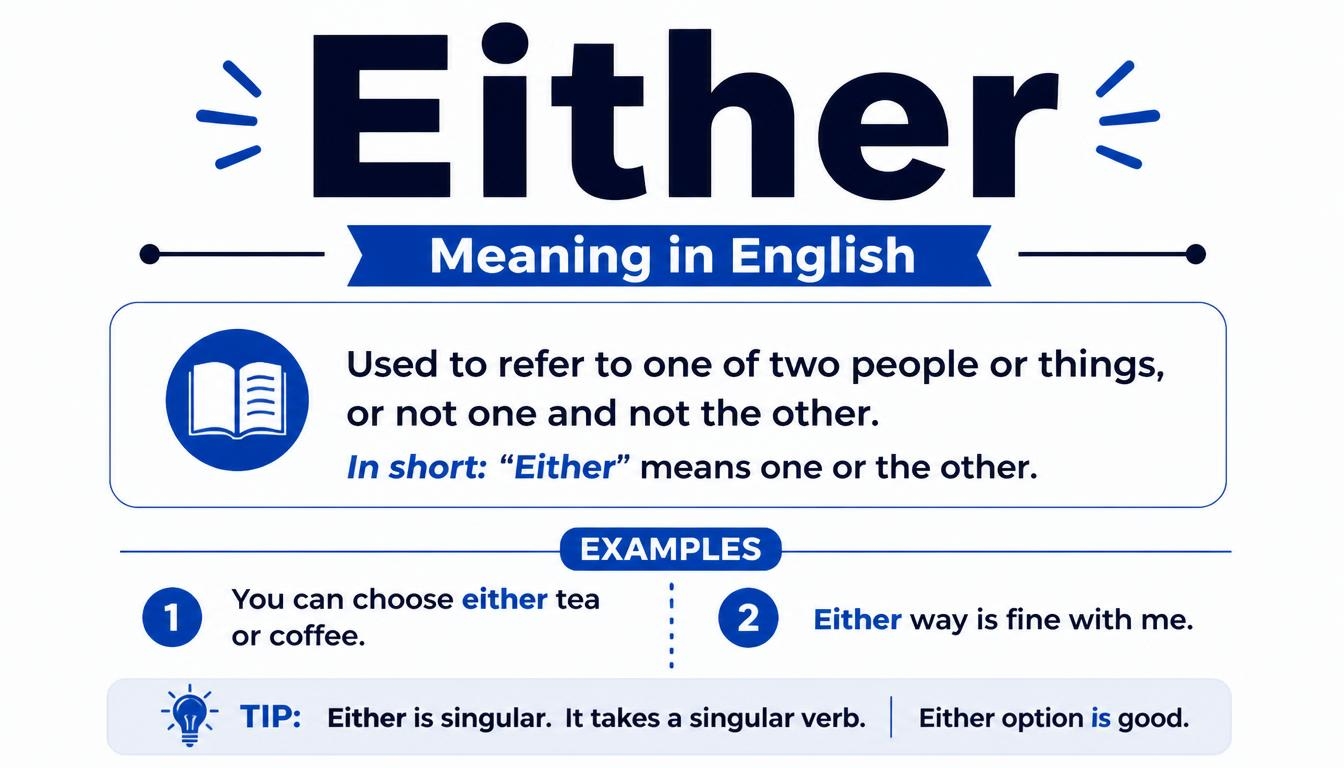
The word either generally refers to one of two people, objects, possibilities, or choices. It can also express agreement with a negative statement, meaning something similar to also or too in a negative context.
According to the general dictionary meaning used in references such as the Cambridge Dictionary, either is associated with two alternatives and can be used in several grammatical ways.
In simple language, either usually communicates one of these ideas:
- One or the other of two available choices.
- Any one of two possible options.
- Agreement with a negative statement.
- Both sides when referring to opposite sides of something.
- A connection between two alternatives through the expression either…or.
For example:
- You may sit in either chair.
- Either my brother or my sister will collect the parcel.
- I don’t watch television much either.
- There are shops on either side of the street.
Notice how the meaning changes according to the sentence. It isn’t always about choosing something, and that’s an important detail to remember.
Meaning of Either: Understanding Its Four Main Grammatical Functions
In English grammar, either can work as a determiner, pronoun, adverb, and conjunction. Each function has its own purpose, and recognizing the difference makes sentence construction much easier.
Let’s look at them individually.
Either as a Determiner
When either appears before a singular countable noun, it works as a determiner. It tells us that one of two people or things is being considered.
The interesting part is that the speaker doesn’t always need to identify which one. Both possibilities are available, and either one is acceptable.
For example:
- Either candidate can win the election.
- You can take either road to reach the village.
- Either restaurant would be suitable for dinner.
- Either answer could be correct.
- You may choose either dress for the party.
- Either student can participate in the competition.
- We can meet on either day.
- Either option will work perfectly well.
- You can use either phone to make the call.
Important grammar tip: When either works as a determiner before a singular countable noun, the noun is normally singular.
Correct: Either student is welcome.
Incorrect: Either students are welcome.
This rule is quite useful in formal writing, especially when discussing two alternatives without showing a preference for one.
Either as a Pronoun
Sometimes, either appears without a noun immediately after it. In this situation, it works as a pronoun.
It replaces the name of two previously mentioned things, people, or possibilities. Instead of repeating the same nouns, you can simply use either to keep the sentence natural.
Consider these examples:
- I have two jackets, and you can borrow either.
- There are two available seats. You may take either.
- Both answers look reasonable, so either is acceptable.
- I don’t mind which restaurant we visit; either is fine.
- We have two routes available, and either will take us there.
- You can choose between the red box and the blue one. Either is suitable.
- Both candidates are experienced, and either could do the job.
- I have two tickets, so either of them is yours.
A particularly common construction is either of.
Examples:
- Either of my friends can help you.
- Either of these books is worth reading.
- Either of the two roads leads to the station.
- Either of them would make a good team leader.
One small detail deserves attention here. In formal English, either of is generally followed by a plural noun or plural pronoun, but the verb is usually singular.
For example:
Either of the students is allowed to enter.
You may hear plural verbs in informal conversation, but singular agreement is the traditional standard.
Either as an Adverb
This is where things become a little different.
When either appears in a negative sentence, it can mean also or too. It is commonly placed at the end of a clause and shows that the same negative situation applies to another person or thing.
For example:
- I don’t like coffee, and my sister doesn’t either.
- He isn’t coming to the party, and I am not either.
- She hasn’t finished her homework, and her brother hasn’t either.
- I can’t drive, and my husband can’t either.
- They don’t eat meat, and we don’t either.
- The movie wasn’t interesting, and the book wasn’t either.
- I haven’t visited London, and my parents haven’t either.
- This restaurant isn’t expensive, and the other one isn’t either.
The meaning is quite close to using neither in certain constructions.
Compare:
I don’t like coffee either.
Neither do I.
Both sentences can communicate agreement with a negative statement, although their grammatical structures are different.
Remember that either in this sense is generally used with negative expressions such as don’t, doesn’t, didn’t, isn’t, haven’t, and can’t.
Either as a Conjunction
The word either can also function as part of a conjunction, especially in the well-known construction either…or.
This structure introduces two alternatives. It tells the reader or listener that one possibility or the other is available, expected, or required.
For example:
- Either we take the train or we travel by bus.
- You can either call me or send a message.
- Either my father or my mother will attend the meeting.
- We can either eat at home or visit a restaurant.
- Either finish the assignment today or submit it tomorrow.
- You can either wear the blue dress or the black one.
- Either the manager or the assistant will contact you.
- We will either watch a movie or listen to music.
The expression is useful in everyday conversations because it presents alternatives without making the sentence unnecessarily complicated.
Either…Or: Meaning and How to Use It Correctly
The expression either…or is one of the most important constructions to understand when learning the meaning of either.
It connects two alternatives and highlights a choice between them. Depending on the context, the alternatives can be nouns, verbs, phrases, or entire clauses.
Here are some practical examples:
- Either Sarah or Emma will organize the birthday party.
- You can either stay here or come with us.
- Either the train arrives on time or we take a taxi.
- He will either study medicine or engineering.
- Either you apologize or accept the consequences.
- We can either order pizza or prepare dinner ourselves.
- Either the weather improves or we’ll cancel the picnic.
- You should either save your money or spend it wisely.
Understanding Subject-Verb Agreement
One common question concerns the verb used with either…or.
When two subjects are connected through either…or, the verb generally agrees with the subject closest to it. This is often called the proximity rule.
For example:
- Either the teacher or the students are responsible.
- Either the students or the teacher is responsible.
- Either my brother or my parents are coming.
- Either my parents or my brother is coming.
The rule may sound slightly confusing at first, but with a little practice it becomes easier.
For more polished writing, you can sometimes rearrange a sentence to avoid awkward combinations of singular and plural subjects.
Can Either Mean Both?
Yes, and this is probably one of the most misunderstood aspects of the word.
Although either usually refers to one of two alternatives, it can sometimes mean both when used in expressions describing opposite sides or positions.
Consider this sentence:
There are trees on either side of the road.
Here, either side means both sides of the road. The sentence describes trees on the left and right sides, not just one side.
More examples include:
- There is a small garden on either side of the house.
- The hotel has windows on either side of the entrance.
- She placed a candle on either side of the cake.
- There were beautiful flowers on either side of the pathway.
- Two guards stood on either side of the door.
- The river has walking paths on either side.
- He looked at the buildings on either side of the street.
- There are benches on either side of the fountain.
This usage is especially common when talking about physical positions, locations, and opposite sides.
However, be careful not to assume that either always means both. Its meaning depends on the expression and context.
How to Use Either in Negative Sentences
Negative sentences are one of the most common places where English learners encounter either.
When you want to say that something is not true for you, just as it isn’t true for another person, either can be placed at the end of your sentence.
For example:
- I don’t understand this lesson either.
- She doesn’t enjoy horror movies either.
- We haven’t received the invitation either.
- They aren’t ready to leave either.
- I can’t remember his name either.
- My brother doesn’t play football either.
- This shop doesn’t accept cards either.
- I wasn’t invited to the meeting either.
Notice that either generally follows the negative verb phrase.
A common mistake is using either with an additional negative word in a way that creates an unintended double negative.
Incorrect: I don’t know nothing either.
Better: I don’t know anything either.
Or:
Neither do I.
The main idea is simple: when expressing negative agreement, either usually comes after the negative statement.
Either vs Neither: What’s the Difference?
Either and neither are closely related, but they don’t communicate exactly the same thing.
Either generally refers to one of two alternatives, whereas neither means not one and not the other.
In other words, either leaves the possibility of choosing one option open. Neither rejects both options.
Compare these sentences:
- You can choose either dress.
- You can choose neither dress.
The first sentence allows you to select one of the two dresses. The second says that you should select none of them.
Here are more examples to make the difference clearer:
| Either | Neither |
|---|---|
| Either answer is correct. | Neither answer is correct. |
| You can take either bus. | Neither bus goes there. |
| Either student can participate. | Neither student is available. |
| Either option is acceptable. | Neither option is suitable. |
| Either restaurant is good. | Neither restaurant is open. |
| Either of them can help. | Neither of them can help. |
Using Neither in Negative Agreement
Neither can also be used to agree with a negative statement.
For example:
Person A: I don’t like cold weather.
Person B: Neither do I.
Alternatively, Person B could say:
I don’t like cold weather either.
Both responses communicate a similar idea, but the sentence structures differ.
A useful reminder: neither already carries a negative meaning, so it normally doesn’t need another negative word in standard English.
Either vs Both: What’s the Difference?
This comparison is especially important because people sometimes confuse the two words.
Either generally means one of two possibilities, while both clearly refers to the two things together.
For example:
- You can choose either apple. (One of the two.)
- You can have both apples. (The two apples.)
Let’s explore some everyday examples:
| Either | Both |
|---|---|
| Either road leads to town. | Both roads lead to town. |
| Either student can answer. | Both students can answer. |
| Either dress looks beautiful. | Both dresses look beautiful. |
| Either option is available. | Both options are available. |
| Either restaurant is suitable. | Both restaurants are suitable. |
| Either book is interesting. | Both books are interesting. |
There is a subtle difference in how these sentences feel.
Either usually focuses on alternatives or individual possibilities. Both emphasizes the two items together.
And yes, the distinction matters when giving instructions, discussing choices, or describing a situation.
Either Way Meaning and In Either Case
You may have come across the expressions either way and in either case in everyday conversations, emails, and written communication.
Both expressions suggest that the outcome or situation remains the same regardless of which of two possibilities occurs.
Meaning of Either Way
Either way means that the result will remain the same regardless of the choice or situation.
Examples:
- We can take the train or the bus. Either way, we’ll arrive before sunset.
- You can call me or send an email. Either way, I’ll respond.
- Whether it rains or shines, either way, we’re going to the event.
- I might study tonight or tomorrow morning. Either way, I’ll finish the work.
- You can pay online or in cash. Either way, the price is the same.
- She may accept the offer or reject it. Either way, we’ll respect her decision.
- We can cook dinner or order food. Either way, everyone will be happy.
- You can wear formal clothes or casual clothes. Either way, you’ll look great.
Meaning of In Either Case
In either case has a similar meaning. It refers to two possible situations and indicates that the following statement applies to both.
Examples:
- You can arrive early or late. In either case, please inform the receptionist.
- We may win or lose. In either case, we’ll learn something.
- Whether you travel by car or train, in either case, remember your tickets.
- The meeting might be postponed or cancelled. In either case, everyone will be informed.
- You can submit the form online or in person. In either case, keep a copy.
- The package may arrive today or tomorrow. In either case, someone should be home.
- She might accept the position or decline it. In either case, we’ll support her.
- We may choose the first plan or the second. In either case, the deadline remains unchanged.
These expressions are particularly useful when discussing plans, explaining conditions, or reassuring someone that the result won’t depend on their choice.
Either Pronunciation: British and American English
Another interesting aspect of the word is its pronunciation. There are two commonly accepted ways to pronounce either, and both are used by native English speakers.
The first pronunciation begins with a long I sound, while the second begins with a long E sound.
British English:
- /ˈaɪ.ðə/
- /ˈiː.ðə/
American English:
- /ˈiː.ðɚ/
- /ˈaɪ.ðɚ/
In simple spelling, you might hear:
- EYE-thuh
- EE-thuh
Both pronunciations are correct. Neither is considered universally better or more grammatically correct than the other.
The pronunciation may depend on regional habits, personal preference, and the speaker’s accent.
For example, one person may say EYE-thuh in conversation, while another prefers EE-thuh. Both can communicate perfectly well.
The most useful advice is to choose the pronunciation that feels natural to you and remain consistent in your speech.
Examples of Either in Everyday English Sentences
Sometimes, the easiest way to understand a word is to see how it works in ordinary situations.
The following examples cover different contexts, including family conversations, restaurants, travel, work, shopping, and daily decisions.
Everyday Conversations
- You can call me either in the morning or evening.
- I don’t have much free time either.
- Either of my sisters can help you.
- We can meet at your house or mine. Either way is fine.
- I don’t think either answer is correct.
- You can choose either seat.
- Either we leave now or we’ll miss the train.
- I haven’t watched that movie either.
At a Restaurant
- You can order either pork or beef.
- Either table is available for dinner.
- I don’t like this sauce, and my friend doesn’t either.
- You can choose either tea or coffee.
- Either restaurant would be a good choice.
- We can either eat inside or sit outside.
- Neither of these dishes is vegetarian.
- Either meal comes with a complimentary drink.
At Work or School
- Either manager can approve the request.
- You can submit the assignment either today or tomorrow.
- I haven’t received the report either.
- Either candidate has the necessary experience.
- We can either postpone the meeting or continue without them.
- Neither student was absent yesterday.
- Either of these methods could improve the results.
- You can complete the project using either software program.
Travel and Transportation
- You can travel by either train or bus.
- Either route will take you to the airport.
- I don’t like flying, and my brother doesn’t either.
- You can sit on either side of the plane.
- Either ticket is valid for the journey.
- We can either rent a car or take a taxi.
- Neither train arrives before noon.
- Either way, we should reach the hotel before dark.
Common Grammar Mistakes When Using Either
Even experienced English speakers sometimes make mistakes with either, especially when using it in longer sentences.
Understanding these common errors can help you avoid awkward constructions and communicate more clearly.
Mistake: Using a plural noun after either as a determiner
Incorrect: Either students can join the competition.
Correct: Either student can join the competition.
When either directly determines a noun, that noun is generally singular.
Mistake: Confusing either with neither
Incorrect: Neither of the two options is acceptable when you actually mean one of them is acceptable.
Correct: Either of the two options is acceptable.
The meaning changes completely, so always consider what you intend to communicate.
Mistake: Using either and both interchangeably
Incorrect: Either students are invited, when you mean the two students together.
Correct: Both students are invited.
Either normally presents alternatives, while both includes the two items.
Mistake: Forgetting or in an either…or construction
Incorrect: You can either take the bus the train.
Correct: You can either take the bus or the train.
The paired expression needs its second part to connect the alternatives.
Mistake: Placing either incorrectly in a negative sentence
Incorrect: I either don’t like coffee.
Correct: I don’t like coffee either.
When either means also in a negative statement, it normally appears at the end of the clause.
Mistake: Using two negatives unnecessarily
Incorrect: I don’t want neither option.
Correct: I don’t want either option.
Alternatively:
I want neither option.
These corrections may look small, but they make a noticeable difference in written English.
Read ARticul: https://ytmeaning.com/anther-meaning/
Is Either an Adjective, Determiner, Pronoun, or Conjunction?
A question that often comes up in English grammar discussions is whether either should be classified as an adjective or a determiner.
In traditional grammar explanations, either is sometimes described as an adjective when it appears before a noun. However, modern grammatical descriptions generally classify this use as a determiner.
Here is a quick overview:
| Grammatical function | Example | Purpose |
|---|---|---|
| Determiner | Either answer is correct. | Identifies one of two options |
| Pronoun | Either is acceptable. | Replaces a noun |
| Adverb | I don’t agree either. | Expresses negative agreement |
| Conjunction | Either stay or leave. | Connects alternatives |
The distinction between an adjective and a determiner is worth understanding because English grammar classifications have evolved over time.
If you’re studying modern English grammar, determiner is generally the more appropriate label when either comes before a noun.
Does Either Mean Also or Too?
Yes, but only in a particular grammatical context.
When either is used in a negative sentence, it can communicate the same general idea as also or too.
Compare these examples:
- I like chocolate too.
- I don’t like chocolate either.
Notice that too is commonly used with affirmative statements, whereas either is commonly used with negative statements.
Here are a few more comparisons:
- She is coming too.
- She isn’t coming either.
- I have visited Paris too.
- I haven’t visited Paris either.
- He can swim too.
- He can’t swim either.
This distinction is quite helpful in everyday English because it allows you to agree naturally with another person’s positive or negative statement.
Translations of Either in Different Languages
The meaning of either can vary depending on the sentence, so there isn’t always one perfect translation for every situation.
Still, looking at other languages can help learners understand the central idea.
| Language | Possible translation or equivalent |
|---|---|
| Chinese (Traditional) | 也、任何一個、要麼……要麼 |
| Chinese (Simplified) | 也、任何一个、要么……要么 |
| Spanish | cualquiera de los dos, tampoco |
| Portuguese | qualquer um dos dois, também não |
These are contextual equivalents rather than fixed translations.
For example, Spanish may use cualquiera de los dos when discussing a choice between two options and tampoco when expressing negative agreement.
Similarly, Portuguese uses different expressions depending on whether the sentence refers to a choice or a negative statement.
The best translation always depends on the sentence, not just the individual word.
How to Remember the Meaning of Either Easily
If you’re still finding it difficult to remember all the grammatical uses, don’t worry. You don’t need to memorize every definition at once.
Instead, connect either with a few simple ideas.
- Either = One of two: Either dress is suitable.
- Either…or = Two alternatives: Either stay or leave.
- Either in a negative sentence = Also or too: I don’t know either.
- Either side = Both sides: There are shops on either side.
- Either of = One of two: Either of them can help.
A good way to practise is to create your own examples using situations you experience every day.
For instance, imagine choosing between a train and a bus. You might say, “I can take either the train or the bus.”
If your friend says they don’t enjoy travelling by bus, you can respond, “I don’t enjoy it either.”
Small exercises like these make grammar feel more connected to real communication, which is much more useful than simply memorizing definitions.
Final Thoughts on Either Meaning in English
The word either may be short, but its role in English is surprisingly flexible. It can introduce two alternatives, replace a noun, express agreement with a negative statement, or describe opposite sides of something.
Once you understand its different grammatical functions, using it becomes much more natural.
Remember these essential points:
- Either generally refers to one of two possibilities.
- It works as a determiner before a singular countable noun.
- It can function as a pronoun when replacing a noun.
- As an adverb, it commonly appears in negative sentences.
- Either…or connects two alternatives.
- Either side can mean both sides in the appropriate context.
- Both and neither have different meanings and shouldn’t be confused with either.
Most importantly, don’t feel that you need to master every rule in one sitting. Read examples, notice how native speakers use the word, and try including it in your own conversations.
English becomes easier when grammar stops feeling like a collection of complicated rules and starts making sense in everyday situations.
And that’s really the beauty of understanding a small word like either: it gives you more ways to express choices, share opinions, explain possibilities, and communicate your thoughts with confidence. Keep practising, stay curious, and remember that even a little improvement in your language skills can make a big difference.