

There are some words that seem to carry a little workshop dust on them. Dovetail is one of those words. You can almost picture a carpenter leaning over a piece of wood, carefully cutting shapes that will lock together so neatly that the joint seems to have been waiting for its other half all along.
But dovetail meaning goes far beyond woodworking.
Today, we use dovetail to describe ideas, plans, personalities, events, and even entire projects that fit together naturally. When two things dovetail, they don’t merely sit beside each other. They connect in a way that makes sense. They align, correspond, complement each other, or fit together into a whole.
That is what makes this little word so useful. It has one foot in the carpenter’s workshop and the other in everyday conversation.
If you’ve ever heard someone say, “Those plans dovetail perfectly,” and wondered what they actually meant, you’re in the right place. Let’s take apart the word, piece by piece, and see how its physical and figurative meanings connect.
What Is the Dovetail Meaning?
The simplest dovetail definition is this: to fit or join together closely and effectively.
As a dovetail noun, the word refers to a particular kind of joint used in woodworking. As a dovetail verb, it means to join things together or to make things fit together successfully.
The word comes from the shape of a dove’s tail. A traditional dovetail joint uses wedge-shaped pieces that resemble the spread or flaring shape associated with a bird’s tail.
In figurative language, the image becomes rather lovely. Two separate things come together, lock into place, and create something stronger or more complete.
For example:
- “Her teaching experience dovetails with her interest in child development.”
- “The new schedule dovetails nicely with our existing plans.”
- “Their skills dovetail perfectly.”
- “The research findings dovetail with earlier studies.”
In each case, dovetail suggests compatibility rather than simple contact. The pieces don’t just meet; they make sense together.
Dovetail Meaning as a Noun
When used as a dovetail noun, the term most often refers to a woodworking feature or joint.
Imagine two pieces of wood. Instead of simply placing one against the other and hoping glue will do all the heavy lifting, a craftsperson cuts one piece into a series of wedge-shaped projections. The other piece receives matching slots.
These parts are called the dovetail tenon and dovetail mortise, depending on the construction and terminology being used.
The result is an interlocking joint.
The shape itself helps prevent the pieces from pulling apart in certain directions. This is one reason dovetails have been prized in traditional furniture making, especially for drawers and cabinets.
A physical dovetail joint might therefore be described as:
- An interlocking woodworking joint
- A tightly fitting connection between pieces of wood
- A joint formed using wedge-shaped parts
- A traditional woodworking joint
- A form of joinery used in furniture and carpentry
The noun has a wonderfully literal origin: the joint looks somewhat like a dove’s tail.
Dovetail Meaning as a Verb

The dovetail verb is where the word becomes especially interesting for everyday communication.
To dovetail means to make things fit together smoothly, either physically or conceptually.
You might say:
- “The two projects dovetail nicely.”
- “Her experience dovetails with the requirements of the position.”
- “The children’s activities dovetail with the school’s educational goals.”
- “These ideas dovetail into a larger argument.”
Here, the meaning is close to fit together, align, coordinate, integrate, or harmonize.
Notice something important: dovetail often describes a relationship between two things that were separate before.
The plans existed separately. The skills existed separately. The ideas existed separately. Then someone notices that they fit.
That little moment of discovery is part of the charm of the word.
Dovetail Meaning in a Sentence
One of the easiest ways to understand a word is to see it behaving naturally inside a sentence.
Here are several dovetail examples:
- “Her background in marketing dovetails with the company’s expansion plans.”
- “The weekend trip dovetails perfectly with our anniversary celebration.”
- “His research dovetails with what scientists have already discovered.”
- “The two departments need to dovetail their efforts.”
- “The new policy dovetails with the organization’s long-term goals.”
- “Their personalities dovetail surprisingly well.”
- “The evidence dovetails with the witness’s account.”
- “The renovation schedule dovetails with the building’s maintenance plan.”
- “My interests dovetail with the kind of work I want to pursue.”
The most common construction is dovetail with something.
So if you see “A dovetails with B,” you can usually understand it as:
A fits, corresponds, aligns, or works appropriately with B.
That pattern is worth remembering because it appears frequently in professional and academic writing.
Dovetail Synonym: Words With Similar Meanings
Looking for a dovetail synonym? The best choice depends on the context.
When talking about plans or ideas, you might use:
- align
- correspond
- coincide
- coordinate
- complement
- harmonize
- integrate
- match
- mesh
- fit together
- work together
- conform
But these words aren’t perfectly interchangeable.
“Align” emphasizes agreement or direction. “Complement” suggests that two things improve or complete each other. “Coincide” often means that things happen together or agree. “Integrate” focuses on combining separate parts.
Dovetail has its own special flavor: separate things fit together neatly, almost as though their shapes were designed to meet.
That’s why saying “Our plans dovetail” can sound more vivid than simply saying “Our plans agree.”
Dovetail and the World of Woodworking
The physical dovetail joint woodworking tradition is where the word began, and it remains one of the most recognizable forms of traditional joinery.
A basic dovetail involves two complementary shapes. One side contains projections that flare outward, while the other contains matching recesses. When the pieces slide together, the shapes interlock.
Think of a puzzle designed by someone who was exceptionally confident about their measurements.
That is the basic idea.
Traditional dovetail woodworking requires precision because the joint depends on accurate cutting. If the spaces are too loose, the connection can be weak. If they are too tight, the pieces may not fit together properly.
A well-made joint can be both practical and beautiful.
This is especially noticeable in handmade wooden drawers. Open an old-fashioned cabinet and you may see the characteristic fan-shaped ends of dovetail joints. They are not simply decorative marks; they’re evidence of a particular construction technique.
Dovetail Joint Meaning and Anatomy
The dovetail joint meaning becomes clearer when we understand its basic anatomy.
A traditional joint contains two complementary components:
- A projecting tenon, often shaped like a flared wedge
- A corresponding mortise, or recessed slot
- Matching surfaces that interlock
- Pieces of wood designed to fit tightly together
Unlike a simple butt joint, where two flat surfaces meet, a dovetail creates a mechanical connection.
The wedge-like shape is the clever part.
As the joint is pulled in a direction that would separate ordinary pieces, the flared dovetail can resist that movement. In good furniture, this makes the joint both functional and visually distinctive.
Modern woodworking may use hand tools, routers, dovetail jigs, or other equipment to create these joints, but the underlying principle remains the same: cut, fit, interlock, and form a whole.
And that physical idea eventually gave English speakers a useful metaphor for relationships between abstract things.
Why Do We Say Things “Dovetail”?
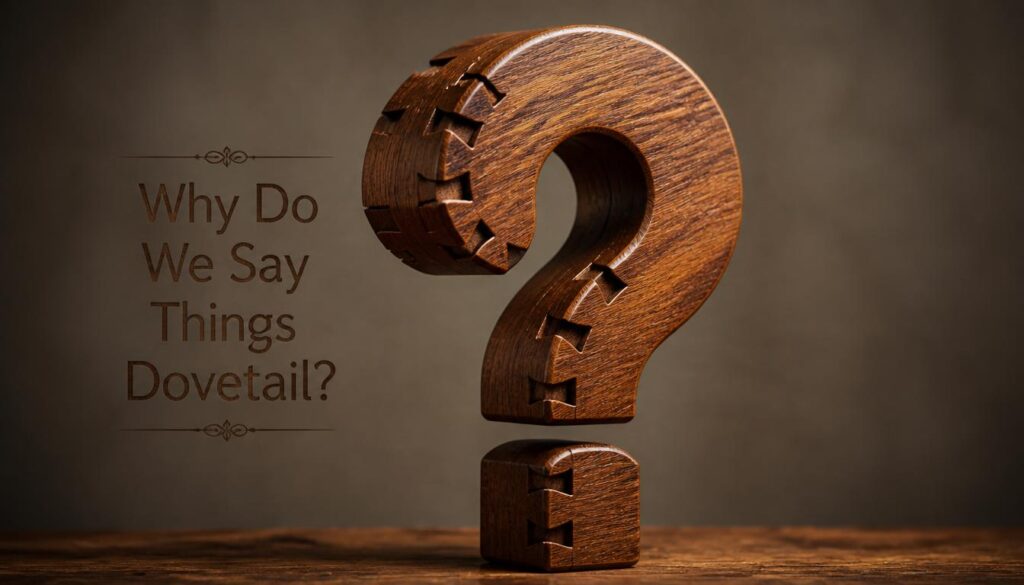
This is where language gets wonderfully visual.
Suppose you have two pieces of a wooden puzzle. One has a shape that appears to belong with the other. They slide together, and suddenly you have one stable object.
Now replace the pieces of wood with ideas.
One idea supports another. One plan fits another. One person’s skills fill a gap in someone else’s abilities.
The same basic relationship is still happening.
That is why we can say:
“Her experience dovetails with the position.”
We’re not talking about wood. We’re saying her experience fits the position unusually well.
This figurative use transforms a physical interlocking joint into a metaphor for compatibility.
It is a small linguistic leap, but a very useful one.
Dovetailed Meaning: What Does “Dovetailed” Mean?
The word dovetailed is the past tense and past participle of dovetail.
If something is dovetailed, it means that it has been fitted, combined, or coordinated with something else.
For example:
- “The two programs were dovetailed to avoid unnecessary duplication.”
- “Her responsibilities were dovetailed with the team’s broader objectives.”
- “The new lessons were dovetailed into the existing curriculum.”
- “Their schedules were carefully dovetailed.”
The word can suggest that someone deliberately arranged things to fit.
That distinction can matter.
If two events simply happen at the same time, they don’t necessarily dovetail. But if their timing or purpose fits together usefully, dovetail becomes a strong choice.
Dovetailing Meaning in Everyday Language
The dovetailing meaning is similar to “coming together in a compatible way.”
You might hear someone say:
“Our schedules are dovetailing nicely.”
They mean that the schedules are working together without causing much trouble.
A project manager might say:
“The design and engineering teams need to dovetail their work.”
Here, the idea is coordination.
A writer might say:
“These two themes dovetail throughout the novel.”
Now the word refers to ideas or themes that connect naturally.
Even in ordinary family life, the concept works.
Perhaps one parent finishes work just as the other arrives home. One handles dinner while the other helps the children with homework. Their responsibilities don’t duplicate each other; they complement each other.
Their routines dovetail.
Sometimes the most useful words are hiding in plain sight like that.
Dovetail Meaning in Professional and Academic Writing
You will often encounter dovetail in business, research, education, journalism, and formal discussion.
It can make a sentence more precise without sounding overly technical.
For example:
“The company’s sustainability goals dovetail with its new investment strategy.”
This means the two sets of goals support or fit with one another.
In academic writing:
“The findings dovetail with previous research.”
That tells readers that the new findings correspond with earlier evidence or conclusions.
In workplace communication:
“The proposed timeline dovetails with the client’s availability.”
Again, the elements fit together.
Because the word carries the idea of a precise connection, it can be especially useful when “agree” feels too vague.
Dovetail Meaning in Relationships and Personal Life

Although dovetail sounds like a word that belongs near sawdust and measuring tapes, it can describe people beautifully.
Two friends might have different personalities but complementary strengths. One is spontaneous; the other is organized. One loves planning trips; the other discovers hidden cafés along the way.
Their personalities dovetail.
The word doesn’t necessarily mean that people are identical. In fact, the opposite can sometimes be true.
Two things can fit precisely because they are different in useful ways.
That’s a valuable distinction.
Compatibility isn’t always about finding someone who mirrors you. Sometimes it is about finding someone whose shape fits beside yours.
Dovetail in a Sentence: More Creative Examples
Here are some less formal examples to help you hear how naturally the word can work:
- “Her love of stories dovetails with her career in publishing.”
- “Our holiday plans dovetailed almost by accident.”
- “The children’s curiosity and the museum’s hands-on exhibits dovetail beautifully.”
- “His sense of humor dovetails with hers, which is probably why they’re always laughing.”
- “The new idea dovetails with something we’d discussed last year.”
- “Their talents dovetail in a way that makes the whole project stronger.”
- “The old tradition and the new celebration dovetail surprisingly well.”
- “My weekend plans don’t exactly dovetail with the weather forecast.”
- “Their goals dovetail, even though their methods are completely different.”
That last example is particularly useful because dovetail doesn’t require identical methods. It is about the overall fit.
Common Mistakes When Using Dovetail
Because dovetail can sound slightly formal, people sometimes use it in places where another word would be clearer.
One common mistake is assuming that it simply means “happen.”
It doesn’t.
If two events happen at the same time, they don’t automatically dovetail. There should usually be some sense of compatibility, coordination, or useful connection.
Another issue is overusing it. Saying that every idea, person, event, and sandwich “dovetails perfectly” can make the word lose its impact.
Save it for situations where the relationship between things really is the point.
And remember the common structure:
A dovetails with B.
For example:
“The schedule dovetails with our plans.”
Not:
“The schedule dovetails to our plans.”
That small preposition matters.
Read more: https://ytmeaning.com/aloof-meaning/
How to Pronounce Dovetail
The dovetail pronunciation is generally:
DUHV-tail
It is commonly represented phonetically as /ˈdʌv.teɪl/.
The first part sounds like “dove” in the sense of the bird, although the vowel is typically pronounced like the “u” sound in “love.” The second part is simply “tail.”
So:
dovetail = DUHV-tail
The plural is dovetails, while the forms dovetailed and dovetailing follow normal English pronunciation patterns.
Once you’ve heard it aloud a couple of times, it is pretty hard to forget.
The Difference Between Dovetail and Complement
These words overlap, but they aren’t twins.
If two things complement each other, each adds something useful to the other.
If two things dovetail, they fit together in a coordinated or compatible way.
Consider two musicians.
Their styles might complement each other because one plays softly while the other adds energy. Their schedules, meanwhile, might dovetail because they rehearse at times that work for both.
So complement often emphasizes what each thing contributes, while dovetail emphasizes how the pieces fit together.
Both are useful. They simply shine under slightly different lighting.
The Difference Between Dovetail and Align
Align is another close synonym.
When plans align, they are consistent or point in the same direction.
When plans dovetail, there is often a stronger sense that their details fit together.
For example:
“Our goals align.”
This means our goals are compatible.
“Our schedules dovetail.”
This suggests the actual arrangements fit together conveniently.
You can think of align as pointing in the same direction and dovetail as fitting into the same structure.
Not a perfect rule, but a useful mental shortcut.
A Simple Way to Remember Dovetail
If you keep forgetting what dovetail means, remember the image of two pieces of wood.
One has a strange little wedge.
The other has a matching space.
They slide together.
That’s dovetail.
Now move that picture into an abstract situation:
- Plans can dovetail.
- Ideas can dovetail.
- Skills can dovetail.
- Schedules can dovetail.
- Goals can dovetail.
- Evidence can dovetail.
- Personalities can dovetail.
Whenever separate things fit together, interlock, correspond, or form a whole, dovetail may be exactly the word you’re looking for.
Dovetail: A Word That Connects Two Worlds

Perhaps the nicest thing about this word is that its literal and figurative meanings aren’t really separate at all.
The carpenter’s dovetail joint gives us the metaphor.
The physical joint works because its parts have been shaped to fit one another. The figurative verb works for the same reason: two ideas, plans, people, or circumstances have a shape that allows them to work together.
Language does this all the time. We borrow something concrete and use it to explain something invisible.
We “grasp” an idea. We “build” an argument. We “bridge” a gap. We “connect” thoughts.
And we dovetail things.
It’s a word about fit.
Not boring, accidental fit, either. The kind of fit where separate pieces suddenly make more sense together than they did apart.
How to Write Your Own Dovetail Example
If you’re trying to use the word correctly, start with two things that have a meaningful connection.
Then ask yourself:
Do these things fit together, support one another, or correspond naturally?
If yes, try dovetail.
For example, imagine you are writing about education and technology.
You could write:
“Interactive learning tools dovetail with the needs of students who benefit from visual instruction.”
Or perhaps you’re writing about career planning:
“Her communication skills dovetail with the leadership responsibilities of the role.”
For something more personal:
“His calm personality dovetails with her energetic nature.”
The trick is not to force the word into the sentence. Let the relationship between the two things do the work.
Frequently Asked qeustions
dovetail
Dovetail means to fit or join things together so that they work well as a whole. It can also refer to a strong interlocking joint used in woodworking.
dovetail meaning
The meaning of dovetail is to fit, match, or work together perfectly. As a noun, it refers to an interlocking joint commonly used to connect pieces of wood.
dovetail definition
Dovetail is a noun and verb. As a noun, it is an interlocking joint made with wedge-shaped parts; as a verb, it means to join or fit things together skillfully.
dovetail def
Dovetail means to join or fit things together to form a complete whole. It is also the name of a wedge-shaped woodworking joint.
what is dovetail
Dovetail is a type of interlocking joint used in woodworking, and it also means to fit or work together well. For example, two plans can dovetail when they complement each other.
Final Thoughts on Dovetail Meaning
The dovetail meaning is wonderfully simple once you see the picture behind it.
As a noun, a dovetail is associated with a distinctive dovetail joint, a strong interlocking joint used in woodworking and joinery. As a verb, dovetail means to fit together, join, align, correspond, or work together in a way that creates a coherent result.
Its journey from carpentry to everyday language is actually quite beautiful. A physical joint became a metaphor for the way human plans and ideas connect.
So when someone says, “Our plans dovetail,” they’re saying more than “our plans are similar.”
They’re saying the pieces fit.
And perhaps that’s why the word has survived for so long. We are always trying to make things fit: schedules with responsibilities, dreams with opportunities, ideas with evidence, people with people. Sometimes the pieces resist. Sometimes they need a little reshaping.
And then, every now and again, they slide into place with that satisfying little click.
That’s when things dovetail.
If you have a favorite example of the word dovetail in conversation, writing, or everyday life, share it. The best way to truly learn a word is not just to memorize its definition, but to notice where it quietly fits into the world around you.