
There are some words that look like they belong in a dusty accounting book, wearing a serious little tie and refusing to explain themselves. Prorated can feel like one of those words. But its idea is actually quite simple: you pay, receive, or are charged only for the portion of something you actually used or were entitled to.
If a subscription starts halfway through the month, your first bill may be smaller. If an employee works only part of a pay period, their paycheck may be adjusted. If a tenant moves into an apartment on the 15th, the landlord may calculate prorated rent instead of charging a full month’s rent. That is proration quietly doing its job.
Understanding the prorated meaning is useful because this little calculation appears everywhere: rent, salaries, software subscriptions, utilities, insurance, memberships, contractor work, and ordinary business billing. It is essentially a way of making an amount proportional rather than pretending every period is always complete.
What Does Prorated Mean?
So, what does prorated mean in plain English? It means an amount has been divided according to a particular share, usually based on time, usage, or another measurable portion.
Imagine a service costs $100 for a full month, but you only use it for half of that month. Instead of paying the entire $100, you might pay approximately $50, depending on the company’s rules and the exact number of days involved.
The word comes from the idea of pro rata, a phrase meaning “in proportion.” Therefore, prorate meaning is closely connected to dividing something fairly according to the relevant portion.
In everyday language, a prorated amount is simply an adjusted amount. You’re not necessarily getting a discount; you’re paying for the part that applies to you.
Prorated Meaning in Payment and Billing
When someone asks, “What does prorated mean in payment?” they’re usually talking about a prorated payment or prorated charge on an invoice, bill, paycheck, or account.
Suppose your internet service costs $60 per month and you activate it halfway through a 30-day billing cycle. The provider might charge you for approximately 15 days rather than charging the entire monthly price.
That is prorated billing. The provider takes the full price, determines the relevant daily or usage rate, and applies it to your partial billing period.
The basic idea is wonderfully unglamorous: don’t charge for something that wasn’t provided. A small principle, perhaps, but a useful one.
What Is the Difference Between Prorated and Full Payment?
A full payment covers an entire agreed period. A prorated payment covers only part of that period.
For example, a $1,200 annual service might normally be paid for twelve months. If an arrangement begins after the year has already started, the first amount could be adjusted to cover only the remaining period.
The same logic works backward. If a customer has already paid for time they will no longer use, a company might issue a prorated credit. This is one reason proration can feel fair from both sides.
The important thing is the underlying measurement: time period, usage, units, hours, or another agreed basis.
How to Calculate a Prorated Amount
The exact method depends on the contract or billing system, but a common prorated calculation follows this basic structure:
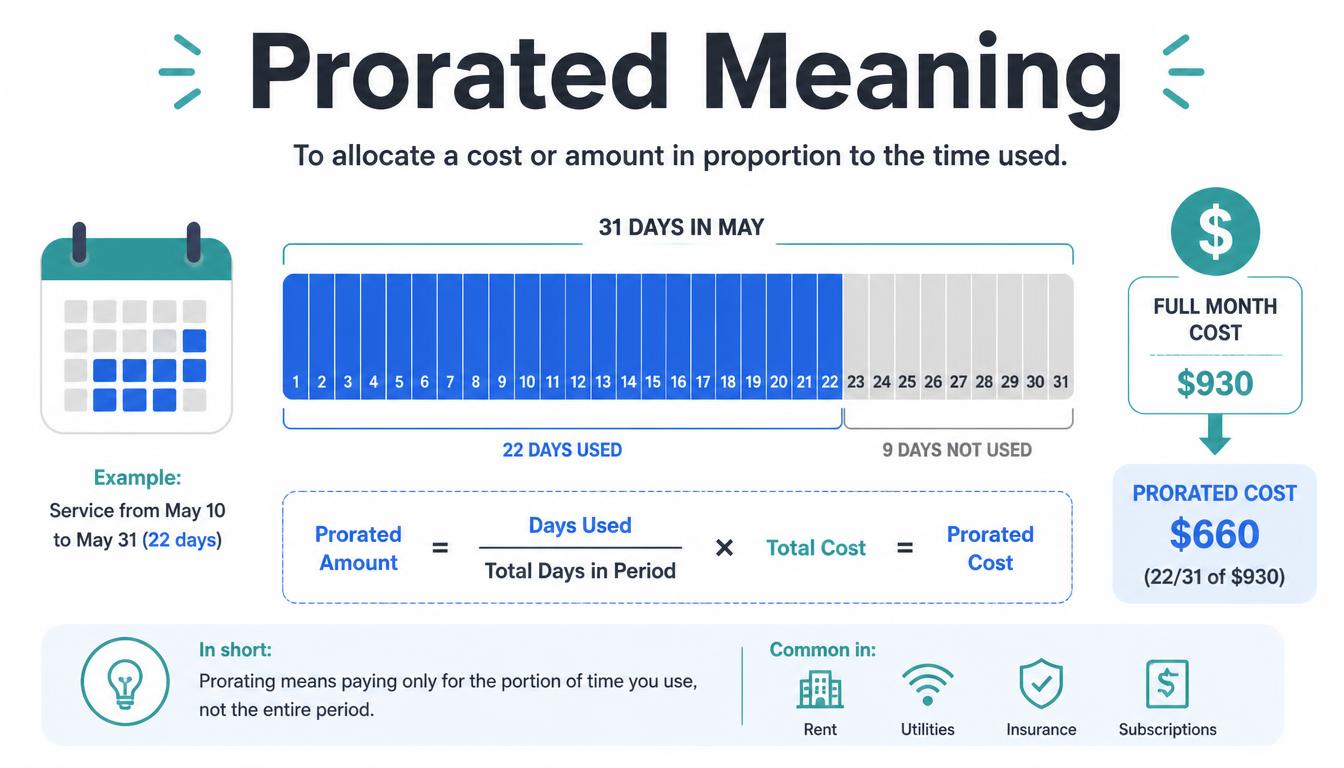
(Total cost ÷ Total periods) × Periods used = Prorated amount
For a simple daily calculation, imagine a monthly service costs $300 and the billing period contains 30 days. If you use it for 10 days:
$300 ÷ 30 × 10 = $100
So the prorated amount would be $100 under that method.
Real-world invoices can be fussier. Some companies use calendar days, some use fixed billing periods, and others may use hours or units. A company’s terms should always be checked before assuming which proration formula applies.
Prorated Calculation by Days
One of the most common approaches is to prorate by days.
The calculation generally begins with a daily rate. You divide the full charge by the number of days in the applicable period and then multiply it by the number of days used.
For example, if rent is $1,500 for a 30-day month and a tenant occupies the property for 12 days:
$1,500 ÷ 30 × 12 = $600
The tenant would owe $600 under that particular daily method.
But here’s the slightly annoying part: months don’t all have the same number of days. February refuses to cooperate, as usual. A lease or provider policy may therefore specify exactly how the prorated rent calculation should be handled.
Prorating by Hours, Units, or Usage
Not everything is measured by days.
A contractor might be paid according to hours worked. A utility provider may calculate costs based on usage. A shared office may allocate expenses according to square footage.
For example, if a contractor’s agreed rate is $40 per hour and they work 17 hours, the proportional payment is:
17 × $40 = $680
This is still the same underlying concept. The amount is connected to the portion actually delivered.
In other words, proration isn’t married to calendars. It can follow whatever measurable basis makes sense for the arrangement.
Prorated Rent: A Common Everyday Example
Prorated rent is perhaps one of the easiest ways to understand the concept.
Imagine someone signs a lease beginning on the 20th of a month. Charging the entire month’s rent may not make sense when the tenant wasn’t occupying the property during the first nineteen days.
A landlord may calculate rent proration using the monthly rent, the applicable daily rate, and the number of days occupied.
This can happen during move-ins, move-outs, lease changes, or other situations where a tenant’s occupancy doesn’t cover the complete rental period.
The lease matters, though. A tenant should check whether the agreement specifies calendar-day calculations, a fixed 30-day method, or another approach.
Prorated Salary and Paychecks
The workplace has its own version of this idea.
A prorated salary generally applies when an employee doesn’t work the complete period covered by a salary calculation. This might happen when a new hire starts halfway through a month or when an employee leaves before the end of a period.
For example, suppose an employee’s monthly salary is $3,000 and the company’s agreed calculation uses 30 days. If the employee is paid for 15 applicable days:
$3,000 ÷ 30 × 15 = $1,500
That would be a simple salary proration example.
Actual payroll can be more complicated because employers may use working days, calendar days, contractual rules, holidays, or other payroll policies. So a prorated paycheck isn’t automatically calculated the same way everywhere.
Prorated Payments for Contractors
Contractor arrangements often make proration particularly useful because payment may depend on work actually completed.
A 1099 contractor, freelancer, consultant, or service provider might have an hourly rate, daily rate, project percentage, or monthly retainer.
Suppose a contractor normally receives $2,000 for a full month of agreed services but provides only half of the contracted service period. The parties may agree on a partial payment based on the portion completed.
The contract should establish the measurement method before the invoice arrives. Otherwise, a seemingly tiny calculation can suddenly become a surprisingly large argument.
Prorated Subscriptions and Software
You’ve probably encountered subscription proration without realizing it.
Imagine you have a software subscription costing $20 per month. Midway through your billing cycle, you upgrade to a $50 plan.
Depending on the provider, you might receive a prorated charge for the higher-priced plan for the remaining portion of the cycle. If you downgrade, the provider might instead issue a prorated credit.
This can also happen with memberships, cloud software, maintenance contracts, and other recurring services.
The exact treatment depends on the provider’s billing system. Some companies calculate everything automatically; others have particular rules for upgrades, downgrades, cancellation, or renewal.
What Happens When You Cancel a Subscription Mid-Cycle?
A mid-cycle cancellation doesn’t always mean you’ll automatically receive money back.
Some companies provide a prorated refund or credit, while others allow continued access until the end of the paid period without returning the unused portion.
This distinction matters because “prorated” describes the calculation, not necessarily the company’s refund policy.
So if you’re wondering, “Will I get a prorated amount after cancellation?” the answer depends on the terms of the particular subscription.
Prorated Utility Bills
Utility expenses can also involve proportional calculations.
Imagine electricity, internet, cleaning, water, or another service begins or ends in the middle of a billing period. A provider may calculate a prorated utility bill based on the applicable service dates or actual usage.
Shared spaces create another interesting situation. A business occupying part of a building might share certain costs according to usage, occupancy, or square footage.
The goal is usually to establish a reasonable fair share of costs, although the exact allocation method should be agreed upon.
Why Businesses Use Prorated Billing
For businesses, proration isn’t just a mathematical trick. It can improve billing accuracy and make invoices easier to understand.
A customer who receives a clear invoice showing a partial-period charge can usually see why the amount is different from the normal recurring price.
That transparency can strengthen customer trust. It can also reduce unnecessary billing disputes, because the invoice explains what period or quantity generated the charge.
For the business, accurate proration also supports cash flow management, financial records, and more predictable payment collection.
Proration in Accounting and Financial Records
From an accounting perspective, partial charges and payments need to be recorded consistently.
Businesses may encounter prorated amounts across accounts payable, accounts receivable, payroll, recurring invoices, contracts, subscriptions, and operating expenses.
A business might use accounting software, a spreadsheet, or dedicated billing software to calculate these amounts.
Tools such as QuickBooks and Xero, along with specialized payment and invoicing platforms, can automate many billing tasks. But automation doesn’t remove the need to understand the underlying calculation. A computer can calculate the wrong rule very efficiently, which is a slightly expensive form of confidence.
Prorated Billing and Cash Flow
A business’s cash flow forecasting can be affected by partial-period payments.
Suppose several customers begin subscriptions at different points during the month. Their first invoices may contain different amounts rather than identical recurring charges.
Understanding these prorated charges helps a company anticipate incoming payments and understand why revenue may look uneven from one billing cycle to another.
Good financial management isn’t only about knowing how much money is coming in. It’s also about understanding why the numbers look the way they do.
Why Clear Proration Matters to Customers
Nobody enjoys opening an invoice and discovering a mysterious number sitting there like it has been invited to dinner without explanation.
A clear prorated invoice should ideally show the relevant service period, rate, quantity or days used, and resulting amount when appropriate.
For example, a line item might explain that a customer received 12 days of service at a particular daily rate.
That kind of invoice transparency makes a payment easier to verify. It also supports customer satisfaction because people generally tolerate charges better when they can understand them.
Common Situations Where Something Is Prorated
The concept appears in more places than many people expect.
- Prorated rent when a tenant moves in or out during a month
- Prorated salary when an employee works part of a pay period
- Prorated subscription fees after a mid-cycle plan change
- Prorated insurance when coverage begins or ends during a term
- Prorated utility bills when service covers only part of a billing period
- Prorated contractor payments based on hours or days worked
- Prorated membership fees when joining partway through a membership period
- Prorated maintenance charges for partial service periods
- Prorated office expenses shared between occupants
- Prorated recurring services when activation or cancellation occurs mid-cycle
The details differ, but the central idea stays wonderfully stubborn: calculate the amount according to the applicable portion.
Is Prorated the Same as Pro Rata?
Generally, pro rata meaning is “in proportion,” and prorated describes something that has been divided or adjusted proportionally.
The terms are closely related and are often used in similar contexts.
For example, a pro rata payment and a prorated payment may describe essentially the same proportional allocation, depending on the context.
Still, specific businesses, contracts, accounting systems, and legal documents can use the terms differently. When money is involved, the actual agreement matters more than the vocabulary alone.
What Is Another Word for Prorated?
Depending on the situation, related expressions include:
- proportional
- allocated
- apportioned
- adjusted
- partial
- divided proportionately
- distributed proportionately
- calculated according to usage
- calculated according to time
- in proportion
However, these aren’t perfect replacements in every sentence. Prorated has a particular financial and billing meaning that “partial” alone doesn’t always capture.
A partial payment, for instance, simply means less than the full amount was paid. A prorated payment explains why that amount corresponds to a particular share.
How to Make a Prorated Calculation More Accurate
Start by identifying the full amount and the exact period it covers. Then determine what portion actually applies.
Next, establish the calculation basis: days, hours, units, usage, workdays, or another agreed measurement.
Finally, check the rounding rule. A calculation might produce several decimal places, while an invoice may require the final prorated amount to be rounded to the nearest cent.
For business use, keep the calculation visible in your records. That makes future questions much easier to answer, especially when several people are involved in billing or accounting.
Common Mistakes With Prorated Amounts
One frequent mistake is assuming every company uses the same formula.
They don’t.
Another is confusing calendar days with workdays. A salary calculation, for example, may follow a payroll policy rather than simply dividing a monthly salary by the number of calendar days.
People also sometimes forget the start date and end date, or they calculate the amount from the wrong billing cycle.
For subscriptions and leases, the written terms should always take priority over a generic online calculator.
Frequently Asked Questions About Prorated Meaning
What does prorated mean?
Prorated means an amount is calculated according to a proportional share of a full amount, often based on time, usage, or quantity.
What does prorated mean in payment?
It means the payment is adjusted so it covers only the applicable portion of a service, work period, subscription, rental period, or other arrangement.
What is a prorated payment?
A prorated payment is a proportional payment made for part of a period or service rather than the complete amount.
What is a prorated charge?
A prorated charge is a partial charge calculated according to the portion of a service, subscription, rental period, or other obligation that applies.
What is proration?
Proration is the process of dividing or adjusting an amount proportionally. It is commonly used in billing, payroll, rent, subscriptions, and business expenses.
How do you calculate a prorated amount?
A common method is to divide the total cost by the total number of applicable periods and multiply the result by the number of periods used.
(Total cost ÷ Total periods) × Periods used = Prorated amount
What is prorated rent?
Prorated rent is rent calculated for only part of a rental period, commonly when a tenant moves into or leaves a property during the month.
What is a prorated salary?
A prorated salary is compensation adjusted for the applicable portion of a pay period, such as when an employee starts or leaves during the period.
Can contractor payments be prorated?
Yes. Contractor payments can be calculated proportionally according to agreed hours, days, milestones, units, or another contractual measurement.
What happens when you upgrade a subscription mid-cycle?
Depending on the provider, you may receive a prorated charge for the higher-priced plan covering the remaining part of the billing cycle.
prorated
Prorated means an amount is adjusted proportionally based on the actual time, usage, or service received. You pay only for the portion you used rather than the full amount.
pro rated meaning
“Pro rated” means a cost or payment is divided fairly according to the portion of a service or period that applies. It is commonly used for rent, subscriptions, salaries, and bills.
pro rated
Pro rated describes a charge or payment that has been calculated proportionally for a partial period or partial use. For example, a new employee may receive a pro rated salary for their first month.
what does prorated mean
Prorated means paying or receiving an amount that matches the actual portion of time, service, or usage involved. For example, starting a subscription halfway through a month may result in a prorated charge.
what is prorated mean
Prorated means a full cost has been adjusted to cover only the part of a service or billing period that was actually used. It helps make payments fair when something starts, ends, or changes mid-cycle.
Read more: https://ytmeaning.com/ornery/
How to Explain a Prorated Charge Clearly
If you’re creating an invoice or explaining a payment to a customer, don’t simply write “prorated fee” and walk away from the conversation like a mysterious accountant.
Give the customer enough information to understand the calculation.
Mention the applicable period, rate, quantity, or dates where appropriate. For example, explain that the charge represents 12 days of service rather than a full monthly subscription.
This small habit improves billing accuracy, reduces confusion, and can prevent payment disputes before they begin.
The Simple Idea Behind Proration
After all the terminology, formulas, invoices, subscriptions, rent, salaries, and accounting records, the heart of proration meaning is surprisingly human.
It’s about proportion.
If someone receives half of a service, they may owe roughly half of the applicable full-period cost. If an employee works part of a period, their compensation may reflect that portion. If a tenant occupies a property for part of a month, their rent may be adjusted accordingly.
The numbers can become complicated, but the principle doesn’t need to.
Conclusion: Prorated Meaning Made Simple
The easiest way to remember the prorated meaning is this: something is prorated when its amount is adjusted to match the portion that actually applies.
That portion might be measured in days, hours, units, usage, work completed, or another agreed basis. You will see the concept in prorated payment, prorated rent, prorated salary, subscription billing, utility bills, contractor invoices, and everyday business finances.
Understanding proration also helps you read invoices with more confidence. Instead of seeing an unfamiliar partial charge and wondering where it came from, you can look at the dates, rate, usage, and calculation behind it.
And that is really the beauty of the idea: proration takes a full amount and makes it fit the reality of the situation. Not every service starts on the first day, not every employee works every day of a pay period, and not every customer uses a service for a complete billing cycle. The calculation simply adjusts to real life, which, frankly, is where numbers should’ve been living all along.