
There are tiny words that somehow manage to carry a whole negotiation inside them. OBO is one of those little expressions. You might see it sitting quietly after a price in a classified advertisement “Used bike, $200 OBO” and wonder whether the seller is giving you a discount, asking you to bid, or simply having a mysterious three-letter moment.
If you have ever searched “OBO meaning”, you are certainly not alone. The expression appears in advertisements for cars, furniture, electronics, bikes, used goods, collectibles, and all sorts of items for sale.
It can also turn up in an old-fashioned garage sale notice or an online marketplace listing, where three letters can mean the difference between paying the stated amount and making a reasonable counteroffer.
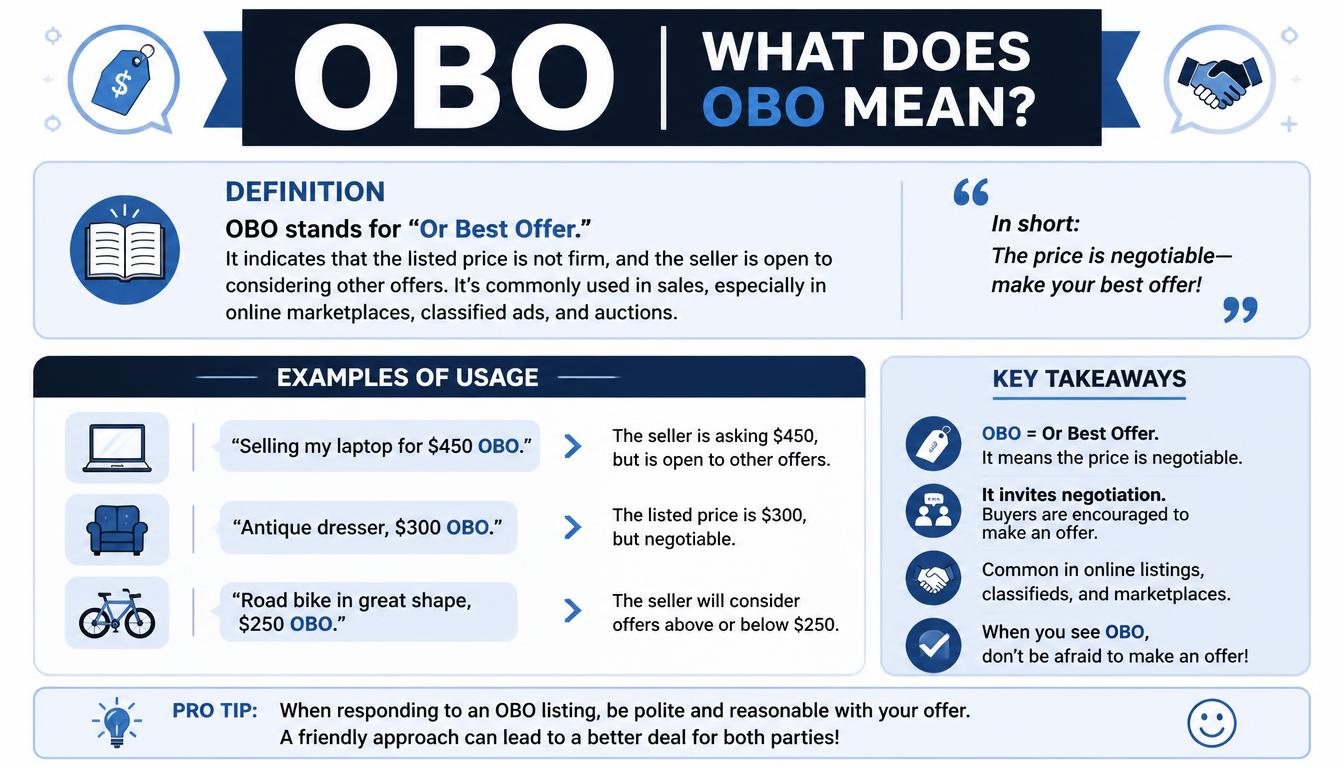
The basic answer is beautifully simple: OBO means “Or Best Offer.” In ordinary American English, it is an American abbreviation used in selling terminology and classified-ad terminology.
When a seller writes an asking price followed by OBO, they are generally telling potential buyers that the listed amount is not necessarily the final price. The seller is willing to consider another offer, usually a lower one. Dictionary.com
But there is a little more personality hiding behind those letters. OBO meaning depends on context, the item, the seller, and sometimes how badly somebody wants that old sofa out of their garage by Saturday.
OBO Meaning in Simple Words
The easiest way to understand OBO is to imagine a seller writing:
- “Used bike — $200 OBO”
- “Old desk — £50 OBO”
- “Vintage camera — $300 OBO”
- “Secondhand Legos — $20 OBO”
In each case, the number is the asking price, while OBO signals that the seller will consider offers.
So, if a used bike is advertised for $200 OBO, you might say, “Would you take $175?” The seller can accept the offer, reject it, or suggest something in between. Maybe they reply, “I could do $185.” Suddenly the three-letter abbreviation has turned into an actual conversation.
That is the heart of OBO in selling: it creates room for price negotiation.
It does not automatically mean that the seller will accept any ridiculously low amount. If someone lists a nearly new laptop for $800 OBO, offering $80 probably won’t produce the magical bargain you imagined. The word “best” still matters. The seller is usually looking for the best reasonable offer, not the funniest offer.
What Does OBO Mean in a Classified Ad?
When people ask, “What does OBO mean in a classified ad?”, the answer is still Or Best Offer, but the practical meaning becomes especially clear in this setting.
Classified advertisements traditionally had very little space, so abbreviations became useful. Instead of writing “I am willing to consider a lower price,” a seller could simply add OBO after the amount. Three letters did a whole paragraph’s work, which is rather efficient when every character matters.
For example:
- “Dining table, good condition, $150 OBO.”
- “Mountain bike, $400 OBO.”
- “Bookshelf, $30 OBO.”
- “Washing machine, £10 OBO.”
The wording tells a potential buyer two things at once: here is my starting point, and I am open to negotiation.
Dictionary.com identifies OBO as an abbreviation for “or best offer” and specifically describes its use after an asking price to indicate that a seller will consider accepting a lower price. It also gives the example of a used bike with panniers and a water bottle advertised for $200 OBO. Dictionary.com
That example is useful because it shows the term behaving exactly as people encounter it in real life, not as some strange dictionary fossil.
OBO Definition and the Meaning Behind “Best Offer”
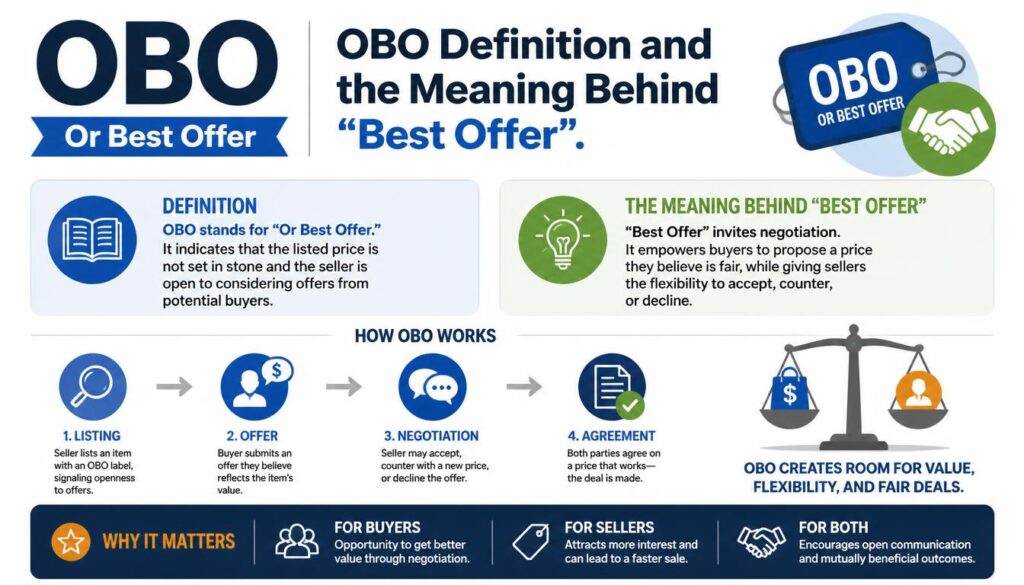
The OBO definition sounds straightforward, but the word “best” can confuse new buyers.
Does “best offer” mean the highest possible offer?
Not always.
In everyday buying and selling, OBO usually means the seller is inviting offers and intends to choose an offer they consider acceptable. Price is obviously important, but other things can matter too. A buyer who can collect the item immediately might be more appealing than someone offering slightly more but asking the seller to deliver it.
Imagine a person selling a washing machine for $250 OBO. One buyer offers $220 and can collect it that evening. Another offers $230 but wants the seller to keep it for two weeks and arrange transportation.
The $230 offer is numerically higher, but perhaps not the “best” offer from the seller’s point of view. That is why OBO is better understood as an invitation to negotiate rather than a strict auction.
It can mean best reasonable offer, offers considered, price negotiable, or seller accepting a lower offer, depending on the circumstances.
OBO vs. Asking Price: What Is the Difference?
The asking price is the amount the seller initially states.
OBO means the seller is not necessarily insisting on receiving exactly that amount.
Consider:
Bike — $200
This often suggests the seller wants $200, and negotiation may or may not be welcome.
Now consider:
Bike — $200 OBO
This communicates something extra: $200 is the starting point, and the seller is willing to negotiate.
That doesn’t mean $200 has suddenly become meaningless. It still anchors the conversation. A buyer who sees “$200 OBO” understands that an offer somewhat below $200 may be appropriate.
This is one reason OBO is common when selling used goods. Used objects don’t always have a single universally accepted value. A ten-year-old bicycle might be worth $200 to one person and $140 to another. Condition, urgency, location, brand, accessories, and local demand all affect the real value.
OBO leaves some breathing room for those differences.
Does OBO Mean Negotiable?
Usually, yes.
If you’re wondering, “Does OBO mean negotiable?”, the practical answer is yes, generally.
A seller using OBO is normally communicating that they are open to offers rather than requiring the exact advertised price.
However, OBO does not guarantee that the seller will accept your preferred number. It is not a coupon code for 60 percent off. You still need to make a sensible offer.
For example, suppose an advertisement says:
- “Good-as-new desk — $100 OBO.”
An offer of $90 might be perfectly normal. An offer of $75 could also begin a negotiation. But saying “$20, take it or leave it” may not be received with enormous enthusiasm, especially if the desk really is in excellent condition.
A respectful bargain is still a bargain. Being rude about it doesn’t make the price magically better.
How OBO Works on Online Marketplaces
The rise of the online marketplace has made OBO even more familiar. People now use the term in local buying-and-selling groups, resale listings, community boards, and digital classified ads.
The basic process usually looks like this:
- The seller chooses an asking price.
- The seller adds OBO to show that offers are welcome.
- A buyer contacts the seller with an offer price.
- The seller accepts, rejects, or counters the offer.
- Both parties agree on a final price.
- The transaction happens.
Suppose somebody lists a set of shelves for $200 OBO. A buyer might offer $170. The seller could respond with $185. The buyer might agree, and the final transaction becomes $185.
That little negotiation is precisely what OBO announces before anyone even sends the first message.
Sometimes the seller may write “offers considered” instead. Other common phrases include or nearest offer, price negotiable, open to negotiation, accepting offers, and seller considers lower offers.
They all point toward roughly the same commercial idea, although their exact implications can vary.
How to Make an Offer When You See OBO
Seeing OBO can make a buyer freeze for a second. “How low should I go?” is the immediate question.
A useful approach is to look at the item’s condition and the local market before making your lower offer. If similar used items are selling for $150 and the seller is asking $200 OBO, an offer around $160–$175 might be more sensible than dramatically undercutting them.
A few natural approaches include:
- “Would you consider $175?”
- “I’m interested. Would you take $180?”
- “Could you do $160 if I pick it up today?”
- “Is the price negotiable?”
- “Would you consider a reasonable offer?”
The important thing is to remember that OBO invites a conversation. You are not required to guess the seller’s secret minimum price, because there probably isn’t one written on a sacred tablet somewhere.
A good offer gives both people somewhere to go.
OBO Meaning in Garage Sales and Secondhand Goods
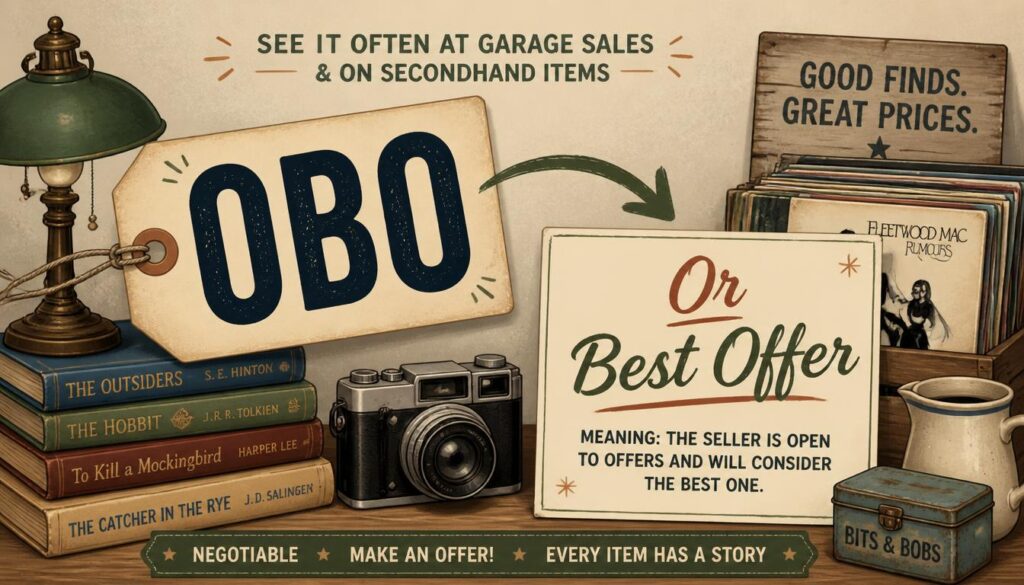
The charm of OBO becomes especially obvious at a garage sale.
Imagine a handwritten sign:
Books $5 OBO
The seller might be moving house, clearing storage, or simply deciding that having fewer boxes is worth more than squeezing every last dollar from them. A buyer may offer $3 for several books, and the seller might say yes.
This is one reason OBO fits naturally with secondhand goods. Their value can be personal and situational.
An old lamp that has sat untouched in a garage for three years might be worth $15 to the seller, but getting $10 today could feel like a win. The buyer gets a bargain, the seller gets space, and everyone goes home without needing a corporate procurement department.
It is a tiny example of how markets actually work in ordinary life.
OBO Meaning Examples You Might Actually See
Real-world examples are often the quickest way to understand an abbreviation.
Here are some adaptable examples:
- “Used bike with panniers and water bottle, $200 OBO.” The buyer can offer less than $200.
- “Good-as-new washing machine, £10 OBO.” The seller is open to offers around the stated price.
- “Vintage lamp, $50 OBO.” The listed $50 is negotiable.
- “Secondhand Legos, $25 OBO.” A buyer can propose a lower amount.
- “Garage sale: all items OBO.” Prices across the sale may be negotiable.
- “Mountain bike, $750 OBO.” The seller wants offers rather than insisting on exactly $750.
- “Old desk, $40 OBO pickup only.” The price is flexible, but the collection condition is separate.
- “Books, $10 OBO for the lot.” The seller may accept a lower offer for the entire collection.
- “Camera equipment, $600 OBO.” Potential buyers can negotiate.
- “Items for sale, make an offer.” This expresses a similar idea without using the abbreviation.
The phrase is particularly useful because it tells you that messaging the seller with a reasonable offer is welcome. You aren’t necessarily being cheeky by asking; the advertisement itself has opened that door.
The Origin of OBO: A Small Bit of Etymology
The Etymology of an abbreviation is often less exciting than people expect, but OBO has a useful history.
Dictionary.com lists the Origin of OBO as first recorded in 1970–75, identifying it as an American abbreviation for “or best offer.” Dictionary.com
That dating fits the broader world of classified advertising, where saving space mattered. Short forms could communicate selling conditions quickly, especially in print advertisements.
The expression later became part of ordinary marketplace language, moving comfortably from newspaper-style classifieds into community noticeboards and, eventually, internet listings.
In other words, OBO didn’t need the internet to exist. The internet merely gave the abbreviation a gigantic new playground.
OBO in American English
The label American English is worth noticing because OBO is especially strongly associated with American classified-ad language.
That doesn’t mean people elsewhere cannot understand it. They certainly can, and examples of the expression appear in British contexts as well.
One interesting literary example appears in David Mitchell’s novel Black Swan Green. Dictionary.com cites a passage involving notices for “secondhand Legos,” kittens needing homes, and good-as-new washing machines for £10 OBO. Dictionary.com
Black Swan Green, published in 2006, is a novel by David Mitchell about Jason Taylor and his life in Worcestershire in the early 1980s. The publisher describes it as a story set in Cold War England and emphasizes its close observation of everyday life. Penguin Random House
That literary example is rather lovely because it demonstrates contextual usage. OBO isn’t restricted to one kind of product. In a noticeboard full of ordinary community advertisements, it sits naturally beside objects, animals, and miscellaneous offers.
OBO in Popular Culture and Other Contexts
There is another reason people sometimes become confused by OBO: the same three letters can appear in contexts that have absolutely nothing to do with buying and selling.
Dictionary references include examples from publications such as Fox News and The Guardian, and the term has also appeared in entertainment and sports-related contexts. Dictionary.com
For example, Dictionary.com lists the phrase “7500 OBO” in a reference to a song title, while examples from The Guardian use OBO in a different sense connected with its live commentary format. Dictionary.com
This is a useful lesson in language: an abbreviation does not always have one universal meaning. Context is king, even when the king is wearing a slightly silly three-letter crown.
So if you see OBO in a marketplace listing, think Or Best Offer. If you encounter it in a newspaper, sports article, book, song title, or specialist community, don’t automatically assume it has the same expansion.
Common Mistakes People Make With OBO
One of the biggest mistakes is assuming that OBO means “the item definitely costs less than the listed price.” It doesn’t.
OBO means the seller is willing to consider an offer.
Another mistake is thinking that the first offer should be extremely low. Negotiation works better when the proposed number has some relationship to the item’s condition and market value.
People also sometimes confuse OBO with an auction. They are not identical. In an auction, competing bids generally move the price upward according to defined rules. With OBO, a seller is simply inviting offers and deciding which one, if any, they want to accept.
And finally, don’t assume OBO overrides every other condition in an advertisement. “$500 OBO, pickup only” still means pickup only. The negotiable part is primarily the price.
Read more; https://ytmeaning.com/dovetail-meaning/
How Sellers Can Use OBO Clearly
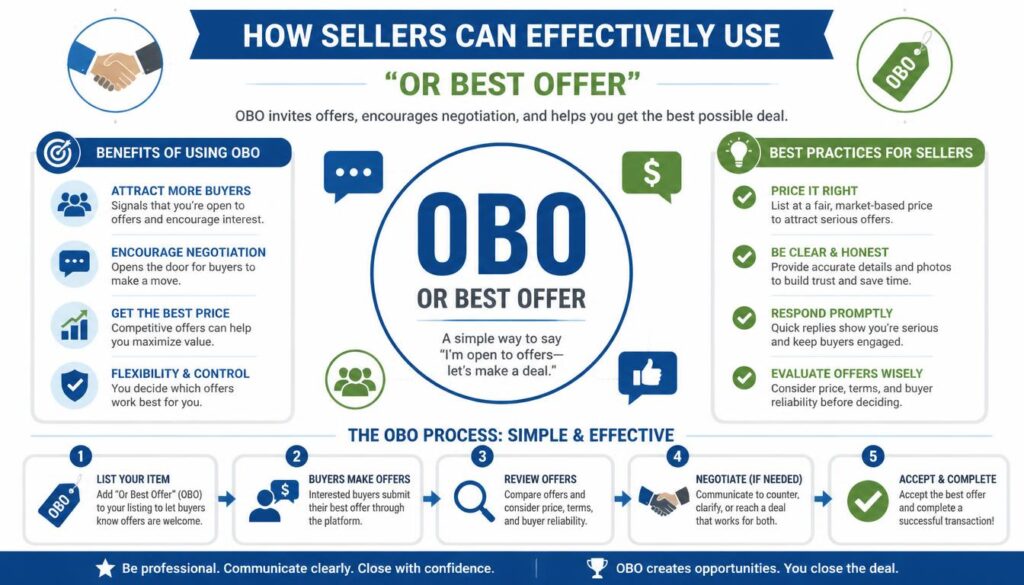
If you are the seller, using OBO can make your listing more approachable, but clarity matters.
Instead of writing:
“Chair $200 OBO”
you could write:
“Chair $200 OBO — excellent condition, pickup this weekend.”
Now the buyer knows the price is negotiable, while the practical details remain clear.
You can also state whether you’re willing to consider trades, whether pickup is required, and whether the price applies to one item or a group.
If you genuinely don’t want to negotiate, avoid adding OBO. Words such as firm price communicate the opposite message.
This small distinction saves everybody time, which in selling is worth rather more than people admit.
OBO vs. “Or Nearest Offer”
You may also encounter or nearest offer, particularly in some non-American varieties of English.
The idea is similar: the seller gives a target price and indicates that they may accept something close to it.
For example:
“Bicycle £200 or nearest offer.”
This tells the buyer that £200 is the reference point, but the seller isn’t necessarily demanding that exact amount.
OBO is more compact and particularly recognizable in classified advertisements, while “or nearest offer” is more explicit. Neither phrase should be treated as a promise that the seller must accept the closest number.
The human being behind the listing still gets the final say.
Practical Tips for Buyers and Sellers
A little common sense goes a surprisingly long way with OBO on marketplace listings.
For buyers:
- Check comparable prices before making an offer.
- Read the entire advertisement, not only the price.
- Make a realistic lower offer.
- Be polite if the seller declines.
- Ask about condition before negotiating heavily.
- If you can collect quickly, mention that.
- Don’t assume OBO means “half price please.”
For sellers:
- Set a realistic asking price.
- Add OBO only if you’re genuinely open to price negotiation.
- Describe defects honestly.
- State pickup or delivery conditions.
- Decide beforehand how low you’re willing to go.
- Be clear if you’re considering trades.
- Don’t feel pressured to accept the first offer.
Negotiation is easiest when both people know what game they’re playing.
Why OBO Still Works So Well

There is something wonderfully human about Or Best Offer.
A fixed price says, “This is the number.”
OBO says, “This is where I’d like to begin talking.”
That small difference changes the emotional shape of a transaction. The buyer has room to ask. The seller has room to decide. Neither side is automatically committed to the first number printed in the advertisement.
And perhaps that is why this old piece of classified-ad terminology continues to survive in modern resale culture. Whether you’re clearing out a garage, selling a used bike, moving apartments, or listing something online at midnight because you suddenly remembered it has been sitting in your cupboard for two years, OBO remains remarkably useful.
Frequetnly asked Questions
abbreviation for best offer
OBO stands for “Or Best Offer.” It means the seller is willing to consider offers lower than the listed asking price.
obo meaning marketplace
On a marketplace, OBO means “Or Best Offer.” It tells buyers that the listed price may be negotiable.
obo price meaning
An OBO price means the seller has listed an asking price but is open to receiving a better or lower offer from a buyer.
price obo meaning
Price OBO means the stated price is negotiable, and the seller may accept another reasonable offer.
obo def
OBO is an abbreviation for “Or Best Offer,” commonly used in sales listings to indicate that the seller is open to negotiation.
Final Thoughts on OBO Meaning
So, what does OBO mean?
In the world of selling, OBO is an American abbreviation meaning Or Best Offer. It normally appears after an asking price and tells potential buyers that the seller is willing to consider a different offer, often a lower price.
If you see “$200 OBO,” don’t read it as “$200 or absolutely nothing else.” Read it more like: “I’m asking $200, but I’m open to offers.”
That distinction is the whole story.
The next time you spot OBO beside a bicycle, a table, a phone, a pile of books, or some wonderfully mysterious object in a neighborhood marketplace, you’ll know what those three letters are quietly saying. They are not demanding, and they’re not exactly inviting a bidding war either. They’re simply leaving the door open for a conversation.
And in the messy, wonderfully ordinary world of buying and selling, sometimes the best deal begins with nothing more dramatic than, “Would you take a little less?”
If you want, I can also turn this into a more SEO-focused 2,000–2,500 word version with a meta title, meta description, FAQ section, and stronger keyword placement while keeping the writing natural.