
There are some names that seem to carry a meaning before we even know their story. Opel is one of those names. You may see it written across the grille of a car, inside an old garage, or in a discussion about German automobiles and wonder, “what does Opel mean?” Is it a German word? Is it an acronym? Does every letter in OPEL stand for something?
The interesting answer is a little less dramatic, but much more human. Opel meaning is closely connected with a family name, a man named Adam Opel, and a small workshop in Rüsselsheim am Main, Germany, that eventually grew into a major European automobile business.
The company did not begin with shiny cars or roaring engines either. It began with sewing machines, then bicycles, and only later entered automobile manufacturing.
So if you searched for what does Opel mean, you are really opening several doors at once: the Opel name, its surname origin, its automotive history, the famous Opel logo, and the modern company owned by Stellantis. Lets take those doors one by one.
Opel Meaning in Simple Words
The simplest Opel definition is this: Opel is primarily a surname and the surname of the founder, Adam Opel, became the name of the company. It is not generally an acronym where O, P, E and L each represent a separate word.
That distinction matters because people sometimes search for what does OPEL stand for as if it were similar to a technical abbreviation. It isn’t. In the context of the Opel car brand, OPEL is simply the recognizable brand name derived from the founder’s family name.
The company was established by Adam Opel in 1862 in Rüsselsheim. His first major business was the production of sewing machines, not automobiles. Later the business expanded into bicycles, and automobile production began in 1899, several years after Adam Opel’s death.
That makes the Opel brand a rather unusual automotive story. A name that now sits on passenger cars, SUVs, compact vehicles and electric vehicles started its commercial life surrounded by needles, thread and mechanical sewing equipment. History has a funny habit of taking the long way around.
What Does Opel Mean as a Name?
When people ask about the Opel name meaning, they are usually asking about the surname rather than the car company.
Surname references connect Opel with German naming traditions, particularly the Saxony region, and describe it as a shortened form associated with the personal names Albert or Adalbert.
This means the Opel surname meaning should not be confused with a modern German dictionary word. In German, Opel functions as a proper noun and surname. It isn’t the German word for “car,” “speed,” “power,” “wealth,” or anything similar.
Some older interpretations connect the wider family-name tradition with names such as Adalbert and with Germanic naming elements. But it is better to treat those explanations as surname etymology rather than claiming that the modern automobile company has a literal dictionary translation. Thats an important little distinction that many quick explanations skip.
In other words, the linguistic meaning and the brand meaning are two different things. Linguistically, Opel is a surname. Commercially, it became the identity of a major German car manufacturer.
Is Opel a German Word?
Not in the ordinary sense.
If someone asks for Opel meaning in German, the safest explanation is that Opel is a German surname and proper noun, rather than a common German vocabulary word. German surname sources connect it with shortened forms of older personal names such as Albert or Adalbert.
The distinction is similar to seeing a family surname on a business sign. You wouldn’t normally translate the surname itself as though it were a household object or action. The name identifies people and, eventually, the company founded by one of those people.
This also explains why searching for an Opel word meaning can become confusing. Search results may mix surname databases, automobile websites, baby-name pages and even unrelated word discussions. The useful question is not only “what does Opel mean?” but also “which Opel are we talking about?”
Who Was Adam Opel?
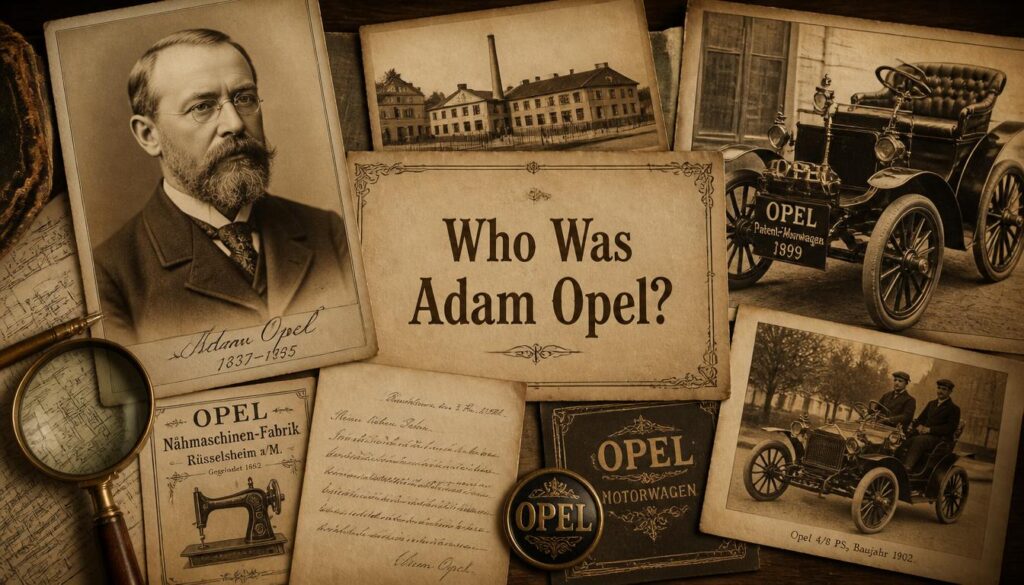
The story of the Opel company begins with Adam Opel, who was born in 1837 in Rüsselsheim. His father was a master locksmith, and Adam initially had a very different future in mind. After traveling and spending time in places including Paris, he became interested in sewing machines.
In August 1862, Adam returned to Rüsselsheim and established a modest workshop in his parents’ house. He assembled his first sewing machine there, creating the foundation of what would eventually become the Opel automobile manufacturer.
The first years were not some glamorous corporate launch. It was a small workshop, experimentation, production problems and gradual growth. Thats actually one of the most interesting parts of the Opel story: the famous German automotive identity was built long before there was an Opel car.
By 1868, Adam Opel had built a new factory, and the company expanded significantly. His wife Sophie also played an important role in the business, including handling bookkeeping.
From Sewing Machines to Bicycles
The Opel history becomes even more interesting when bicycles enter the picture.
In 1886, Opel produced its first bicycle in Rüsselsheim after Adam Opel encountered bicycle technology during a trip to Paris. The company soon expanded its bicycle range and adopted new technologies.
The business grew rapidly enough that Opel eventually became one of the world’s largest bicycle manufacturers. The five sons of Adam Opel also became famous bicycle racers and helped promote the family business through competition and publicity.
That family connection is worth remembering. Before the Opel car brand became associated with engines and roads, the Opel family was already associated with mechanical products and bicycles.
By the 1920s, Opel had embraced assembly-line manufacturing, and a bicycle could leave the production line every few seconds. This was a major step toward the industrial manufacturing culture that later became central to the company’s automobile business.
When Did Opel Start Making Cars?
The answer is 1899.
Automobile production began after Adam Opel’s death in 1895. His sons continued developing the company and on January 21, 1899, Opel acquired the motor-car factory of Friedrich Lutzmann in Dessau. That transaction helped launch Opel into the automobile era.
The first Opel automobile was the Opel Patent-Motorwagen System Lutzmann.
So when somebody asks when was Opel founded, two dates can appear depending on what they mean:
- 1862 — Adam Opel founded the company.
- 1899 — Opel entered automobile production.
Both dates are correct, but they describe different chapters of the same story.
This is why saying simply “Opel was founded as a car company in 1862” would be misleading. It was founded as a manufacturing business, while the Opel automobile arrived decades later.
Opel’s Journey Into Mass-Market Cars
One of Opel’s most important historical ideas was making modern technology more accessible.
The company introduced assembly-line production in automobile manufacturing, and in 1924 the Opel 4/12 PS “Laubfrosch” became the first German car produced using assembly-line technology. Opel later introduced affordable models that helped move the automobile away from being purely a luxury product.
That history helps explain the personality of the Opel brand. It was never only about building expensive prestige automobiles. Opel developed a strong identity around practical, accessible mobility.
This is different from the image associated with brands such as BMW, Mercedes-Benz, or Audi, where premium positioning has historically been much more prominent. Opel’s traditional territory has been closer to practical family cars, compact cars, everyday passenger vehicles and commercial transportation.
What Is the Opel Blitz?
The Opel Blitz is one of the names that became deeply connected with the company’s history.
The word “Blitz” is German for “lightning,” and the Blitz became a famous Opel commercial vehicle name in the 1930s. Opel’s commercial-vehicle history actually goes back to 1899, but the Blitz name became particularly prominent from 1930 onward.
More than 400,000 Blitz vehicles were produced in Germany before production of the German Blitz ended in 1975. The name eventually retired from active vehicle production, but its visual legacy remained important to the brand.
And here the meaning of Opel gets a little poetic without us needing to invent anything: the Blitz gave Opel a powerful visual association with lightning, movement and energy.
Opel Logo Meaning: What Does the Lightning Bolt Represent?
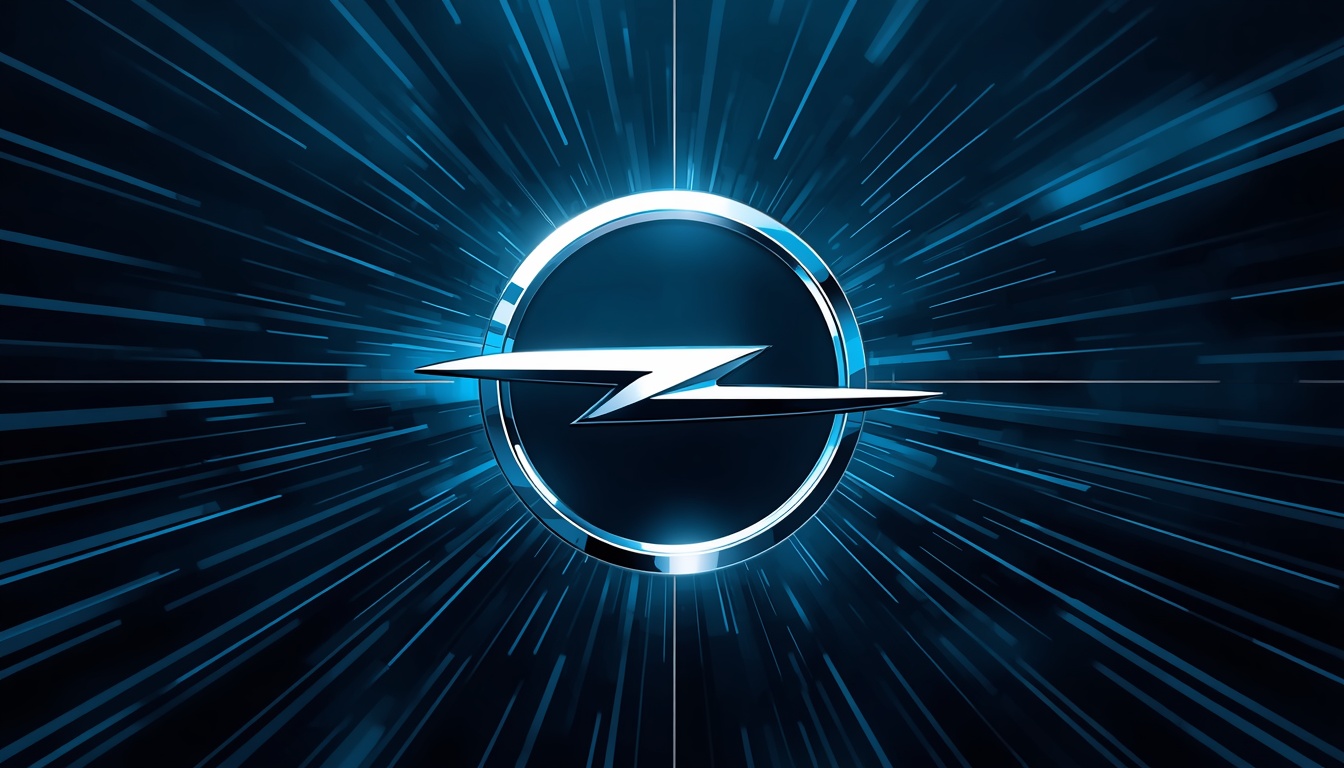
The Opel logo is one of the easiest automotive emblems to recognize because of its circular form and lightning-bolt-like Blitz.
The symbol has evolved considerably throughout Opel’s history, but the lightning idea became closely associated with the brand through the Opel Blitz. Opel’s own historical material describes the Blitz as the symbol that continues to characterize the brand.
So if you are searching for Opel logo meaning, the most useful interpretation is not that every element represents a secret word. The lightning imagery naturally communicates ideas such as energy, movement and dynamism, while the circle gives the emblem a contained, recognizable shape.
Modern branding has simplified the visual identity, but the basic idea remains instantly recognizable. A lightning bolt sitting inside a circle doesn’t whisper. It sort of announces itself.
Is Opel an Acronym?
No.
This is one of the easiest questions to answer.
OPEL is not normally an acronym, and there is no official four-word phrase represented by the letters O-P-E-L.
Therefore, searches such as OPEL full form, OPEL abbreviation, OPEL acronym meaning, or what does OPEL stand for can be misleading when applied to the automotive company.
The company name comes from Adam Opel’s surname, not from a sentence created by assigning a word to each letter.
This is also why invented “full forms” of OPEL found on random websites should be treated cautiously. If a page claims that each letter represents a technical or motivational word, that is generally a backronym rather than the historical origin of the company name.
Is Opel Still a German Company?
Yes, in terms of brand heritage and German identity, Opel remains strongly associated with Germany. The brand’s headquarters and historic roots are in Rüsselsheim, and Opel continues to describe itself as a major European car manufacturer with German roots.
But there is an important modern ownership detail.
Today, Opel is part of Stellantis. Stellantis identifies Opel as one of its regional brands and also lists British sister brand Vauxhall alongside it.
So asking “Is Opel German?” can have two answers depending on what you mean.
Culturally and historically, absolutely: Opel is a German automotive brand.
Corporate ownership is another matter: Opel belongs to the international Stellantis group.
Those two facts aren’t contradictory. A brand can retain its national heritage while belonging to a multinational corporation.
Opel Ownership: General Motors, PSA and Stellantis
The Opel ownership history is one of the most interesting parts of the company’s modern story.
In 1929, General Motors (GM) acquired a majority interest in Opel, beginning an ownership relationship that lasted for decades. Opel and Vauxhall eventually became part of GM’s European operations.
Then came another major change.
In 2017, PSA Group acquired Opel and Vauxhall from General Motors. The acquisition was completed on July 31, 2017.
A few years later, PSA and Fiat Chrysler Automobiles merged. On January 16, 2021, the merger became effective, and the combined company became Stellantis.
So the modern chain can be remembered quite simply:
Opel → General Motors → PSA Group → Stellantis
That timeline helps answer the common question “Who owns Opel?” Today, the answer is Stellantis.
Read more: https://ytmeaning.com/icl-meaning/
Opel and Vauxhall: Why Are They Connected?
If you’ve spent time looking at cars in the United Kingdom, you may notice something curious: some vehicles that look like Opel cars carry the Vauxhall badge.
That’s because Opel and Vauxhall are sister brands under Stellantis. Stellantis describes Opel as a major European manufacturer and Vauxhall as its British sister brand.
The connection goes back much further than Stellantis, however. Opel and Vauxhall became linked under General Motors and were later transferred together to PSA in 2017.
So the difference is largely about market identity and branding rather than two completely unrelated automotive histories.
Opel in the Modern Automotive Industry
Today’s Opel automobile manufacturer operates in a very different world from the workshop Adam Opel established in 1862.
Modern Opel produces vehicles across several segments, including compact cars, family cars, SUVs, commercial vehicles and electrified models. Stellantis currently describes Opel as one of Europe’s largest car manufacturers and says Opel and Vauxhall are represented in more than 60 countries.
Electrification is now an especially important part of the brand’s strategy. Opel has been expanding its range of electric vehicles, while maintaining its connection with practical everyday mobility.
That creates a strange but rather beautiful historical circle. The original company was built around making useful technology accessible to ordinary people. More than a century later, the company is applying that same broad idea to new forms of mobility.
Opel vs. Other German Car Brands
When people hear “German car,” they may immediately think of Volkswagen, BMW, Mercedes-Benz, or Audi. Opel belongs in the German automotive conversation too, but its traditional market positioning has been different.
Volkswagen has long been associated with mass-market mobility. BMW, Mercedes-Benz, and Audi are strongly associated with premium and luxury vehicles. Opel has generally focused more heavily on practical transportation, compact cars, mid-size cars, family vehicles, SUVs and accessible technology.
That doesn’t make one approach better than another. They’re simply different identities within the enormous German automotive industry.
And “German engineering” is not one single personality. It can mean a luxury sedan, a family hatchback, a delivery van, or an electric crossover. Opel’s history fits into that broader engineering tradition in its own particular way.
Opel Pronunciation: Is It “Opal”?
This is another small question that appears surprisingly often.
The Opel pronunciation in German is approximately OH-pel, with the first vowel pronounced long and the second syllable relatively light. German pronunciation sources give the form [ˈoːpl̩].
English speakers may sometimes pronounce it in a way that sounds closer to “OH-puhl,” depending on accent.
It is also commonly confused with opal, the gemstone.
But Opel and opal are different words. One is a surname and automotive brand; the other is a mineral and gemstone. Their sounds can come surprisingly close in casual speech, which probably explains some of the confusion.
Opel vs. Opal: Are They Related?
No direct relationship should be assumed simply because the words look similar.
Opal is the gemstone. Opel is the surname and brand.
The visual similarity is a classic near-homophone situation: two forms that can sound alike or nearly alike but have different origins and meanings.
So if someone searches Opel jewel meaning, Opel Sanskrit meaning, or connects Opel with wealth and gemstones, they may actually be mixing the automotive name with opal or with unrelated baby-name interpretations.
That is why context is king here. A search engine can put several meanings beside each other, but that doesn’t make them historically connected.
Is Opel a Baby Name or Given Name?
You may occasionally find Opel listed on baby-name websites or surname databases as a possible given name. But that does not mean the automotive brand was created from a baby-name meaning.
The historically relevant Opel name origin is the family surname associated with Adam Opel. Genealogical sources connect the surname with forms of Albert or Adalbert.
So if someone wants to use Opel as a baby name, that becomes a personal naming choice rather than an explanation of the automobile company’s origin.
Claims connecting Opel directly to meanings such as “jewel,” “fortune,” “peace,” “help,” or “aid” should be treated carefully unless a reliable linguistic source supports that particular interpretation. Search results can sometimes blend unrelated languages and naming traditions together, creating a meaning that sounds lovely but isn’t historically established.
What About “Opel Stitch” in Knitting?
There is another unusual search around the word: Opel stitch or Opel knitting meaning.
This should not be confused with the automobile company.
There are established knitting terms such as knit stitch and purl stitch, as well as sewing techniques such as the whip stitch. But Opel stitch is not a standard, universally recognized knitting stitch in the way those terms are.
If you encounter “Opel stitch” on a clothing, knitting or textile page, check the specific context carefully. It could be a product name, a local terminology choice, a brand reference or an informal label rather than a universally accepted technical stitch.
In other words, don’t let one mysterious search result turn Opel meaning into an entire textile conspiracy. Sometimes a word on the internet is simply a word used by one particular seller.
Why Is Opel Called Opel?
The answer is wonderfully straightforward: it is called Opel because the company was founded by Adam Opel and took his family name.
There is no hidden four-letter code waiting to be decoded.
There is no official secret translation.
There is no evidence that the name was invented as an acronym for automotive technology.
The company carried the founder’s surname from its earliest days, long before cars became its main identity.
And perhaps that is what makes the name memorable. It started as a person’s family name and gradually became a name recognized across the European automotive market.
A Quick Opel Timeline
If you want to remember the Opel history without reading an entire book about it, this timeline does the job nicely:
- 1862: Adam Opel establishes his business in Rüsselsheim and begins with sewing machines.
- 1886: Opel begins bicycle manufacturing in Rüsselsheim.
- 1895: Adam Opel dies; his sons continue developing the company.
- 1899: Opel enters automobile manufacturing with the Lutzmann motor car.
- 1920s: Opel becomes a major bicycle manufacturer and adopts assembly-line production.
- 1929: General Motors becomes the major corporate owner of Opel.
- 1930s: The Opel Blitz becomes an important commercial vehicle name and later influences the famous lightning emblem.
- 2017: PSA completes its acquisition of Opel and Vauxhall from GM.
- 2021: PSA and FCA merge to create Stellantis.
- Today: Opel remains a major European automotive brand under Stellantis, with a growing focus on electrified mobility.
Opel Meaning: The Bigger Story Behind the Name
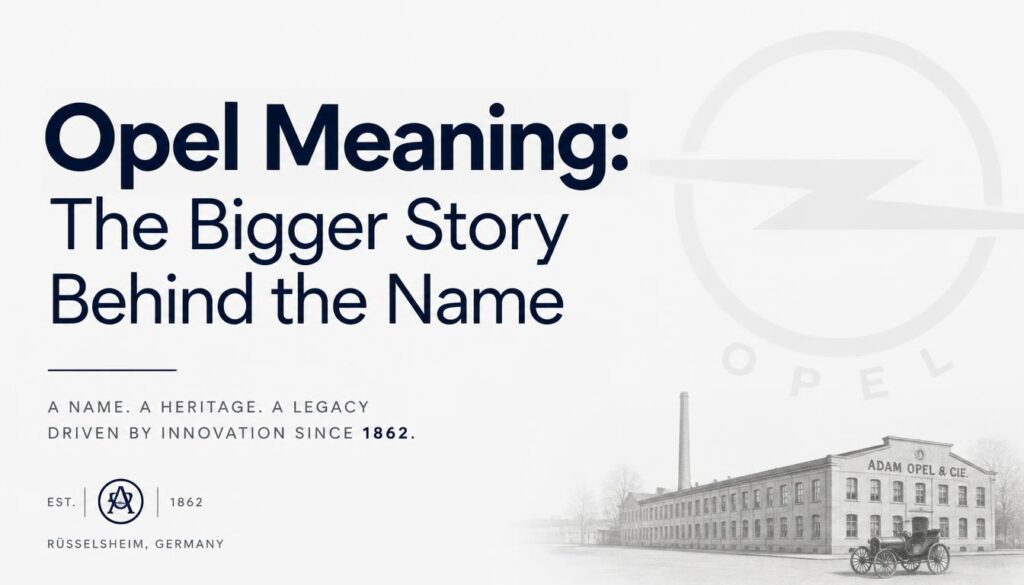
The most interesting thing about Opel meaning is that it isn’t really a single word-definition story.
It is a story about transformation.
A surname became a workshop. The workshop became a manufacturing company. Sewing machines gave way to bicycles. Bicycles gave way to automobiles. Automobile manufacturing developed into mass-market production, commercial vehicles, global ownership and eventually electric mobility.
The name stayed.
Adam Opel could hardly have known that the modest workshop he established in 1862 would eventually become an internationally recognized German car brand. Yet that is exactly what happened.
So when someone asks “what does Opel mean?”, the best answer isn’t simply “a German surname.” That is technically useful, but it leaves out the fun part.
Opel means a founder’s family name turned into a brand. Its linguistic roots belong to surname history; its modern associations belong to more than a century of engineering, manufacturing and mobility.
Final Thoughts on the Opel Name
The Opel meaning becomes much clearer once you separate the different things people are searching for.
As a linguistic term, Opel is a surname, with surname references connecting it to forms of Albert or Adalbert.
As a company name, it comes from Adam Opel.
As an automotive brand, it represents a long-running German manufacturing tradition that began with sewing machines in 1862, moved into bicycles, entered automobile production in 1899, and eventually became part of Stellantis.
And as a visual identity, the Opel symbol carries the distinctive Blitz or lightning-bolt idea that has become one of the brand’s most recognizable features.
So next time you see an Opel badge, there is a little more history sitting behind those letters than the average car badge suggests. It isn’t an acronym, it isn’t simply a German word for something, and it isn’t derived from the gemstone opal.
It is, quite literally, a family name that travelled a very long road. And honestly, thats a pretty good meaning for a car brand.