
Sometimes three letters can carry far more emotion than a whole paragraph. You see JFC in a text message, a comment, a meme, or an online chat, and for a second you may wonder whether someone has just invented another strange corner of internet language.
They havent, though. JFC is an informal acronym used to express strong emotion, usually shock, frustration, disbelief, surprise, or even anger.
The interesting thing about JFC meaning is that it has both a softened expansion and a much more explicit one. People commonly interpret it as “Jesus Freaking Christ,” while the original and more profane expansion is “Jesus F***ing Christ.”
The second version contains profanity and uses the name of Jesus Christ as an emotional exclamation, so its meaning isnt only about vocabulary; it can also touch Christian faith, religious sensitivity, and social context.
If you have ever searched what does JFC mean, you are probably looking for more than a dictionary-style answer. You may have seen someone type “JFC, thats expensive” or “JFC, I cant believe that happened” and wondered what feeling those three letters were supposed to carry.
This guide explains the JFC acronym, its history and usage, JFC meaning in text, whether it is considered offensive, and when it might be better to choose different words.
What Does JFC Mean?
The most common answer to what does JFC stand for is “Jesus F***ing Christ.” A less explicit version, especially when people want to avoid writing profanity, is “Jesus Freaking Christ.”
In everyday digital communication, JFC works as an exclamation rather than a literal reference to Jesus Christ. Someone might write “JFC, that scared me!” when they experience a sudden surprise. Another person could say “JFC, this traffic is terrible” to express frustration.
So, the JFC definition is best understood as an informal emotional expression with a religious reference and profane undertone.
The exact feeling depends heavily on context, because the same three letters can communicate annoyance in one conversation and genuine shock in another. Language is funny like that; sometimes punctuation does half the emotional work.
What Is JFC Short For?
If you’re wondering what is JFC short for, it generally represents “Jesus F***ing Christ.” The softened version “Jesus Freaking Christ” is also widely understood.
The word replacing the F in the softened version isnt necessarily the historical expansion of the acronym. Instead, “freaking” acts as a cleaner substitute for people who want to preserve the expression’s intensity without writing an explicit swear word.
For example:
- “JFC, that was close!” expresses shock or relief.
- “JFC, why is this taking so long?” expresses frustration.
- “JFC, you actually did it!” can communicate surprise.
- “JFC, thats a huge house!” may express amazement.
In each case, the speaker usually isnt talking about Jesus Christ literally. The phrase has become an emotional expression in casual communication.
JFC Meaning in Text and Texting
The JFC meaning in text is usually straightforward once you understand the emotional tone behind it. In texting, people often use the acronym when they want to make their reaction sound stronger than a simple “wow” or “seriously?”
Imagine your friend sends you a photograph of a restaurant bill after ordering dinner for six people. You might reply:
“JFC, how much did you guys order?”
Here, JFC text meaning communicates disbelief mixed with amusement.
Or suppose someone tells you they waited three hours at an airport:
“JFC, thats ridiculous.”
Now the expression carries frustration.
Unlike formal written language, texting allows people to communicate through shorthand, emojis, abbreviations, and internet slang. JFC belongs firmly in that informal world.
JFC Meaning in Chat and Online Communication
The JFC meaning in chat is almost identical to its meaning in texting, but the surrounding conversation can make the emotional shade clearer.
People use JFC on social media, gaming platforms, discussion boards, private messages, and other forms of online communication. It is particularly common when someone reacts immediately to something unexpected.
A person might type:
“JFC 😂 I didnt expect that.”
The laughing emoji changes the atmosphere considerably. Instead of sounding furious, the message may come across as shocked and amused.
This is why understanding tone matters. Internet communication removes facial expressions and vocal cues, so abbreviations often become substitutes for those missing signals.
Why Do People Use JFC?
People use JFC because it is short, emotionally powerful, and instantly recognizable to many internet users. Typing three letters can be easier than writing an entire emotional sentence.
It can express:
- Shock at unexpected news
- Disbelief when something seems impossible
- Frustration with an annoying situation
- Surprise at something impressive
- Anger during an intense conversation
- Amusement when something is ridiculous
- Amazement at something unusually large or impressive
The acronym can almost behave like a verbal gasp. Thats probably why it survives in fast-moving digital conversations.
JFC as Internet Slang
JFC slang belongs to the broader family of texting acronyms, online abbreviations, and informal expressions that became increasingly common with digital communication.
People began shortening phrases because online conversations reward speed. LOL, OMG, WTF, IDK, BRB, and similar abbreviations became part of everyday internet culture.
JFC fits into this same linguistic ecosystem, although its religious reference and profanity make it somewhat more sensitive than harmless abbreviations such as “LOL.”
The important point is that internet slang doesnt always follow formal language rules. Words evolve because people use them repeatedly, and eventually a strange-looking abbreviation becomes perfectly understandable to a particular audience.
Is JFC a Swear Word?
This question doesnt have a single answer for every person or situation.
The explicit expansion of JFC contains a profanity, so it is reasonable to classify it as a swear word or profane expression. Even the softened “Jesus Freaking Christ” version retains the religious reference and can still be viewed as inappropriate by some people.
For others, JFC has become so common as slang that they see it simply as a strong emotional expression.
The safest interpretation is this: JFC is informal and potentially offensive language, especially in professional, religious, or family-sensitive settings.
You dont need to panic if you see it, but you should understand that it isnt a neutral abbreviation.
Is JFC Profanity?
Yes, JFC is generally considered profanity, particularly when it represents “Jesus F***ing Christ.”
The expression combines an explicit swear word with the name Jesus Christ. Because of that combination, it can be considered religious profanity or blasphemous language by people who regard the phrase as disrespectful toward their faith.
At the same time, the speaker may not intend a religious insult at all. In many casual conversations, JFC functions simply as an emotional reaction.
Intent matters, but so does impact. A phrase can be casual to one person and deeply offensive to another.
Is JFC Offensive?
Whether JFC is offensive depends on the audience, setting, and personal beliefs.
Someone who regularly uses strong internet slang may barely notice it. A person with strong religious convictions, however, may consider the expression disrespectful because it uses the name of Jesus Christ as an expletive.
This is where religious sensitivity becomes important.
Using JFC with close friends who understand your communication style is very different from using it in a formal workplace email or speaking it around someone whose religious beliefs make the phrase uncomfortable.
The safest rule is simple: if you arent sure how your audience will react, dont use it.
JFC and Christian Faith
The relationship between JFC and Christian faith is one reason this acronym can be more sensitive than ordinary slang.
Christianity places significant importance on the name of Jesus Christ. Using that name within a profanity can therefore be interpreted as disrespectful or blasphemous language.
However, not every person who types JFC is deliberately mocking Christianity. In many cases, the phrase is simply inherited from popular American slang, movies, television, online communities, or casual conversation.
That distinction between intention and interpretation is important.
A person might write “JFC!” without thinking about the religious implications at all, while another reader might immediately notice the reference and find it offensive.
JFC in American Slang and Internet Culture
The expression is strongly associated with informal English-speaking culture, particularly American slang and digital communication.
As texting and social media became everyday communication tools, abbreviations became less mysterious. Young Americans, teenagers, gamers, and online communities helped spread countless shortened expressions.
JFC developed within this broader tradition of strong emotional language.
It isnt really a formal vocabulary term. You wont normally see someone writing JFC in a business report, academic essay, or official announcement unless they’re discussing the acronym itself.
Its natural habitat is the casual conversation, where people speak quickly and emotions occasionally arrive before grammar does.
Examples of JFC in Everyday Texting
Understanding examples can make the JFC meaning in texting much easier to recognize.
- “JFC, that movie was intense.” — expresses strong reaction or disbelief.
- “JFC, you scared me!” — expresses shock.
- “JFC, its already midnight?” — expresses surprise.
- “JFC, this assignment is huge.” — expresses frustration.
- “JFC, thats expensive.” — expresses disbelief about a price.
- “JFC, you won the whole thing?” — expresses amazement.
- “JFC 😂 I cant stop laughing.” — expresses amused disbelief.
- “JFC, what happened here?” — expresses shock or confusion.
- “JFC, that was fast.” — expresses surprise.
- “JFC, I forgot my keys again.” — expresses frustration with oneself.
Notice how the acronym doesnt have one fixed emotional definition. The sentence around it tells you what kind of reaction is happening.
How to Use JFC Appropriately
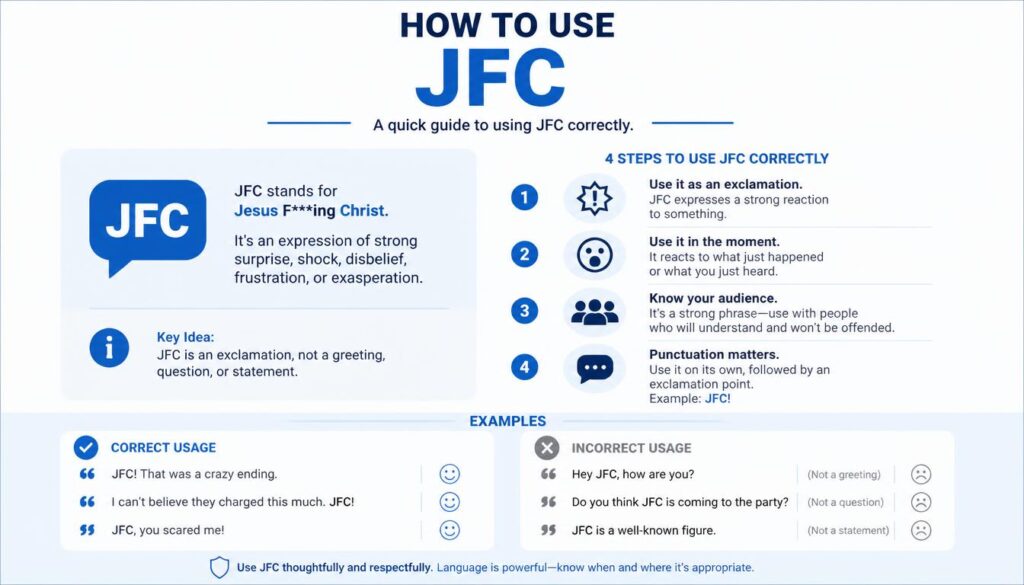
Knowing how to use JFC is less about grammar and more about knowing your audience.
Use it only in situations where casual, potentially profane language is acceptable. A private conversation with close friends is very different from a message to your manager.
Consider the following before using the expression:
- Who are you speaking to?
- Is the conversation formal or casual?
- Could religious language make someone uncomfortable?
- Is profanity acceptable in the environment?
- Would a milder expression communicate the same feeling?
- Could the message be misunderstood without vocal tone?
These questions may sound overly careful for three letters, but digital messages can travel further than expected. One casual text can end up being screenshotted, forwarded, or read completely out of context.
When You Should Avoid JFC
There are plenty of situations where JFC is not appropriate.
Avoid it in formal business communication, academic writing, professional emails, official documents, customer service messages, and sensitive religious discussions.
It is also wise to avoid strong profanity when communicating with children or in situations where you dont know the audience’s age or boundaries.
For example, instead of writing:
“JFC, this is impossible.”
You could say:
“Wow, this is much harder than I expected.”
Same emotional territory, less chance of causing a problem.
Language doesnt lose its personality just because you remove the swear word. Sometimes the cleaner version actually sounds more thoughtful.
JFC vs. Similar Internet Acronyms
There are many internet acronyms that express strong emotions, but they arent interchangeable.
OMG usually means “Oh my God” and can express surprise, excitement, or disbelief.
WTF is another profane expression commonly used for confusion, shock, or frustration.
JFC tends to feel particularly intense because it combines an expletive with a religious reference.
LOL generally signals amusement and is much less aggressive.
IDK simply means “I don’t know.”
Understanding these differences helps you interpret the emotional temperature of a message instead of treating every acronym as though it means the same thing.
JFC in Social Media
On social media, JFC often appears beneath surprising photographs, shocking news, funny videos, celebrity posts, sports moments, or controversial discussions.
A comment such as “JFC 😭” can communicate an entire emotional paragraph without actually explaining anything.
The surrounding platform culture also matters. A gaming community may treat strong language as completely ordinary, while a professional networking environment may view the same expression as careless.
This is why audience awareness is one of the most important parts of understanding modern slang.
JFC in Workplace Communication
Using JFC at work is generally risky.
Even if your coworkers casually use profanity, written workplace communication can be stored, forwarded, or reviewed later. An acronym that felt funny in a group chat can look surprisingly unprofessional when copied into an email.
For professional communication, alternatives such as these are safer:
- “Wow, thats unexpected.”
- “I honestly cant believe it.”
- “Thats quite surprising.”
- “This is extremely frustrating.”
- “I didnt see that coming.”
- “That is a lot more than I expected.”
You still get the emotion across without inviting an unnecessary social repercussion.
JFC and Different Generations
Different generations can interpret JFC differently.
Younger people who grew up with social media may recognize it immediately as casual internet slang. Older readers may understand the individual words but interpret the phrase more literally or find its religious element more noticeable.
This doesnt mean one generation is right and another is wrong. Language changes.
What matters is knowing the communication environment you’re entering. A phrase that works beautifully in a meme caption may work terribly in a formal letter.
Is “Jesus Freaking Christ” the Real Meaning?
“Jesus Freaking Christ” is commonly presented as a cleaner explanation of JFC, but the more explicit expansion is “Jesus F***ing Christ.”
“Freaking” is essentially a softened substitute.
People sometimes use the cleaner expansion because they dont want to spell out profanity, especially on websites where explicit language may be filtered. Others genuinely prefer the softened wording because they want to keep the expression less offensive.
So if you see someone asking JFC Jesus Freaking Christ, they are generally referring to the sanitized version of the acronym.
JFC Meaning: Literal vs. Practical
There is a funny little gap between the literal meaning and the practical meaning of JFC.
Literally, the words refer to Jesus Christ.
Practically, most users are not making a theological statement. They are reacting emotionally.
If someone says:
“JFC, I nearly missed the train!”
They arent usually discussing Jesus Christ. They’re saying, in a very informal way, “That was extremely stressful!”
Understanding this difference is essential when interpreting JFC meaning in a message.
Cultural Sensitivity Matters
Slang is never completely separate from culture.
Words connected to religion, race, sexuality, nationality, or other sensitive subjects can carry emotional weight that isnt obvious from their dictionary definition.
Because JFC contains a religious reference, religious sensitivity should always be considered.
You dont have to avoid every strong expression in life. But knowing when a phrase might hurt, offend, or simply make someone uncomfortable is part of being an effective communicator.
Good communication isnt only about saying what you mean. Its also about understanding how the other person may hear it.
What Does JFC Mean on Social Media?
If you searched what does JFC mean on social media, the short answer is: it is an informal exclamation used to express strong emotion.
The emotion could be:
- Surprise
- Shock
- Frustration
- Disbelief
- Anger
- Amazement
- Amusement
For example, someone seeing an unexpectedly high concert ticket price might comment, “JFC, $400?”
The acronym adds emotional force to the statement. Without it, the comment might sound neutral. With it, the reader immediately understands that the price has caused a strong reaction.
What Does JFC Mean in a Text Message?
The JFC meaning in a text message usually depends on whatever happened immediately before it.
If your friend writes:
“JFC, I forgot the exam was today.”
They’re frustrated.
If they write:
“JFC, you bought that car?”
They’re surprised.
If they write:
“JFC 😂 that was hilarious.”
They’re amused.
So when reading JFC, dont translate it word-for-word every time. Instead, read the surrounding sentence and identify the emotion.
That is how native speakers usually understand slang.
How to Respond When Someone Says JFC
You dont necessarily need to comment on the acronym itself.
If someone says:
“JFC, that was terrifying!”
You can simply respond:
“Honestly, same. I thought something terrible happened.”
If you’re uncomfortable with profanity, you can still continue the conversation without making it awkward. Not every language difference needs to become a debate.
And if someone uses JFC toward you in an angry way, context matters again. It could be a casual exclamation, or it could be part of an aggressive statement.
Look at the entire message, not just the acronym.
Safer Alternatives to JFC

If you want the same emotional effect without profanity or potentially offensive language, there are many alternatives.
For surprise:
- “Wow!”
- “No way!”
- “Seriously?”
- “I cant believe it!”
For frustration:
- “Oh, come on!”
- “This is ridiculous.”
- “What a headache!”
- “Im so frustrated.”
For disbelief:
- “Youre kidding!”
- “Thats unbelievable.”
- “Are you serious?”
For amazement:
- “Thats incredible!”
- “Wow, thats huge!”
- “I honestly didnt expect that.”
Sometimes a well-timed “Wow” has more personality than a three-letter acronym anyway.
Final Thoughts on JFC Meaning
The JFC meaning is ultimately about emotional emphasis. Most commonly, JFC represents “Jesus F***ing Christ,” while “Jesus Freaking Christ” is a softened alternative. In texting, chat, and online communication, it can express shock, frustration, disbelief, surprise, anger, or amazement.
At the same time, JFC isnt completely neutral. Because it combines profanity with a reference to Jesus Christ, it can be considered religious profanity, blasphemous language, or offensive slang by some people. Others may simply see it as another piece of everyday internet vocabulary.
That difference is exactly why context, tone, audience, and sensitivity matter.
If you’re chatting with close friends who regularly use casual slang, JFC may not raise an eyebrow. In a professional email, classroom assignment, formal conversation, or religious setting, however, choosing a cleaner expression is usually the smarter move.
Words are tiny things, but they can carry surprisingly large suitcases of history and emotion. JFC is a good example: three letters, several possible feelings, one religious reference, and a whole little story about how language keeps changing online.
If you have seen JFC used in a sentence that confused you, look at the surrounding words before deciding what the person meant. And if you have your own interesting experience with texting slang, share it — because honestly, the internet has probably invented another mysterious three-letter acronym while we were writing this.