
Some words look tiny on the page but carry a surprisingly large suitcase of history. Skat is one of those words. At first glance, it may seem like a strange three-letter term, perhaps a typo for “scat” or simply another unfamiliar bit of gaming vocabulary.
But look a little closer and a whole card table appears, with three players, bidding, contracts, clever decisions and two hidden cards waiting in the middle.
So, what exactly is the skat meaning?
In its most recognized dictionary sense, Skat is a traditional German three-handed card game played with a 32-card deck. The players compete through bidding for the opportunity to choose and attempt a contract.
There is also a special group of two cards, commonly called the “skat” or two-card widow, which becomes important during play.
That sounds simple enough, but Skat is not really a game you understand by reading one sentence. Its charm sits between mathematics and instinct.
You count cards, estimate possibilities, listen to the bidding and sometimes make a decision that feels a little dangerous. Thats where the fun begins.
Skat Meaning in Simple Words
The easiest way to understand the meaning of skat is to think of it as the name of a classic European card game, especially associated with German gaming tradition.
According to the Merriam-Webster Dictionary, skat is a noun referring to a three-handed card game played with 32 cards. Players bid for the privilege of attempting one of several contracts. The same dictionary also defines the word in relation to the two-card reserve used in the game.
In plain English, skat meaning can therefore be summarized as:
- A traditional German card game
- A game normally involving three players
- A game played with a 32-card deck
- A game involving bidding
- A game based around different contracts
- A game containing a two-card reserve called the skat
- A strategic contest where decisions matter almost as much as the cards themselves
So when someone asks, “what is skat?” they are usually asking about the card game rather than the unrelated English word “scat.” That little spelling difference matters quite a lot, actually.
What Is Skat Card Game?
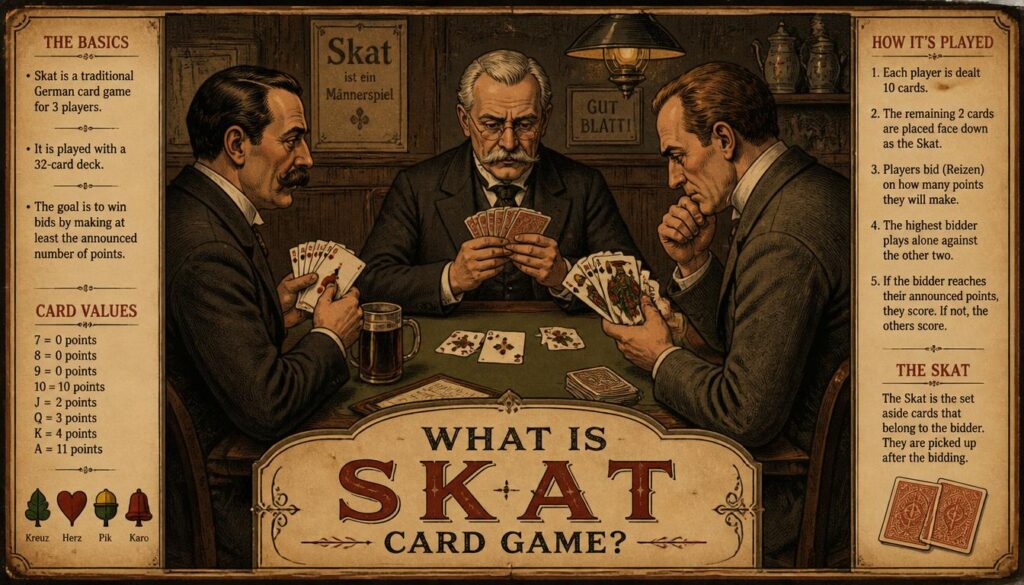
The skat card game is a three-player trick-taking game that developed in Germany and became one of the best-known traditional German card games.
Unlike casual card games where everybody simply receives cards and starts playing, Skat adds another layer before the main action begins. Players participate in bidding, and the result of that bidding determines who gets the opportunity to play a particular contract.
This makes Skat feel like two games happening inside one another.
First comes the contest of estimation: How strong is my hand? How much can I realistically achieve?
Then comes the contest of execution: Now that I have chosen the contract, can I actually deliver it?
That combination is what makes the Skat game unusually strategic. A player can hold attractive cards and still lose because the contract was too ambitious. Another player may have a less glamorous hand but use it with excellent judgment.
Skat Definition According to the Dictionary
A proper skat definition helps remove some confusion surrounding the word.
Merriam-Webster defines Skat as a “three-handed card game” played with 32 cards in which players bid for the privilege of attempting different contracts. It also gives a second sense connected to the two-card widow that may be used by the winner of the bid.
That second meaning is interesting because it shows that Skat can refer not only to the game itself but also, in dictionary usage, to the special two-card reserve within the game.
In other words, context matters.
If someone says, “We played Skat last night,” they mean the game. If someone is discussing the cards set aside during the deal, they may be talking about the skat itself.
Why Skat Is Called a Three-Handed Card Game
One of the easiest ways to recognize Skat is its unusual player count.
The standard game is designed around three players. That gives every person a significant role because there isn’t a large crowd of players hiding behind one another’s decisions.
Each player has to pay attention.
Each bid reveals something.
Each discarded card can potentially tell a story.
The three-player structure also gives the game a distinctive rhythm. One player becomes the declarer or contract player after the bidding process, while the other two play against that contract. It creates an interesting temporary alliance between the two opponents, although they are still competing individually in the broader scoring structure.
A normal four-player card game can sometimes feel like a noisy room. Skat feels more like three people quietly trying to read each other’s minds.
The 32-Card Deck Used in Skat
A standard 32-card deck is central to traditional Skat.
Instead of using all the cards found in a typical 52-card deck, Skat uses a reduced deck. This keeps the game compact while making every card more meaningful.
The deck generally contains the ranks from seven through ace in four suits.
That means the cards are not merely decoration. Their distribution affects probability, strategy and bidding decisions.
A player who understands the composition of the card deck can make more informed decisions because they know how many important cards are potentially still outside their hand.
And this is where Skat starts becoming less about “having good cards” and more about understanding what your cards imply.
How Skat Bidding Works
Skat bidding is one of the most important features of the game.
Before the contract is played, players compete through a structured bid. The bidding determines who receives the privilege of becoming the player who attempts the contract.
The winner of the bid gets an important advantage: they can pick the contract they want to attempt and interact with the two-card skat.
This doesn’t mean winning the bid automatically means winning the round. Quite the opposite.
A high bid can put pressure on the player who makes it.
If you announce a contract that your cards cannot support, confidence can turn into a very expensive mistake. Its a classic lesson in games: being brave and being reckless are not the same thing.
What Is the Skat or Two-Card Widow?
The word becomes especially interesting here.
In the game, the skat widow, also known as the two-card widow, consists of two cards set aside during the deal. These cards form a small reserve that becomes available according to the rules and contract.
The winner of the bidding gets access to this reserve in traditional play.
That means the two hidden cards can change how a player evaluates their hand.
Imagine holding cards that look almost useful but not quite enough. Then the hidden cards appear and suddenly the shape of your possible contract changes.
Or perhaps the opposite happens.
You see the two cards and think, “Well, that did not help much.”
That little moment of hope followed by disappointment is part of card-game life.
Skat Discard and the Importance of Hidden Cards
The skat discard process is another part of the game’s strategic character.
When the player who wins the bid picks up the two-card reserve, they can use the information from those cards when shaping their final hand and contract, according to the rules of the particular form being played.
The discarded cards can therefore become strategically significant.
A player isn’t simply throwing away two cards at random. The choice can influence the strength and structure of the hand they eventually play.
This is why experienced skat players don’t look at cards in isolation. They consider suits, ranks, possible tricks, contracts and the likely cards held by opponents.
One small discard can sometimes make a big difference later.
Skat Contracts: The Heart of the Game
A Skat contract tells the table what kind of challenge the declarer is attempting.
This is one of the features that separates Skat from many simpler traditional card games.
Instead of merely trying to win as many tricks as possible without additional conditions, the declarer selects a specific contract. Different contracts create different objectives, values and strategic requirements.
The player who wins the bidding therefore receives the privilege of attempting a contract, but also accepts the responsibility attached to it.
Thats an important idea to remember.
The bidding gives you power, but it also gives you a target.
How Is Skat Played?
If you’re wondering how is skat played, the broad structure can be understood in stages.
First, three players receive cards from the 32-card deck, with two cards placed aside as the skat.
Then comes the bidding stage.
Players compete for the right to become the declarer. The winner of the bid takes the relevant action involving the skat and chooses an appropriate contract.
After that, the actual card play begins.
Players play tricks according to the rules of the selected contract. The declarer attempts to fulfill the contract, while the other two players attempt to prevent that from happening.
The exact details of card ranking, following suit, trump selection and scoring depend on the contract and rules being used, so beginners should learn the specific rules before playing for serious stakes.
Read more: https://ytmeaning.com/tonearm-meaning/
Why Skat Is More Strategic Than It Looks
At first, Skat can look like a quiet old-fashioned card game played around a wooden table.
Then you actually play it.
Suddenly, every card starts looking suspicious.
A missing suit matters. A bid matters. A discarded card matters. Even an opponent’s hesitation can make you wonder what they might be holding.
The game’s strategy comes from incomplete information.
You never see everything.
You make decisions based on probabilities, known cards, bidding behavior and your understanding of the contract.
That makes skat game rules easier to memorize than to master. Knowing the rules tells you what you can do. Experience teaches you what you probably should do.
Skat Terminology Beginners Should Know
If you’re learning skat terminology, a few words will appear again and again.
- Skat — the two-card reserve in the game, and also the name of the game itself.
- Players — traditionally, three people participate in the standard game.
- Bid — a declaration during the bidding phase.
- Bidding — the process through which players compete for the contract-playing privilege.
- Winner of the bid — the player who gains the right to attempt the contract.
- Contract — the type of game or objective selected by the declarer.
- Widow — another term used for the two-card reserve.
- Discard — cards set aside as part of the process of forming the final hand.
- Trick — a round in which each player contributes a card and one card wins according to the applicable rules.
- Declarer — the player attempting to fulfill the selected contract.
Learning these terms first makes the rest of the German card game rules much less intimidating.
The Etymology Behind the Word Skat
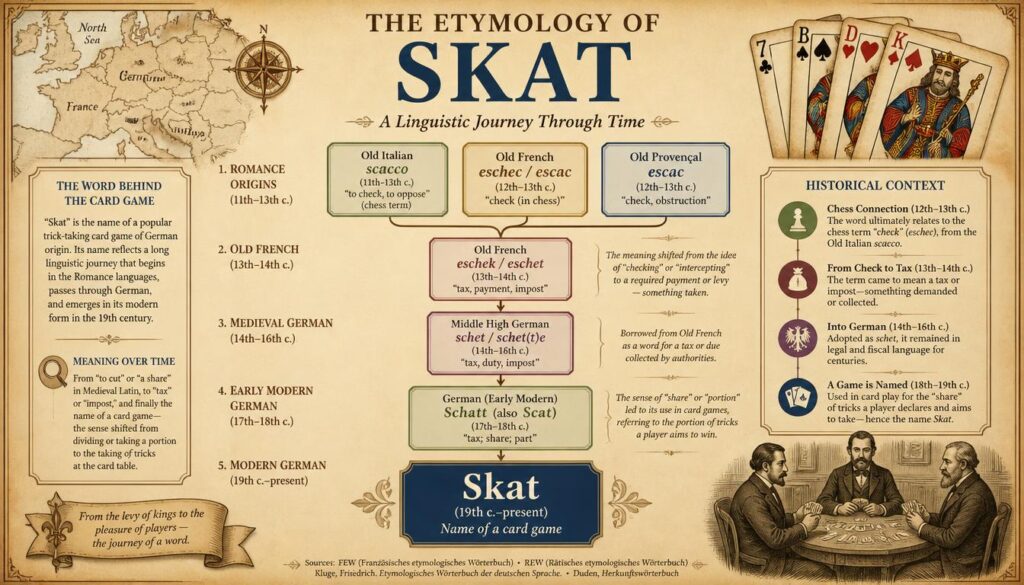
The skat etymology is one of the more fascinating parts of the word’s history.
Merriam-Webster traces Skat to German, with the German form connected to the Italian word scarto, meaning “discard.” The Italian verb scartare means “to discard.” The deeper etymological trail connects the form to Latin elements including ex- and carta, meaning card.
So the word carries an idea of putting something aside or discarding it.
That connection makes surprising sense when you remember the game’s two-card reserve and its historical terminology.
Words sometimes preserve tiny fingerprints of old activities. A player may not think about language while holding cards, but the vocabulary sitting on the table can quietly carry centuries of history.
Italian Scarto and the Word’s History
The Italian scarto is particularly important when discussing the word origin of Skat.
Scarto relates to the idea of a discard, while scartare means to discard. According to Merriam-Webster’s etymological entry, the German term was influenced by this Italian vocabulary.
The trail then reaches Latin, where carta relates to card or paper, with the entry also connecting the prefix ex- to the development of the form.
It is a nice reminder that a simple gaming word isn’t always born in one place and then left untouched. Language travels, changes clothes and sometimes sits down at another country’s card table.
When Was Skat First Used?
The first known use of skat in the English dictionary record cited by Merriam-Webster is 1864. The entry identifies 1864 as the first known use for the card-game sense.
There is an important little dictionary lesson here, though.
“First known use” does not necessarily mean “the exact day the word was invented.” Dictionary dates generally represent the earliest documented written or printed use that researchers have identified. Words may exist in speech before anyone records them on paper.
So 1864 should be understood as a documented milestone, not necessarily the birthday of the word.
Skat and German Gaming Culture
The German card game tradition is rich, and Skat occupies a particularly recognizable place within it.
Traditional card games often become more than games. They become social rituals. A family table, a club, a gathering of friends or an evening with neighbors can all become the setting for repeated rounds.
Skat has that kind of social personality.
You aren’t simply moving pieces around a board. You are watching people calculate, bluff through confidence, reconsider their choices and occasionally celebrate a beautifully played hand.
The game rewards concentration, but it also creates conversation. Thats probably one reason traditional card games survive even when newer forms of entertainment keep appearing.
Skat Meaning in Cards vs. Other Uses of “Scat”
It is worth making one distinction very clearly.
Skat and scat are not automatically the same word.
The English word “scat” has several unrelated meanings, including a command meaning to go away, animal droppings, and a style of jazz singing involving improvised syllables. Merriam-Webster treats these as separate entries and gives different histories for them.
Therefore, if someone searches skat meaning in English, they may actually be looking for the German card-game term.
The spelling with a “k” is the useful clue.
Skat = the card game and its related terminology.
Scat = several completely different English words.
One letter can send a search query into a totally different neighborhood.
Is Skat Difficult to Learn?
For a complete beginner, the hardest part may not be playing cards. It may be understanding the vocabulary and the logic behind bidding.
Once you understand the basic structure, the game becomes easier to follow.
Start by learning:
- The composition of the 32-card deck
- The role of the three players
- The purpose of the skat
- How bidding works
- How the winner of the bid selects a contract
- The basic trick-taking rules
- How scoring works
- What makes a contract successful or unsuccessful
Don’t try to become an expert in one afternoon.
Card games have a funny habit of teaching humility. You can understand every rule and still make a terrible decision five minutes later.
Tips for New Skat Players
If you’re learning the game of skat, begin slowly.
First, play practice rounds without worrying too much about score. Concentrate on understanding why a player chooses a particular bid or contract.
Then start paying attention to what opponents reveal through their play.
Try to remember cards that have already appeared. You don’t need a photographic memory; even remembering a few important cards can improve your decisions.
Most importantly, don’t treat every strong-looking hand as a reason to make an ambitious bid. A good player isn’t only someone who knows when to attack. A good player also knows when the sensible move is to step back.
That second skill takes time.
Why People Still Enjoy Skat

There are thousands of digital games now, yet traditional card games still have a strange ability to pull people toward a table.
Skat offers something a screen often doesn’t: direct human uncertainty.
You see the other players.
You hear the bids.
You watch the cards land.
Someone laughs after a risky decision. Someone else suddenly realizes their contract may be in trouble. A quiet player wins a hand that everyone thought was hopeless.
Those moments are difficult to automate.
The Skat card game survives because it isn’t only about cards. It is about decisions made between people.
Frequently Asked Questions About Skat Meaning
What does Skat mean?
Skat is the name of a traditional German three-player card game played with a 32-card deck and based heavily on bidding and contracts.
What is the Skat card game?
The Skat card game is a three-handed trick-taking game in which players bid for the opportunity to choose and attempt a contract.
How many players play Skat?
Traditional Skat is designed for three players, making it a classic three-player card game.
How many cards are in a Skat deck?
Skat traditionally uses a 32-card deck, rather than the standard 52-card playing-card deck.
What is the Skat widow?
The Skat widow, or two-card widow, is the pair of cards set aside during the deal and associated with the winner of the bid.
Where did Skat originate?
Skat is a traditional German card game, and its name has an etymological connection to the Italian scarto, meaning discard.
When was Skat first used?
Merriam-Webster records 1864 as the first known use of “skat” in the card-game sense in English.
Is Skat the same as scat?
No. Skat refers to the card game, while English scat has several unrelated meanings, including a command to leave, animal droppings and jazz vocal improvisation.
what is skat
Skat is a traditional three-player card game from Germany, played with a 32-card deck. It involves bidding, strategy, and choosing different contracts.
skat definition
Skat is defined as a three-handed card game in which players bid for the chance to play a chosen contract using 32 cards.
what is a skat
A skat can refer to the card game itself or, in the game, the two-card set placed aside after dealing that may be used by the successful bidder.
skats
“Skats” is the plural form of skat and can refer to multiple games of skat or, depending on context, different uses of the term.
How to Remember the Meaning of Skat
If you want one simple memory trick, think of three things:
Three players.
Thirty-two cards.
Bidding for contracts.
Those three ideas will take you surprisingly far.
Then remember the hidden pair of cards, the skat, sitting quietly in the middle of the action. Once that image sticks in your head, the word becomes much easier to recognize.
The skat meaning is not just another dictionary definition to memorize. It points toward a whole tradition of strategy, language and social play that developed around a card table.
Final Thoughts on Skat Meaning
A small word can have a long journey.
The Skat definition may fit neatly into a dictionary, but the actual game is much bigger than that short explanation. It combines a 32-card deck, three players, bidding, contracts, hidden cards and careful decisions into a game that rewards both calculation and nerve.
Its history makes the word even more interesting. The German term carries an etymological connection to Italian scarto and scartare, ideas associated with discarding, with the trail reaching back toward Latin carta, or card.
And while the documented English first known use dates to 1864, the game itself belongs to a broader European history of card playing that cannot be reduced to a single date.
So, if someone asks you “what is Skat?”, you can give them the short answer: it is a traditional German three-handed card game.
But if you want the better answer, tell them about the bidding.
Tell them about the contracts.
Tell them about the two mysterious cards in the middle.
Then deal the cards.
Because sometimes the best way to understand a card game is not by explaining it at all, but by sitting down and playing the first hand. And yes, that first hand will probably humble you a little. Thats normal.