
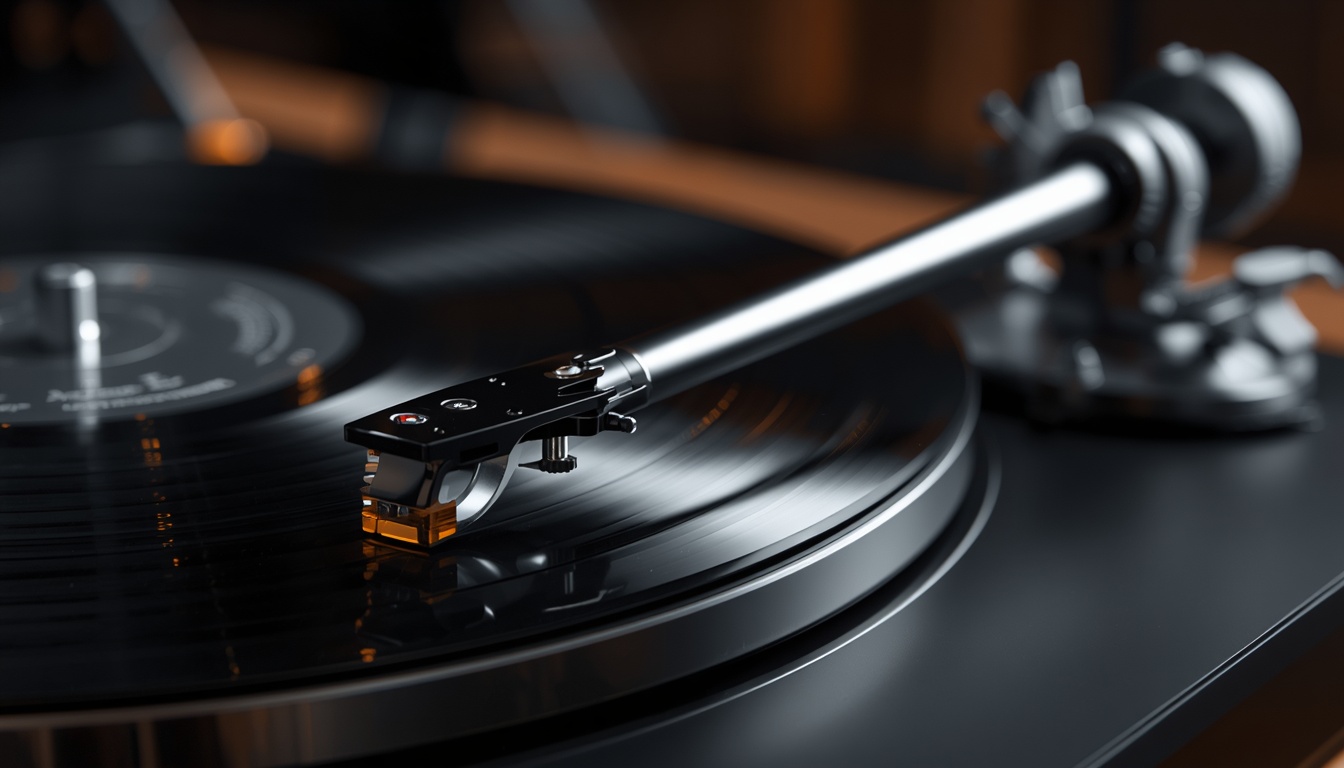

There is something almost magical about watching a vinyl record spin. The platter turns quietly, the needle settles into a tiny record groove, and suddenly an old recording seems to breathe again. But between that spinning disc and the music coming from the speakers sits a surprisingly important little machine: the tonearm.
It looks simple, almost too simple, yet its job is delicate. It carries the stylus, keeps the cartridge positioned over the record, and allows the groove to be translated into an electrical signal.
In other words, the tonearm is one of those pieces of audio equipment that you may ignore until you understand how much it actually does. And yes, the name sounds slightly strange at first.
If you searched for tonearm meaning, you probably want the plain answer first. A tonearm is the movable arm on a record player or turntable that holds the pickup or cartridge and allows the stylus to track the groove of a vinyl record. It pivots or moves across the disc during playback.
That is the dictionary-sized answer, but the real story is much more interesting because tonearms combine mechanics, balance, alignment, vibration control, and tiny amounts of pressure. A lot is happening there, quietly.
Tonearm Meaning in Simple Words
The easiest tonearm definition is this: a tonearm is the movable part of a record player that holds the phono cartridge and stylus above a spinning record. When you lower the arm, the stylus touches the groove and follows its path while the cartridge converts those physical movements into an electrical audio signal.
Think of the tonearm as a bridge between the record and the rest of your audio system. The vinyl record contains information in its groove, the stylus physically reads that information,
the cartridge turns the movement into an electrical signal, and the amplifier and speakers eventually turn that signal into sound. The tonearm has to let the stylus follow the groove without pushing it around like an impatient finger.
For a quick understanding, keep these ideas in your head:
- Tonearm = movable arm that carries the cartridge and stylus.
- Stylus = tiny tip that physically follows the record groove.
- Cartridge = device that converts stylus movement into an electrical signal.
- Platter = rotating surface that supports the vinyl record.
- Plinth = main body or base of the turntable.
- Counterweight = adjustable weight used to balance the tonearm.
- Tracking force = downward force applied by the stylus to the record.
- Playback = the process of reading the groove and producing sound.
That little chain is basically the heart of analog playback. Once you see how each piece connects, tonearm meaning stops sounding like some technical dictionary puzzle.
Tonearm Meaning on a Record Player
A tonearm on a record player is usually mounted beside the platter and designed to move horizontally toward the center of the record. The arm itself normally holds a cartridge at its front end, while a counterweight sits toward the back. This arrangement lets the user balance the arm and set an appropriate tracking force.
When someone says record player tonearm, they are talking about the same essential component, although modern turntables can have considerably more sophisticated designs. Some arms are very basic and mechanically operated, while others offer precise adjustment for cartridge alignment, tracking force, anti-skate, and vertical tracking angle.
The basic sequence is wonderfully physical:
- The platter spins the vinyl.
- The tonearm positions the cartridge.
- The stylus or needle enters the groove.
- The stylus follows tiny groove movements.
- The cartridge senses those movements.
- The cartridge produces an electrical signal.
- The signal travels into the phono stage and wider stereo system.
- Speakers turn the electrical information back into audible sound.
So when someone asks, “What does the tonearm do?”, the answer isn’t simply “it holds the needle.” That is true, but incomplete. It also helps maintain the correct relationship between the stylus and groove throughout playback.
Tonearm on a Turntable: Why Does It Matter?
The tonearm on a turntable matters because the stylus needs to stay accurately positioned inside the record groove. A badly balanced or poorly adjusted arm can create tracking problems, excessive record wear, distortion, or unstable playback. Nobody buys vinyl records just to make them suffer, after all.
A good tonearm is therefore more than a stick with a cartridge attached. Its geometry, bearings, mass, construction, and adjustment options all influence how effectively the stylus tracks the groove.
Here are some of the main things a tonearm has to accomplish:
- Carry the pickup securely.
- Hold the cartridge in the correct position.
- Allow controlled movement across the record.
- Maintain stylus tracking during playback.
- Apply appropriate tracking force.
- Support cartridge alignment.
- Limit unwanted resonance.
- Remain balanced during operation.
- Transfer very little unwanted vibration into the cartridge.
- Enable reliable record playback over the entire side.
That last point sounds ordinary, but it isn’t. A record can take twenty minutes or more to play, and the tonearm has to follow the changing groove path continuously without wandering off course.
The Tonearm, Stylus, Needle, and Cartridge: What Is the Difference?
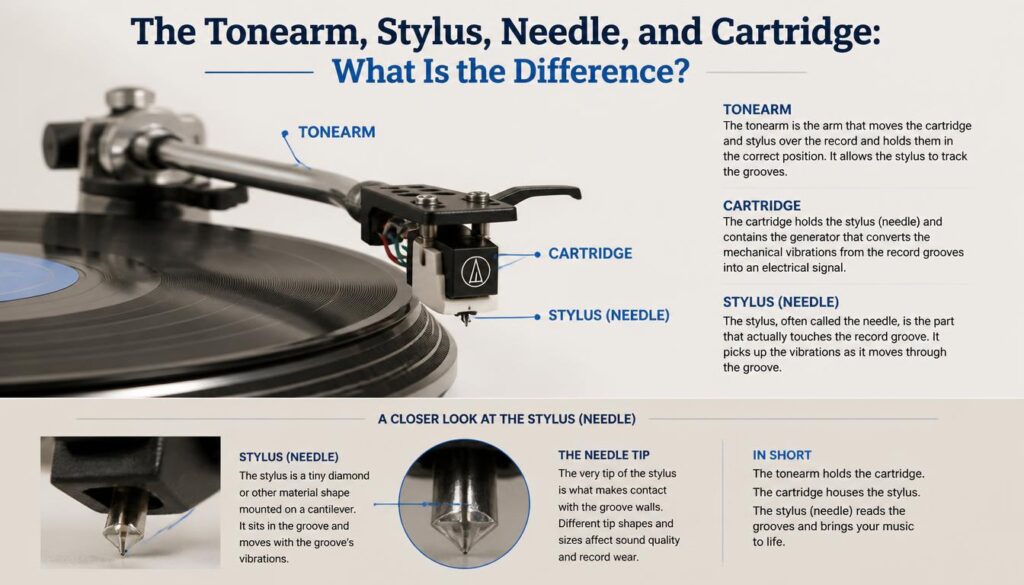
People sometimes use tonearm needle, tonearm stylus, and tonearm cartridge as if they are the same thing. They aren’t. They’re related parts, but each has a different job.
The stylus, commonly called the needle, is the tiny contact point that sits in the record groove. It may be made from diamond or another suitable material. The stylus physically moves as it encounters the microscopic variations in the groove.
The cartridge is attached to the tonearm and contains the mechanism that responds to stylus movement. A common design is the moving magnet cartridge, where the stylus movement causes a tiny magnet to move relative to coils. Other cartridge designs use different principles.
The tonearm carries the cartridge, and the cartridge carries the stylus assembly. So, roughly speaking:
- Tonearm holds and positions the cartridge.
- Cartridge converts mechanical movement into an electrical signal.
- Stylus physically traces the groove.
- Needle is the everyday term many people use for stylus.
- Pickup is another term associated with the cartridge or pickup assembly.
- Phono cartridge is the specialized cartridge used for record playback.
- Moving magnet cartridge is one common cartridge technology.
This distinction becomes especially useful when shopping for replacement parts. If someone says they need a new “needle,” they may actually mean a stylus replacement, not an entirely new cartridge.
Different Types of Tonearms
Not every turntable tonearm looks or behaves exactly the same. Manufacturers use different shapes and materials to achieve particular mechanical properties, and enthusiasts can have strong opinions about them. Vinyl lovers can debate a tonearm for longer than some people debate dinner menus, which is part of the charm.
A straight tonearm has a relatively direct shape and is common on many turntables. It can be designed in different ways depending on the manufacturer and intended use.
Other designs use curved or angled geometry. The goal is not merely to make the turntable look stylish. Geometry affects cartridge alignment and the path that the stylus follows across the record.
You may also encounter these descriptions:
- Straight tonearm designs for relatively direct geometry.
- Curved or offset tonearms designed around particular tracking geometries.
- Carbon-fiber tonearm designs emphasizing low mass and stiffness.
- Aluminum tonearms offering a familiar balance of weight, rigidity, and manufacturing practicality.
- Adjustable tonearm systems allowing several setup parameters to be changed.
- Lightweight tonearms designed for compatible cartridges.
- Heavier tonearms intended for cartridges requiring different mechanical matching.
- Removable or swappable cartridge arrangements.
- Pre-mounted cartridges for easier setup.
- Damped tonearms intended to manage unwanted resonance.
There isn’t one magical tonearm design that is perfect for every cartridge or every listener. Compatibility matters much more than simply choosing the fanciest-looking arm.
Tonearm Counterweight and Tonearm Balance
The tonearm counterweight is one of the most recognizable features at the rear of many turntables. It may look like a small metal cylinder attached to the arm, but its job is crucial.
Before playback, the tonearm can be balanced so that it floats in a controlled position. The counterweight is then adjusted to establish the recommended tracking force for the cartridge. This allows the stylus to sit in the groove with the appropriate pressure.
If the tracking force is too low, the stylus may fail to track the groove properly. If it is too high, unnecessary pressure can be placed on the stylus and record. Neither situation is ideal, obviously.
A typical setup process may involve:
- Unlocking or positioning the tonearm correctly.
- Setting the counterweight so the arm balances.
- Establishing the manufacturer’s recommended tracking force.
- Adjusting the tracking-force scale.
- Setting anti-skate when available.
- Checking cartridge alignment.
- Confirming that the stylus sits correctly over the record.
- Testing playback at a moderate listening level.
The exact procedure varies between turntables, so the manufacturer’s instructions should always take priority over generic advice.
Why Tonearm Adjustment Is Important
Tonearm adjustment is where the humble-looking component becomes surprisingly technical. The objective is to make sure the cartridge and stylus interact with the record groove in the way the manufacturer intended.
Several variables can matter, including tracking force, cartridge alignment, tonearm height, anti-skate, and sometimes vertical tracking angle. A turntable intended for casual listening may provide only basic adjustments, while enthusiast equipment can offer considerably more control.
Good setup can help with:
- Stable stylus tracking.
- Better channel balance.
- Lower distortion.
- Appropriate tracking force.
- More consistent sound quality.
- Reduced unnecessary record wear.
- Better cartridge performance.
- More predictable vinyl playback.
The important lesson is that an expensive cartridge cannot magically fix a badly configured tonearm. The little mechanical details still matter.
Read more: https://ytmeaning.com/imbue-meaning/
Tonearm and Record Groove: How Does It Actually Read Music?
A record groove is not just a line carved into plastic. It contains physical variations representing the recorded audio. As the stylus travels through that groove, its microscopic movements correspond to the information stored there.
The tonearm allows this movement to happen while maintaining the cartridge’s position relative to the record. The stylus moves, the cartridge responds, and the resulting electrical signal eventually becomes the music you hear.
You can think of the whole mechanism as a translation chain:
- Vinyl record stores physical groove information.
- Record groove causes the stylus to move.
- Stylus transfers that movement to the cartridge.
- Cartridge generates an electrical signal.
- Phono electronics amplify and equalize the signal.
- The audio system processes and amplifies it.
- Speakers reproduce the resulting sound.
That is why tonearm design can influence the experience even though the tonearm itself doesn’t “make” the music. It is responsible for helping the stylus read the source accurately.
Tonearm Materials: Aluminum, Carbon Fiber, and More
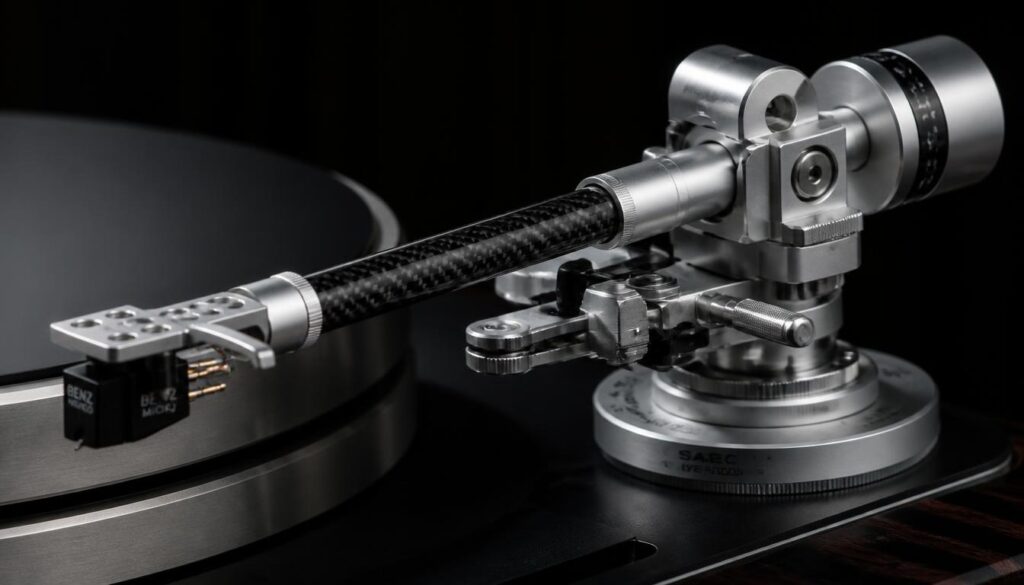
Modern audio equipment manufacturers use several materials for tonearms. Aluminum is common because it can provide useful stiffness and reasonable weight while being relatively practical to manufacture.
A carbon-fiber tonearm is another option. Carbon fiber can offer a useful combination of low mass and rigidity, depending on how the arm is engineered. But material alone doesn’t tell you whether a tonearm is good. Construction, geometry, bearings, resonance behavior, and cartridge compatibility all matter.
You may see product descriptions mentioning:
- Carbon fiber
- Aluminum
- Lightweight construction
- Rigid construction
- Damped structures
- Low-resonance designs
- Balanced construction
- Precision bearings
- Removable headshells
- Adjustable geometry
A fancy material name shouldn’t become a substitute for engineering. “Carbon fiber” sounds impressive, sure, but the whole tonearm has to work as a system.
Tonearm Resonance and Sound Quality
One of the less obvious subjects in turntable design is resonance. Every physical object can vibrate in response to energy. A tonearm is no exception.
Unwanted resonance can potentially interfere with the delicate signal being generated by the cartridge. Designers therefore consider the relationship between tonearm mass, cartridge compliance, construction, damping, and the overall mechanical system.
This is where terms such as resonance reduction, damped platter, and low-resonance construction appear in discussions about hi-fi equipment.
Still, don’t assume that every claim about resonance means you need the most expensive turntable in the shop. For most listeners, correct setup, a suitable cartridge, a stable platter, and a well-designed turntable are much more useful starting points than chasing exotic specifications.
Tonearm Meaning in the History of the Phonograph
The story of the tonearm is connected to the larger history of the phonograph and mechanical sound reproduction. Early recording and playback machines used mechanical systems very different from modern hi-fi turntables, but the basic challenge remained: a physical playback element had to follow information stored in a groove.
The word tonearm itself has a long history; Merriam-Webster lists its first known use as 1907. Over the decades, tonearms evolved alongside record players, cartridges, records, and amplification technology.
The journey moved from early mechanical phonographs toward sophisticated vinyl playback systems, with improvements in stylus design, cartridge technology, tonearm bearings, platter construction, and electronic amplification. What looks like a simple arm today is actually the result of more than a century of refinement.
Common Tonearm Questions People Ask
If you’re new to vinyl, these are the questions that usually come up first:
- What is a tonearm?
It is the movable arm that carries and positions the cartridge and stylus over a record. - What does a tonearm do?
It allows the stylus to follow the record groove while maintaining appropriate tracking conditions. - Is the tonearm the needle?
No. The needle is usually another name for the stylus, which is attached to the cartridge at the end of the tonearm. - Does every turntable have a tonearm?
Traditional turntables designed for vinyl playback generally use a tonearm or an equivalent pickup mechanism. - What is a tonearm cartridge?
The cartridge is the signal-generating component mounted to the tonearm. - What is a tonearm counterweight?
It is a weight used to balance the arm and help establish the correct tracking force. - Can a tonearm affect sound?
Yes. Tracking accuracy, resonance, alignment, and mechanical compatibility can influence playback performance. - What is a carbon-fiber tonearm?
It is a tonearm using carbon-fiber material in its construction, often to achieve useful stiffness and low mass. - What is tonearm balance?
It refers to properly balancing the arm before setting the desired tracking force. - What is tracking force?
It is the downward force with which the stylus contacts the record groove during playback.
Tonearm Meaning: Quick Comparison of Related Parts
Sometimes the fastest way to understand a technical word is to place it beside the other words surrounding it. Here’s the short version:
| Part | Main job |
|---|---|
| Tonearm | Carries and positions the cartridge |
| Stylus | Follows the record groove |
| Needle | Common everyday term for stylus |
| Cartridge | Converts stylus movement into an electrical signal |
| Phono cartridge | Cartridge designed for record playback |
| Moving magnet cartridge | Cartridge design using a moving magnet |
| Platter | Spins and supports the vinyl record |
| Plinth | Supports the turntable’s main components |
| Counterweight | Helps balance the tonearm |
| Record groove | Contains the physical information read by the stylus |
Seeing the parts together makes the meaning much less mysterious. The tonearm is not the star of the show exactly, but without it the stylus would have a pretty miserable time doing its job.
How to Choose a Good Tonearm
If you’re buying a turntable, don’t judge the tonearm only by appearance. A beautifully machined arm can still be a poor match for a particular cartridge.
Look at cartridge compatibility, adjustment options, effective mass, bearing quality, tracking capability, and whether the design allows you to set things correctly. If you’re a beginner, an easy-to-use pre-mounted cartridge and straightforward adjustment system may be more useful than a highly adjustable arm with a frighteningly complicated setup process.
For experienced vinyl listeners, the priorities may be different. They might care more about cartridge alignment, interchangeable headshells, precise tracking adjustments, resonance characteristics, and compatibility with specialist cartridges.
The best tonearm is therefore not necessarily the most expensive one. It is the one that works properly with the rest of the hi-fi system.
Tonearm Pronunciation and Usage
The tonearm pronunciation is straightforward: it is generally pronounced “TOHN-arm,” combining the ordinary words tone and arm. The term is usually written as one word: tonearm.
You might encounter sentences such as:
- “The tonearm needs adjustment.”
- “The cartridge is mounted to the tonearm.”
- “Lower the tonearm gently onto the record.”
- “This turntable uses a straight tonearm.”
- “Check the tonearm counterweight.”
- “The tonearm follows the record groove.”
- “The carbon-fiber tonearm is lightweight.”
- “The tonearm carries the pickup.”
- “Adjust the tracking force before playback.”
- “The record player tonearm should move smoothly.”
These examples also show why the word appears so often in vinyl discussions. It describes a specific physical component, not a vague idea about music.
Interesting Facts About Tonearms
A few small details make the subject more memorable, especially if you’re just entering the world of analog audio.
- The word tonearm dates back to at least 1907 according to Merriam-Webster.
- A tonearm doesn’t simply move randomly across a record; its geometry is designed around stylus tracking.
- The rear counterweight helps balance the mass of the cartridge and front portion of the arm.
- The stylus is the part that actually contacts the record groove.
- A cartridge and stylus are related, but they are not the same component.
- Tonearms can be straight, curved, lightweight, damped, or made using materials such as carbon fiber.
- Poor setup can undermine otherwise good turntable hardware.
- Tracking force is a key part of cartridge and tonearm setup.
- Resonance is an important consideration in mechanical audio design.
- Tonearm performance depends on the relationship between the arm, cartridge, stylus, and record.
Why the Tonearm Still Matters in the Age of Digital Music

Digital music has made listening incredibly convenient, but vinyl has survived because convenience isn’t the only thing people value. There is something tactile about taking a record from its sleeve, placing it on the platter, brushing away dust, and lowering a tonearm by hand.
The tonearm becomes part of that ritual. It is visible, mechanical, and physical. You can actually watch the system reading the music. A streaming app hides almost everything that is happening; a turntable puts the mechanism right in front of you.
That doesn’t automatically make vinyl superior to digital audio. They’re different playback approaches, with different strengths and compromises. But the tonearm helps explain why analog playback remains fascinating to so many listeners.
Frequently Asked Qeustions
What is the meaning of tonearm?
A tonearm is the movable part of a record player that holds the cartridge and stylus over a vinyl record.
What does a tonearm do on a turntable?
A tonearm carries the stylus and allows it to follow the record groove accurately during playback.
What is a tonearm cartridge?
A cartridge is attached to the tonearm and converts the stylus’s physical movements into an electrical audio signal.
What is a tonearm counterweight?
A counterweight balances the tonearm and helps set the correct tracking force for the stylus.
Can a tonearm affect sound quality?
Yes, tonearm balance, alignment, tracking, and resonance can affect the accuracy and overall quality of vinyl playback.
Final Thoughts on Tonearm Meaning
So, tonearm meaning can be summed up in one clean sentence: a tonearm is the movable mechanical arm on a record player or turntable that holds the cartridge and stylus and allows the stylus to track the groove of a vinyl record.
But the little arm deserves more credit than that sentence gives it. It sits between delicate groove information and the electrical side of the audio system, balancing movement, pressure, alignment, and vibration while a record spins beneath it. The tonearm on a turntable may look almost boring when the music is playing, yet its job is wonderfully precise.
If you’re learning about turntable parts, remember the simple chain: tonearm → cartridge → stylus → record groove → electrical signal → sound. Once that sequence clicks, terms such as tracking force, counterweight, cartridge alignment, tonearm balance, and phono cartridge become much easier to understand.
And perhaps that’s the nicest thing about learning old-school audio: a word that initially looks odd—tonearm—opens a tiny door into the entire mechanical world of vinyl. Spin the record, lower the arm, let the stylus find its groove, and suddenly the explanation isn’t just technical anymore. You can hear it.
A Note on the “Baby Girl Wishes” Requirement
The requested instructions also mentioned welcoming a baby girl and creating baby-girl wishes. That theme doesn’t naturally belong in an article about tonearm meaning, so I kept the article focused on the stated title and its related semantic terms rather than inserting unrelated congratulations messages that would make the article confusing and less useful.