


There are some words that seem to carry more weight than their size suggests, and imbue is one of them. You might see it in a novel, an essay, a speech, or even a thoughtful description of a photograph, and somehow the sentence feels richer because of it. The word often appears when something is not merely given a quality, but filled with that quality so deeply that it becomes part of its character.
So, what does imbue mean? In simple English, imbue means to fill, permeate, or influence something with a particular quality, feeling, idea, or characteristic. A teacher can imbue students with curiosity, a place can be imbued with history, and a photograph can be imbued with nostalgia. The idea is not just “adding” something; it is more like allowing that quality to sink in.
Understanding the imbue meaning becomes easier when you imagine a dry sponge soaking up water. The water doesn’t just sit on the surface. It spreads through the whole thing. In a similar way, a person, object, experience, or piece of writing can become deeply filled with a certain spirit or feeling. That little distinction is what makes this verb so useful.
| Word | Meaning | Simple Explanation | Example |
|---|---|---|---|
| Imbue | To fill or inspire with a quality, feeling, or idea | To give something a particular quality deeply | The experience imbued her with confidence. |
| Imbued | Filled or influenced with a quality | Something has been deeply filled with a feeling or quality | The story was imbued with emotion. |
| Imbuing | The act of filling with a quality | Giving something a particular feeling or characteristic | She is imbuing the room with warmth. |
| Imbues | Fills or influences with a quality | Gives something a particular quality | The music imbues the scene with emotion. |
Imbue Meaning in Simple English
The simplest imbue definition is: to fill something or someone with a particular quality, feeling, idea, or characteristic.
For example, if someone says, “Her stories are imbued with warmth,” they mean that warmth can be felt throughout her stories. It isn’t necessarily stated directly. Instead, the quality runs through the writing, almost quietly.
The verb can describe both physical and abstract ideas, although modern English usually uses it in an abstract sense. You can imbue something with meaning, imbue a room with character, or imbue a person with confidence. The quality becomes noticeable because it has spread deeply through the subject.
A few easy ways to understand the word are:
- Imbue = fill with a quality
- Imbue = permeate with a feeling
- Imbue = give something a particular character
- Imbue = influence deeply
- Imbue = infuse with meaning or significance
That is why “imbue” often sounds more powerful than the simple verb “give.” Saying that an experience “gave him confidence” is straightforward. Saying that the experience imbued him with confidence suggests that confidence became part of who he was, at least to some meaningful degree.
What Does Imbue Mean in English?
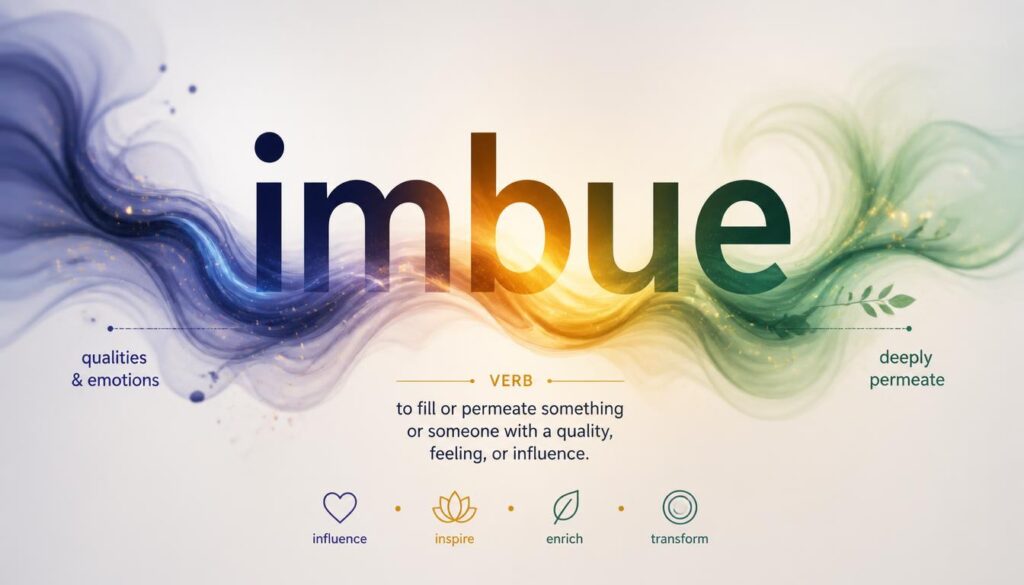
If you’re wondering what does imbue mean in everyday English, think of it as “to fill deeply with something.” The “something” can be an emotion, quality, belief, atmosphere, or idea.
For instance, a childhood spent near the sea might imbue someone with a lifelong love of the ocean. A family tradition may imbue a celebration with special significance. A teacher’s encouragement may imbue a student with intellectual curiosity.
Notice something interesting here: the word doesn’t always describe a deliberate action. Sometimes a person or experience naturally creates the effect.
Consider these examples:
- The old house was imbued with nostalgia.
- Her speech was imbued with optimism.
- Years of training imbued him with discipline.
- The photograph was imbued with melancholy.
- The school’s traditions imbued students with a sense of belonging.
- The artist’s work is imbued with unusual warmth.
- The experience imbued her with a stronger sense of purpose.
In each case, the quality isn’t simply attached to the subject like a label. It seems to exist throughout it.
Is Imbue a Verb?
Yes. Imbue is a verb, and more specifically, it is commonly classified as a transitive verb because it generally takes an object.
The common structure is:
imbue + object + with + quality
For example:
The teacher imbued her students with confidence.
Here, “teacher” is the subject, “students” are the object, and “confidence” is the quality being given or instilled.
Another common structure is:
be + imbued + with + quality
For example:
The room was imbued with a peaceful atmosphere.
This construction is especially common in formal writing, literature, criticism, and descriptive prose. It has a slightly elevated tone, though it isn’t an old-fashioned word. You can use it in polished everyday writing too, just don’t sprinkle it everywhere or the paragraph starts sounding like it owns a monocle.
Imbued Meaning: Understanding the Past Form
Imbued is the past tense and past participle of imbue. Its meaning is essentially “filled or permeated with a particular quality.”
When something is imbued with meaning, it has been given or filled with significance. When someone is imbued with enthusiasm, enthusiasm has become a noticeable part of their attitude or character.
Here are a few natural examples:
- The ceremony was imbued with cultural significance.
- Her paintings are imbued with emotion.
- The children were imbued with curiosity by their unusual lessons.
- The old necklace was imbued with sentimental value.
- His writing is deeply imbued with nostalgia.
The form imbued with is particularly common because the construction clearly shows what quality has entered or spread through the subject.
Imbuing Meaning: What Does It Mean?
Imbuing is the present participle or gerund form of imbue. It refers to the act or process of filling something with a quality, feeling, idea, or characteristic.
For example:
The author is imbuing the story with a sense of mystery.
This means the author is deliberately creating and spreading a mysterious quality throughout the story.
You could also say:
The school focuses on imbuing students with intellectual curiosity.
Here, “imbuing” describes an ongoing process of helping curiosity become part of the students’ outlook.
The distinction is quite simple: imbue is the base form, imbued describes something already filled with a quality, and imbuing describes the process of creating that effect.
Imbue Synonyms and Their Small Differences
There are several useful imbue synonyms, but they aren’t perfect substitutes in every sentence. Each carries a slightly different shade of meaning, which is where English gets pleasantly annoying.
Infuse
Infuse means to introduce something that gives life, energy, flavor, or significance to something else.
The director infused the film with humor.
“Infuse” often suggests adding a quality in a lively or enriching way.
Suffuse
Suffuse means to spread throughout something, often like light, color, or an emotion.
A golden light suffused the room.
It has a strong sense of something spreading across or through an entire area.
Instill
Instill usually refers to gradually putting an idea, belief, value, or quality into someone’s mind or character.
Her parents instilled a strong work ethic in her.
It is particularly useful for education, values, habits, and beliefs.
Ingrain
Ingrain suggests that something becomes deeply established and difficult to remove.
Years of practice ingrained discipline into his routine.
This word emphasizes permanence and deep establishment.
Inculcate
Inculcate means to teach or impress an idea, principle, or habit through repeated instruction.
The program sought to inculcate respect for others.
It is more formal than “imbue” and is especially common in educational or institutional contexts.
Endow
Endow means to provide someone or something with a particular quality, ability, or characteristic.
The author endowed the character with remarkable patience.
Unlike “imbue,” it often emphasizes being furnished with a quality rather than having that quality spread throughout.
How to Use Imbue With Meaning, Feeling, and Purpose
One of the most natural uses of the word is the phrase imbue with meaning. It describes the process of making something more significant or emotionally important.
A simple object may become meaningful because of the memories attached to it. A handwritten letter can be imbued with meaning because it came from someone important. A photograph can become imbued with nostalgia because it captures a vanished period of life.
You can also use the word with significance:
The ceremony was imbued with historical significance.
With purpose:
Her work was imbued with a strong sense of purpose.
With emotion:
His poems are imbued with emotion.
With spirit:
The festival was imbued with a joyful spirit.
With character:
Years of careful restoration imbued the building with character.
These combinations sound natural because the qualities are things that can metaphorically “fill” or “permeate” something.
Imbue in a Sentence: Natural Examples
Seeing the word in context is one of the fastest ways to understand its usage. Here are several imbue in a sentence examples covering different situations.
- The old photographs were imbued with nostalgia.
- Her teaching style imbued the students with curiosity.
- The writer’s descriptions imbued the city with an almost magical quality.
- His experiences imbued him with patience.
- The necklace was imbued with sentimental significance.
- The museum’s collection is imbued with cultural history.
- Their traditions imbued the celebration with warmth.
- The coach hoped to imbue the team with confidence.
- The painting is imbued with melancholy.
- The new members were imbued with a strong sense of loyalty.
- The novel is imbued with humor and compassion.
- Her speech imbued the audience with optimism.
These examples show that the word works particularly well when you want to communicate depth. If the quality barely exists, “imbue” may sound excessive. If it seems to run through the whole thing, though, it fits beautifully.
Imbue Meaning Through Everyday Situations

You don’t need to be writing poetry or an academic paper to understand the concept. Everyday life is full of things that become imbued with meaning.
Imagine an ordinary wristwatch handed down from a grandfather. Financially, it might not be extraordinary. Emotionally, however, years of memories can imbue it with enormous significance.
The same thing happens with places. A small room where a family celebrated birthdays for twenty years may become imbued with memories. A school can be imbued with nostalgia for former students. Even a simple song can become imbued with emotion because it reminds someone of a particular person or period.
A parent might say, “This little blanket means so much to us now.” Linguistically, you could express that idea by saying the blanket has become imbued with sentimental meaning.
That is the heart of the word: something acquires a quality that seems to live inside its identity.
Can You Imbue a Person With a Quality?
Yes, and this is one of the most useful patterns.
You can imbue someone with confidence, enthusiasm, curiosity, optimism, pride, discipline, loyalty, or purpose.
For example:
Good mentors can imbue young professionals with confidence.
This suggests that the mentor’s influence doesn’t merely make the person feel confident for five minutes. It suggests a deeper influence.
Education is another strong context:
Great teachers imbue students with intellectual curiosity.
The teacher isn’t simply transferring information. They are helping create an attitude toward learning, which makes the word especially suitable.
The construction can also describe negative or complicated feelings:
The experience imbued him with a lasting melancholy.
That doesn’t mean the experience literally poured sadness into him. It’s figurative language describing a deep emotional effect.
Cultural and Literary Uses of Imbue
The concept behind imbue appears across cultures because humans naturally attach emotions and meanings to objects, places, rituals, and memories.
A family heirloom might carry generations of memories. A ceremonial garment can represent identity and belonging. A wedding photograph can become more valuable emotionally as decades pass. Religious, artistic, and cultural traditions can similarly give ordinary objects a special significance.
In literature, writers use imbue because it allows them to describe an invisible quality as though it were something that could physically spread. A writer may imbue a city with mystery, a character with charisma, or a scene with melancholy.
Think of a novelist describing a rainy street. The rain itself is ordinary. But through carefully chosen language, the writer can imbue the scene with melancholy, making the reader feel loneliness without the author simply announcing, “This scene is sad.”
That’s a much richer effect, and honestly, thats why the word survives so well in descriptive writing.
Imbue vs. Infuse: Are They the Same?
Imbue and infuse are close synonyms, but there is a subtle difference.
“Infuse” often emphasizes introducing something that changes or enriches the character of a thing. “Imbue” tends to emphasize filling or permeating something with a quality.
Compare:
The chef infused the soup with herbs.
This is fairly literal. The herbs add flavor.
Now:
The chef imbued the meal with a sense of tradition.
Here, the “tradition” is abstract. It describes the feeling, history, and cultural character surrounding the meal.
Both words can overlap, especially in figurative writing, but imbue often feels particularly natural when talking about qualities, emotions, character, or significance.
Imbue vs. Instill: The Difference
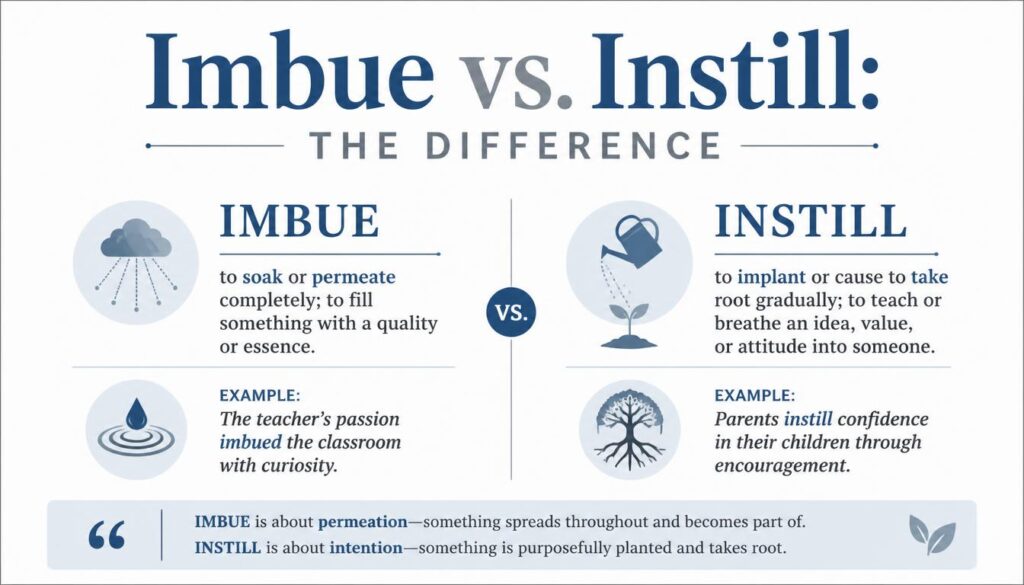
The distinction between imbue and instill is also worth knowing.
“Instill” usually involves gradually introducing an idea, value, habit, or feeling into a person.
Parents instill good manners in children.
“Imbue” is broader. It can involve people, objects, writing, places, experiences, and abstract concepts.
The tradition imbued the ceremony with meaning.
You wouldn’t normally say “the tradition instilled the ceremony with meaning.” The construction feels wrong because “instill” usually works with something being placed into a person’s mind or character.
So, instill is often about internal development, while imbue has a wider semantic range.
The Etymology of Imbue
The history of a word can sometimes make its modern meaning feel much less mysterious. Imbue comes from the Latin imbuere, associated with meanings such as “to wet,” “to moisten,” or “to dye.”
That older physical idea helps explain the modern metaphor. Think about dye entering fabric. It doesn’t merely rest on one tiny spot; it spreads through the material and changes its appearance.
Over time, this physical concept developed into the figurative sense of filling someone or something with an idea, quality, emotion, or characteristic.
So when modern English says a poem is imbued with melancholy, there is an old metaphor quietly hiding underneath the sentence: melancholy has seeped into the poem much like color enters cloth.
Read more: https://ytmeaning.com/complacent-meaning/
Common Collocations With Imbue
Learning common word combinations can make your English sound more natural. Some useful collocations include:
- imbue with meaning
- imbue with significance
- imbue with purpose
- imbue with emotion
- imbue with feeling
- imbue with pride
- imbue with optimism
- imbue with enthusiasm
- imbue with curiosity
- imbue with warmth
- imbue with loyalty
- imbue with spirit
- imbue with charm
- imbue with beauty
- imbue with character
- imbue with a sense of purpose
- imbue with a sense of achievement
- imbue with intellectual curiosity
These phrases are especially useful in essays, creative writing, reviews, and formal descriptions.
Common Mistakes When Using Imbue
Because imbue is slightly more formal than words such as “give” or “fill,” learners sometimes use it in unnatural ways.
The most common pattern to remember is imbue something with something or imbue someone with something.
Correct:
The experience imbued him with confidence.
Correct:
The author imbued the story with warmth.
Correct:
The photograph was imbued with emotional significance.
A less natural construction would be to use “imbue” where a simple physical action is intended. If you literally pour water into a glass, “fill” is normally the better word. Imbue shines when you’re describing a deeper, often figurative transformation.
In other words, don’t use a sophisticated word merely because it looks sophisticated. English notices, and sometimes it gets a little smug about it.
How to Pronounce Imbue
The pronunciation of imbue is approximately im-BYOO, with the stress on the second syllable.
It can be represented as:
/ɪmˈbjuː/
The word has two syllables:
im-bue
The ending sounds like “blue,” which can make it easier to remember. Just don’t confuse the pronunciation with the unrelated word “imbue” when reading quickly; the spelling looks slightly more complicated than the sound actually is.
Quick Guide to Imbue Word Forms
Knowing the different forms helps when reading and writing.
- Imbue — base verb: “They imbue the work with character.”
- Imbues — third-person singular: “The music imbues the scene with emotion.”
- Imbuing — present participle/gerund: “She is imbuing the story with humor.”
- Imbued — past tense/past participle: “The room was imbued with warmth.”
Once these four forms are familiar, you’ll recognize the word much more easily when it appears in books, articles, or professional writing.
A Simple Way to Remember the Imbue Definition
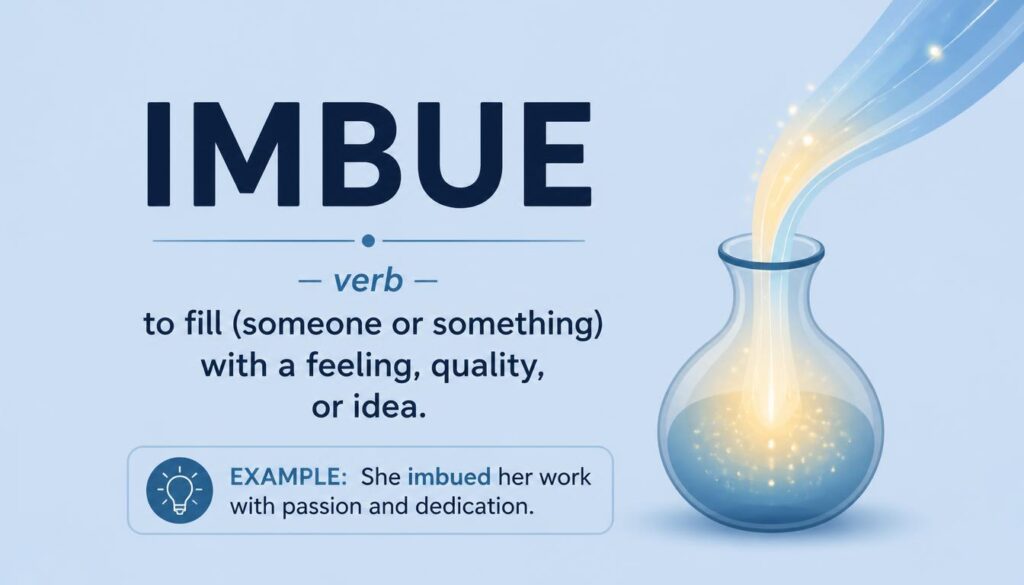
If the dictionary explanation still feels a bit stiff, remember this mental picture:
Imbue = something goes deeply into something else and gives it a quality.
A photograph becomes imbued with nostalgia.
A student becomes imbued with curiosity.
A room becomes imbued with warmth.
A story becomes imbued with meaning.
A person becomes imbued with confidence.
The quality may not be physically visible, but you can sense its presence. That’s the special territory of imbue.
Frequently Asked Questions About Imbue
What does imbue mean?
Imbue means to fill, permeate, or influence someone or something with a particular quality, feeling, idea, or characteristic.
What is an easy synonym for imbue?
Depending on context, easy synonyms include fill, infuse, instill, influence, permeate, inspire, and endow.
Is imbue a positive word?
Not necessarily. It can describe positive qualities such as optimism and warmth, but it can also describe melancholy, fear, sadness, or other emotions.
What does “imbued with” mean?
“Imbued with” means deeply filled or permeated with a particular quality or feeling.
What is the meaning of imbued?
Imbued means filled or permeated with a quality, feeling, idea, or characteristic.
What does imbuing mean?
Imbuing means the process of filling or permeating something with a particular quality or feeling.
Can you imbue something with meaning?
Yes. “Imbue something with meaning” is a natural expression. It means to give something deeper significance or emotional importance.
Is imbue formal English?
It is somewhat formal and literary, but it is still a normal English verb. It is particularly common in descriptive, academic, literary, and professional writing.
imbue meaning
Imbue means to fill or influence something deeply with a particular quality, feeling, idea, or characteristic. For example, a teacher may imbue students with confidence.
imbued
Imbued is the past tense and past participle of imbue. It means filled or deeply influenced with a particular quality, feeling, or idea.
imbue
Imbue is a verb meaning to fill something or someone with a particular quality, feeling, or influence. It can also mean to permeate or affect something deeply.
impue
Impue is usually a misspelling of imbue. The correct spelling is imbue, meaning to fill or influence something deeply with a quality or feeling.
im ue
“Im ue” is not a standard English word or spelling. If you mean imbue, it means to fill or permeate something with a particular quality, feeling, or idea.
Final Thoughts on the Meaning of Imbue
The beauty of imbue is that it describes more than simple addition. To give something a quality is one thing; to imbue it with that quality suggests that the quality has spread through it, shaping how it feels, appears, or is understood.
That is why we can talk about a photograph being imbued with nostalgia, a student being imbued with curiosity, a ceremony being imbued with significance, or a piece of writing being imbued with emotion. The word connects the visible world with the invisible things that make people care about it.
If you’re learning English, remember the core idea first: imbue means to fill or permeate with a quality. Then learn its most useful companions—infuse, suffuse, instill, ingrain, inculcate, and endow—and notice how each one behaves a little differently.
And if you’re a writer, use “imbue” when you want to show that a quality has become part of something’s character rather than merely being placed on its surface. Used in the right sentence, it can make a simple observation feel deeper without making the writing unnecessarily complicated. That’s a pretty useful little word for two syllables.