

There are words that simply describe a mood, and then there are words that seem to carry an entire tired little universe inside them. Jaded is one of those words.
You may hear someone say, “I’m feeling jaded,” after years at the same job, too many disappointing relationships, endless bad news, or just a long stretch of life that has asked for more energy than it gave back.
It doesn’t always mean someone is physically tired; sometimes the person is tired of caring, which is a rather different thing.
Understanding the jaded meaning becomes easier when you imagine enthusiasm slowly being rubbed away by experience.
A person who was once excited, curious, or hopeful may become jaded by experience, repeated disappointments, or overexposure. The sparkle hasn’t exactly vanished forever, but it has certainly gone on a coffee break.
What Does Jaded Mean?
So, what does jaded mean in simple English? The word jaded is an adjective used to describe someone who has become tired, bored, or emotionally worn out because of too much experience, repetition, disappointment, or overexposure to something.
The jaded definition is often connected with a loss of enthusiasm. A person may have seen the same problems again and again, experienced too many disappointments, or simply become exhausted by a particular environment. They may still perform their duties, smile at people, and get through the day, but inside, the excitement has become noticeably quieter.
For example, a journalist who has covered years of political scandals might become a jaded journalist, expecting every new announcement to end in another controversy. A worker who has heard countless promises about promotions might become jaded by work. A person who has experienced several painful relationships may become jaded by relationships and stop believing that the next one will be different.
In other words, being jaded is more than being tired. It often contains an emotional layer of disappointment or cynicism.
Jaded Meaning in Simple Words
If you want the meaning of jaded in the easiest possible language, think of it as:
Jaded = emotionally tired, less enthusiastic, and no longer easily impressed because of too much experience or disappointment.
Someone can be tired after sleeping badly, but that doesn’t automatically make them jaded. A jaded person may have plenty of physical energy and still feel emotionally drained. Thats the little distinction that makes this word interesting.
Imagine a child seeing snow for the first time. Their eyes go wide, they run outside, and suddenly the entire world is a white adventure. Now imagine someone who has lived beside a snowy mountain for thirty years. Snow may still be beautiful, but the reaction could be more like, “Oh, snow again. Great, where’s the shovel?” That second reaction has a touch of jadedness.
Jaded as an Adjective
Grammatically, jaded is primarily a jaded adjective. It describes a person, attitude, outlook, appetite, or emotional condition.
You might describe someone as having a jaded attitude, a jaded outlook, or a jaded personality. The word can also describe reactions and expectations rather than the entire person.
Consider these examples:
- She became jaded after years of working in a highly competitive industry.
- His jaded attitude made every new idea sound pointless.
- After countless disappointing dates, she felt jaded by relationships.
- The reporter sounded jaded after covering years of political conflict.
- He looked jaded, although he insisted that everything was fine.
- Years of overwork had left her emotionally jaded.
- Constant overexposure to bad news can make people feel jaded.
The word therefore doesn’t have to mean that someone is permanently negative. A person can become jaded and later recover their curiosity or enthusiasm, which is actually a hopeful little detail.
Jaded vs Tired: Are They the Same?
One of the most common questions about the word is jaded vs tired. They overlap, but they are not identical.
Tired usually refers to a lack of physical or mental energy. You might be tired after travelling, studying, exercising, or working late. Sleep and rest can often solve ordinary tiredness.
Jaded, however, suggests something deeper. It can involve emotional exhaustion, mental fatigue, disappointment, boredom, or a loss of enthusiasm caused by repeated experiences.
Someone might say:
“I’m tired after working ten hours.”
But they might say:
“I’m jaded after ten years of doing the same work and hearing the same promises.”
The first person needs a rest. The second person might need a change, a fresh challenge, or simply some distance from what has been draining them. And yes, sometimes both people need a very large cup of tea.
Jaded vs Cynical
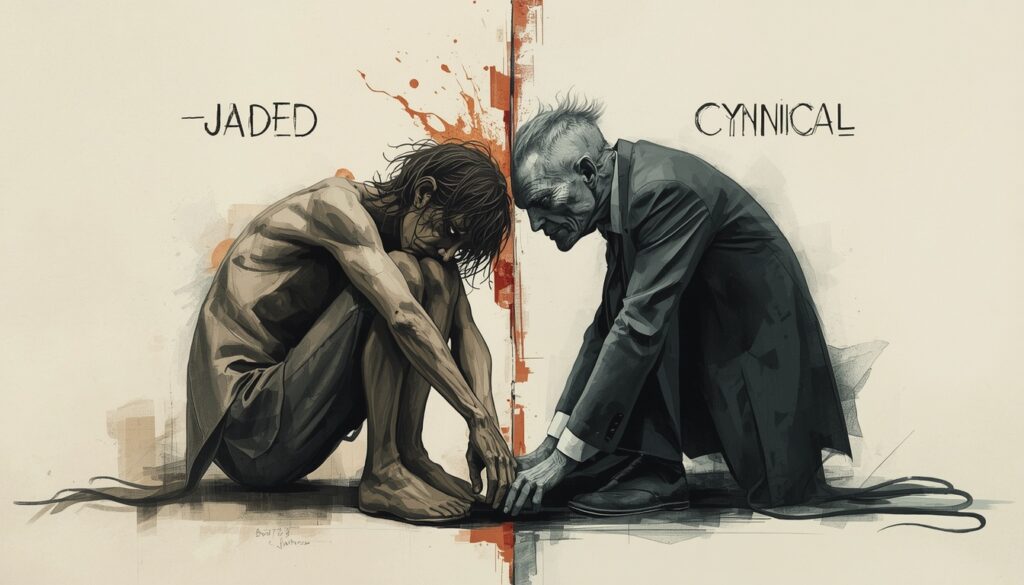
The jaded vs cynical distinction is also worth understanding because the two words frequently travel together.
A cynical person tends to distrust people’s motives and may expect selfishness or dishonesty. Jaded, on the other hand, focuses more on being worn down or disillusioned by experience.
A person can become jaded without being deeply cynical. For example, an employee might be tired of repetitive corporate routines but still believe their colleagues are good people. Their enthusiasm has faded, but their trust hasn’t necessarily disappeared.
Still, jaded cynicism can develop when repeated disappointment changes not only someone’s enthusiasm but also their expectations of other people. The person begins to assume that good outcomes are unlikely. That is where jaded outlook and cynical thinking begin to overlap.
Jaded Synonyms You Can Use
There are many useful jaded synonyms, although each one carries a slightly different shade of meaning.
- Tired lacking energy or needing rest.
- Weary deeply tired, often after prolonged effort.
- Exhausted extremely tired or depleted.
- Worn out physically or emotionally used up.
- Fatigued tired, especially from sustained effort.
- Drained lacking emotional or physical energy.
- Bored uninterested because something lacks novelty.
- Disillusioned disappointed because reality failed to match expectations.
- Apathetic showing little interest or concern.
- World-weary tired of life’s difficulties or disappointments.
- Blasé unimpressed because something has become too familiar.
- Dissatisfied unhappy because expectations aren’t being met.
For example, someone can be weary without being cynical, while someone who is jaded often has a history behind their lack of enthusiasm. The difference is small sometimes, but language loves these small differences.
Jaded Antonyms: What Is the Opposite of Jaded?
The main opposite of jaded is unjaded, although everyday English offers many other possibilities.
Useful jaded antonyms include:
- Unjaded
- Enthusiastic
- Excited
- Energetic
- Optimistic
- Hopeful
- Interested
- Passionate
- Engaged
- Refreshed
- Curious
- Inspired
An unjaded person tends to retain their sense of curiosity and wonder. They may have experienced disappointment, but those experiences haven’t completely dulled their enthusiasm.
A good example is a teacher who has been working for twenty years but still gets excited when students discover something new. The person has plenty of experience, but experience hasn’t turned into emotional exhaustion. They remain interested, engaged, and perhaps slightly amazed that teenagers still ask the same question every single year.
Jaded Feeling: What Does It Feel Like?
A jaded feeling can be difficult to describe because it isn’t always dramatic. Sometimes it is incredibly quiet.
You might notice that things which once excited you now barely register. Compliments feel predictable. New projects seem like old projects wearing a different shirt. You hear another promise and immediately think, “Sure, we’ve heard that before.” This can be a form of loss of excitement.
Other people may notice that you seem distant or indifferent. You might not be angry; you simply don’t have the emotional energy to react anymore. This is where indifference, dissatisfaction, and emotional weariness can appear.
A person who is emotionally jaded may still care very deeply underneath the surface. Their emotional response has simply been dulled by repetition, disappointment, or prolonged stress. It isn’t always coldness. Sometimes it is caring that has become exhausted.
Why Do People Become Jaded?

People can become jaded for many reasons, and there isn’t one universal cause.
Jaded by Experience
Repeated bad experiences can change how someone sees the world. If every new opportunity ends badly, a person may eventually stop expecting anything good from the next opportunity.
This is often described as becoming jaded by experience. The experience itself isn’t necessarily harmful; rather, the accumulation of similar experiences can slowly create emotional weariness.
Jaded by Overwork
Being jaded by overwork is common in demanding careers. Constant deadlines, repetitive tasks, pressure, and little recognition can create burnout-like feelings.
At first, someone might work late because they are ambitious. Later, they may work late because they feel trapped. Eventually, even a simple email can look like an ancient enemy returning from the sea.
Jaded by Overuse and Overexposure
The human mind can become accustomed to almost anything. When something is constantly repeated, its emotional impact can become weaker.
This is why overuse, saturation, and overexposure may contribute to jadedness. A person who hears dramatic news every morning may eventually stop reacting strongly to stories that would once have shocked them.
Jaded by Life
The phrase jaded by life is often used when someone has experienced enough disappointment that optimism becomes difficult. Financial problems, failed plans, broken promises, difficult relationships, or prolonged uncertainty can all contribute.
This doesn’t mean the person is doomed to stay that way. A negative outlook can change, although usually not because someone simply says, “Cheer up.” If it were that easy, dictionaries would have solved half of humanity’s problems.
Jadedness Meaning
Jadedness is the noun form connected with the state of being jaded. The jadedness meaning refers to emotional weariness, reduced enthusiasm, or a sense of cynicism caused by excessive experience, disappointment, repetition, or overexposure.
For example:
- His jadedness was obvious during the meeting.
- Years of disappointment had produced deep jadedness.
- The novel captures the jadedness of people living through constant conflict.
- Her natural optimism slowly disappeared beneath layers of jadedness.
The word can describe an atmosphere too. A workplace may have a feeling of jadedness when everyone has stopped believing that change is possible.
Jadedly Meaning and Usage
Jadedly is the adverb form of the word. It describes an action performed in a jaded or weary manner.
For example:
- He jadedly dismissed the announcement.
- She jadedly listened to another promise of reform.
- The employee jadedly said that the new policy would probably change again next month.
In natural conversation, people don’t use jadedly very often. It is more common in formal writing, journalism, essays, or literary descriptions. Saying “He replied jadedly” is perfectly correct, but “He replied with a tired, doubtful look” might sound more natural in everyday speech.
Jaded in a Sentence: Everyday Examples
If you’re learning English vocabulary, seeing jaded examples can make the word much easier to remember.
- After years in the same industry, he felt jaded.
- She was becoming jaded by life after several difficult years.
- The jaded journalist expected another scandal.
- His jaded attitude surprised everyone who knew him as an optimistic teenager.
- Constant rejection left the young artist jaded.
- She wasn’t angry, just jaded.
- The traveller became jaded after visiting too many tourist-packed destinations.
- Years of overwork made him physically tired and emotionally jaded.
- Her jaded outlook made it difficult for her to enjoy new opportunities.
- Even after many disappointments, he remained remarkably unjaded.
Notice how the word usually carries a story behind it. You don’t simply wake up jaded for no reason; there is often a trail of experiences leading there.
Jaded Person Meaning

A jaded person is someone whose enthusiasm, optimism, or emotional responsiveness has been reduced by repeated experiences, disappointment, overwork, or excessive familiarity.
A jaded person may appear cynical, apathetic, bored, or dissatisfied. But appearances can be misleading. Someone who seems indifferent might actually be protecting themselves from another disappointment.
For example, imagine a person who has applied for twenty jobs and received twenty rejections. On the twenty-first application, they may say, “Whatever happens, happens.” That doesn’t necessarily mean they don’t care. It may mean they have learned not to let hope become too expensive.
Jaded Personality and Jaded Behavior
A jaded personality often appears skeptical, detached, or difficult to impress. Such a person may question enthusiastic claims and expect problems before they happen.
Jaded behavior can include dismissing new ideas, expecting failure, showing little excitement, or responding to impressive events with a shrug.
But it’s important not to use the label too quickly. Someone having a bad week isn’t automatically a jaded person. Temporary exhaustion, sadness, stress, or boredom can look similar on the surface.
The word usually suggests something more established: a gradual loss of enthusiasm shaped by experience.
Jaded Etymology: Where Did the Word Come From?
The jaded etymology of the word is particularly interesting. The adjective comes from the older word jade, which historically referred to a worn-out or inferior horse.
The root is therefore connected to the idea of something becoming exhausted through excessive use. Over time, the meaning moved from an overworked animal to a person whose energy or enthusiasm had similarly been worn down.
The word was first recorded around 1585–95, according to commonly cited dictionary histories. The suffix -ed creates the adjective jaded, essentially describing a person or thing affected by this state.
So the old image of a tired horse eventually became a modern description of a tired human spirit. Language does have a strange way of dragging old farmyard images into modern office conversations.
Jaded Pronunciation
The standard jaded pronunciation is:
/ˈdʒeɪdɪd/
It sounds roughly like “JAY-did.”
The first part rhymes with “made,” while the ending sounds like “did.” In both American English and British English, the pronunciation is broadly similar, although individual accents naturally change the sound a little.
The related word jade is pronounced differently at the ending because it has only one syllable: /dʒeɪd/.
Jaded in Literature, Journalism, and Popular Culture
The idea behind jaded appears frequently in literature and journalism because writers often explore what repeated suffering or disappointment does to people.
Characters who have travelled widely, fought wars, experienced political corruption, or survived difficult relationships are sometimes portrayed as jaded because their experiences have changed what they expect from the world.
The idea also appears in works and cultural references associated with writers such as Kurt Vonnegut, including Slaughterhouse-Five, where war and human suffering challenge simple ideas about optimism and meaning. Similar themes can be found in stories of adventure, conflict, ambition, and disillusionment.
Modern journalism also uses the term frequently. A writer may describe consumers, investors, voters, employees, or audiences as jaded when repeated promises or disappointments have weakened their enthusiasm.
Jaded vs Unjaded: Can Experience Make You Better Instead?
Being experienced doesn’t automatically make someone jaded. That’s an important point.
A person can encounter failure without becoming cynical. They can experience heartbreak without deciding that love is meaningless. They can work in a difficult industry without losing their curiosity.
This is where unjaded becomes useful. Someone can be experienced and still enthusiastic, cautious but hopeful, knowledgeable without being cynical.
In fact, the healthiest response to disappointment may not be blind optimism. It might be something more balanced: “I know things can go wrong, but I still want to try.”
That is not naïve. It’s experienced hope, which is a rather sturdy kind of hope.
How to Use Jaded Correctly
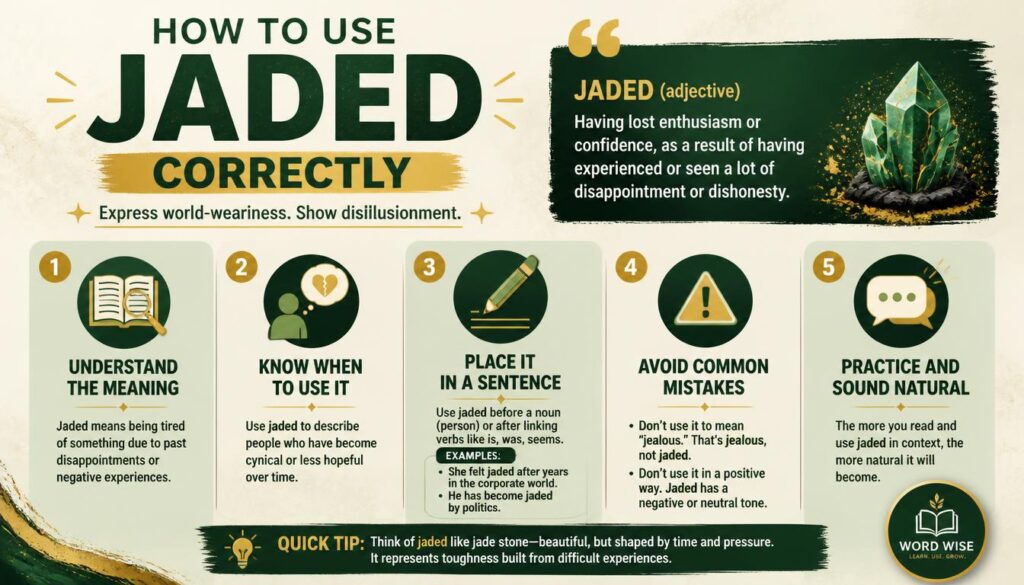
Use jaded when you want to communicate that someone’s enthusiasm, optimism, or emotional response has been worn down by experience.
A useful pattern is:
Person + became/felt/seemed + jaded + because of experience
Examples:
- She felt jaded after years of office politics.
- He became jaded by repeated failures.
- The actor seemed jaded by fame.
- The reporter had grown jaded by constant bad news.
- She was jaded by overwork, not lazy.
Avoid using jaded simply as a fancy replacement for “tired.” If you only need to say someone needs sleep, tired is usually the better word.
Frequently Asked Questions
jaded definition
Jaded means feeling tired, bored, or less enthusiastic because of too much experience, disappointment, or overexposure to something.
what does jaded mean
Jaded describes someone who has lost excitement or interest after experiencing the same things repeatedly or facing too many disappointments.
define jaded
To define jaded, it means being emotionally worn out, disillusioned, or no longer easily impressed because of past experiences.
jaded meaning
The jaded meaning is a state of emotional tiredness where a person becomes less hopeful, enthusiastic, or interested due to repeated experiences.
jaded def
Jaded is an adjective for someone who feels weary, cynical, or uninterested after too much experience, repetition, or disappointment.
Final Thoughts on the Jaded Meaning
The real beauty of the word jaded is that it describes more than exhaustion. It describes what can happen when experience becomes too heavy, too repetitive, or too disappointing and slowly takes the shine out of things.
The jaded meaning is therefore closely connected to emotional exhaustion, disillusionment, loss of enthusiasm, cynicism, and weariness. Yet being jaded doesn’t have to become someone’s permanent identity. People can rediscover curiosity. They can rest, change direction, meet new people, find meaningful work, or simply allow themselves to be surprised again.
If you remember only one thing, remember this: tired means your energy is low; jaded suggests your enthusiasm has been worn down by experience. That’s the little difference, but it carries a whole lot of meaning.
And perhaps that is why the opposite, unjaded, feels so lovely. It suggests that despite everything life has thrown at someone, there is still a corner of them that can look at something ordinary and say, “Wait… that’s actually pretty amazing.” Sometimes, that tiny reaction is where enthusiasm begins again.