

There are some English words that seem to walk into a sentence wearing perfectly normal shoes, and then somehow leave the whole sentence looking slightly chaotic. Unhinged is one of those words.
You may see someone describe a movie as unhinged, a celebrity interview as unhinged, a friend’s late-night text as unhinged, or even a perfectly innocent cake recipe as “absolutely unhinged.” And you might stop for a second and think, wait, what does that even mean here?
The unhinged meaning depends quite a lot on context. Traditionally, the word describes someone who is mentally disturbed, emotionally unstable, or behaving in a way that seems to have lost normal restraint.
In everyday internet language, however, it has developed a much broader and often humorous sense. Something can be called unhinged because it is wildly strange, excessive, chaotic, unpredictable, or simply so ridiculous that ordinary words have packed their bags and gone home.
That little shift in meaning is what makes the word interesting. It can sound serious in one sentence and completely playful in another. Understanding that difference is the key to using unhinged without accidentally making a conversation much darker than you intended.
Unhinged Meaning in Simple English
The simplest unhinged definition is something like: not mentally or emotionally stable, or behaving in an uncontrolled and extreme way.
Cambridge Dictionary lists unhinged as an adjective and gives its traditional sense as mentally ill, with related words including disturbed, mad, crazy, and unbalanced.
But language is a slippery little creature. In modern informal speech, especially online, unhinged can mean something closer to “wildly chaotic,” “completely outrageous,” or “having absolutely no filter.”
For example:
- “His reaction was unhinged.”
This could mean his reaction was seriously disturbing or irrational.
But:
- “That comedian’s airport story was completely unhinged.”
Here, the speaker probably means the story was absurd, chaotic, and hilariously over-the-top.
And then there is:
- “She ate an entire pizza at 2 a.m. and called it breakfast. Unhinged.”
Nobody is necessarily making a medical judgement about her. They are probably just teasing her for an impressively chaotic decision.
So, what does unhinged mean? It means different things depending on the emotional temperature of the sentence.
The Literal Idea Behind the Word
The word becomes easier to understand when you picture a door.
A hinged door is attached to its frame and moves within a controlled range. An unhinged door has come off those hinges. It is no longer behaving the way a door is supposed to behave. It swings loose, falls over, or becomes difficult to control.
That physical image eventually became a metaphor for the human mind and behavior. If someone is described as unhinged, the suggestion is that their normal emotional or mental control has somehow come loose.
It is a rather dramatic metaphor, honestly. English looked at a door falling off its hinges and apparently thought, “Yes, that perfectly describes a person having a terrible day.”
The related verb is unhinge, meaning to disturb someone mentally or emotionally. Cambridge gives examples involving shock, grief, and pressure causing someone to become unhinged.
So you can have:
- “The experience completely unhinged him.”
- “The shocking news unhinged her.”
- “Years of pressure had begun to unhinge him.”
In these examples, the word is not really humorous. It describes serious emotional disturbance or loss of stability.
Unhinged as an Adjective
From a grammar point of view, unhinged is primarily an adjective.
An adjective describes a person, thing, situation, action, or experience. So you might say:
- “He seemed unhinged.”
- “That was an unhinged decision.”
- “The movie becomes increasingly unhinged.”
- “Her message was completely unhinged.”
- “The villain has an unhinged obsession.”
- “Their argument turned unhinged very quickly.”
- “That theory sounds a little unhinged.”
Notice something interesting here: the word can describe both people and things.
That is one reason its modern informal use has become so flexible. A movie cannot literally have a mental state, obviously, but we can describe its plot as unhinged because it behaves in a chaotic, bizarre, or unpredictable manner.
Language does this sort of thing constantly. Nobody asks a sentence to show its passport before letting it use a metaphor.
Unhinged Meaning in Modern Slang
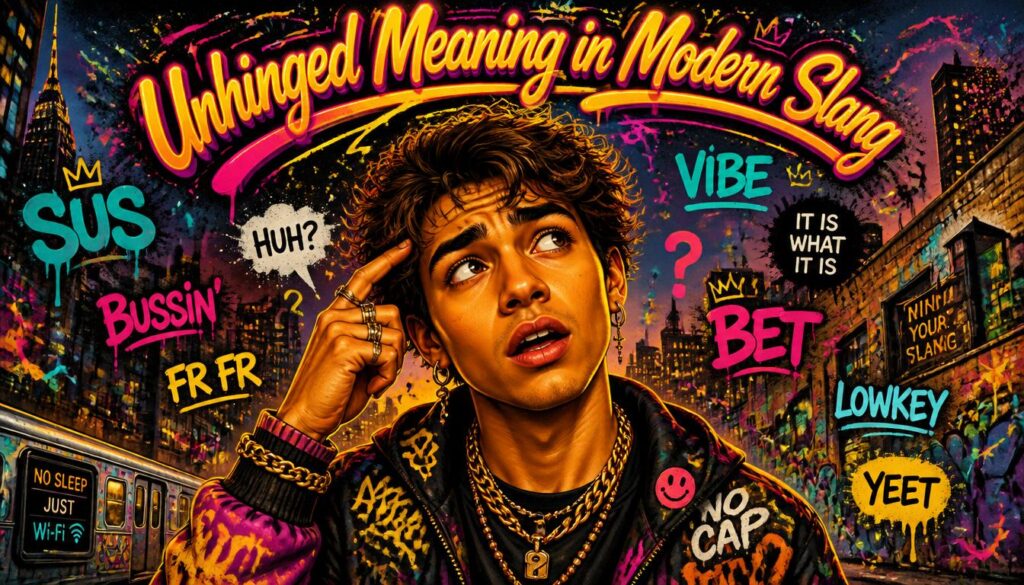
On social media, unhinged has become one of those wonderfully elastic words that can stretch to fit almost any ridiculous situation.
Someone might post a screenshot of an absurd text message and caption it:
- “This is unhinged.”
A friend may wear six different colors to a formal dinner:
- “Your outfit is unhinged, but I respect it.”
A movie might contain a plot twist that makes absolutely no sense:
- “The third act went fully unhinged.”
A celebrity could make an unexpectedly bizarre comment during an interview:
- “That answer was genuinely unhinged.”
In these cases, the speaker often isn’t saying the person is mentally ill. They are saying the behavior is extreme, unpredictable, strange, excessive, or delightfully chaotic.
That distinction matters.
Modern slang often exaggerates for comic effect. Calling your friend’s breakfast order “unhinged” is very different from describing a person who is genuinely experiencing a serious psychological crisis.
Unhinged Synonyms: Which Words Are Similar?
There are many unhinged synonyms, but they aren’t all interchangeable.
Words such as crazy, mad, disturbed, unstable, irrational, wild, erratic, and maniacal can overlap with unhinged, but each carries its own flavor.
Cambridge’s thesaurus associates unhinged with words including frantic, frenzied, fanatical, insane, maniacal, mad, wild, irrational, strange, eccentric, bizarre, and absurd, among others.
Here is how some of them feel in ordinary conversation:
- Crazy — very common and casual, but potentially insensitive when referring to mental illness.
- Mad — can mean angry, insane, or wildly enthusiastic depending on the variety of English.
- Disturbed — usually darker and more serious.
- Unstable — suggests a lack of emotional or psychological stability.
- Irrational — focuses more on unreasonable thinking or decisions.
- Erratic — emphasizes unpredictable behavior.
- Maniacal — dramatic, extreme, and often associated with frightening or obsessive behavior.
- Wild — often playful and much less psychologically loaded.
- Bizarre — strange or unusual rather than necessarily emotionally unstable.
- Absurd — focuses on something ridiculous or unreasonable.
So if your friend orders twelve desserts for three people, “wild” may be playful, “unhinged” may be funny and exaggerated, while “mentally unstable” would be an entirely different and much more serious statement.
When “Unhinged” Is Funny
The humorous use of unhinged usually comes from exaggeration.
Imagine someone saying:
“I couldn’t decide which socks to wear, so I bought a new personality instead.”
That is unhinged in the internet-slang sense. It is strange, dramatic, unnecessary, and funny because the response is wildly disproportionate to the problem.
Here are some harmless examples:
- “He put hot sauce on ice cream. Absolutely unhinged.”
- “She emailed her own shopping list to herself and replied ‘Thanks.’ Unhinged behavior.”
- “My cat knocked over one glass and then stared at me like I owed him money. Completely unhinged.”
- “The group chat went from birthday plans to conspiracy theories in seven minutes.”
- “Ordering soup at a barbecue is mildly unhinged, but brave.”
- “He brought a suitcase to a one-hour meeting. Nobody knows why.”
- “She made a PowerPoint presentation to explain why she deserved the last slice of cake.”
- “That wedding dance routine was so unhinged that everybody eventually joined in.”
- “I reorganized my fridge at midnight instead of sleeping. A little unhinged, perhaps.”
Here the word is basically a cousin of chaotic, ridiculous, or out of pocket.
It is less “something is medically wrong” and more “what on earth are you doing, and why is this somehow entertaining?”
When Unhinged Is Serious
The playful meaning should not make us forget that unhinged also has a serious meaning.
If a news report describes an unhinged extremist, violent offender, or person displaying disturbing behavior, the word may be intended to convey severe instability or dangerous irrationality.
Likewise, phrases such as:
- “He became increasingly unhinged.”
- “The threats left her emotionally unhinged.”
- “His behavior appeared irrational and disturbed.”
- “The character becomes psychologically unhinged.”
- “The experience completely unhinged him.”
can describe distress, loss of control, or serious emotional disturbance.
This is also why using the word casually about a real person’s mental health can be unkind. Saying “that meme is unhinged” is harmless internet banter. Saying “my neighbor is unhinged” about somebody you barely know can sound like a serious accusation.
Basically, context is doing a lot of unpaid labor here.
Unhinged vs. Crazy, Insane, and Psychotic
People often search for unhinged synonyms such as crazy, insane, or psychotic, but these words should not always be treated as perfect replacements.
Unhinged is broader and often more figurative. It can describe a fictional villain, a bizarre movie, an absurd joke, an extreme decision, or an emotionally distressed person.
Psychotic, on the other hand, is a clinical term connected with psychosis and should not be casually used as a synonym for “weird.” A person behaving strangely is not automatically psychotic. That distinction gets lost online way too easily.
Similarly, insane has a long history of casual usage, but it can be insensitive when used to characterize someone’s actual mental-health condition.
If you simply mean “really strange,” alternatives such as bizarre, wild, absurd, chaotic, or extreme are often better.
Unhinged Behavior: What Does It Look Like?

The phrase unhinged behavior usually points toward actions that appear extremely irrational, unpredictable, excessive, or uncontrolled.
Depending on context, examples might include:
- An obsessive reaction to a minor disagreement.
- An extreme response to criticism.
- An irrational decision made without considering consequences.
- A bizarre public outburst.
- A fictional character suddenly abandoning all normal rules.
- A conspiracy theory built from almost no evidence.
- A wildly excessive response to an ordinary problem.
- Obsessive pursuit of something far beyond reasonable limits.
- Erratic behavior that seems completely unpredictable.
- A dramatic emotional reaction that keeps escalating.
However, it is worth remembering that observing unusual behavior does not tell us what is happening inside someone’s mind. Unhinged is a description, not a diagnosis.
That little distinction can save a lot of unnecessary assumptions.
Unhinged Meaning in Movies and Pop Culture
Pop culture practically adopted the word and gave it a louder microphone.
A movie can be called unhinged when its story becomes increasingly bizarre, violent, surreal, unpredictable, or excessive. A super villain may be described as unhinged because their plans are wildly irrational. A comedy can be unhinged because it keeps pushing situations far beyond normal social behavior.
For example:
- “The villain’s plan is completely unhinged.”
- “That Marvel-style superhero plot gets more unhinged every ten minutes.”
- “The ending was so unhinged nobody in the theater knew whether to laugh.”
- “The chef character has an unhinged obsession with perfection.”
- “The show starts normally and then becomes gloriously unhinged.”
- “Her character is charming, but there’s something slightly unhinged underneath.”
- “The director clearly decided realism was optional.”
- “That episode was pure unhinged chaos.”
- “The final scene takes an already strange story into completely unhinged territory.”
Here, the word usually communicates intensity rather than a literal psychological diagnosis.
Unhinged Humor and the Internet
An unhinged sense of humor is usually humor that deliberately ignores normal expectations.
It might be absurd, unexpectedly dark, extremely random, aggressively silly, or built around a joke that arrives from somewhere nobody invited.
Someone with an unhinged sense of humor might respond to:
“I’m having a bad day.”
with:
“Have you considered becoming a mysterious lighthouse keeper?”
There is no logical connection. That is partly the point.
The joke works because it breaks the expected pattern. The response is weird enough to become funny. Internet culture especially loves this style because screenshots, memes, comments, and short videos reward quick unexpected turns.
But again, unhinged humor does not automatically mean offensive humor. It can simply mean unpredictable and absurd.
Unhinged Obsession Meaning
Another common expression is unhinged obsession.
An obsession is an unusually intense fixation on a person, subject, activity, idea, or goal. Adding unhinged suggests that the fixation has become extreme, irrational, excessive, or difficult to control.
For example:
- “His unhinged obsession with finding the perfect burger became a family joke.”
- “She developed an unhinged obsession with organizing every book by color.”
- “The character’s unhinged obsession drives the entire story.”
- “His pursuit of the missing photograph becomes increasingly unhinged.”
- “The fan theory has grown into an unhinged obsession.”
- “She spent three days investigating a fictional character’s backstory.”
- “That level of detective work is impressive but slightly unhinged.”
In fictional or humorous contexts, this can be entertaining. In real-life situations involving harassment, stalking, threats, or dangerous fixation, however, the phrase describes something much more serious.
Read more: https://ytmeaning.com/icymi-meaning/
How to Use Unhinged in a Sentence
The easiest formula is simply to put unhinged before a noun or after a linking verb.
Examples:
- “That was an unhinged decision.”
- “His behavior became unhinged.”
- “The story gets more unhinged every chapter.”
- “That is an unhinged theory.”
- “She has an unhinged sense of humor.”
- “The character becomes completely unhinged.”
- “This conversation has taken an unhinged turn.”
- “That was perhaps the most unhinged thing I’ve seen all week.”
- “The comments section became unhinged.”
- “I respect the creativity, but the execution was unhinged.”
You can also intensify it with words such as completely, absolutely, genuinely, totally, or slightly.
“Completely unhinged” sounds much stronger than “slightly unhinged,” obviously. English has apparently decided that even chaos requires volume controls.
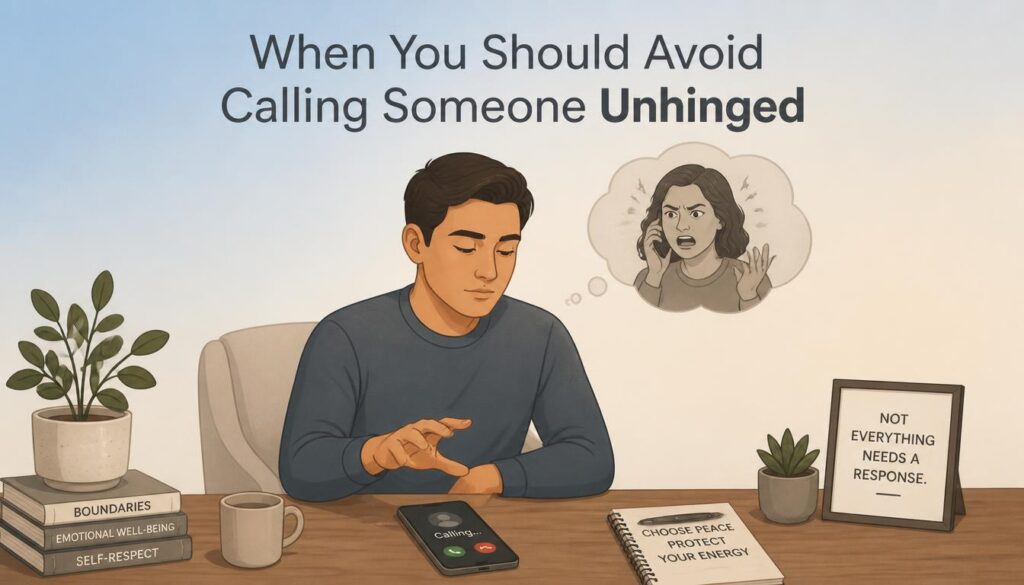
When You Should Avoid Calling Someone Unhinged
This is one of the most useful parts of understanding the meaning of unhinged.
Avoid casually labeling a real person as unhinged when you are actually making a judgement about their mental health. The word can carry a strong implication of mental instability, particularly in serious contexts.
Instead of:
- “She’s unhinged.”
you could say:
- “Her reaction seemed unusually intense.”
- “His behavior was unpredictable.”
- “That decision seemed irrational.”
- “The situation became very chaotic.”
- “He appeared extremely distressed.”
- “Her response seemed disproportionate.”
These alternatives describe what happened without pretending you know the person’s psychological condition.
In casual joking between close friends, unhinged may be perfectly fine. In professional, medical, journalistic, or sensitive conversations, more precise language is usually the smarter choice.
A Quick Guide to the Different Meanings
The word can be understood through a few broad shades:
Traditional meaning: mentally disturbed or emotionally unstable.
Behavioral meaning: acting irrationally, unpredictably, or without normal restraint.
Informal meaning: wildly strange, chaotic, excessive, or outrageous.
Humorous meaning: absurd in a way that is funny rather than genuinely dangerous.
Pop-culture meaning: extreme, bizarre, unpredictable, or deliberately over-the-top.
Emotional meaning: deeply distressed or thrown off balance.
Character meaning: a fictional person whose actions seem obsessive, irrational, dangerous, or wildly unpredictable.
Once you understand these shades, most examples become fairly easy to decode.
Frequently Asked questions
unhinged meaning
“Unhinged” means highly disturbed, emotionally unstable, or unable to think and behave in a normal, controlled way. It is often used to describe someone acting irrationally or extremely.
unhinged definition
The definition of “unhinged” is being mentally or emotionally unstable, disturbed, or distraught. It can also describe behavior that seems irrational, extreme, or out of control.
what does unhinged mean
“Unhinged” describes a person or behavior that appears extremely unstable, irrational, or emotionally disturbed. For example, someone acting wildly or unpredictably may be described as unhinged.
unhinged def
“Unhinged” is an adjective meaning highly disturbed, unstable, or distraught. It is commonly used for someone whose behavior seems irrational or extreme.
define unhinged
To define “unhinged” simply, it means mentally or emotionally unstable, disturbed, or out of control. Similar words include crazy, irrational, unstable, and distraught.
Final Thoughts on the Unhinged Meaning
So, what does unhinged mean? At its core, it describes something or someone that has moved away from ordinary control or stability. In its traditional sense, it can mean mentally or emotionally disturbed. In casual modern language, it often means wildly chaotic, irrational, bizarre, excessive, or delightfully ridiculous.
The word is powerful partly because it has this double life. One minute, someone can say, “His behavior became unhinged,” and mean something deeply serious. Five minutes later, somebody else can post a picture of a sandwich covered in twenty toppings and write, “This is unhinged,” while laughing at their own culinary crime.
That is language for you. It refuses to stay in one room.
If you’re trying to use unhinged yourself, the best rule is simple: look at the context before you let the word loose. Use it playfully for absurd situations when the audience understands the joke. Choose more precise language when discussing someone’s actual mental or emotional state. And remember that unhinged synonyms such as crazy, insane, psychotic, mad, or disturbed can carry different levels of seriousness and should not be swapped around like identical socks.
Ultimately, the unhinged meaning sits somewhere between instability, extremity, irrationality, and chaos, with modern slang giving it a much cheekier personality. It is a word for moments when normal behavior seems to have quietly walked out the back door.
And sometimes, honestly, the group chat really is unhinged.