
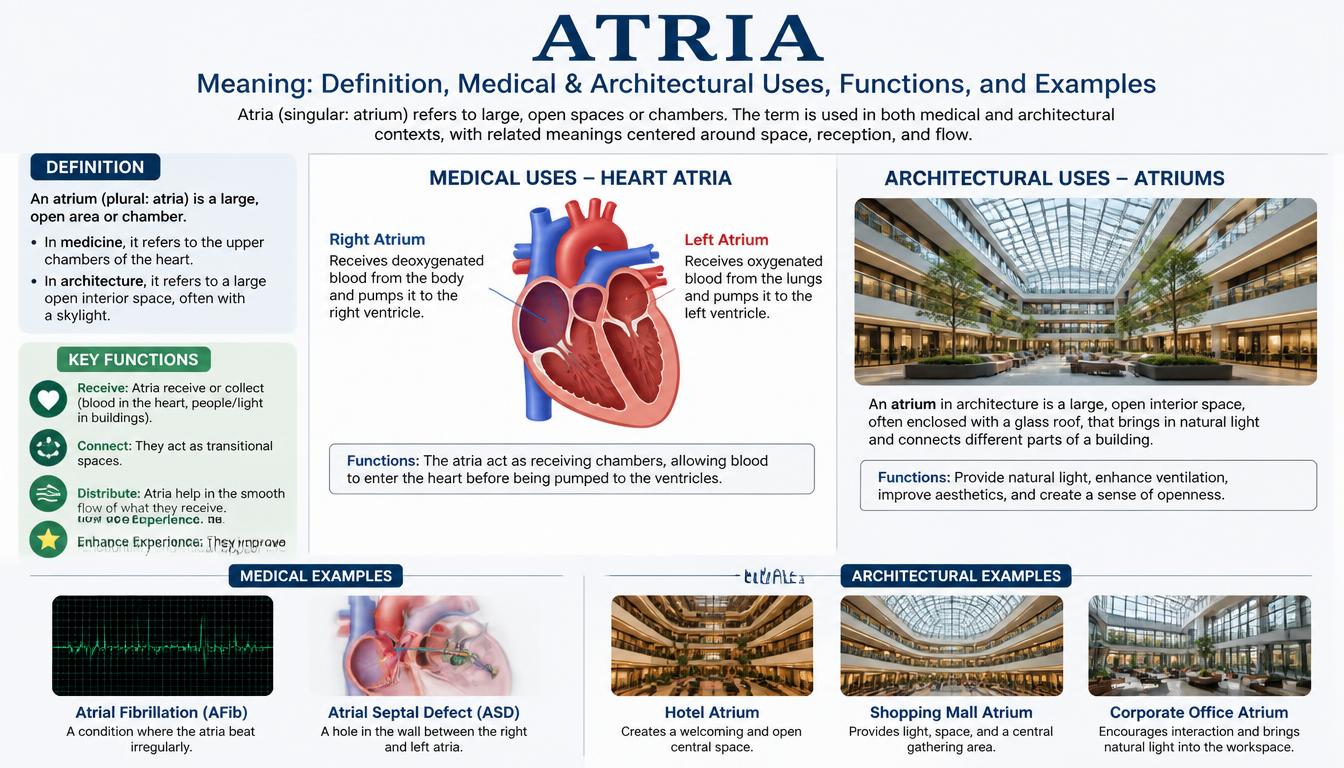

Have you ever searched for atria meaning and found completely different explanations? That’s because the word atria has more than one meaning. In medicine, it refers to the two upper chambers of the heart atria.
In architecture, it describes large open spaces inside buildings designed to improve natural light, ventilation, and energy efficiency. This dual meaning often confuses readers, but once you understand the context, it becomes quite simple.
In this guide, you’ll learn the meaning of atria, where the term comes from, how it is used in medicine and architecture, and why it is important in both fields. We’ll also compare the singular and plural forms, explore real-world examples, and answer common questions people ask.
What Is the Meaning of Atria?
Atria is the plural form of the word atrium.
The meaning depends on the context:
| Context | Meaning |
|---|---|
| Medicine | The two upper chambers of the heart that receive blood before passing it to the ventricles. |
| Architecture | Large open central spaces inside buildings, often covered with glass roofs to provide natural light and ventilation. |
Although both uses share the same Latin origin, they describe completely different structures.
Atria Meaning in Medical Terms
In medicine, the atria are the two upper chambers of the heart. Every healthy human heart contains:
- Right atrium
- Left atrium
These chambers receive blood before it moves into the lower chambers, known as the ventricles.
Simply put:
Atria → receive blood → ventricles pump blood
This process keeps blood circulating throughout the body.
The Right Atrium
The right atrium collects oxygen-poor blood returning from the body through the superior and inferior vena cava.
Its main responsibilities include:
- Receiving deoxygenated blood
- Passing blood through the tricuspid valve
- Sending blood into the right ventricle
- Supporting continuous circulation
Without the right atrium, blood would not enter the lungs for oxygenation.
The Left Atrium
The left atrium receives oxygen-rich blood from the lungs through the pulmonary veins.
Its job is to:
- Receive oxygenated blood
- Transfer blood into the left ventricle
- Help supply oxygen-rich blood to the entire body
Although these steps sound straightforward, they happen continuously roughly once every second in a resting adult.
Functions of the Heart Atria
The atria perform several important tasks.
1. Receiving Blood
The primary function of the atria is receiving incoming blood.
- Right atrium receives blood from the body.
- Left atrium receives blood from the lungs.
2. Regulating Blood Flow
The atria contract gently to move blood into the ventricles.
Atria → contract → blood enters ventricles
This coordinated movement ensures efficient heart function.
3. Supporting Cardiac Rhythm
The heart’s natural pacemaker, called the sinus node, is located inside the right atrium.
It generates electrical impulses that regulate heartbeat.
This means:
Sinus node → generates impulses → heart beats rhythmically
4. Maintaining Healthy Circulation
Healthy atria contribute to:
- Stable blood pressure
- Efficient oxygen delivery
- Normal heart rhythm
- Proper cardiac output
Even though they’re smaller than the ventricles, their role is incredibly important.
Common Medical Terms Related to Atria
When reading medical literature, you’ll often encounter related anatomical terms.
| Medical Term | Meaning |
|---|---|
| Sinus venosus | An embryonic heart structure contributing to the right atrium. |
| Coronary sinus | A large vein that drains blood from the heart muscle into the right atrium. |
| Atrioventricular node (AV node) | Electrical relay station between the atria and ventricles. |
| Mitral valve | Valve between the left atrium and left ventricle. |
| Tricuspid valve | Valve between the right atrium and right ventricle. |
These structures work together to maintain proper heart function.
Medical Conditions Affecting the Atria
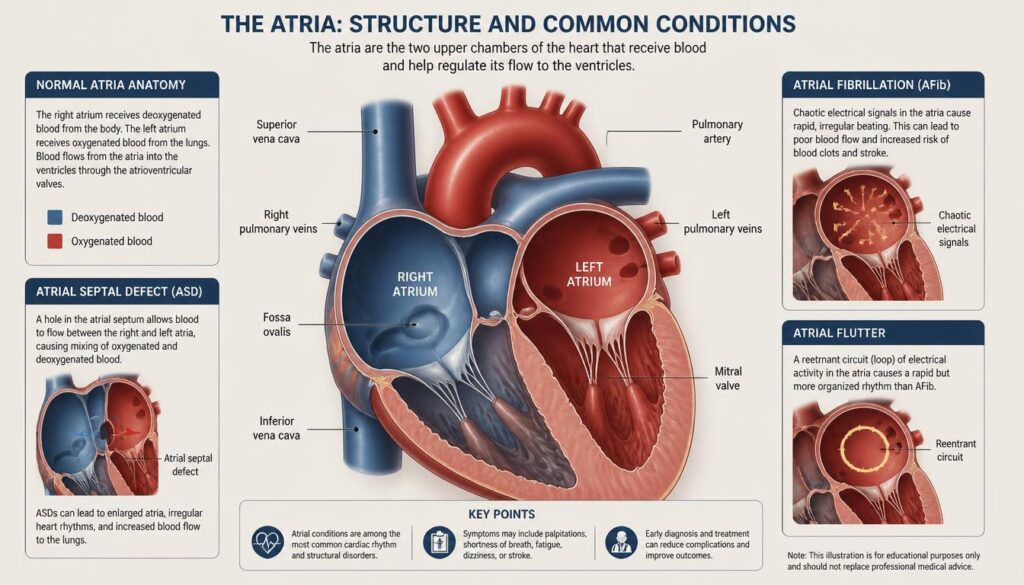
Several heart conditions involve the atria.
Atrial Fibrillation
One of the most common rhythm disorders.
It occurs when the atria beat irregularly, causing:
- Rapid heartbeat
- Fatigue
- Dizziness
- Increased stroke risk
Enlarged Left Atrium
An enlarged left atrium may develop because of:
- High blood pressure
- Valve disease
- Long-term heart conditions
Doctors often identify this using echocardiography.
Congenital Heart Defects
Some babies are born with abnormalities involving the atria.
Examples include:
- Atrial septal defect (ASD)
- Congenitally corrected transposition
- Abnormal positioning of the atria
These conditions may require monitoring or surgical treatment depending on severity.
Atria Meaning in Architecture
Outside medicine, atria refers to large open interior spaces inside buildings.
An atrium is typically:
- Tall
- Open
- Naturally lit
- Centrally located
- Often covered by glass roofing
Modern offices, shopping malls, hotels, hospitals, airports, and universities frequently feature atria.
Unlike the heart, architectural atria are designed to improve the indoor environment rather than circulate blood.
Why Buildings Have Atria
Architects use atria for several practical reasons.
Better Natural Light
Glass-covered atria allow daylight to reach deep into buildings.
This reduces dependence on artificial lighting during daytime.
Improved Ventilation
Many buildings use natural airflow.
Night-time ventilation → cools → thermal mass
This cooling strategy can reduce indoor temperatures the following day.
Energy Savings
Well-designed atria contribute to lower energy consumption.
However:
Larger atria → do not necessarily improve → energy savings
The size, orientation, glazing, and climate all influence performance.
Enhanced Appearance
Large atria create an open and welcoming atmosphere.
Visitors often perceive buildings with atria as brighter and more spacious.
Types of Architectural Atria
Architectural atria come in different forms.
Some common designs include:
- Central atrium
- Linear atrium
- Multi-storey atrium
- Covered courtyard
- Enclosed atrium
- Glass-roof atrium
Each serves different architectural and environmental purposes depending on the building’s design and climate.
How Atria Improve Building Performance
Architectural atria are not just decorative spaces. When designed properly, they can improve a building’s environmental performance and create a more comfortable indoor environment.
Some of the main benefits include:
- Better distribution of natural daylight
- Improved air circulation
- Enhanced indoor comfort
- Reduced reliance on artificial lighting
- Potential energy savings
- Attractive interior spaces
For example, an office building with a well-designed atrium may require less electric lighting during the day. That said, the overall efficiency depends on climate, orientation, glazing, and ventilation strategy. So, it’s not always a one-size-fits-all solution.
Climate Considerations for Architectural Atria

The performance of an atrium changes depending on the local climate.
Winter Benefits
During colder months, an atrium can act as a passive solar system.
Sunlight enters through the glazed roof and warms the interior space.
This creates several advantages:
- Increased indoor temperatures
- Better thermal comfort
- Reduced heating demand
- Improved natural lighting
Many sustainable buildings use this approach to lower heating costs.
Summer Challenges
While atria provide excellent daylight, they may also trap heat during warmer months.
Some common challenges include:
- Higher indoor temperatures
- Increased cooling requirements
- Excessive solar heat gain
- Glare from large glazed surfaces
To address these issues, architects often include:
- External shading devices
- Operable windows
- Night-time ventilation
- Thermal mass materials
- High-performance glazing
These features help maintain comfortable temperatures throughout the year.
Understanding Thermal Mass and Ventilation
One important concept associated with architectural atria is thermal mass.
Thermal mass refers to materials—such as concrete, brick, or stone—that absorb heat during the day and release it slowly later.
This creates a more stable indoor temperature.
A common design strategy is:
Night-time ventilation → cools → thermal mass
During cool evenings, fresh air removes heat stored in building materials. The cooled thermal mass then helps keep the building comfortable the next day.
This approach is widely used in sustainable architecture.
Solar Gain and Building Orientation
The direction an atrium faces has a significant impact on its performance.
Research has shown that:
North-facing atria → require → higher energy loads
This happens because north-facing spaces generally receive less direct sunlight, reducing natural solar gain.
By contrast:
- South-facing atria often receive more winter sunlight.
- East-facing atria capture morning sun.
- West-facing atria may experience higher afternoon heat.
Proper orientation allows architects to balance daylight, heating, and cooling needs more effectively.
Enclosed Atria and Self-Shading
Many modern buildings include enclosed atria protected by glass roofs and walls.
One interesting characteristic is:
Enclosed atria → provide → greater self-shading
Because of their height and surrounding walls, portions of the atrium naturally shade other areas during parts of the day.
This can help reduce direct solar exposure while still allowing natural light to enter the building.
However, designers must balance self-shading with daylight requirements to avoid overly dark interiors.
Medical Atria vs Architectural Atria
Although the same word is used, the meanings are entirely different.
| Feature | Medical Atria | Architectural Atria |
|---|---|---|
| Meaning | Upper chambers of the heart | Large open interior spaces in buildings |
| Purpose | Receive blood before it enters the ventricles | Improve lighting, ventilation, and aesthetics |
| Location | Human heart | Commercial and public buildings |
| Function | Support blood circulation | Support environmental performance |
| Related Concepts | Sinus venosus, coronary sinus, AV node | Thermal mass, solar gain, passive solar systems |
Understanding the context is the easiest way to identify which meaning is intended.
Origin of the Word “Atria”
The word atrium comes from Latin, where it referred to the central hall of a Roman house.
In ancient Roman homes, the atrium served as the main gathering space. It often featured an opening in the roof that allowed sunlight and rainwater to enter.
Over time, the word expanded into other fields:
- Architecture retained the original meaning of an open central space.
- Medicine adopted the term because the upper chambers of the heart act as entry chambers, much like an entrance hall.
Today:
- Atrium = singular
- Atria = plural
Common Examples of Atria
Medical Examples
- The right atrium receives oxygen-poor blood from the body.
- The left atrium receives oxygen-rich blood from the lungs.
- Doctors examine the atria during echocardiograms to assess heart function.
Architectural Examples
Many public buildings feature impressive atria, including:
- Airports
- Shopping malls
- Hotels
- Universities
- Hospitals
- Office towers
- Museums
- Convention centers
These spaces create a brighter, more welcoming environment for visitors.
Common Mistakes About the Meaning of Atria
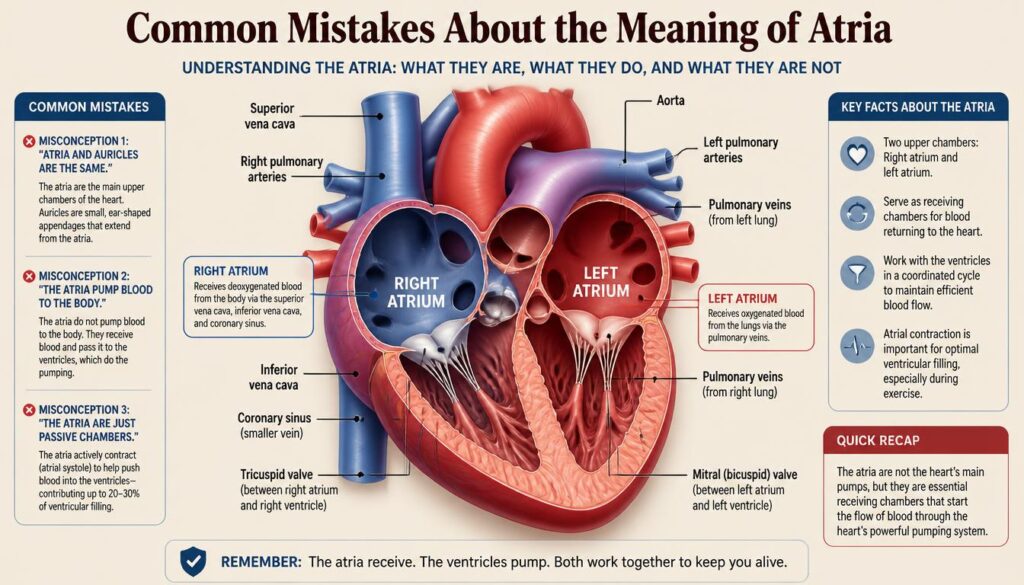
People often misunderstand the word because it has multiple meanings.
Here are some common misconceptions:
- Atria always refers to the heart.
Not true. It can also describe architectural spaces. - Atrium and atria are different structures.
Incorrect. “Atrium” is singular, while “atria” is plural. - Larger atria always save more energy.
Not necessarily. The effectiveness depends on climate, orientation, glazing, ventilation, and design. - Architectural atria are only decorative.
In reality, they also improve daylight, airflow, and, in some cases, energy performance.
Why Understanding the Context Matters
Because “atria” has two established meanings, context is everything.
If you’re reading:
- a biology textbook,
- a cardiology report,
- or a medical journal,
the word almost certainly refers to the heart.
If you’re reading:
- an architectural magazine,
- a building design guide,
- or a sustainability report,
it’s referring to building atria.
Knowing the surrounding topic helps avoid confusion.
Key Takeaways
To summarize:
- Atria is the plural form of atrium.
- In medicine, the atria are the two upper chambers of the heart.
- The right atrium receives oxygen-poor blood, while the left atrium receives oxygen-rich blood.
- Important related structures include the sinus venosus, coronary sinus, and atrioventricular (AV) node.
- In architecture, atria are open interior spaces that improve natural light, ventilation, and building aesthetics.
- Properly designed atria can support passive solar systems, enhance thermal mass performance, and contribute to energy savings, though results depend on climate and design.
Frequently Asked Questions
What does atria mean?
Atria is the plural form of atrium. In medicine, it refers to the two upper chambers of the heart that receive blood before it moves into the ventricles. In architecture, it describes large open interior spaces designed to improve daylight, ventilation, and the overall indoor environment.
What is the difference between atrium and atria?
Atrium is the singular form, meaning one chamber or one open interior space. Atria is the plural form, referring to two or more heart chambers or multiple architectural atriums.
What are the functions of the heart atria?
The heart atria receive blood entering the heart. The right atrium collects oxygen-poor blood from the body, while the left atrium receives oxygen-rich blood from the lungs. They then move this blood into the ventricles for circulation throughout the body.
Why do modern buildings have atria?
Modern buildings use atria to increase natural daylight, improve ventilation, create visually appealing interiors, and support energy-efficient design. Features such as thermal mass, passive solar heating, and night-time ventilation can further enhance building performance when carefully integrated.