
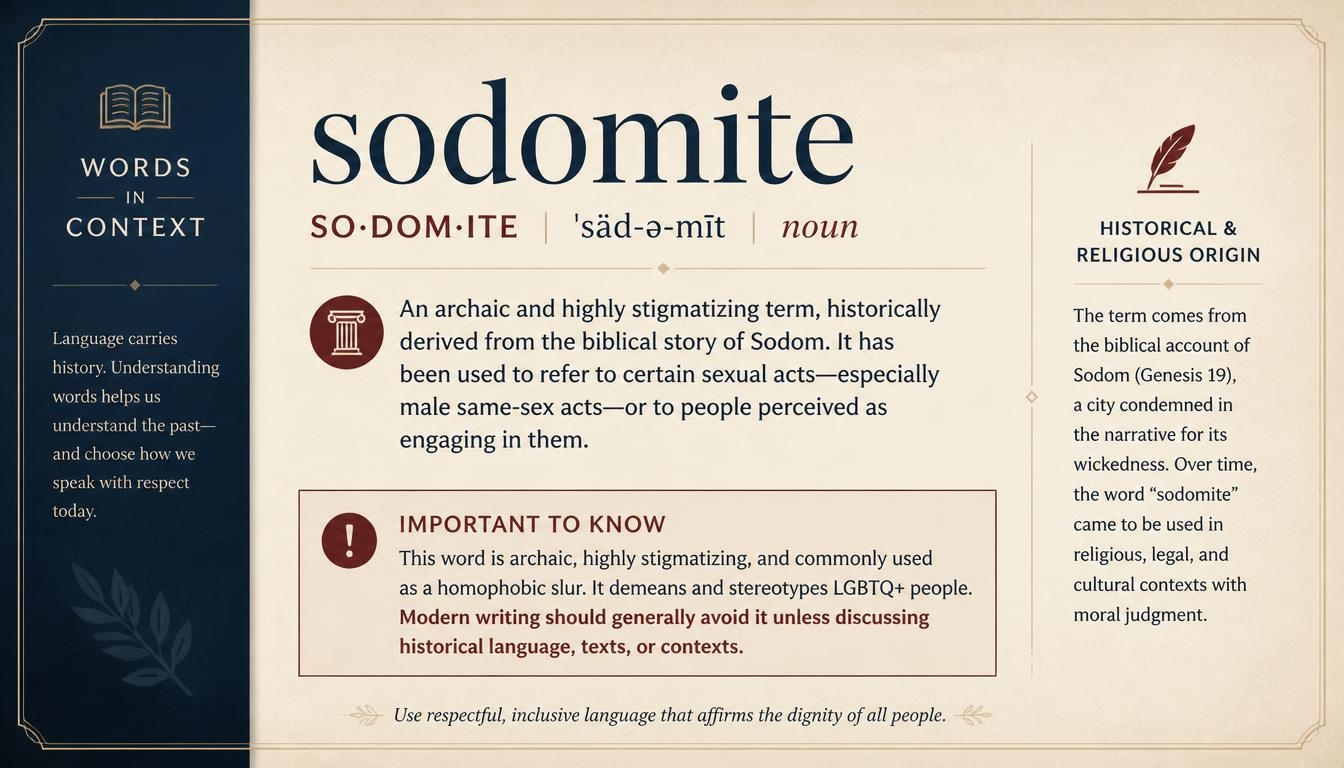

Have you ever come across the word sodomite while reading an old dictionary, religious text, historical document, or an online discussion and wondered what it actually means?
It is one of those English words that carries a long history, and its meaning can feel confusing without understanding the background behind it.
Although the word may look like an ordinary noun, its historical, religious, and cultural associations make it quite different from many everyday vocabulary terms.
The sodomite meaning is generally defined as a person who practices sodomy. Historically, the term has also been used as an insulting or disparaging label, particularly against gay people. Because of these associations, it is generally considered an offensive word in modern English.
Understanding this word involves more than memorizing a dictionary definition. Its pronunciation, historical development, biblical connections, and changing social usage all help explain why it is treated carefully today. Let’s explore its meaning and origin in a straightforward way.
What Does Sodomite Mean?
A sodomite is traditionally defined as a person who practices sodomy, a term historically used for certain types of sexual intercourse. The exact meaning of sodomy has varied across religious traditions, legal systems, and historical periods.
In older English usage, the word was associated with particular sexual practices that were considered prohibited or socially unacceptable by certain cultural and religious standards.
However, the word developed another meaning in everyday language. It was sometimes used as a derogatory term for a gay person, even when the speaker had no knowledge of that person’s actual sexual practices.
Here are a few important points to understand:
- Sodomite is a noun referring historically to someone who practices sodomy.
- It has strong associations with religious and historical discussions.
- It has been used as a term of abuse and disparagement.
- It is generally considered offensive when directed at another person.
- It should not be treated as a neutral synonym for gay person.
The distinction matters because a dictionary definition explains the historical meaning of a word, while modern usage explains how people may understand or react to it.
Sodomite Definition in English
According to the Merriam-Webster dictionary, a sodomite is traditionally defined as someone who practices sodomy. The dictionary also identifies its insulting and disparaging usage.
In simple English, the sodomite definition refers to a person historically associated with sodomy, although the term has also been used as an offensive label for gay people.
Part of speech: Noun
Singular form: Sodomite
Plural form: Sodomites
Related noun: Sodomy
Related adjective: Sodomitic
Related term: Sodomist
The word is not generally appropriate for casual conversations or respectful descriptions of people. If you encounter it in an older book, religious discussion, or historical document, understanding its original context is important.
Sodomite Pronunciation: How to Pronounce Sodomite
Pronunciation can make an unfamiliar word easier to recognize, especially when you hear it in a conversation or educational discussion.
The standard sodomite pronunciation is:
sod·om·ite
Phonetic pronunciation: /ˈsɑː.də.maɪt/
It can be broken into three syllables:
- Sod: The opening sound.
- O: A short, unstressed middle sound.
- Mite: The final syllable, pronounced like the English word “might.”
The emphasis is placed on the first syllable: SOD-uh-mite.
If you are learning English vocabulary, listening to a reliable dictionary pronunciation can help you understand the correct sound and stress pattern.
Historical Meaning of Sodomite
The historical meaning of sodomite is closely connected with the biblical city of Sodom. The city appears in the Book of Genesis, where its destruction is described in a religious narrative.
Over many centuries, religious interpreters associated Sodom with various forms of wrongdoing, including sexual misconduct. These interpretations influenced the development of words such as sodomy and sodomite.
The term eventually became part of English vocabulary and was used in religious writing, legal discussions, and social commentary.
However, it is important to recognize that interpretations of the biblical story have differed across religious communities. The story of Sodom has been discussed in relation to violence, inhospitality, injustice, sexual conduct, and broader moral questions.
Consequently, the historical meaning of the word cannot be understood through one interpretation alone.
Why Is Sodomite Considered an Offensive Word?
Language changes over time, and certain words acquire negative meanings because of the ways people use them. Sodomite is one example.
Historically, the term was used to criticize or condemn people whose sexual behavior was considered unacceptable under particular religious or cultural standards.
It was also used to insult gay people by associating their identities with a supposedly immoral practice. This usage contributed to its reputation as a derogatory term.
There are several reasons why the word is considered offensive today:
- Historical discrimination: It has been used to shame and marginalize individuals.
- Negative associations: It carries strong religious and cultural judgments.
- Personal attacks: It has frequently appeared in insulting or hostile language.
- Misrepresentation: It incorrectly reduces a person’s identity to an assumed sexual practice.
- Social sensitivity: Modern respectful communication generally avoids using the term to describe individuals.
For these reasons, it is better to use respectful and accurate language when discussing people.
A historical explanation of the word is appropriate in an educational setting, but using it as a personal label is different.
Sodom and the Biblical Association
To understand the sodomite word meaning, it helps to look at the historical connection with Sodom.
Sodom is a city mentioned in the Hebrew Bible, particularly in Genesis. Its story describes a community that faces divine judgment because of its wrongdoing.
Over time, the name Sodom became associated with moral corruption in several religious and cultural traditions.
The English word sodomite developed from this association. It was historically used to describe someone believed to engage in conduct associated with the traditional understanding of sodomy.
The relationship between Sodom and the later word is an important part of its etymology, but the biblical narrative and the modern dictionary definition should not be treated as identical things.
They belong to connected but distinct historical and linguistic contexts.
Sodomite Etymology: Where Does the Word Come From?
The sodomite etymology reveals how the word traveled through several languages before becoming part of English vocabulary.
According to the historical word development recorded in dictionaries, the term has connections to Greek, Late Latin, Anglo-French, and Middle English.
Its linguistic development can be understood through the following stages:
- Greek: The term is connected to Sodomítēs, referring to someone associated with Sodom.
- Late Latin: The form Sodomita continued the same association.
- Anglo-French: The word appeared as sodomite.
- Middle English: Related forms included sodomyte and sodomit.
- Modern English: Sodomite became the standard spelling.
The suffix -ite is commonly used in English to identify a person associated with a particular place, group, or belief.
In this case, the word originally identified someone through an association with Sodom.
This journey through languages explains why the word has such a recognizable connection to ancient religious history.
When Was the Word Sodomite First Used?
The first known use of sodomite in English dates to the 14th century, according to Merriam-Webster.
This makes it a historical vocabulary term that has existed for hundreds of years.
Its early appearance reflects the influence of religious writing and Latin-derived vocabulary on Middle English.
During this period, religious institutions had a considerable influence on education, literature, law, and public discussions about morality. Words associated with biblical stories often entered written English through these channels.
Although its spelling and surrounding usage have changed over time, the central connection with sodomy and Sodom has remained recognizable.
The word’s history also demonstrates how language can preserve old cultural attitudes long after the original social conditions have changed.
Sodomite vs. Sodomist: What Is the Difference?
The words sodomite and sodomist are related, but they are not equally common in modern English.
Both are associated with sodomy, and both may appear in historical or religious discussions.
Here is a simple comparison:
| Word | Meaning and context |
|---|---|
| Sodomite | A person traditionally described as practicing sodomy; also used as an offensive label. |
| Sodomist | A related term referring to someone associated with sodomy. |
| Sodomitic | An adjective relating to sodomy or the historical terminology surrounding it. |
| Sodomy | A historical and legal term for certain sexual practices. |
| Sodom | The biblical city associated with the word’s origin. |
Sodomite is the more familiar term in general dictionary usage.
Sodomist is a related word that may appear in older writing, but it is less common in everyday English.
Neither term should be used casually as a description of someone’s identity.
Sodomite, Sodomites, and Other Word Variations
English nouns sometimes change their spelling when referring to more than one person. The word sodomite follows the regular plural formation by adding the letter s.
Understanding its variations can help readers recognize it in dictionaries, historical documents, and older literature.
Sodomite: This is the singular form, referring to one person.
Sodomites: This is the plural form, referring to more than one person.
Sodomyte: An older Middle English spelling.
Sodomit: Another historical Middle English spelling.
Sodomist: A related noun used in some historical and religious writing.
Sodomitic: An adjective connected with sodomy.
The spelling sodomite is the standard modern form. The older variations are mainly useful when studying the development of English vocabulary.
What Does Sodomy Mean?
Since the definition of sodomite is directly connected with sodomy, understanding the related noun makes the original word easier to interpret.
Sodomy is a historical term used for certain types of sexual intercourse. Its precise definition has varied significantly between legal systems and historical periods.
In some older religious and legal texts, the word was used broadly to describe sexual conduct considered prohibited under the standards of the time.
In modern legal language, its definition depends on the jurisdiction and the particular law being discussed.
It is also worth noting that historical definitions should not automatically be applied to modern relationships or identities.
The words sodomy and sodomite have a shared linguistic history, but they serve different grammatical purposes.
How Is Sodomite Used in Historical and Modern Language?
The context in which a word appears can change how readers understand it. This is particularly true of a term with such a complicated history.
In older religious literature, sodomite may appear in discussions of biblical interpretation, morality, or prohibited conduct.
In historical legal documents, it may appear as a label used under the laws and social attitudes of a particular period.
In modern conversations, however, the word is generally recognized as offensive, especially when directed at gay people.
Consider these examples of educational usage:
- A historian examined how the word sodomite appeared in medieval English literature.
- The dictionary explained the historical connection between sodomite and sodomy.
- The researcher studied the religious associations of the term in older documents.
- The article discussed why sodomite became a derogatory label.
- The linguist explored the word’s development from Middle English terminology.
These examples discuss the word rather than using it to insult someone.
That distinction is important when writing about sensitive historical vocabulary.
Understanding the Cultural and Religious Context
Words associated with religion often carry meanings beyond their literal definitions. The word sodomite is a good example of how religious interpretations can influence language and social attitudes.
The story of Sodom has been interpreted in different ways across Jewish, Christian, and other religious discussions.
Some traditional interpretations emphasize sexual wrongdoing, while other discussions give attention to violence, cruelty, arrogance, injustice, and the mistreatment of strangers.
These differences have influenced how the word sodomite has been understood throughout history.
In older societies, religious and legal definitions sometimes overlapped. As a result, terminology from religious teachings became part of legal language and everyday insults.
Modern readers should therefore consider the time period, author, and purpose of a text before interpreting the word.
Is Sodomite Still Used in Modern English?
Yes, the word still appears in modern English, but it is relatively uncommon in ordinary respectful conversation.
You may encounter it in:
- Historical books and academic research.
- Religious studies and biblical discussions.
- Older legal documents.
- Dictionary definitions and vocabulary lessons.
- Discussions about offensive or derogatory language.
Its appearance does not necessarily mean the writer is using it as an insult. Sometimes the word is simply being discussed as a historical term.
Nevertheless, its negative associations make it unsuitable for describing someone in everyday conversation.
If your goal is to discuss sexual orientation respectfully, gay person or another accurate, relevant term is generally more appropriate.
Frequently Asked Questions About Sodomite Meaning
What does sodomite mean?
A sodomite traditionally means someone who practices sodomy. Historically, the word has also been used as an offensive label for gay people.
What is the meaning of sodomite in English?
The sodomite meaning in English refers to a person associated with sodomy. It is a noun with strong historical, religious, and derogatory associations.
Is sodomite an offensive word?
Yes. It is generally considered offensive, particularly when used to describe or insult gay people. Its historical association with discrimination makes it unsuitable for respectful everyday communication.
Is sodomite a derogatory term?
Yes. The word has historically been used as a term of disparagement and an insult, especially against people believed to engage in certain sexual practices.
What is the plural of sodomite?
The plural of sodomite is sodomites. The spelling follows the regular English rule of adding s to a singular noun.
How do you pronounce sodomite?
It is pronounced SOD-uh-mite, with the emphasis on the first syllable. Its phonetic pronunciation is /ˈsɑː.də.maɪt/.
Where does the word sodomite come from?
The word comes from the name Sodom and passed through Greek, Late Latin, Anglo-French, and Middle English before becoming part of modern English.
When was sodomite first used?
Its first known English use dates to the 14th century, according to Merriam-Webster.
What is the difference between sodomite and sodomist?
Both are related to sodomy. Sodomite is the more familiar English noun, while sodomist is a less common related term found in some historical writing.
What does sodomy mean?
Sodomy is a historical term for certain types of sexual intercourse. Its precise definition has differed across religious traditions, legal systems, and historical periods.
What is the historical meaning of sodomite?
Historically, it referred to a person believed to practice sodomy. It was also used in religious and legal contexts and eventually became a disparaging label in some forms of social communication.
Is sodomite the same as gay person?
No. These words are not interchangeable. Gay person is a description of sexual orientation, whereas sodomite is a historically loaded term associated with particular sexual practices and is generally offensive.
Is sodomite a noun or an adjective?
Sodomite is a noun. Its related adjective is sodomitic.
What is another spelling of sodomite?
Historical Middle English forms include sodomyte and sodomit. Sodomite is the standard spelling in modern English.
sodomite meaning
A sodomite is traditionally defined as someone who practices sodomy. The word is generally considered offensive and has historically been used as a derogatory term for gay people.
what is a sodomite
A sodomite is a person described as someone who engages in sodomy. The term has historical, religious, and cultural associations and is considered insulting in modern usage.
sodomites meaning
Sodomites is the plural form of sodomite, referring to multiple people described as practitioners of sodomy. It is also used as an offensive or disparaging label for gay people.
sodomite
Sodomite is a noun that originated from historical references to Sodom and sodomy. It first appeared in English during the 14th century and is now generally regarded as a derogatory term.
Read Articul: https://ytmeaning.com/boujie-meaning/
How to Understand and Use the Word Correctly
When you encounter an unfamiliar word, understanding its definition is only the first step. You should also consider its historical background, grammatical function, and the feelings it may create in modern communication.
For sodomite, there are a few useful guidelines:
- Check a reliable dictionary for its formal definition.
- Understand the connection between Sodom, sodomy, and sodomite.
- Recognize that its historical use may differ from its modern social meaning.
- Avoid using it as a personal label or insult.
- When discussing the word academically, explain its offensive associations.
- Choose neutral and respectful vocabulary when describing people.
For example, if you are writing an educational article about medieval English, you can discuss the term as part of its historical vocabulary. However, using it to address someone directly would be inappropriate.
A little awareness of language can prevent unnecessary misunderstanding, and it also makes communication more thoughtful.
Conclusion
The sodomite meaning has developed through centuries of religious, cultural, and linguistic history. Traditionally, it describes someone who practices sodomy, while its historical use also includes its appearance as a derogatory label, particularly against gay people.
Its origins can be traced through Greek, Late Latin, Anglo-French, and Middle English, with its first known English use dating to the 14th century. Related words such as sodomy, sodomist, and sodomitic help explain its linguistic development.
Ultimately, understanding this word means recognizing both its dictionary definition and its social implications. Language is not simply about knowing what a word means; it is also about understanding how that word affects others.
By learning its history and using respectful alternatives in everyday communication, readers can develop a clearer and more responsible understanding of English vocabulary.
If you have encountered the word in an old book, religious passage, or historical document, sharing that context can make its particular meaning even easier to understand.
Is this conversation helpful so far?