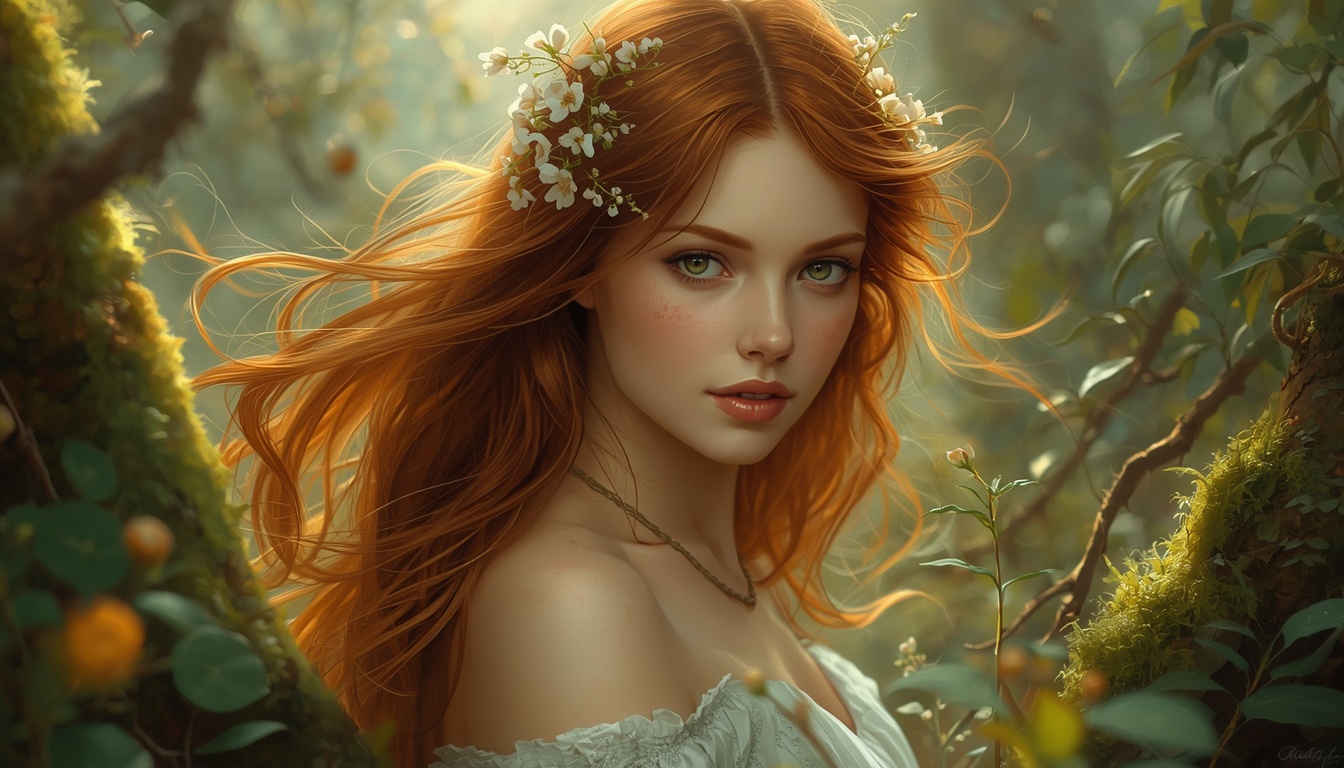

There are some words that seem to arrive carrying an entire little world inside them. Nymph is one of those words. You may meet it in a mythology book, a fantasy novel, a poem about a forest, or rather unexpectedly in a biology textbook talking about insects.
Same spelling, very different picture. One moment you are imagining a mysterious nature spirit beside a river; the next, you’re looking at a tiny immature insect preparing for another stage of its life. A funny little word, really, because it manages to belong to both ancient imagination and modern science.
So, what is the nymph meaning exactly? In its most familiar mythological sense, a nymph is a supernatural female figure associated with nature, especially trees, forests, rivers, mountains, and springs. In biology, however, a nymph is an immature insect that generally resembles the adult form but has not yet reached adulthood.
The two meanings are completely different, although both carry an interesting idea of development and transformation. Cambridge Dictionary lists both meanings and gives the pronunciation as /nɪmf/. Cambridge Dictionary+1
Nymph Meaning in Simple Words
If you only need the quick definition of nymph, here it is: a nymph can mean either a mythological female nature spirit or a juvenile stage of certain insects. Context does nearly all the heavy lifting here, which is why the surrounding sentence matters quite a lot.
In ancient Greek mythology and later Roman mythology, a nymph was usually imagined as a young woman or divine female spirit connected with the natural world.
She wasn’t exactly the same as a major goddess, though some nymphs could possess supernatural powers and live for extraordinarily long periods.
They belonged to a softer, more localized layer of mythology the spirit of a particular stream, tree, mountain, or woodland, so to speak. Cambridge describes the mythological nymph as a goddess or spirit in the form of a young woman living in places such as trees, rivers, or mountains. Cambridge Dictionary
In biology, the word takes a sharp turn. An insect nymph is an immature insect that has not become an adult yet and is often physically similar to the adult. It grows through repeated stages called instars, shedding its skin through molting or moulting as its body develops. Cambridge Dictionary
That contrast is worth remembering:
- Nymph in mythology: a female spirit, often linked with nature.
- Nymph in biology: an immature insect.
- Nymph pronunciation: /nɪmf/, sounding roughly like “nimf.”
- Nymph plural: nymphs.
- Nymphal: an adjective relating to a nymph, especially in biology.
- Nymph vs. larva: these describe different developmental patterns in insects.
Nymph Meaning in Greek and Roman Mythology
The mythological nymph meaning is the older and more poetic sense of the word. Imagine a world where a river is not merely water flowing downhill, where an ancient tree isn’t simply timber waiting to become furniture, and where a mountain has a personality of its own. That is roughly the imaginative landscape in which Greek nymphs belong.
Nymphs were female spirits associated with particular parts of the natural world. Some were linked with forests and trees, some with rivers and springs, and others with mountains or meadows.
They were often portrayed as beautiful young women, but reducing them to beauty alone misses the point. They represented nature as something alive, watchful, attractive, sometimes dangerous, and never entirely under human control.
Here are a few common ways the word appears in its mythological sense:
- A wood nymph is associated with woodland, trees, or forests.
- A water nymph may be connected with a river, spring, lake, or other body of water.
- A forest nymph belongs to the green, shadowy world of woodland spirits.
- A tree-associated nymph may be called a dryad in Greek tradition.
- A river-associated spirit may belong to traditions surrounding water and flowing streams.
- Nymphs can appear as supernatural companions of gods, heroes, hunters, or other mythical figures.
- In literature, the word may simply suggest an enchanting young woman or fanciful female figure, although this literary use should not be confused with the strict mythological definition.
The Cambridge Dictionary also gives examples involving Apollo and Daphne, Narcissus, and Rusalka, showing how the word has travelled beyond a single narrow story into wider literary and folkloric usage. Cambridge Dictionary
Types of Mythological Nymphs
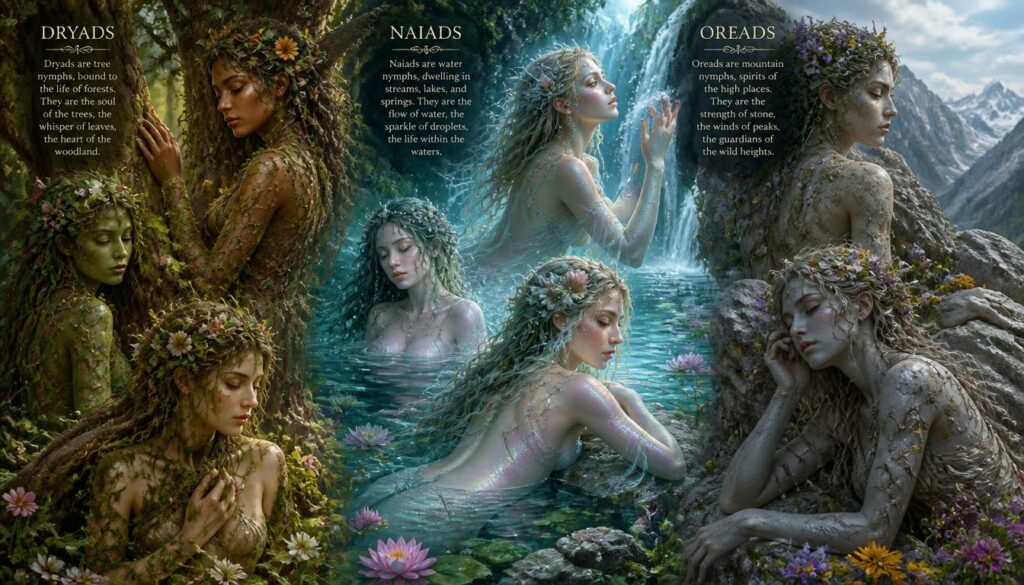
The ancient stories did not treat every nymph as if she belonged to one giant identical family. Their identities were often tied to the environment they inhabited, and that makes the mythology unusually earthy almost like nature had learned to wear a human face.
A few useful categories help make the idea clearer:
- Dryads: tree or woodland nymphs, especially associated with trees.
- Naiads: water nymphs connected particularly with freshwater sources such as springs and rivers.
- Oreads: mountain or hill nymphs.
- Oceanids: female spirits associated with the ocean and the sea, traditionally daughters of Oceanus in Greek mythology.
- Nereids: sea nymphs traditionally associated with Nereus and the Mediterranean world.
- Wood nymphs: a broader modern phrase for nymph-like female nature spirits of forests and trees.
- Water nymphs: a flexible phrase often used in literature for female spirits associated with water.
- Nature spirits: a broader category that can include nymphs while also covering other supernatural beings.
This is where the word becomes especially useful in storytelling. Calling a character a forest nymph instantly gives the reader a setting, mood, and personality before the character has even spoken. There is moss somewhere. There is probably a stream. Something is glowing that shouldn’t be glowing. You get the idea.
Famous Nymphs: Daphne, Narcissus, and Rusalka
Some mythological figures help make the nymph definition much easier to remember because their stories have survived for centuries.
Daphne is perhaps one of the best-known nymphs connected with classical mythology. She is associated with a famous story involving Apollo, who pursues her. In many versions of the myth, Daphne escapes by being transformed into a laurel tree.
The story is romantic only if you ignore the rather uncomfortable fact that Apollo’s pursuit is unwanted; modern readers often notice that tension much more directly than older retellings did.
Narcissus belongs to another famous story involving nymphs. His extraordinary beauty and obsession with his own reflection became the foundation for the word “narcissism.” The nymph Echo is particularly important to the story, although her fate is every bit as tragic as Narcissus’s in its own strange way.
Then there is Rusalka, a water spirit from Slavic folklore rather than classical Greek mythology. She is often described in modern discussions alongside water nymphs, though technically she belongs to a different folklore tradition. Cambridge itself uses Rusalka in an example of the broader literary use of “water nymph.” Cambridge Dictionary
That distinction matters. A nymph is not a universal word for every female supernatural creature in every culture. Stories borrow imagery from one another, sure, but traditions have their own histories.
Nymph Meaning in Biology
Now comes the wonderfully strange second definition.
In biology, a nymph insect is an immature insect that resembles the adult form but has not yet reached sexual maturity. It is part of an insect’s life cycle, but it isn’t simply a miniature adult in every case. Its body can change substantially during successive stages of development.
This term is especially associated with insects that undergo incomplete metamorphosis, sometimes called hemimetabolous development. Instead of passing through egg → larva → pupa → adult, as butterflies do, these insects generally develop through stages more like egg → nymph → adult.
During its growth, the insect may pass through several instars. Each instar is a developmental stage between molts. The nymph sheds its old skin because its outer covering cannot expand indefinitely. It’s a rather practical biological solution: grow, outgrow the outer layer, shed it, and continue.
Examples include:
- Aphid nymphs, which can look quite similar to their adult relatives.
- Tick nymphs, which are immature stages in the tick life cycle.
- Certain cicada nymphs, which spend considerable periods developing before reaching adulthood.
- Froghopper nymphs, which emerge from eggs and continue developing through successive stages.
- Phylloxera nymphs, which appear in studies of insect development and plant-associated populations.
- Other insects with incomplete metamorphosis, where young individuals gradually acquire adult characteristics.
- Some species develop wing structures progressively, with wing development becoming more obvious through later stages.
Cambridge’s dictionary examples include tick nymphs, aphids, cicadas, froghoppers, phylloxera, and laboratory observations of nymphs at different instars. Cambridge Dictionary
Read more: https://ytmeaning.com/chud-meaning/
The Nymphal Stage and Insect Growth
The nymphal stage is basically a period of becoming. The insect has already hatched from an egg, but it hasn’t arrived at its adult form yet. That middle ground is important.
A young grasshopper, for instance, can look recognizably like a grasshopper while still being immature. It may lack fully developed wings, reproductive maturity, or other adult characteristics. As it grows, it molts repeatedly.
The sequence can be thought of like this:
- Egg: the insect begins its life inside an egg.
- First instar: the newly emerged nymph starts feeding and developing.
- Later instars: the insect becomes larger and gradually develops adult characteristics.
- Molting: the nymph sheds its old skin between developmental stages.
- Wing development: in winged species, wings or wing pads become increasingly developed.
- Adulthood: the insect reaches its mature form and becomes reproductively capable.
This is one reason nymph vs. larva is a useful comparison. A larva, such as a caterpillar, can look dramatically different from its adult butterfly or moth. It eventually enters a pupa stage before becoming an adult. A nymph, by contrast, generally resembles the adult more closely and does not normally pass through a pupal stage. The distinction isn’t just vocabulary—it tells you something about the insect’s development.
Nymph vs. Larva vs. Pupa
People sometimes use these words as though they are interchangeable, but they aren’t. Biology likes its boxes labelled properly, even when nature occasionally makes the labels complicated.
A nymph is generally an immature insect resembling the adult and developing through successive molts. A larva is an immature stage found in insects with complete metamorphosis, such as butterflies and beetles, and it may look very different from the adult. A pupa is the transformation stage between larva and adult in complete metamorphosis.
So, in a very simplified comparison:
- Nymph: young insect, usually adult-like in body shape.
- Larva: young insect, often quite different in appearance from the adult.
- Pupa: transitional stage between larva and adult in complete metamorphosis.
- Adult: mature reproductive stage.
There are exceptions and biological details that a textbook would happily spend twelve pages discussing, but for everyday understanding this distinction works nicely.
Nymph Pronunciation and Plural Form
The nymph pronunciation is another thing that catches people out. It is pronounced /nɪmf/, roughly “nimf.” The final sound is an f, not a “th” sound and not “neem.” Cambridge gives the same pronunciation for both UK and US English. Cambridge Dictionary
The plural is straightforward: nymphs.
A few related forms are useful too:
- nymph singular noun.
- nymphs plural noun.
- nymphal adjective, especially common in biological contexts.
- nymphet a related word, but not a synonym for nymph and best treated carefully because of its sexualized literary history.
- nymphomania / nymphomaniac historically related in form, but these are separate terms and should not be treated as meanings of “nymph.”
That last distinction is worth making because search engines sometimes throw related-looking words into the same pile. Language doesn’t always organise itself as neatly as an SEO keyword list does, unfortunately.
Nymph Meaning in Literature and Fantasy
Outside mythology and biology, nymph has developed a rich literary life. Writers use the word when they want to suggest beauty, mystery, youth, wildness, or a connection with nature.
A fantasy writer might describe a character as a forest nymph to make her feel less like an ordinary human and more like part of the landscape itself. A poet might use “water nymph” to evoke a river without literally saying that a supernatural spirit lives there.
Painters, poets, playwrights, and novelists have repeatedly returned to nymph imagery because it gives them a shortcut into a world of forests, desire, music, flowers, flowing water, and the uneasy border between human and divine.
The imagery can also become playful. Modern fantasy may portray nymphs as guardians of forests, mischievous woodland spirits, healers, magical beings, or immortal creatures. Those versions don’t always follow classical mythology exactly, and that’s okay. Folklore gets retold; it doesn’t sit quietly in a museum forever.
Nymph Meaning, Beauty, and the Idea of Nature
There is a deeper reason the word has survived so well.
The mythological nymph turns nature into a character. A river isn’t merely a geographical feature anymore—it can have a spirit. A tree isn’t simply a plant it can have a guardian. A mountain becomes a home for a supernatural woman who belongs there in a way humans never quite can.
That is why the word often carries emotional associations with love, beauty, freedom, wilderness, and transformation. Nymphs occupy an unusual space between the human and divine.
They may look human, feel human emotions, and participate in human-like stories, but they remain tied to a world beyond ordinary mortality.
In some stories, that boundary is exactly where the trouble begins. Someone falls in love with a supernatural being, someone chases someone else through a forest, someone gets transformed into a tree. Classical mythology was not particularly shy about making emotional complications spectacular.
How to Use “Nymph” in a Sentence
If you’re unsure how to use the word, context makes it much easier. These examples show the two major meanings without mixing them up:
- “The poet imagined a wood nymph dancing beneath the ancient oak.”
- “The story describes a water nymph guarding a hidden spring.”
- “Daphne is remembered as a nymph in Greek mythology.”
- “The young insect remained in its nymphal stage for several weeks.”
- “The researcher examined the aphid nymphs under a microscope.”
- “Tick nymphs are an immature stage of the tick life cycle.”
- “The insect molts several times before reaching adulthood.”
- “The character was written as a mysterious forest nymph, rather than an ordinary human woman.”
Notice how the setting tells you which meaning is intended. A forest and a goddess suggest mythology; an instar and molting suggest biology.
Why the Word “Nymph” Can Be Confusing
The confusion is perfectly understandable because the two major meanings seem to live on opposite planets. One belongs to classical mythology and the other to entomology.
Yet both meanings share a curious connection to stages and identity. The mythological nymph stands between the human and divine worlds, while the biological nymph stands between hatching and adulthood. That doesn’t mean the two definitions have the same historical origin or scientific relationship it’s simply an interesting conceptual resemblance.
When you see nymph, don’t immediately decide what it means from the word alone. Read the sentence around it. If the writer mentions a river spirit, Apollo, Daphne, dryads, forests, or mythology, you’re looking at the mythological meaning. If you see aphids, ticks, instars, eggs, molting, or adult insects, you’re firmly in biology territory.
A Quick Guide to Nymph Synonyms and Related Words
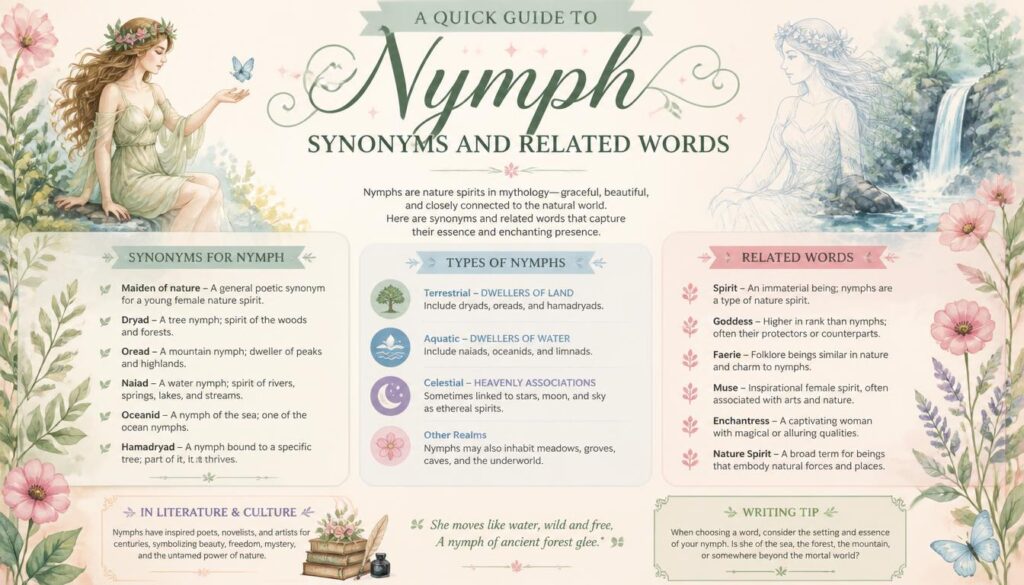
There isn’t one perfect nymph synonym because the word changes meaning according to context. In mythology, words such as dryad, naiad, nature spirit, or female nature spirit may be relevant, although they are not always exact replacements.
Cambridge’s thesaurus includes terms such as female nature spirit, naiad, dryad, sylph, wood nymph, belle, charmer, and beauty among related words. Dictionary
For the biological sense, “immature insect” is a useful explanatory phrase, but it isn’t necessarily a perfect synonym in every scientific context. The distinction between nymph, larva, and pupa remains important.
This is also why translating the word can be slightly tricky. A translator has to know whether the author is talking about mythology, literature, or insects before selecting the most natural equivalent.
Frequently Asked Questions
nymph meaning
A nymph is a female nature spirit in ancient Greek mythology, often associated with forests, trees, rivers, and mountains. In biology, a nymph is also an immature insect that resembles the adult but has not fully developed yet.
nymphs meaning
Nymphs is the plural form of nymph and refers to more than one nymph. The word can describe mythological nature spirits or immature insects, depending on the context.
what does nymph mean
Nymph means a supernatural female nature spirit in mythology or an immature insect in biology. Its exact meaning depends on how the word is used.
define nymph
To define nymph simply, it is a nature spirit from classical mythology or a young, immature insect that develops through several stages before becoming an adult.
what is a nymph
A nymph is either a mythical female spirit connected with nature or an immature insect that looks similar to its adult form. The biological meaning is commonly used when discussing insect growth and development.
Final Thoughts on the Nymph Meaning
The beauty of nymph is that it refuses to be only one thing. In one sentence, it can belong to the old world of Greek mythology, where female spirits inhabit trees, rivers, mountains, and forests. In another, it belongs to a laboratory, where researchers count aphid nymphs, observe tick development,
examine instars, and record mortality or growth. Cambridge Dictionary confirms these two central senses and the pronunciation /nɪmf/, making it a useful reference when you’re unsure which meaning applies. Cambridge Dictionary+1
If you remember just one idea, remember this: NYMPH → MYTHOLOGY → FEMALE NATURE SPIRIT, while NYMPH → BIOLOGY → IMMATURE INSECT STAGE. That tiny mental map clears up most of the confusion, pretty quickly.
And maybe that’s why the word feels so memorable. A nymph can be a spirit hiding among trees in an ancient story, or a tiny insect shedding its skin on the way toward adulthood.
One belongs to imagination, one to science and somehow both remind us that nature is full of things that are not quite what they first appear to be.
:::