


The name Javert carries more weight than it first appears to. For readers of Victor Hugo’s Les Misérables, Javert is not simply a police inspector chasing a former prisoner through nineteenth-century France. He becomes almost a living argument about law, justice, morality, mercy, and human change. His name is tied to strictness, authority, discipline, and a worldview where right and wrong seem to have very hard borders.
That is what makes the Javert meaning so interesting. He is a fictional character, but his struggle feels surprisingly real. What happens when someone believes so strongly in a system that they can no longer accept anything outside it? And what happens when kindness appears where punishment was expected? Javert spends much of Les Misérables trying to answer those questions, even though he never really knows how to ask them.
What Does Javert Mean?
If you are searching for what does Javert mean, there are two useful ways to understand the name. First, Javert is the surname of Inspector Javert, one of the major characters in Les Misérables. Second, in literary discussion, “Javert” has come to suggest a person who represents rigid obedience to law and authority.
Javert does not simply enforce rules because it is his job. Javert’s worldview is deeply connected to the idea that the law represents order and that criminals deserve punishment. He has very little patience for grey areas, excuses, or moral uncertainty. For him, rules are not suggestions floating around society; they are the structure holding everything together.
So, when people discuss Javert symbolism, they often connect his name with legalism, strict justice, authority, and moral absolutism. It is less about a dictionary definition of the surname and more about what the character has come to represent.
Who Is Javert in Les Misérables?
Inspector Javert is a police inspector in Victor Hugo’s Les Misérables. His most important role in the story is his long pursuit of Jean Valjean, a former prisoner who has transformed his life.
Javert sees Valjean primarily through the identity of a criminal. Valjean, however, becomes a compassionate and generous man whose actions challenge the simple categories Javert depends upon. This creates the central tension between the two men. One believes that the past defines a person, while the other demonstrates that people can change.
Javert is therefore more than an antagonist. He represents a particular philosophy of life. His sense of justice is powerful, but it is also extremely inflexible, and that becomes his greatest weakness.
Javert’s Personality and Worldview
The most recognizable feature of Javert’s personality is his rigidity. He believes in order, discipline, obedience, and authority. His personal identity is closely connected to his work as a police officer, so following the law is not merely professional behavior for him. It is part of who he is.
Javert’s thinking often resembles a black-and-white picture. A law-abiding person belongs on one side, while a criminal belongs on the other. There isn’t much room in between, which is exactly where human life tends to become complicated.
His rigid worldview makes him formidable. He is persistent and disciplined, and he does not easily abandon a pursuit. Yet those same qualities make him unable to respond comfortably when reality stops matching his beliefs.
Javert and the Law
For Javert, the law is almost sacred. He places tremendous importance on legal authority and believes that his duty is to enforce it rather than question it.
This is where the character becomes especially interesting. Javert does not usually think of himself as cruel for the sake of cruelty. He believes that punishment protects society and that people who break the law must face consequences. His problem is that he struggles to recognize situations where strict legal judgment and genuine moral goodness point in different directions.
This creates the larger theme of law versus morality in Les Misérables. A law may define an action as illegal, but does that automatically make the person performing it evil? Hugo repeatedly pushes readers toward that uncomfortable question.
Javert and Jean Valjean

The relationship between Javert and Valjean is the heart of Javert’s character. Their conflict is not simply a police officer chasing a fugitive. It is a collision between two different ideas about human nature.
Jean Valjean begins the story as a prisoner, but through encounters with compassion and kindness, he changes. His life becomes increasingly defined by generosity, responsibility, and sacrifice.
Javert cannot easily accept this transformation. His belief system tells him that a criminal is a criminal. Yet Valjean repeatedly behaves in ways that do not fit that category. The contradiction slowly becomes impossible for Javert to ignore.
In a strange way, Valjean becomes the person who knows how to change while Javert remains trapped inside his own beliefs.
Why Is Javert So Strict?
Javert’s strictness is not random. His character is shaped by his experiences and by the social world around him. Hugo presents him as someone whose identity is strongly connected to authority and the established order.
Javert has spent his life understanding society through categories such as criminal and law-abiding citizen, officer and prisoner, right and wrong. His professional life reinforces these divisions again and again.
This helps explain Javert’s obsession with law. If the law is wrong, then his entire understanding of himself becomes unstable. If someone he considers a criminal can demonstrate extraordinary compassion, then the moral categories he depends upon begin to fall apart.
That is a much deeper problem than simply admitting that one person was mistaken.
Javert and Fantine
The story of Javert and Fantine also reveals the limits of his worldview. Fantine is a vulnerable woman caught in poverty and social hardship, and her suffering exposes the gap between strict enforcement and human compassion.
Javert tends to focus on the legal and social rules surrounding people rather than the circumstances that brought them there. This is part of Hugo’s broader criticism of a society that can punish vulnerable people while failing to understand the conditions behind their actions.
Through characters such as Fantine and Valjean, the novel asks whether justice without compassion can really be called justice.
Javert does not have an easy answer. In fact, his inability to find one becomes central to his downfall.
Javert as a Symbol of Justice
One of the strongest interpretations of Javert symbolism is that he represents rigid legal justice.
He believes that society needs rules and that authority must be respected. Those ideas are not automatically evil. A functioning society does need laws, institutions, and systems of accountability. The problem begins when rules are treated as more important than human beings.
Javert represents what happens when justice becomes inflexible.
His tragedy is not simply that he believes in law. It is that he cannot imagine justice existing alongside mercy. He struggles with forgiveness because forgiveness introduces uncertainty. It says that a person can do wrong and still become something better.
For Javert, that possibility is almost unbearable.
Javert Meaning in a Deeper Literary Sense
The deeper Javert meaning is therefore connected to the conflict between certainty and complexity.
Javert wants the world to remain understandable. Criminals should be punished. Officers should obey. Laws should be followed. Good people should be good, and bad people should be bad.
But Les Misérables is built around characters who refuse to remain inside those neat categories.
Valjean is a former criminal who becomes a deeply compassionate man. Fantine is judged by society while suffering from circumstances far beyond simple moral labels. Other characters also reveal that human beings are rarely as simple as institutions want them to be.
Javert’s tragedy comes from his inability to accept this moral ambiguity.
Javert and Moral Absolutism
The term moral absolutism helps explain Javert particularly well. Moral absolutism, in this context, refers to the belief that certain actions or categories are absolutely right or wrong, without much room for circumstance.
Javert’s thinking frequently operates this way. The law is right. Breaking the law is wrong. Criminality indicates a person’s character. Authority deserves obedience.
But Hugo keeps introducing situations that challenge these assumptions.
What if someone breaks a rule for a compassionate reason? What if a person who committed a crime becomes genuinely good? What if obeying the law produces an outcome that feels morally wrong?
These questions are precisely what Javert cannot comfortably handle.
Javert’s Inner Conflict
For much of the novel, Javert appears emotionally controlled and certain. Underneath that surface, however, there is an increasingly serious inner conflict.
The contradiction created by Valjean is especially destructive because Javert cannot simply dismiss it. Valjean is supposed to fit into one category, yet his actions repeatedly place him somewhere else.
Eventually, Javert faces a terrible choice between the worldview he has always trusted and the evidence standing directly in front of him.
This is why Javert’s psychological conflict is so important. His problem is not merely external. Nobody can arrest or punish the contradiction inside his own mind.
What Happens to Javert?
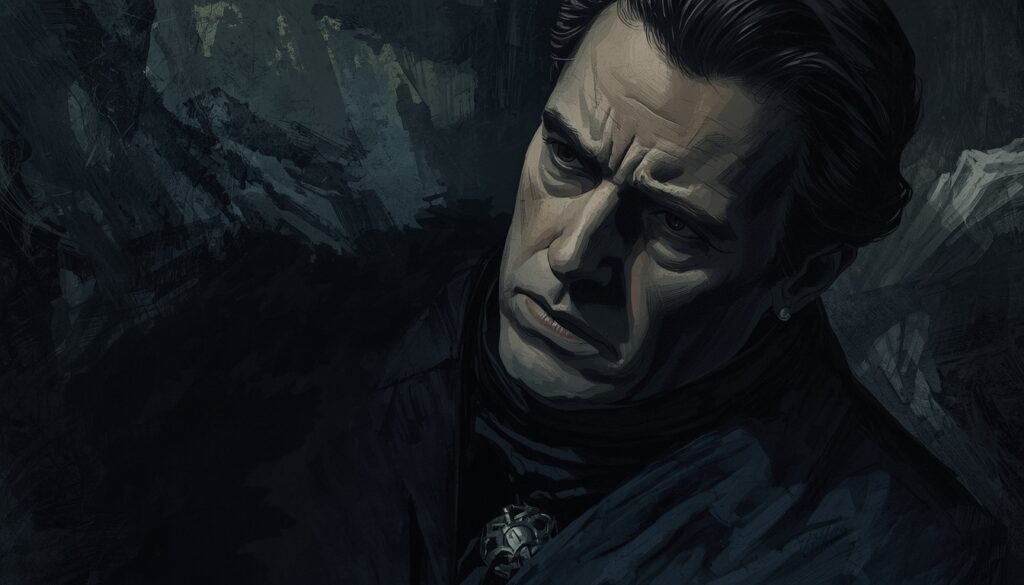
Javert’s story ends in tragedy. After Valjean shows him mercy, Javert is forced to confront the fact that the man he has considered a criminal can act with remarkable compassion toward him.
That moment destroys the certainty on which Javert has built his identity.
He cannot comfortably accept Valjean’s mercy, but he also cannot simply return to his previous understanding of the law. His old worldview and his new experience cannot peacefully coexist.
Eventually, Javert dies by suicide after his moral and psychological crisis reaches its extreme point. His death is not presented merely as the end of a villain. It represents the collapse of an entire worldview.
Why Does Javert Die?
The question why does Javert die has fascinated readers because his death is closely connected to his inability to reconcile law with mercy.
If he arrests Valjean, he feels he is obeying justice. But if he allows Valjean to remain free, he believes he is betraying the law. Yet Valjean has shown him compassion, something Javert’s rigid worldview has difficulty accepting.
There is no comfortable option for him.
His death therefore symbolizes a complete worldview collapse. Javert cannot become a different person easily because his beliefs are deeply connected to his identity. When those beliefs break, he does not know who he is anymore.
Javert as a Tragic Character
Calling Javert simply a villain misses much of his literary importance. He certainly functions as an antagonist, especially because of his relentless pursuit of Valjean, but he is also a tragic character.
A one-note villain would have little reason to question himself. Javert does question himself, eventually, and the result is devastating.
His tragedy comes from a quality that initially appears admirable: certainty.
He is disciplined. He is committed. He is persistent. He takes his responsibility seriously. But without flexibility or compassion, those virtues become destructive. It is a bit like holding a perfectly straight ruler against a world that refuses to be straight.
What Does Javert Represent in Les Misérables?
Javert represents several connected ideas in Les Misérables:
- Law and authority
- Rigid justice
- Moral absolutism
- Black-and-white thinking
- Institutional power
- Punishment
- Resistance to personal transformation
- The conflict between law and morality
- Justice without compassion
- The fear of moral uncertainty
His character gives Hugo a way to explore the weaknesses of a justice system that focuses too heavily on punishment while overlooking human circumstances.
Javert is not the only representation of law in the novel, but he is perhaps the clearest and most memorable one.
Javert Meaning Compared With Jean Valjean
The contrast between Javert and Jean Valjean makes both characters easier to understand.
Valjean changes because he encounters mercy and eventually learns to extend that mercy to others. Javert resists change because his identity depends on believing that people remain defined by their legal categories.
Valjean shows that a person can move from crime toward goodness. Javert believes that the past carries a permanent moral label.
That contrast creates one of the novel’s strongest themes: redemption versus punishment.
Valjean asks, in effect, “Can a person become better?” Javert’s worldview answers, “A criminal remains a criminal.” The story itself increasingly supports Valjean’s side.
Is Javert Evil?

It is tempting to call Javert evil because of his harsh actions, but that interpretation is too simple.
Javert can be cruel, unsympathetic, and excessively rigid. Yet he genuinely believes that he is serving justice. His character is frightening partly because he does not see himself as a villain.
This distinction matters. Javert’s righteousness is sincere, but sincerity does not guarantee moral correctness.
A person can honestly believe they are doing the right thing and still cause suffering. Hugo uses Javert to explore exactly that uncomfortable truth.
Javert’s Importance to the Story
Without Javert, Jean Valjean’s transformation would not carry the same dramatic pressure.
Javert constantly reminds Valjean that his past can return. He represents the social judgment that follows Valjean even after his personal transformation.
At the same time, Javert gives the reader a way to examine the novel’s larger question about good and evil. If a former prisoner can become compassionate and a respectable police officer can become morally trapped, then goodness cannot simply be assigned according to social labels.
That is why Javert remains memorable long after the plot itself has been finished.
How to Understand Javert in One Simple Idea
If you want a short answer to Javert meaning, think of him as a symbol of law without flexibility and justice without enough mercy.
He is a police inspector in Les Misérables who believes deeply in authority and the law. His pursuit of Jean Valjean becomes a personal and philosophical struggle when Valjean repeatedly demonstrates compassion and moral goodness.
Javert’s eventual crisis shows what can happen when a person’s entire identity depends upon a belief system that reality suddenly proves incomplete.
Frequently Asked Questions About Javert Meaning
What does Javert mean in Les Misérables?
Javert represents strict law enforcement, rigid justice, authority, and moral absolutism. His character also symbolizes the conflict between legal rules and compassionate morality.
Who is Inspector Javert?
Inspector Javert is a police inspector and major antagonist in Victor Hugo’s Les Misérables. He is particularly known for his relentless pursuit of Jean Valjean.
What does Javert symbolize?
Javert symbolizes rigid law, legalism, authority, and a black-and-white understanding of good and evil. His downfall highlights the limits of justice without compassion.
Why does Javert hate Jean Valjean?
Javert sees Valjean as a criminal who has escaped the consequences of his past. His professional and personal commitment to the law makes Valjean’s transformation extremely difficult for him to accept.
Why does Javert die?
Javert dies by suicide after experiencing a profound moral crisis. Valjean’s mercy forces him to confront contradictions that his rigid worldview cannot resolve.
Is Javert a villain?
Javert functions as an antagonist, but he is more complicated than a simple villain. He sincerely believes in law and justice, which makes his moral conflict one of the most interesting parts of the novel.
What is the main difference between Javert and Valjean?
Javert believes people are largely defined by law and their past actions, while Valjean demonstrates that people can transform through compassion, responsibility, and redemption.
Final Thoughts on Javert Meaning
The Javert meaning is ultimately bigger than the name of one fictional police inspector. Javert becomes a symbol of what happens when certainty is valued above compassion and when law is treated as incapable of error.
Victor Hugo gives him a powerful role because he does not make the conflict comfortable. Javert is not simply wrong about everything. His belief in responsibility, order, and justice has value. The tragedy begins when those values leave no room for mercy, circumstances, or human transformation.
That is why Javert remains such a fascinating character. He spends his life believing that the world can be divided neatly into right and wrong, yet Jean Valjean forces him to see the messy middle. And perhaps that is the real lesson hidden inside his story: justice needs truth, but human beings also need mercy.
Javert’s downfall reminds us that changing our minds is sometimes painful, but refusing to change when reality teaches us something new can be far more destructive. In that sense, his story still feels strangely modern, even though Hugo wrote it in nineteenth-century France.