Have you ever received a message saying “PM me,” “I sent you a PM,” or simply “PM?” and wondered what it actually means? You’re definitely not the only one.
As online communication keeps evolving, abbreviations and texting slang appear everywhere, making conversations faster but sometimes a little confusing too.
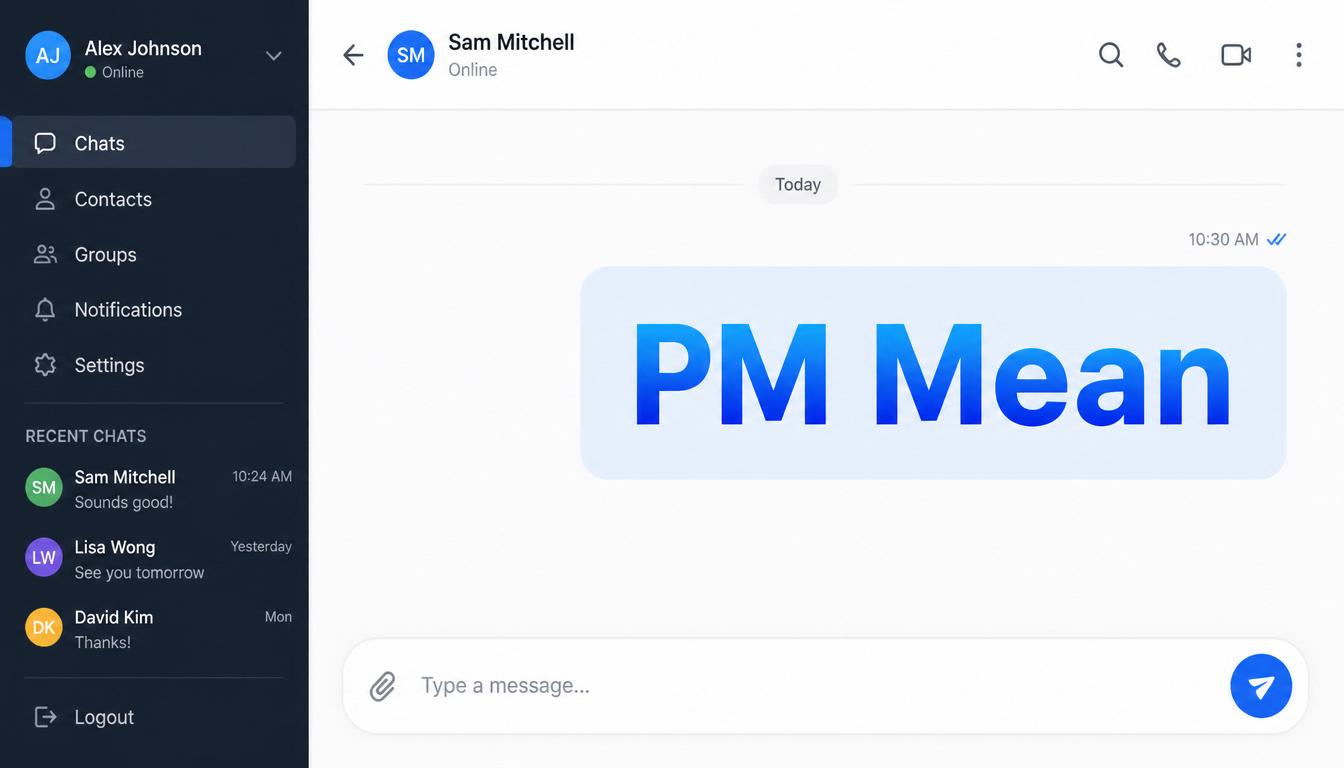
If you’re searching for what does PM mean in text, the short answer is simple: PM usually means Private Message. However, depending on the context, platform, and conversation,
PM can also mean Post-Meridiem (afternoon/evening time) and even carry different meanings in professional or social settings.
Understanding the meaning of PM helps you communicate more clearly on social media, messaging apps, online forums, and even in business conversations.
This guide explains everything in plain English, with examples, platform-specific uses, comparisons, and real-world scenarios.
What Does PM Mean in Text?
PM means Private Message in most texting and online communication situations.
A private message is a one-to-one conversation that takes place away from a public discussion, comment section, or group chat.
When someone says:
- “PM me.”
- “Check your PMs.”
- “I sent you a PM.”
They are asking you to continue the conversation privately.
Quick Definition
PM → stands for → Private Message
This is one of the most common abbreviations used in text messaging, social media messaging, online forums, and chat applications.
Why Do People Use PM Instead of Public Replies?
People often prefer private communication when discussing information that shouldn’t be visible to everyone.
Common reasons include:
- Sharing personal information
- Sending phone numbers
- Discussing prices
- Asking sensitive questions
- Avoiding public arguments
- Keeping conversations organized
- Discussing confidential business matters
A private conversation provides more comfort and privacy than a public comment thread. Sometimes it’s simply easier, honestly.
PM Meaning Across Different Platforms
While the meaning remains mostly the same, the way PM is used varies slightly between platforms.
PM Meaning on Social Media
On social media, PM generally refers to sending a private message through the platform’s messaging system.
Examples:
- “PM me for more information.”
- “I sent a PM about the product.”
- “Please PM your contact details.”
Social media users frequently move conversations from public comments into private chats to avoid clutter and maintain privacy.
PM Meaning in Online Forums
Before modern social networks became popular, forums heavily relied on private messaging systems.
Examples:
- “I’ll PM you the tutorial.”
- “Check your PM inbox.”
- “Sending you the details via PM.”
In forum communities, PM has been part of digital language for decades, and many users still prefer the term today.
PM Meaning in Chat Applications
In messaging apps, PM often refers to leaving a group discussion and switching to a direct conversation.
Examples:
- “Let’s continue this in PM.”
- “I’ll PM you later.”
- “Can we talk privately?”
Although modern apps may use different labels, users still commonly say PM out of habit.
PM vs DM: What’s the Difference?
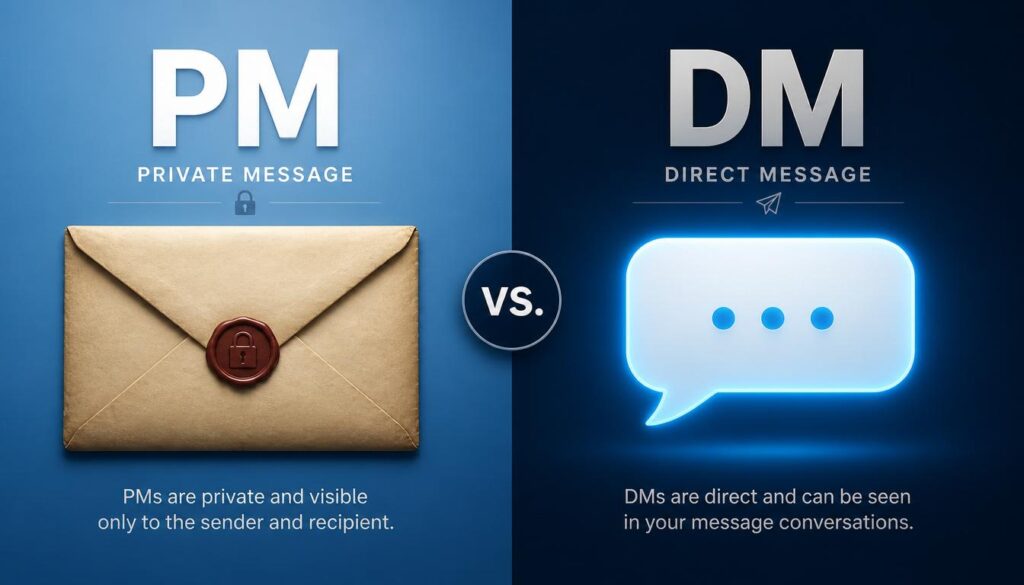
One of the most common questions people ask is whether PM and DM mean the same thing.
The answer is mostly yes, but there are subtle differences.
| Term | Full Form | Common Usage |
|---|---|---|
| PM | Private Message | Forums, communities, general internet communication |
| DM | Direct Message | Social media platforms and apps |
| IM | Instant Message | Real-time chat applications |
Key Differences
- PM is an older internet term.
- DM became popular through social media platforms.
- Both describe private one-to-one communication.
- Many users use them interchangeably.
DM → is similar to → PM
For example:
- “DM me the details.”
- “PM me the details.”
Both requests mean essentially the same thing.
Other Meanings of PM in Text
Although Private Message is the most common interpretation, PM can have other meanings.
PM as Post-Meridiem (Time)
PM also means Post-Meridiem, which refers to the period after noon.
Examples:
- “The meeting starts at 4 PM.”
- “Dinner is at 7 PM.”
- “Call me after 6 PM.”
In this case:
PM → can also mean → Post-Meridiem
This meaning has absolutely nothing to do with messaging.
PM in Professional Environments
In some workplaces, PM may refer to:
- Project Manager
- Product Manager
- Program Manager
- Preventive Maintenance
Examples:
- “The PM approved the proposal.”
- “Speak with the project PM.”
Context matters a lot here.
How to Know Which PM Meaning Is Being Used
The easiest way to understand PM is by examining the surrounding words.
PM Usually Means Private Message When:
- PM me
- Sent you a PM
- Check your PMs
- Let’s discuss in PM
- PM for details
PM Usually Means Time When:
- 2 PM
- 5 PM
- 10 PM
- Meeting at 4 PM
A simple rule works most of the time:
If PM appears beside a number, it almost always refers to time.
If PM appears beside words like “me,” “you,” or “sent,” it generally means private message.
Context → determines → Correct PM Meaning
Real-Life PM Examples in Conversations
Here are examples people actually use every day.
Private Message Examples
- “PM me your address.”
- “I already sent a PM.”
- “Can you PM the details?”
- “Let’s talk in PM.”
- “Please PM your email.”
Time Examples
- “The event starts at 8 PM.”
- “Call me around 7 PM.”
- “I’ll finish work at 5 PM.”
- “See you after 6 PM.”
Same abbreviation. Completely different meaning.
That’s why context is everything.
What Does PM Mean on Facebook?
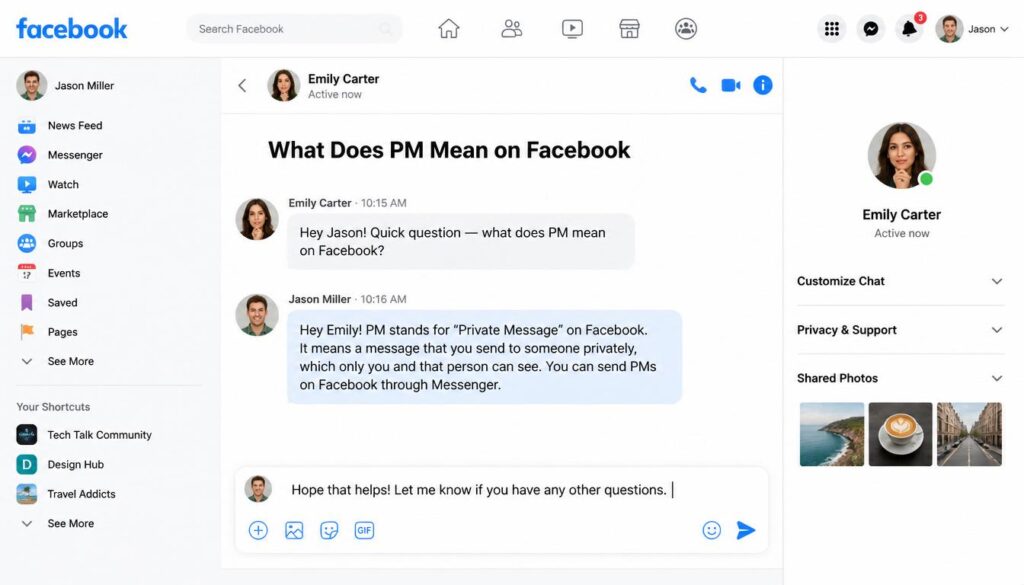
On Facebook, PM refers to a private conversation through Messenger.
Examples:
- “PM me for pricing.”
- “Send me a PM.”
- “I’ll respond in PM.”
Facebook Marketplace sellers frequently use PM when discussing products, delivery options, and payment details.
Why Facebook Users Prefer PM
- Protect personal information
- Discuss prices privately
- Arrange transactions
- Avoid public negotiations
Many buyers and sellers still say PM even though the platform officially uses Messenger.
What Does PM Mean on Instagram?
On Instagram, PM generally means sending a message through the platform’s messaging system.
Although Instagram officially labels messages as DMs, many users still use PM.
Examples:
- “PM me for collaboration.”
- “PM for booking information.”
- “PM if interested.”
In practice, PM and DM are often treated as identical on Instagram.
What Does PM Mean on Facebook Marketplace?
Facebook Marketplace has made the phrase “PM for details” incredibly popular.
Common Marketplace Phrases
- PM for price
- PM for availability
- PM if interested
- PM for location
- PM for delivery options
Many sellers choose private communication to avoid public bargaining and unnecessary comments.
Online sellers → use PM → For pricing and negotiations
What Does PM Mean on Snapchat?
On Snapchat, PM generally means a private chat between users.
Examples include:
- “PM me your Snap.”
- “Let’s continue in PM.”
Although Snapchat doesn’t officially promote the term PM, users still understand what it means.
Why PM Became So Popular Online
The popularity of PM is directly connected to the growth of digital communication.
Several factors contributed:
- Social media expansion
- Online communities
- Increased privacy concerns
- Faster communication habits
- Mobile-first messaging
People naturally seek shorter ways to communicate.
Instead of writing “Please send me a private message,” typing “PM me” saves time and effort.
That’s kinda how internet language evolves.
The Evolution of PM vs DM
One area many articles overlook is how messaging terminology changed over time.
Early Internet Era
During the early internet years, forums dominated online communication.
Users relied on:
- PM (Private Message)
- Personal Message
- Private Mail
PM became the standard term for one-to-one communication.
Rise of Social Media
As social platforms grew, new terminology emerged.
Platforms began using:
- Direct Message
- Message Requests
- Inbox
- Chat
This led to the widespread adoption of DM.
Why DM Became More Popular
Several reasons explain the shift:
- Platform branding.
- Simpler user interfaces.
- Social media influence.
- Mobile messaging growth.
Even today, however, millions of users continue using PM.
PM Etiquette: How to Use Private Messages Politely
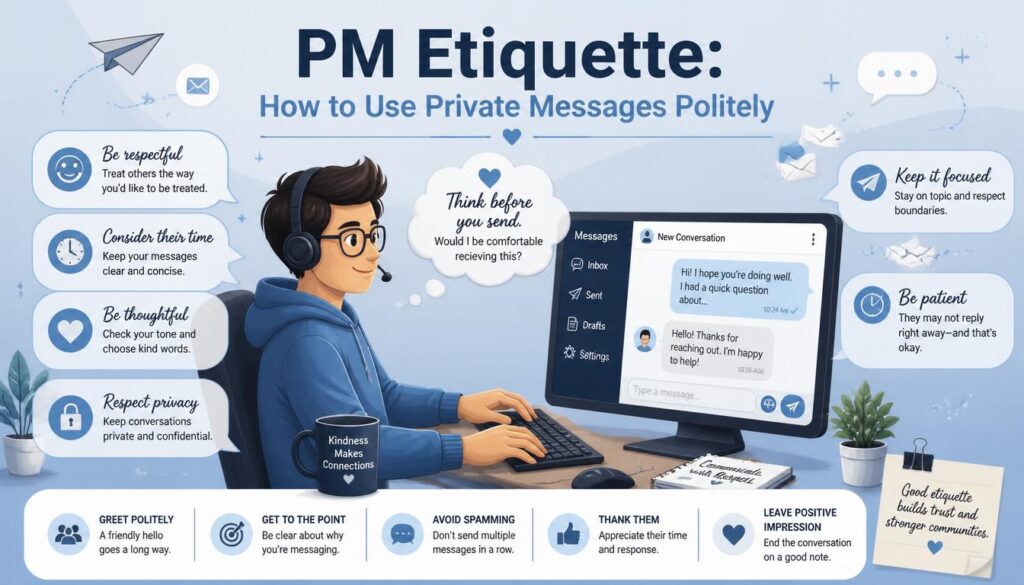
Good messaging etiquette helps create positive interactions.
Best Practices
- Ask permission before sending lengthy messages.
- Be respectful.
- Avoid spam.
- Stay on topic.
- Respond professionally when necessary.
Examples:
Good:
“May I PM you for more details?”
Good:
“Would it be okay if I send you a private message?”
Less ideal:
“PM me now.”
Small differences can make conversations feel much more respectful.
PM Meaning in Business Communication
Businesses often use PM to move conversations away from public channels.
Business Uses of PM
- Customer support
- Sales discussions
- Lead generation
- Client communication
- Technical assistance
Examples:
- “Please PM your order number.”
- “PM us for assistance.”
- “Send a PM regarding your account.”
Private Messages → provide → Privacy in online conversations
This is especially important when handling customer information.
PM Meaning in Relationships and Friendships
Sometimes a PM carries a more personal tone.
When someone invites another person into a private conversation, it can signal:
- Friendship
- Interest
- Trust
- Emotional openness
For example:
- “Can I PM you?”
- “Let’s talk privately.”
While it doesn’t automatically indicate romantic interest, moving from public conversation to private chat often creates a more personal atmosphere.
PM, DM, IM, and Message Requests Explained
Many people confuse these terms.
PM (Private Message)
A general term for private communication.
DM (Direct Message)
Most commonly associated with social media platforms.
IM (Instant Message)
Real-time chat communication.
Message Requests
Messages from users outside your contact list.
Although there are technical differences, all four involve private communication in some form.
Common PM Slang Variations
Modern internet users have created several PM-related expressions.
Examples include:
- PM me
- PM ASAP
- PM pls
- PM details
- PM if interested
- PM sent
- PM received
Understanding these phrases helps you navigate online conversations more confidently.
How AI and Modern Technology Interpret PM
As artificial intelligence becomes more common, systems increasingly rely on context to interpret abbreviations.
For example:
If a message says:
“Meet me at 8 PM.”
AI identifies PM as time.
If a message says:
“PM me your details.”
AI recognizes PM as Private Message.
This demonstrates an important principle:
Context → determines → Meaning
Without context, abbreviations can become ambiguous.
Common Misunderstandings About PM
Several misunderstandings occur frequently.
Confusing PM with Time
Someone reading “PM me later” might initially think of evening hours rather than messaging.
Confusing PM with DM
Many users believe they are completely different concepts.
In reality, they’re very closely related.
Confusing PM with Email
Private messaging and email are separate communication methods.
Emails generally involve formal communication, while PMs are often casual and immediate.
Quick Summary Table
| Situation | Meaning of PM |
| PM me | Private Message |
| Sent a PM | Private Message |
| Check your PMs | Private Message |
| Meeting at 4 PM | Post-Meridiem |
| Available after 6 PM | Post-Meridiem |
| Marketplace PM | Private Message |
| Instagram PM | Private Message |
| Facebook PM | Private Message |
Why Understanding PM Matters
Understanding PM helps you:
- Communicate clearly online
- Avoid misunderstandings
- Navigate social media confidently
- Participate in online communities
- Interpret texting slang correctly
As internet language keeps evolving, abbreviations will continue appearing in everyday communication. Knowing their meanings makes digital interactions much smoother.
Frequently Asked Questions
What does PM mean in text slang?
In text slang, PM usually means Private Message. It refers to a private one-to-one conversation that takes place away from public comments, group chats, or discussion threads. People often use PM when sharing personal details or continuing conversations privately.
Is PM the same as DM?
In most situations, yes. PM means Private Message, while DM means Direct Message. Both describe private communication between users. DM is more common on modern social media platforms, while PM remains widely used in forums, communities, and general internet conversations.
Can PM mean time instead of messaging?
Yes. PM can also stand for Post-Meridiem, meaning afternoon or evening hours after noon. When PM appears next to a number, such as 6 PM or 9 PM, it almost always refers to time rather than private messaging.
Is it professional to say PM me?
It depends on the setting. PM is acceptable in online communities, customer support chats, and informal business discussions. In formal emails or official correspondence, it’s usually better to write “please send a private message” or “contact me directly.”
Final Thoughts
So, what does PM mean in text?
Most of the time, PM stands for Private Message, a simple way to move a conversation from a public space into a private one-to-one chat. However, PM can also mean Post-Meridiem, referring to afternoon and evening hours.
The key to understanding PM is context. Whether you’re using social media messaging, participating in online forums, chatting in apps, or browsing marketplace listings, recognizing how PM is used will help you communicate clearly and avoid confusion. Once you know the context, the meaning becomes pretty obvious, and honestly, you’ll start noticing PM everywhere online.
Meta Description: What Does PM Mean in Text? Learn the full meaning of PM, including Private Message, Post-Meridiem, platform usage, examples, and FAQs.