
Have you ever played an online multiplayer game, won several matches in a row, and then suddenly found yourself losing against opponents who seemed almost impossible to defeat? You might start wondering whether your skills have disappeared overnight or whether something unusual is happening behind the scenes. It’s a familiar feeling for many competitive gamers, and it has helped fuel countless discussions about matchmaking algorithms.
One term that frequently appears in these conversations is EOMM (Engagement Optimized Matchmaking). Short for Engagement Optimized Matchmaking, EOMM describes a matchmaking approach that focuses on keeping players interested in a game rather than simply creating matches between people with similar skill levels.
The concept has attracted attention because it raises an interesting question: should a game prioritize competitive fairness, or should it prioritize keeping players engaged for longer periods? Although these goals can sometimes work together, they aren’t always identical.
Understanding the EOMM meaning, its mathematical foundations, and its differences from traditional matchmaking can help explain why online games sometimes produce surprising match outcomes. Let’s explore how this system works, what academic research actually says, and whether EOMM is genuinely used in modern multiplayer games.
What Is EOMM (Engagement Optimized Matchmaking)?
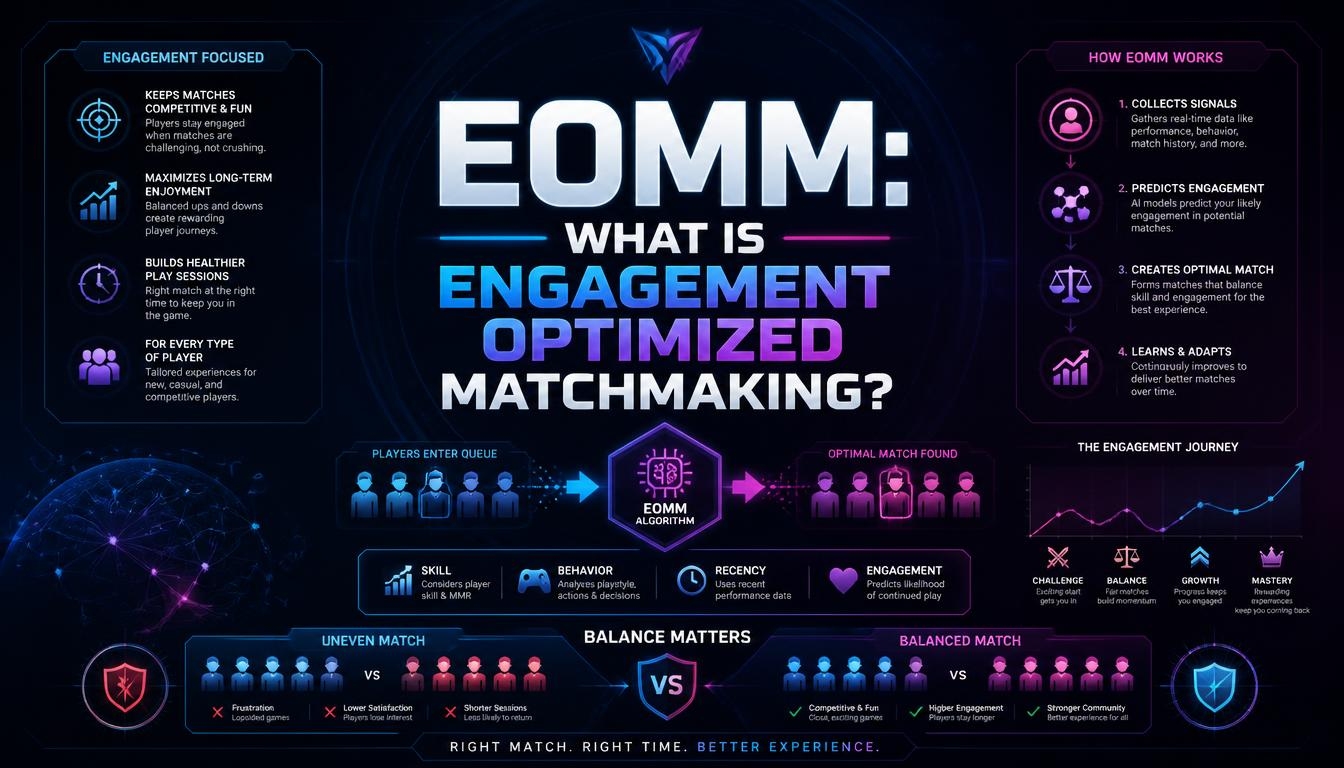
EOMM stands for Engagement Optimized Matchmaking, a matchmaking framework designed to maximize overall player engagement. Instead of focusing exclusively on matching players with similar abilities, it considers how different match outcomes might influence whether players continue playing.
In simple terms, an EOMM matchmaking system attempts to create player pairings that are expected to encourage continued participation. It considers factors such as previous match results, player behavior, estimated skill, and the possibility that someone might stop playing.
For example, imagine two players who have experienced several frustrating losses. A traditional skill-based system might pair them with opponents based primarily on their estimated abilities. An engagement-oriented approach could consider additional information about their recent experiences and predicted responses to different possible opponents.
The objective is not necessarily to make every individual match perfectly balanced. Instead, the broader engagement optimized matchmaking system considers how match assignments might affect the collective engagement of the player population.
It’s important to understand one distinction: EOMM is a researched mathematical framework, not proof that every multiplayer game secretly controls individual victories and defeats.
What Does EOMM Mean in Online Gaming?
The EOMM meaning becomes easier to understand when we look at the business and behavioral side of online gaming.
Multiplayer games depend on active communities. Developers want players to return regularly, participate in matches, explore new content, and remain interested in the experience. When players become frustrated and abandon a game, developers may lose both active users and potential long-term revenue.
This behavior is commonly described as player churn.
EOMM approaches matchmaking as one possible way to influence player engagement and reduce the likelihood of abandonment. It considers the relationship between match outcomes and future gaming activity.
Several important concepts help explain this approach:
- Player engagement: How actively someone participates in a multiplayer game.
- Player retention: The ability of a game to keep players returning over time.
- Player churn: The situation in which players stop participating or abandon a game.
- Predicted engagement: An estimate of how likely players are to continue playing after particular experiences.
- Match assignment: The process of deciding which players compete against one another.
- Aggregate retention: The combined retention behavior of the wider player population.
These concepts show why EOMM is different from a matchmaking system that only considers competitive ability.
How Does EOMM Work?
The EOMM algorithm uses mathematical modeling and player information to estimate which matchmaking arrangements could produce better engagement outcomes.
The original research introduced a framework involving player skill estimation, churn prediction, and graph-based matchmaking optimization. These components work together to evaluate possible match arrangements.
Let’s examine the main stages.
Player Skill Estimation
Before creating a match, matchmaking systems need some understanding of player ability. This can involve previous match results, performance statistics, win rates, and other gameplay information.
A skill model estimates how capable a player is compared with other participants. It helps developers understand the likely competitive balance between different opponents.
However, EOMM doesn’t stop at skill estimation.
Two players with similar abilities might respond differently to the same match outcome. One may enjoy a difficult competition, while another could become frustrated after repeated losses.
This is where engagement-related information becomes important.
Churn Prediction Model
The second important component is the churn prediction model.
This model estimates the likelihood that a player will stop playing based on available behavioral information and possible future experiences.
For instance, a player experiencing repeated defeats might have a higher predicted probability of leaving than someone who regularly enjoys competitive matches. However, this is a statistical possibility, not a universal rule.
A churn prediction model can consider different indicators, including:
- Recent winning and losing streaks.
- Previous match outcomes.
- Player activity patterns.
- Session lengths.
- Historical participation.
- Changes in gameplay behavior.
- Responses to previous gaming experiences.
These indicators help estimate possible future engagement.
The goal is to understand how different match outcomes might influence a player’s decision to continue playing.
Graph Matching Model
The third major component is the graph matching model.
In mathematical terms, a graph can represent players as individual nodes and possible match pairings as connections between them. Each potential pairing can receive a value based on its predicted engagement outcome.
The matchmaking optimization process then evaluates possible combinations.
Rather than selecting opponents randomly, the system searches for player pairings that could produce a higher overall engagement value across the available match pool.
This is an important part of the EOMM framework because matchmaking decisions are evaluated collectively.
A match that looks ideal for one player might not be the best option for another. The algorithm considers the broader combination of possible outcomes instead of treating every player independently.
The Three Main Components of the EOMM Algorithm
Although the mathematical implementation can be more complicated, the original EOMM research can be understood through three central components.
Skill Model
The skill model estimates the abilities of individual players and helps determine possible match outcomes.
It provides a foundation for understanding competitive differences between opponents. Without reasonable skill estimation, predicting match results would become considerably more difficult.
Churn Prediction Model
The churn prediction model estimates whether players might abandon a game after particular experiences.
It uses historical information and behavioral patterns to estimate possible engagement changes. This allows the framework to consider more than immediate match results.
Matchmaking Optimization
The final component combines available information to identify suitable player pairings.
Using mathematical optimization and graph matching, the system evaluates possible arrangements and attempts to maximize predicted aggregate engagement.
Together, these components form the foundation of engagement-based matchmaking.
EOMM vs. SBMM: What Is the Difference?
One of the most common discussions surrounding EOMM is its relationship with SBMM (Skill-Based Matchmaking).
Although both approaches involve player matchmaking, their primary objectives are different.
Skill-Based Matchmaking focuses on grouping players according to their estimated abilities. The intention is to create competitive matches where participants have reasonably similar skill levels.
EOMM, on the other hand, considers how matchmaking decisions might influence player engagement and retention.
Here is a closer comparison:
| Feature | EOMM | SBMM |
|---|---|---|
| Full form | Engagement Optimized Matchmaking | Skill-Based Matchmaking |
| Main objective | Optimize predicted player engagement | Match players according to skill |
| Primary signals | Engagement predictions, churn risk, and skill | Player skill and performance |
| Matchmaking approach | Engagement-based player pairing | Skill-based player pairing |
| Player retention | A central objective | Not necessarily the primary objective |
| Competitive fairness | May be considered alongside engagement | A major matchmaking consideration |
| Match outcomes | Evaluated for their potential engagement impact | Evaluated through competitive ability |
| Optimization | Aggregate engagement | Competitive balance |
Is EOMM Better Than SBMM?
There isn’t a universal answer because the two systems are designed around different objectives.
SBMM can help players find opponents with comparable abilities, potentially making matches more competitive and enjoyable. However, even skill-balanced matches can produce frustrating experiences.
EOMM introduces another consideration: how different match experiences might influence continued participation.
For example, a game developer might want to reduce early frustration among new players. A retention-aware approach could examine how matchmaking experiences affect whether beginners return for another session.
However, optimizing engagement doesn’t automatically guarantee competitive fairness or player satisfaction.
The best matchmaking experience may involve combining several signals, including skill, connection quality, queue time, and player experience.
Why Does EOMM Focus on Player Retention?
Player retention is an important part of modern gaming because multiplayer games depend on active communities.
When players regularly return, matchmaking queues remain populated, communities stay active, and developers have more opportunities to introduce updates and additional content.
By contrast, early player churn can create problems for both players and gaming studios.
Imagine downloading a multiplayer game for the first time. You spend several hours learning its controls, understanding its mechanics, and improving your performance. However, your first few matches are extremely difficult, and you struggle to compete.
Some players will continue practicing. Others might decide the game isn’t worth their time.
This is one reason developers study the new player experience.
An engagement-oriented matchmaking framework considers whether different match assignments could influence future participation.
Important retention-related factors include:
- Early player churn: New players abandoning a game shortly after joining.
- Player lifecycle: The different stages of someone’s participation in a game.
- Player satisfaction: How positively players perceive their overall experience.
- Player session length: The amount of time someone spends playing during a session.
- Long-term player retention: The ability to maintain an active gaming community.
- Player LTV: The estimated lifetime value of an individual player.
These measurements help studios understand how matchmaking relates to broader gaming business objectives.
Is EOMM Real? Understanding the 2017 Academic Research
Yes, EOMM is a real matchmaking concept that was introduced through academic research in 2017.
The original research, associated with Chen et al., presented a mathematical framework called Engagement Optimized Matchmaking. The researchers explored how matchmaking could be optimized around predicted player engagement rather than focusing exclusively on traditional skill-based pairing.
The research was associated with Electronic Arts (EA) and examined how anonymized gaming data could support the development of engagement-oriented matchmaking models.
One of the important contributions of the paper was demonstrating that matchmaking could be formulated as a mathematical optimization problem involving player behavior and predicted engagement.
The research also explored how graph matching could be used to identify player pairings that maximize aggregate engagement.
However, there is an important difference between researching a matchmaking framework and confirming that a particular commercial game uses it.
The existence of the 2017 academic paper does not establish that every EA title, or any specific multiplayer game, currently uses the proposed system.
Does EA Use EOMM?
This is one of the most frequently asked questions in gaming communities.
The connection between EOMM and EA comes from the academic research associated with the company. However, that connection should not automatically be interpreted as confirmation of a specific live-game implementation.
To establish whether a particular game uses EOMM, reliable evidence would be needed, such as official developer statements, technical documentation, or credible implementation details.
Players sometimes associate unusual matchmaking experiences with EOMM, especially when they encounter repeated losses or unexpected opponent difficulty.
But player experiences alone cannot establish which algorithm a game is using.
It is better to separate documented research from assumptions about commercial matchmaking systems.
Does EOMM Manipulate Match Outcomes?
This question is at the heart of many discussions about EOMM gaming.
Some players believe engagement-based matchmaking deliberately gives them easy matches after losing streaks and difficult matches after winning streaks.
Others think matchmaking systems intentionally create frustrating experiences to keep people playing longer.
However, these claims require careful examination.
The original EOMM framework focuses on optimizing predicted engagement through player assignments. It does not, by itself, prove that a commercial game secretly forces particular players to lose.
There is also a difference between influencing possible match outcomes and directly controlling gameplay results.
A matchmaking algorithm may select opponents based on certain predictions, but the actual result still depends on player decisions, teamwork, game mechanics, and random events.
For example, two players with similar abilities can produce completely different results depending on their connection quality, equipment, communication, and performance during a match.
Therefore, a losing streak isn’t automatic evidence of manipulation.
Why Do Players Experience Losing Streaks?
There are several possible explanations for repeated defeats in multiplayer games.
Statistical variance: Even reasonably balanced matches can produce unexpected results. Winning and losing streaks are natural possibilities in competitive environments.
Changing player pools: The available opponents may change depending on the time of day, region, and matchmaking population.
Skill differences: Player abilities can be difficult to estimate perfectly, particularly when performance changes over time.
Team composition: A player’s experience may depend on teammates, communication, and coordination.
Matchmaking parameters: Games may consider different factors, including connection quality, queue time, rank, and other internal criteria.
Although EOMM is one possible framework for engagement-aware matchmaking, these explanations show why unusual match outcomes should not automatically be attributed to it.
What Is the EOMM Demon?
The term EOMM demon is an informal expression used in gaming discussions to describe matchmaking experiences that players believe are unfairly difficult or deliberately frustrating.
For example, someone might win five matches consecutively and then lose several games against noticeably stronger opponents.
They may jokingly blame an imaginary EOMM demon for ruining their winning streak.
The expression has become associated with conversations about manipulated losing streaks, difficult opponents, and suspicious matchmaking patterns.
However, the EOMM demon isn’t an official technical component of the original research.
It’s better understood as community slang reflecting player frustration and perceptions of matchmaking fairness.
Some players use the expression humorously, while others genuinely believe their matchmaking experiences are being influenced by hidden engagement-based systems.
Without access to a game’s internal matchmaking data, it’s difficult to determine whether those experiences result from an engagement algorithm, ordinary statistical variation, or other matchmaking factors.
How EOMM Could Affect Live-Service Games
Live-service games operate through continuous updates, online communities, seasonal content, and ongoing player participation.
Unlike traditional games that may offer a relatively fixed experience, live-service titles depend on maintaining interest over extended periods.
This makes player retention an important consideration for gaming studios.
An engagement-oriented matchmaking framework could potentially help developers evaluate how different match experiences affect player participation.
Some possible applications include:
- Improving the experience of newly registered players.
- Understanding how losing streaks influence player behavior.
- Identifying situations associated with early player abandonment.
- Evaluating the relationship between match outcomes and session lengths.
- Studying how different matchmaking patterns affect player retention.
- Supporting long-term engagement strategies.
- Providing additional information for player analytics.
However, these are potential applications of the broader concept, not confirmation that every live-service studio has implemented EOMM.
Developers also need to balance engagement objectives with competitive fairness, transparency, and community trust.
A matchmaking system that keeps players active but makes them feel manipulated could damage the very community it is supposed to support.
How Gaming Studios Monitor Matchmaking Frustration
Matchmaking quality isn’t measured through mathematical models alone. Developers also need to understand how actual players experience their games.
This is where gaming support systems and community feedback become useful.
Players frequently report matchmaking-related problems through support tickets, community channels, discussion forums, and in-game feedback systems.
For example, someone might contact customer support because they repeatedly encounter opponents with significantly higher skill levels.
Another player may complain about long matchmaking queues or frustrating team assignments.
These reports can help developers identify patterns that aren’t immediately obvious from match statistics.
Platforms such as Helpshift, which focuses on gaming customer support and player engagement, provide tools for managing player interactions and support requests.
AI-powered solutions such as Care AI can also help streamline certain support processes, allowing gaming teams to handle common questions and analyze player concerns more efficiently.
Industry discussions, including the AI in Gaming Support Report, highlight the growing role of artificial intelligence in gaming customer support and player experience management.
It’s worth remembering that customer support analytics and matchmaking optimization are different things. Monitoring complaints about matchmaking doesn’t mean a support platform controls the matchmaking algorithm.
Still, both areas contribute to understanding player satisfaction and community sentiment.
Benefits and Potential Limitations of EOMM
Like any data-driven matchmaking approach, EOMM offers potential advantages but also raises important questions.
Potential Benefits
Improved player retention: Engagement-aware matchmaking could help developers understand which experiences encourage players to continue participating.
Reduced early frustration: New players may benefit from matchmaking strategies that consider their early gaming experiences.
Better player analytics: Combining skill estimation with behavioral predictions can provide a broader understanding of gaming communities.
Long-term engagement: Developers can evaluate how different match assignments relate to continued participation.
Gaming business intelligence: Engagement predictions can provide useful information for broader game development and retention strategies.
Potential Limitations
Competitive fairness: Optimizing engagement may create conflicts with the expectation that players should face opponents based on comparable abilities.
Player trust: If people believe matchmaking is manipulating their experiences, confidence in the game may decline.
Prediction accuracy: Human behavior is complicated, and no churn prediction model can perfectly determine how someone will respond to a match.
Privacy concerns: Behavioral analysis requires responsible handling of player information and appropriate data practices.
Community sentiment: Even a mathematically effective system might receive negative feedback if players feel its decisions are unfair.
Implementation complexity: Developing, testing, and maintaining an engagement-aware matchmaking system requires suitable data, technical resources, and ongoing evaluation.
These limitations demonstrate why predicted engagement shouldn’t automatically become the only objective of multiplayer matchmaking.
Can EOMM and SBMM Work Together?
Yes, engagement-based and skill-based matchmaking concepts can potentially be combined.
There is no fundamental reason why a multiplayer game must choose only one matchmaking signal.
A developer could consider estimated player skill while also evaluating connection quality, queue times, recent match history, and predicted engagement.
For example, a system might first identify opponents within an acceptable skill range and then evaluate which available match arrangement offers a better overall experience.
This type of approach could help balance competitive fairness with player retention objectives.
However, the exact implementation would depend on the game’s design, available data, and matchmaking priorities.
Combining different signals also introduces trade-offs. If engagement optimization receives too much importance, players might question whether the system is prioritizing fair competition.
The challenge for game developers is finding a balance that supports enjoyable matches without undermining player confidence.
Frequently Asked Questions About EOMM
What does EOMM stand for?
EOMM stands for Engagement Optimized Matchmaking. It is a mathematical matchmaking framework designed to optimize predicted player engagement rather than focusing exclusively on skill-based player pairings.
What is EOMM in online gaming?
EOMM in online gaming refers to an engagement-based matchmaking approach that considers player behavior, predicted match outcomes, and possible player retention when evaluating opponent assignments.
How does EOMM work?
EOMM uses three important components: a skill model, a churn prediction model, and a graph matching model. Together, they help evaluate possible player pairings based on predicted engagement outcomes.
Is EOMM different from SBMM?
Yes. SBMM primarily focuses on matching players with similar skill levels, whereas EOMM considers how matchmaking decisions might influence overall player engagement and retention.
Read ARticul: https://ytmeaning.com/valkyrie-meaning/
Does EOMM cause losing streaks?
There is no reliable basis for claiming that every losing streak is caused by EOMM. Repeated losses can result from statistical variation, changing opponent pools, team performance, and other matchmaking factors.
Does EA use Engagement Optimized Matchmaking?
EOMM is associated with academic research involving EA researchers. However, the existence of that research does not independently confirm that a particular EA game currently uses the proposed framework.
What is the EOMM demon?
The EOMM demon is an informal gaming expression used to describe frustrating matchmaking experiences, particularly unexpected losing streaks or difficult opponent pairings. It isn’t an official component of the EOMM algorithm.
Can matchmaking algorithms predict player behavior?
Matchmaking algorithms can use statistical models to estimate player behavior and possible engagement patterns. However, these predictions are probabilities rather than guaranteed descriptions of what someone will do.
Does EOMM improve player retention?
EOMM was developed around the idea of optimizing predicted engagement. It provides a mathematical approach to exploring retention-related matchmaking decisions, but actual improvements depend on implementation, data quality, and player responses.
Is EOMM used in every multiplayer game?
No. Different games use different matchmaking approaches, and the presence of EOMM research doesn’t establish that all multiplayer games use engagement-based matchmaking.
eomm
EOMM stands for Engagement Optimized Matchmaking, a gaming matchmaking approach designed to maximize player engagement and encourage players to keep participating in online multiplayer games.
what is eomm
EOMM is a matchmaking framework that considers player skill, match history, and predicted engagement to create player pairings that may improve overall player retention.
eomm matchmaking
EOMM matchmaking uses player behavior, skill estimation, and churn prediction to evaluate possible opponent pairings and optimize overall engagement in multiplayer gaming.
Final Thoughts on EOMM: Understanding Engagement Optimized Matchmaking
EOMM (Engagement Optimized Matchmaking) introduces an interesting way of thinking about multiplayer matchmaking. Instead of considering only how closely players match in skill, it explores how different opponent assignments might influence engagement, retention, and future participation.
Its three main components, including skill estimation, churn prediction, and graph matching, demonstrate how mathematical optimization can be applied to player matchmaking.
However, understanding EOMM also means separating academic research from gaming rumors. A difficult match, unexpected defeat, or frustrating losing streak doesn’t automatically prove that an engagement-based algorithm is controlling the experience.
For players, competitive fairness and enjoyable gameplay remain essential. For developers, maintaining an active community requires more than simply increasing session lengths or predicting player behavior.
Ultimately, successful matchmaking should create an environment where players want to return because they genuinely enjoy competing, improving, and connecting with others. That’s the real challenge behind understanding EOMM and the future of online gaming.
Remove Repetitive EOMM ExplanationsClarify Research Versus Proven Implementation