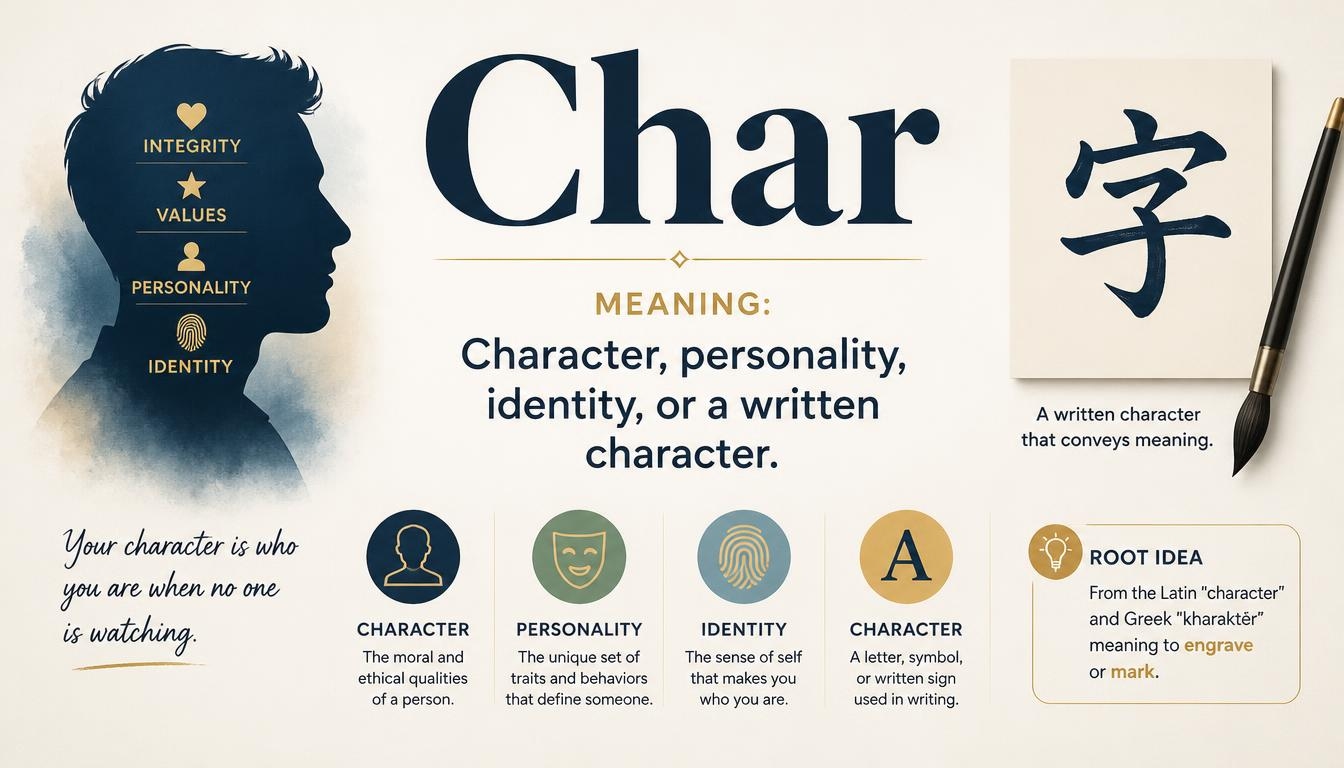

The word char is one of those short English words that can leave people wondering what it actually means. You might see it in a dictionary, read it in a cooking recipe, hear someone talking about grilled food, or come across it while learning about freshwater fish. Interestingly, the same three letters can describe several quite different things, depending on the sentence.
So, char meaning is not limited to burning something. It can refer to a type of freshwater fish, the process of burning or scorching a material, a darkened surface on grilled food, or even a domestic cleaning worker in British English. That’s quite a lot of meaning packed into such a small word!
Understanding the context makes everything easier. In this guide, we’ll explore the char definition, pronunciation, word history, different grammatical uses, synonyms, and practical examples to help you understand how this word works in everyday English.
What Does Char Mean?
The word char has several meanings in English, and its interpretation depends on how it is being used. As a verb, it generally means to burn something partially, leaving a blackened or carbonized surface. As a noun, it can refer to a freshwater fish belonging to the genus Salvelinus.
In British English, char can also be an informal term for a woman employed to do domestic cleaning or household work.
Here are the main meanings:
- Burning: To burn, scorch, or turn something black through exposure to heat.
- Fish: A freshwater fish related to trout, including Arctic char and brook trout.
- Cooking: A darkened, slightly burned surface that develops when food is grilled or exposed to intense heat.
- Domestic work: A shortened form of charwoman, referring to a cleaning woman or domestic worker.
For example, if someone says, “The fire charred the wooden door,” they mean the door became blackened from burning. But if a restaurant menu mentions Arctic char, it is talking about a fish, not something that has been burned.
Char Definition and Dictionary Meaning
According to the Merriam-Webster Dictionary, char has multiple dictionary entries covering its use as a noun and verb. Its meanings include a type of fish, the act of burning something, and a historical British term for domestic work.
The char dictionary definition can be understood through its different grammatical roles.
Char as a noun:
- A freshwater fish belonging to the genus Salvelinus.
- A blackened or burned substance in certain contexts.
- An informal British term for a charwoman or domestic cleaning worker.
Char as a verb:
- To burn or partially burn something.
- To turn a surface black through heat.
- To produce a charred or carbonized appearance.
The word is particularly interesting because its noun and verb forms can appear in completely different conversations without changing their spelling.
Char Pronunciation in English
The correct char pronunciation is simple once you hear it. It is generally pronounced as one syllable, with the same vowel sound found in words such as car and far.
- Spelling: Char
- Pronunciation: /tʃɑːr/ in many British pronunciations
- American pronunciation: /tʃɑːr/
- Syllables: One
- Part of speech: Noun and verb
The beginning sounds like the “ch” in chair, while the ending has an open vowel sound.
Try saying these words aloud: char, charm, charcoal, and charred. They share similar opening sounds, making them fairly easy to recognize.
Char Meaning as a Noun
When used as a char noun, the word can describe different things depending on the surrounding words.
Its most recognized noun meaning is a freshwater fish. However, historical British usage gives it another meaning connected with household cleaning.
Consider these examples:
- The fisherman caught a beautiful char in the cold mountain lake.
- Arctic char is popular in many seafood restaurants.
- The old char worked in several households.
- The chef admired the char on the surface of the grilled steak.
Notice how each sentence uses the same word but communicates a different idea. This is why checking the surrounding sentence is more useful than relying on one dictionary definition.
Char Meaning as a Verb
The char meaning as a verb is connected with burning, scorching, or partially destroying something through heat.
When an object chars, its surface becomes dark or black. Depending on the material and the amount of heat, the process may also leave behind carbon-rich residue.
For example:
- The intense fire began to char the wooden furniture.
- Be careful not to char the vegetables while grilling.
- The cook allowed the peppers to char slightly.
- The electrical fault charred part of the plastic covering.
In everyday language, char often describes something that has been exposed to enough heat to change its appearance.
Charred Meaning: What Does Charred Mean?
The word charred is the past tense and past participle of the verb char. It describes something that has been partially burned, usually leaving a darkened or blackened surface.
The charred meaning can change slightly depending on the object being described.
For instance, charred wood has been burned and darkened by fire, while charred vegetables may have developed a flavorful, browned exterior during cooking.
Examples include:
- The building had charred walls after the fire.
- She served charred corn with butter and spices.
- The wooden fence was completely charred in some places.
- A few charred pieces of paper remained on the floor.
A charred surface does not always mean the entire object has been destroyed. Sometimes only its outer layer has experienced burning.
What Does Charring Mean?
Charring refers to the process of burning a material until its surface becomes darkened or carbonized.
It can happen naturally during a fire or intentionally during food preparation. The amount of heat, exposure time, and type of material all influence the final result.
For example, when wood burns, it can develop a black carbon-rich surface. During grilling, vegetables may develop small charred patches that add a smoky flavor.
The charring process is also important in industrial and scientific settings because heat can change the chemical and physical properties of materials.
Here are a few examples:
- Charring wood can leave behind a blackened outer layer.
- Charring vegetables can improve their grilled flavor.
- Excessive charring may make food bitter.
- The charring of building materials can indicate exposure to intense heat.
Char Meaning in Cooking
In cooking, char usually refers to the darkened, slightly burned surface that develops when food is exposed to high heat.
You may notice it on grilled steak, hamburgers, vegetables, peppers, or fish. Those dark patches are often associated with a smoky grilled flavor and a crisper texture.
8 Restaurant Chains That Use Frozen Steaks, According To Former Employees
Top Grilling & Barbecue Tips
Best Grilled Corn On The Cob Recipe
A little char can make food more appealing, especially when the inside remains tender and juicy. However, excessive burning can produce an unpleasant bitter taste.
How Food Develops a Char
Food develops a char when its surface comes into direct contact with intense heat. This can happen on a gas grill, charcoal grill, barbecue, or hot cooking pan.
Several factors influence the result:
- High temperature: Strong heat helps create darkened patches on food.
- Cooking time: Leaving food over heat for too long can cause excessive burning.
- Moisture: Drier surfaces generally brown and char more easily.
- Marinade: Ingredients such as brown sugar can encourage faster surface browning.
- Grilling technique: Turning food at the right time helps create an even exterior.
The goal is usually to develop a flavorful surface without burning the entire piece of food.
What Is a Charred Crust?
A charred crust is the dark outer layer that forms when food is cooked at high temperatures.
A grilled steak is a familiar example. The outside may develop a rich brown or blackened crust while the center stays tender.
Some people enjoy this contrast because the outside provides a slightly smoky flavor and a different texture from the softer inside.
Charred Steak Meaning
A charred steak is a steak with a darkened or slightly burned exterior produced through grilling or high-temperature cooking.
A well-prepared charred steak can have a delicious crust, but the distinction between controlled charring and excessive burning matters.
The seasoning, cooking time, thickness of the steak, and heat level all contribute to the final result.
Charred Hamburger Meaning
A charred hamburger is a burger whose outer surface has developed darkened patches during grilling.
These patches can provide a smoky taste and a slightly crisp texture. However, a hamburger should still be cooked to a safe internal temperature, regardless of how dark its exterior looks.
Ingredients That Work Well With Grilled Food
Many ingredients can complement the smoky taste of grilled food.
For example, a marinade made with brown sugar, cumin, fish sauce, tamarind purée, and red pepper flakes can create a sweet, spicy, and savory flavor.
An extra glaze during the final stage of cooking may also improve the appearance and taste. Just keep an eye on the cooking time because sugary ingredients can burn quickly.
Char Meaning as a Fish: What Is Arctic Char?
Another important char meaning relates to freshwater fish. Char refers to fish belonging to the genus Salvelinus, which is part of the salmonid family.
These fish are related to trout and salmon, and several species are found in cold freshwater environments.
Martin Falklind filmar stökiga rödinghanar och städande rödinghonor
Karin Nilsson | Medarbetarwebben
Cafe 43 at George W. Bush Presidential Center brings new lunch option to ParkCities – CultureMap Dallas
One of the best-known members of this group is Arctic char, a fish found in cold northern regions, including Arctic and subarctic waters.
Arctic Char Characteristics
Arctic char is a cold-water fish that can live in freshwater lakes, rivers, and coastal marine environments.
Its appearance varies depending on its habitat and breeding season. Some fish have light-colored spots against a darker body, while spawning individuals may develop striking reddish or orange colors.
Important characteristics include:
- Belongs to the Salvelinus fish genus.
- Closely related to salmon and trout.
- Lives in cold-water environments.
- Can have distinctive light-colored spots.
- Is valued as a food fish.
- Has a flavor often compared with trout and salmon.
Is Char a Type of Trout?
Char is closely related to trout, but it is not simply another name for every trout species.
Both belong to the salmonid family, but char belongs specifically to the genus Salvelinus. Brook trout, despite its common name, is actually a species of char.
This is a small but interesting detail that often surprises people who are learning about freshwater fish.
Brook Trout and Char
Brook trout (Salvelinus fontinalis) is a well-known North American freshwater fish.
Despite having the word trout in its common name, it belongs to the char genus. It is recognized by its colorful appearance, distinctive markings, and preference for cool, clean water.
This explains why dictionary descriptions sometimes use the phrase small-scaled trout when explaining the meaning of char.
Char Meaning in British English
In historical and informal British English, char can refer to a woman employed to perform household cleaning or domestic tasks.
The term is associated with the longer word charwoman, which traditionally described a woman hired to clean homes or perform household chores.
For example:
- The family hired a char to clean the house.
- The charwoman arrived early in the morning.
- She worked as a domestic worker for several households.
This meaning is less common in modern everyday conversation, and the word may sound old-fashioned today.
Charwoman Meaning
A charwoman is traditionally a woman employed to perform domestic cleaning work, often on a part-time or occasional basis.
Her responsibilities might include:
- Cleaning floors and rooms.
- Dusting furniture.
- Washing household items.
- Helping with general household chores.
- Performing basic cleaning duties.
Modern alternatives include cleaning woman, housekeeper, domestic worker, and cleaner.
It is worth remembering that the historical term reflects older employment practices. Today, more neutral and respectful job titles are generally preferred.
Char Synonyms and Antonyms
The char synonyms depend on which meaning of the word you are trying to express. There is no single synonym that works perfectly for every context.
For the burning-related verb, common alternatives include:
| Word | Meaning |
|---|---|
| Burn | To damage something through heat or fire |
| Scorch | To burn the surface of something |
| Singe | To burn slightly, especially the outer edges |
| Sear | To expose something to intense heat |
| Bake | To cook using surrounding dry heat |
| Light | To set something on fire |
For the domestic worker meaning, related words include:
- Housekeeper
- Maid
- Cleaning woman
- Domestic worker
- Charwoman
There are also some useful opposites, although they depend on the sentence.
For example, cool, extinguish, protect, and preserve can contrast with the burning-related meaning of char.
Char vs Charcoal: What Is the Difference?
Char and charcoal are related to burning, but they do not mean exactly the same thing.
Char generally describes the process of burning or the darkened material left behind. Charcoal is a carbon-rich material produced by heating wood or other organic substances with limited oxygen.
Here is a simple comparison:
| Char | Charcoal |
|---|---|
| Can describe an action | Names a material |
| Means to burn or scorch | A carbon-rich fuel |
| Can describe a darkened surface | Often used for grilling |
| Can refer to charred residue | Can be produced through controlled heating |
For example, when a wooden piece chars in a fire, its surface becomes blackened. Charcoal, on the other hand, is commonly used as fuel in a charcoal grill.
The two words are connected through the chemistry of heat and carbon, but they should not be used interchangeably.
Char vs Scorch: Understanding the Difference
Char and scorch are sometimes used as synonyms, but there is a small difference between them.
To scorch something usually means to burn or damage its surface through excessive heat. To char something generally suggests a darker, more noticeably blackened or carbonized surface.
For example:
- A hot iron can scorch a shirt.
- A strong fire can char a wooden door.
- A grill can scorch food if the heat is too high.
- A piece of wood can become charred after prolonged exposure to fire.
Both words describe heat-related damage, but char often suggests more visible blackening.
Char Plural: What Is the Plural of Char?
The char plural form is interesting because the word has more than one accepted plural spelling.
When referring to the fish, the plural can be char or chars. The alternative spelling charr also exists, with plural forms including charr and charrs.
Examples:
- The lake contains several char.
- Researchers studied different species of chars.
- Arctic char are found in cold northern waters.
- Several charr were observed during the survey.
In ordinary usage, the correct form depends on the sentence and the dictionary convention being followed.
Char vs Charr: Are They the Same?
Char and charr are variant spellings used for the freshwater fish.
Both refer to fish belonging to the genus Salvelinus. However, char is the more familiar spelling in many modern English dictionaries.
The verb meaning related to burning is normally written as char, charred, and charring.
Remember these forms:
- Char
- Chars
- Charr
- Charrs
- Charred
- Charring
The spelling charr is particularly associated with the fish meaning, although usage can vary between references.
Char Word Origin and Etymology
The char word origin is another interesting part of its history because the different meanings do not necessarily share the same historical development.
The burning-related verb is generally traced to Middle English charren, meaning to turn or become charred. Its historical development is connected with older English words and expressions relating to burning.
The fish name has a separate history and is associated with northern European language traditions.
The domestic-worker meaning developed from the word charwoman, which was historically associated with doing household chores.
Char First Known Use
The burning-related verb is commonly dated to the 14th century in historical dictionary references, while the fish and domestic-worker meanings have their own usage histories.
The date 1662 is sometimes associated with the fish-related entry in dictionary discussions, but first-use dates can differ depending on the particular sense and the historical evidence available.
A first known use does not necessarily mean the word was invented in that year. It simply identifies an early written example that researchers have found.
Chare and Chore: Are They Related?
The words chare and chore have historical connections worth mentioning when exploring older British English vocabulary.
A chore generally refers to a small routine task, especially household work. Historically, chare has also been associated with a task or piece of domestic work.
This is one reason charwoman became associated with household cleaning and similar duties.
Char Examples: How to Use Char in a Sentence
The easiest way to understand a word is to see how people actually use it. The following char examples cover its major meanings.
Burning and scorching:
- The flames began to char the wooden roof.
- Too much heat can char the outside of the bread.
- The paper was charred after being exposed to fire.
- The fire left a layer of charred material behind.
Cooking and grilling:
- I like a little char on my grilled vegetables.
- The chef carefully charred the peppers.
- The hamburger developed a smoky char on the grill.
- The steak had a delicious darkened crust.
Fish:
- Arctic char is a popular cold-water fish.
- The fisherman caught a char in the mountain stream.
- Brook trout belongs to the char genus.
- Several char species live in northern freshwater habitats.
Domestic work:
- The historical novel describes a woman working as a char.
- A charwoman was hired to clean the household.
- The old term char is rarely used in modern conversation.
Char in a Sentence: Common Everyday Expressions
Sometimes the word appears in phrases rather than standing alone. Understanding these expressions helps readers recognize its meaning more quickly.
- Charred wood: Wood that has been burned and blackened.
- Charred building: A building with surfaces damaged by fire.
- Charred steak: Steak with a darkened exterior from grilling.
- Charcoal grill: A cooking appliance that uses charcoal as fuel.
- Arctic char: A freshwater or migratory cold-water fish.
- Charwoman: A traditional term for a woman employed to perform household cleaning.
- Charring process: The process of turning a material dark through heat.
These expressions are especially useful when reading recipes, historical writing, environmental reports, or dictionary entries.
Frequently Asked Questions About Char Meaning
What does char mean?
Char has several meanings. It can mean to burn or scorch something, refer to a freshwater fish in the genus Salvelinus, describe a darkened surface on grilled food, or refer informally to a domestic cleaning worker in historical British English.
What is the meaning of char in English?
The char meaning in English depends on the context. As a verb, it means to burn something partially. As a noun, it can describe a fish or a historical domestic-worker term.
Is char a noun or a verb?
Char can be both a noun and a verb. Its noun meanings include a type of freshwater fish, while its verb meaning is to burn or blacken something.
What does charred mean?
Charred means partially burned or blackened by heat. It is the past tense and past participle of char.
What does charring mean?
Charring describes the process of burning a material until its surface becomes darkened or carbonized.
What is the plural of char?
The plural form can be char or chars. The alternative spelling charr also has the plural forms charr and charrs.
What are the synonyms of char?
For the burning-related meaning, synonyms include burn, scorch, singe, and sear. For the domestic-worker meaning, related terms include housekeeper, maid, and cleaning woman.
Read aRticul: https://ytmeaning.com/sodomite-meaning/
What does char mean in cooking?
In cooking, char refers to the darkened or slightly burned surface that develops when food is exposed to high heat, especially during grilling.
Is char another word for charcoal?
No. Char describes burning or a darkened substance, while charcoal is a carbon-rich material commonly produced by heating wood with limited oxygen.
Is Arctic char a type of trout?
Arctic char is closely related to trout and salmon, but it belongs to the separate genus Salvelinus. Brook trout is also a member of this genus.
What does char mean in British English?
In historical British English, char can be an informal shortened form of charwoman, meaning a woman employed to perform domestic cleaning work.
What is a charwoman?
A charwoman is a traditional term for a woman hired to clean houses or perform household duties. Modern terms include cleaner, housekeeper, and domestic worker.
How do you pronounce char?
Char is pronounced as one syllable, rhyming with car and far. Its common phonetic representation is /tʃɑːr/.
What is the origin of the word char?
The burning-related verb has roots in Middle English, while the fish name and domestic-worker usage have separate historical developments.
char
Char has several meanings depending on the context. It can refer to a type of freshwater fish, something burned or scorched, or a British term for a cleaning woman.
char meaning
The word char can mean to burn something partially or completely, usually through heat. It can also describe a dark, crispy layer on grilled food or a type of trout known as Arctic char.
char definition
Char is both a noun and a verb. As a noun, it can refer to a freshwater fish, charcoal, or a charred substance; as a verb, it means to burn, scorch, or turn something into carbon.
char def
The short definition of char is to burn or scorch something with heat. It can also mean charcoal, a grilled food crust, or a small-scaled trout.
definition of char
The definition of char varies by usage: it can mean a type of trout, the process of burning or scorching, a darkened crust on grilled food, or a domestic cleaning worker in British English.
How to Remember the Different Meanings of Char
Because char has several unrelated or historically distinct meanings, remembering all of them might feel a little confusing at first.
A simple approach is to connect the word with its surroundings.
- If the sentence mentions fire, wood, or heat, char probably means burning.
- If it mentions steak, vegetables, or grilling, char describes a darkened food surface.
- If it mentions lakes, trout, or freshwater, char probably refers to a fish.
- If it appears in an old British story about cleaning a house, it may refer to a charwoman.
This little trick makes the word much easier to understand, especially when you encounter it in unfamiliar reading material.
Conclusion: Understanding the Meaning of Char
The word char may look simple, but its meanings cover several interesting areas of English vocabulary. It can describe burning and scorching, refer to freshwater fish such as Arctic char, explain the darkened surface of grilled food, or appear as an old British term for a domestic cleaning worker.
The most important thing to remember is that char meaning depends on context. Learning its noun and verb forms, pronunciation, synonyms, plural spelling, and word history can help you understand it more confidently.
Whether you encounter char in a dictionary, a cooking recipe, a fishing article, or an old English novel, you’ll now have a better idea of what the writer is trying to say. One small word, several meanings, and a surprisingly interesting history!