
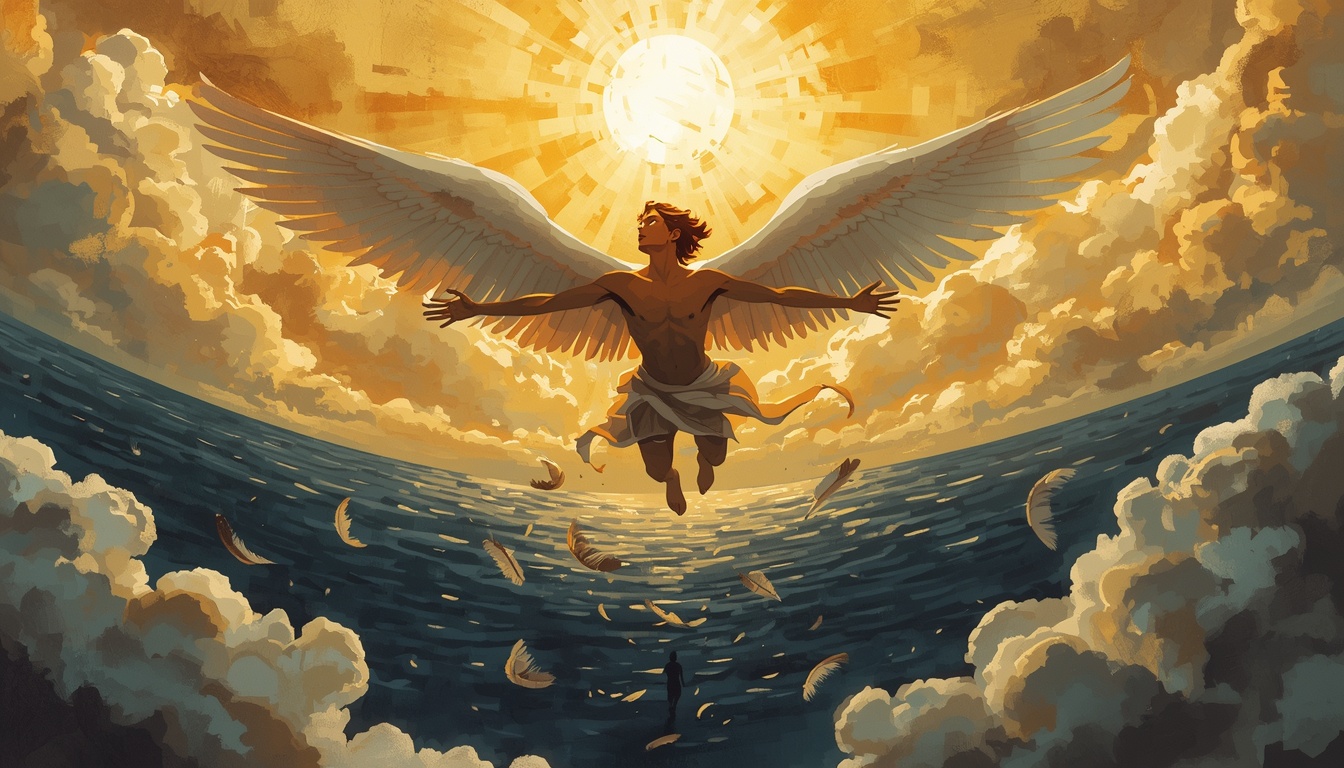

The name Icarus carries a story that has travelled through centuries, and honestly, it is one of those ancient stories that still feels surprisingly close to modern life. Whenever someone talks about ambition, taking risks, or reaching for something beyond their limits, the name Icarus often comes into the conversation.
But what does Icarus mean, and why do people associate this name with flying too close to the sun? The answer comes from an ancient Greek myth about a young man, his father, a pair of handmade wings, and a flight that ended in tragedy.
The story is not simply about a boy who wanted to fly. It explores the relationship between freedom and responsibility, excitement and caution, and dreams and the consequences of ignoring advice. There is something deeply human about Icarus, which is probably why his story has remained meaningful for so long.
In this guide, we will explore the Icarus meaning, its Greek mythology background, pronunciation, origin, etymology, symbolic meaning, and the important lessons hidden inside his unforgettable story.
What Is the Meaning of Icarus?
Icarus is a character from Greek mythology, best known as the son of Daedalus, a highly skilled craftsman and inventor. He became famous for attempting to escape imprisonment using artificial wings made from feathers and wax.
The name is strongly associated with ambition, freedom, risk-taking, and the danger of becoming overconfident. His tragic flight towards the sun eventually caused his wings to fall apart, leading him into the sea.
In modern English, Icarus is often used symbolically to describe someone whose ambition or confidence leads them beyond sensible limits.
Here is a quick look at the meaning:
- Name: Icarus
- Original Greek form: Ikaros
- Language: Greek, transmitted through Latin
- Mythological identity: Son of Daedalus
- Famous association: Flying too close to the sun
- Symbolism: Ambition, freedom, pride, risk, and overconfidence
- Pronunciation: IK-uh-rus
- Related adjective: Icarian
One important distinction is that Icarus is primarily a mythological proper noun rather than an ordinary Greek word with one universally accepted literal translation. Its familiar meaning comes mainly from the story associated with the character.
Icarus Meaning in Greek Mythology
In Icarus Greek mythology, Icarus represents a young man who experiences the excitement of freedom but fails to respect the limits that could keep him safe.
His father, Daedalus, creates artificial wings to help them escape from imprisonment. Before their flight, Daedalus gives his son clear instructions about how to use them.
He warns Icarus not to fly too low because the sea could damage the wings, and not to fly too high because the sun’s heat could melt the wax.
Unfortunately, Icarus becomes fascinated by the experience of flying. He rises higher and higher, forgetting his father’s warning.
The heat causes the wax to melt, the feathers separate, and Icarus falls into the sea.
This is why the name has become a powerful expression of ambition without caution. It reminds people that having a big dream is wonderful, but understanding the risks is equally important.
The Story of Icarus and Daedalus Explained
Ícaro y el desafío al sol – Cuento de libertad
runruneando.com
The story of Icarus begins with two characters whose lives become connected through invention, imprisonment, and a desperate attempt to escape.
Daedalus was known for his extraordinary intelligence and craftsmanship. He could design complicated structures, create remarkable inventions, and solve problems that seemed impossible to ordinary people.
However, his talents also placed him in difficult circumstances.
Who Was Daedalus?
Daedalus was Icarus’s father and one of the most celebrated inventors in Greek mythology.
He was known for his technical knowledge, creativity, and ability to construct extraordinary objects. His intelligence made him valuable, but his circumstances eventually brought him into imprisonment.
Daedalus understood that escaping through ordinary methods would be difficult. Instead of accepting their situation, he began thinking about an unusual solution.
He decided to create wings that could allow both of them to fly away.
Why Were Icarus and His Father Imprisoned?
In the commonly told version of the myth, Daedalus and Icarus were kept on the island of Crete under the authority of King Minos.
Daedalus had helped Theseus escape the Labyrinth, a complicated structure associated with the Minotaur. His involvement angered Minos, who wanted to prevent him from leaving.
As a result, Daedalus and his son faced imprisonment.
They could not simply walk away or travel by ship without being discovered. Daedalus therefore considered the sky as their possible escape route.
How Did Daedalus Make the Artificial Wings?
Daedalus collected feathers of different sizes and arranged them carefully to resemble the wings of birds.
He connected the feathers using thread and wax, creating two artificial wings for himself and Icarus.
The construction required patience and careful work. Every feather had a purpose, and the materials needed to remain attached during flight.
This invention became the central part of the Icarus and Daedalus story.
It also demonstrates Daedalus’s extraordinary creativity, as he found a solution using materials that were available to him.
What Warning Did Daedalus Give Icarus?
Before taking off, Daedalus explained how important it was to maintain a safe flying height.
He warned Icarus against flying too close to the sea because moisture could make the feathers heavy. He also warned him against flying too close to the sun because the heat could melt the wax.
His instructions were simple, but they carried enormous importance.
Icarus needed to follow the middle path, neither too low nor too high. His father was not trying to limit his happiness; he was trying to protect him.
Why Did Icarus Fly Too Close to the Sun?
At first, Icarus followed his father and flew carefully.
But as he experienced the freedom of flight, his excitement increased. The ability to move through the sky probably felt like something beyond anything he had imagined before.
He became distracted by the beauty and excitement of the experience.
Eventually, he started flying higher, moving closer to the sun despite his father’s warning.
His excitement turned into overconfidence, and the consequences were tragic.
How Did Icarus Die?
Icare : la chute comme jugement – ViragePrépa
virageprepa.com
As Icarus continued flying upwards, the heat of the sun melted the wax holding his artificial wings together.
The feathers began separating and falling away. Without properly functioning wings, Icarus could no longer remain in the air.
He fell from the sky into the sea and drowned.
Daedalus could not save his son, and the escape that had promised freedom ended in heartbreak.
According to the traditional myth, the sea where Icarus fell became known as the Icarian Sea.
Flying Too Close to the Sun Meaning
The expression flying too close to the sun comes directly from the myth of Icarus.
Today, it describes someone who takes excessive risks, becomes too ambitious, or allows confidence to push them beyond their abilities.
It can apply to many situations in everyday life.
For example, imagine someone who starts a successful business and suddenly decides to invest all their savings into several new projects without proper planning.
Their ambition might be positive, but ignoring financial risks could create serious problems.
Similarly, a student might become so confident before an examination that they stop preparing. Their confidence becomes a weakness rather than an advantage.
Some common interpretations include:
- Taking risks without understanding the consequences.
- Becoming overconfident after experiencing success.
- Ignoring useful advice from experienced people.
- Chasing an ambitious goal without considering limitations.
- Allowing excitement to replace sensible judgment.
- Reaching for something extraordinary without proper preparation.
The expression is not always negative. Sometimes people use it to describe individuals who dream boldly and refuse to accept ordinary limitations.
However, the traditional myth reminds us that ambition without awareness can become dangerous.
Icarus Symbolism: What Does Icarus Represent?
Icarus: Myth of Ambition and Fall – Paleothea
paleothea.com
The Icarus symbolism is one of the most interesting parts of the myth because different readers interpret his story in different ways.
For some, Icarus represents foolishness and excessive pride. For others, he represents courage, curiosity, freedom, and the willingness to attempt something extraordinary.
Both interpretations can exist together, which makes the character more interesting than a simple warning against ambition.
Ambition and Big Dreams
Icarus represents the desire to achieve something beyond ordinary expectations.
His flight can symbolize the human desire to explore new possibilities, challenge limitations, and experience things that once seemed impossible.
It is a reminder that dreaming big is not necessarily a mistake.
Freedom and Independence
The wings represent freedom from imprisonment and the desire to control one’s own destiny.
Icarus was not satisfied with remaining trapped. He wanted to experience the world beyond the boundaries surrounding him.
For many modern readers, this makes him a symbol of independence and personal freedom.
Pride and Overconfidence
Another important interpretation is excessive pride.
Icarus receives clear instructions from his father but allows excitement to influence his decisions.
His downfall demonstrates what can happen when someone believes their success makes them invulnerable.
Youth and Curiosity
Icarus is also associated with youthful excitement and curiosity.
His behaviour can be understood as that of someone experiencing something extraordinary for the first time. He becomes so fascinated by the experience that he forgets the dangers.
This interpretation makes the story particularly relatable to younger generations.
The Consequences of Ignoring Advice
Daedalus represents knowledge and experience, while Icarus represents youthful enthusiasm.
Their relationship highlights the importance of listening to people who have already experienced difficult situations.
It does not mean that younger people should never take risks. Rather, it suggests that experience and enthusiasm can work better together.
Icarus Wax Wings: Why Were They Important?
The Icarus wax wings are perhaps the most recognizable feature of the entire myth.
They were made from feathers attached with wax and thread, allowing Daedalus and his son to imitate the flight of birds.
However, the wings were not natural or permanent. Their ability to function depended on the materials staying together.
The wax represented a weakness hidden inside an extraordinary invention.
This detail adds another layer to the story. Even though Daedalus created something remarkable, the invention had limitations that could not be ignored.
The wings can symbolize several things:
- Human creativity and invention.
- The desire to overcome physical limitations.
- The temporary nature of success.
- The importance of understanding how something works.
- The difference between possibility and safety.
In modern interpretations, the wings can also represent opportunities. They may help someone reach new heights, but using them responsibly remains important.
Icarus Pronunciation: How to Pronounce Icarus
The usual English pronunciation of Icarus is:
IK-uh-rus
Three syllables: IK · uh · rus
Simple pronunciation guide
- IK: Sounds like the beginning of “icky.”
- uh: A short, relaxed vowel sound.
- rus: Sounds similar to the ending of “virus.”
The original Greek name is commonly written as Ikaros (Ἴκαρος).
The English pronunciation may vary slightly depending on accent, but IK-uh-rus is a widely recognized form.
If you are learning English vocabulary, remembering the name alongside the famous story can make its pronunciation much easier.
Icarus Origin and Etymology: Where Does the Name Come From?
The Icarus origin is connected to ancient Greek mythology.
The original Greek form is Ikaros, which was transmitted into Latin as Icarus and later became the familiar English spelling.
However, the exact linguistic meaning of the original name is uncertain. It would be misleading to claim that Icarus has one definite literal translation in Greek.
Greek Word Ikaros
Ikaros is the original Greek name associated with the mythological character.
It appears in ancient Greek literary traditions, where Icarus is remembered through his relationship with Daedalus and his tragic flight.
The Greek form is the starting point for understanding the name’s historical development.
Latin Icarus
The name passed into Latin as Icarus.
Latin literature helped preserve and transmit many Greek mythological names and stories throughout European literary history.
This explains why the spelling Icarus became familiar in English and other languages.
Icarus First Known Use
Merriam-Webster identifies the first known English use of Icarus in the 14th century.
This historical detail is useful because it shows that the name has been part of English literary and dictionary traditions for hundreds of years.
The exact date of first known use refers to the documented appearance of the word in English, not the beginning of the ancient Greek myth.
Icarus as a Noun
In dictionary usage, Icarus is a noun because it identifies a particular mythological character.
It can also appear in figurative writing when describing someone whose ambition or overconfidence causes a downfall.
What Is the Icarian Meaning?
Icarian is an adjective derived from the name Icarus.
It is generally associated with Icarus, his mythological story, or the characteristics represented by his famous flight.
Depending on the context, the word can describe something connected with his story or something that resembles his ambitious but dangerous attempt to reach beyond ordinary limits.
For example:
- An Icarian ambition may suggest an extremely bold or risky goal.
- An Icarian flight may refer to an attempt to rise beyond one’s limitations.
- An Icarian downfall may describe a failure caused by excessive ambition or overconfidence.
- An Icarian dream may suggest a beautiful but potentially dangerous aspiration.
The adjective is less commonly used than the name itself, but it appears in literary and descriptive writing.
Icarus Myth Explained: Important Lessons From the Story
The myth of Icarus has survived because it raises questions that remain relevant even today.
It is not just a story about flying. It is also about decision-making, personal growth, ambition, and understanding the consequences of our actions.
Dream Big, but Prepare Carefully
One of the most valuable lessons is that ambitious goals require preparation.
Icarus had an opportunity to escape because his father created the wings. But having an opportunity and knowing how to use it are two different things.
In real life, people often become excited about new opportunities without understanding the work required to achieve them.
Listen to Experience
Daedalus had knowledge that Icarus did not possess.
His warning came from experience and concern, not from a desire to destroy his son’s happiness.
The story encourages us to consider advice carefully, especially when it comes from people who understand the risks.
Confidence Needs Balance
Confidence is important because it encourages people to attempt difficult things.
However, confidence without preparation can create problems.
Icarus reminds us that success should not make someone believe that ordinary limitations no longer apply.
Freedom Comes With Responsibility
The wings offered Icarus freedom, but that freedom also required responsibility.
He needed to understand how the invention worked and respect its limitations.
The same idea applies to modern opportunities, whether someone is starting a business, travelling, learning a new skill, or making an important life decision.
Icarus Meaning in Modern Literature, Art, and Culture
Henri Matisse. Icarus (Icare) from Jazz. 1947 | MoMA
SOPHROSYNE: A justa medida. “…e é temperante aquele que, conhecendo… | by Náucratis | Comunidade Helênica | Sep, 2025 | Medium
5
Icarus has become a popular figure in literature, paintings, poetry, music, and modern storytelling.
Artists often use his image to explore the complicated relationship between human ambition and failure.
One famous artistic interpretation is Pieter Bruegel the Elder’s painting Landscape with the Fall of Icarus. It presents Icarus’s fall as a relatively small event within a much larger landscape, drawing attention to how ordinary life continues even when something tragic happens.
Henri Matisse also created an artwork titled Icarus, using a striking visual approach to represent the falling figure.
In modern writing, the character frequently appears as a symbol of people who take extraordinary risks in pursuit of their dreams.
Some writers focus on his mistakes, while others admire his willingness to fly despite the dangers.
That difference in interpretation is part of what keeps the myth alive.
Icarus Meaning in Everyday Conversations
The name Icarus is sometimes used in conversations to describe people, decisions, or situations involving ambition and risk.
Here are some examples of how the word can be used naturally.
- “He became an Icarus when his success made him forget the risks.”
- “The company’s rapid expansion was an Icarian ambition.”
- “She was warned not to fly too close to the sun, but she ignored every warning.”
- “His story reminds me of Icarus and the danger of overconfidence.”
- “The project was an Icarian attempt to achieve something extraordinary.”
These examples show how a mythological name can become part of modern English expression.
The word does not need to appear in everyday conversation to remain meaningful. Its famous story already gives people a way to understand the ideas behind it.
Frequently Asked Questions About Icarus Meaning
What does Icarus mean?
Icarus is a character from Greek mythology, known as the son of Daedalus. His name is commonly associated with ambition, freedom, overconfidence, and the dangers of flying too close to the sun.
Who was Icarus in Greek mythology?
Icarus was the son of Daedalus, a skilled inventor. He escaped imprisonment with his father using artificial wings made from feathers and wax but drowned after flying too close to the sun.
What is the main meaning of the Icarus story?
The main lesson is that ambition and confidence should be balanced with wisdom and caution. The story also explores freedom, curiosity, and the consequences of ignoring important advice.
Why did Icarus fly too close to the sun?
Icarus became excited by the experience of flying and allowed his enthusiasm to overcome his father’s warning. He climbed higher until the sun’s heat melted the wax holding his wings together.
How did Icarus die?
Icarus died by drowning after the wax in his artificial wings melted, causing him to fall into the sea.
What does flying too close to the sun mean?
The expression describes someone who takes excessive risks or becomes overconfident while pursuing an ambitious goal. It comes from the tragic flight of Icarus.
What is the meaning of Icarus wings?
Icarus’s wings symbolize freedom, ambition, creativity, and the desire to overcome limitations. They can also represent the risks that come with opportunities and extraordinary achievements.
Is Icarus a Greek or Latin name?
Icarus comes from the Greek name Ikaros. The Latin form Icarus helped transmit the name into later European languages, including English.
What is the Icarus pronunciation?
Icarus is commonly pronounced IK-uh-rus, with three syllables. The original Greek form is Ikaros.
What does Icarian mean?
Icarian is an adjective derived from Icarus. It describes something related to the mythological character or suggests ambition, daring, and the danger of overreaching.
When was Icarus first used in English?
Merriam-Webster records the first known English use of Icarus in the 14th century. The myth itself is much older and comes from ancient Greek tradition.
Was Icarus a real person?
There is no historical evidence establishing Icarus as a real person. He is known as a character from Greek mythology, and his story belongs to ancient mythological tradition.
What is the difference between Icarus and Daedalus?
Daedalus was Icarus’s father, an intelligent craftsman and inventor who designed the artificial wings. Icarus was his son, who ignored his warning and flew too close to the sun.
Articul: https://ytmeaning.com/fr-meaning/
icarus meaning
Icarus is a character from Greek mythology, known for flying with artificial wings made of feathers and wax. His story symbolizes ambition, freedom, and the dangers of becoming overconfident.
what is an icarus
Icarus was the son of Daedalus in Greek mythology. He is famous for flying too close to the sun, which melted the wax holding his wings together and caused him to fall into the sea.
define icarus
Icarus is a mythological figure whose name is commonly associated with excessive ambition, risk-taking, and overconfidence. His tragic flight serves as a reminder to balance dreams with wisdom and caution.
what does icarus mean
Icarus represents someone who reaches beyond their limits because of excitement or excessive confidence. The name is often used to describe ambition that leads to failure when important warnings are ignored.
meaning of icarus
The meaning of Icarus is connected to the Greek myth of a young man who attempted to escape imprisonment by flying with wax wings. Today, it symbolizes freedom, ambition, youthful curiosity, and the consequences of ignoring limitations.
How to Understand and Remember the Meaning of Icarus
If you want to remember the meaning of Icarus, the easiest approach is to connect the name with three important ideas: wings, the sun, and the sea.
The wings represent opportunity and freedom. The sun represents the danger of going beyond safe limits, while the sea represents the tragic consequence of ignoring those limits.
You can also remember this simple explanation:
Icarus represents the beauty of ambition and the danger of overconfidence.
Whenever you encounter the phrase “flying too close to the sun,” think about the young man who had the opportunity to fly but failed to understand the importance of his father’s warning.
This simple connection makes the name easier to understand, even if you have never studied Greek mythology before.
Conclusion: The Lasting Meaning of Icarus
The meaning of Icarus is much deeper than the story of a young man who flew too close to the sun. It represents ambition, freedom, youthful curiosity, creativity, and the consequences of ignoring important warnings.
Through the relationship between Icarus and Daedalus, the myth explores the balance between experience and excitement. Daedalus provides knowledge and guidance, while Icarus represents the desire to discover something beyond familiar boundaries.
Although his flight ends tragically, his story continues to inspire discussions about courage, risk-taking, and human ambition.
Perhaps the most meaningful lesson is not that we should never reach for the sun. It is that we should understand our wings before we begin to fly.
Icarus reminds us that extraordinary dreams deserve extraordinary preparation, and sometimes the wisest way to reach great heights is to know when to rise and when to remain grounded.