


Some words are small, almost easy to walk past, yet they carry a surprisingly sharp idea inside them. Foist is one of those words.
You may see it in a newspaper, a novel, a product review, or an argument where someone says that an unwanted thing was pushed onto another person. At first glance, it sounds a little old-fashioned, but it still has a very useful place in modern English.
The foist meaning is closely connected with forcing, imposing, or secretly passing something onto someone who did not really want it.
There is often an element of deception, stealth, or unfairness involved. It isn’t simply asking someone to accept something; it suggests that the thing was slipped, pushed, or imposed on them rather cleverly.
For example, if a shopkeeper sells an inferior product by pretending it is valuable, someone might say the shopkeeper tried to foist it on an unsuspecting customer. That tiny word carries quite a bit of attitude, doesn’t it?
Foist Meaning in Simple English
The simplest meaning of foist is to force or impose something unwanted on another person, often by using deceit or by introducing it without the person’s proper knowledge or agreement.
The word is a verb, and more specifically, it is normally used as a transitive verb. That means it generally acts on an object: you foist something on someone. The object can be an idea, responsibility, product, expense, excuse, or even something completely false.
A simple definition would be:
Foist: to force someone to accept something unwanted, especially by deception or in a sneaky way.
Imagine somebody brings you a broken chair and tells you it is an antique masterpiece. If they somehow convince you to take it, they have tried to pass off something inferior as valuable. In ordinary conversation, “They foisted that old chair on me” would express the frustration nicely.
Foist Definition and Word Meaning
The foist definition has two closely related ideas: imposing something on another person and passing something off deceptively. These ideas often overlap, although deception is particularly important in many uses of the word.
When someone foists something on someone, they are not simply making a polite suggestion. There is pressure involved, or the other person is being tricked into accepting something they probably would have rejected.
Consider these situations:
- A company might foist an unwanted service on customers through confusing terms.
- A shopkeeper might foist a shoddy product on an unsuspecting tourist.
- A manager might foist an unwanted responsibility on an employee.
- A government could be criticized for foisting unnecessary expenses on local taxpayers.
- Someone might foist a false story on the public as though it were genuine.
The word therefore often carries a negative feeling. Something has been pushed where it doesn’t really belong.
What Does Foist Mean?
So, what does foist mean when you encounter it in everyday English?
It usually means to force, impose, or pass something unwanted onto somebody, often through trickery or an unfair method.
Suppose your friend buys a terrible souvenir and then somehow convinces you to take it home. You could jokingly say, “You foisted that awful souvenir on me.” You’re saying that your friend managed to make you accept something you didn’t really want.
There is another important point here. Foist does not always mean physically forcing someone. The pressure can be social, financial, emotional, or deceptive. A person can be made to accept an unwanted responsibility without anyone laying a hand on them.
That wider sense is what makes the word useful.
Foist Meaning in English With Examples

Understanding a word becomes much easier when you see it behaving naturally inside sentences. Here are some foist example sentences that show different shades of the word.
- The salesman tried to foist an expensive and unnecessary warranty on me.
- The shopkeeper foisted a cheap imitation on an unsuspecting tourist.
- She refused to let her colleagues foist their unfinished work on her.
- The company was accused of foisting hidden charges on customers.
- He attempted to foist the blame for the mistake onto his assistant.
- The dishonest seller tried to pass off a fake product as genuine and foist it on the buyer.
- They shouldn’t foist their personal problems onto everyone else.
- The contractor tried to foist unnecessary expenses on the homeowners.
- The advertisement seemed designed to foist a costly product on inexperienced consumers.
- Nobody should be able to foist an unwanted responsibility on another person.
Notice how the word changes slightly with the tense. The basic form is foist, while foisted describes something that already happened, and foisting describes an ongoing action.
Foist Something on Someone
The common construction is “foist something on someone.” This is probably the most useful pattern to remember.
For instance, “They foisted an expensive insurance plan on him” means they managed to make him accept the insurance plan, even though he did not necessarily want it.
You may also see “foist something upon someone.” The meaning is essentially the same, but “upon” can sound slightly more formal.
A few natural examples:
- The seller foisted the unwanted product on the customer.
- My colleague tried to foist his extra work on me.
- The company shouldn’t foist unnecessary fees upon its customers.
- They attempted to foist an outdated system on the staff.
The important structure is simple: foist + thing + on/upon + person.
Foist Upon Meaning
Foist upon means to impose something on somebody, particularly when that thing is unwanted or unwelcome.
You could say, “The manager foisted another project upon the already busy team.” The sentence suggests the team didn’t ask for the project and would rather not have it, but the manager made them deal with it anyway.
There is a slightly formal flavor to “foist upon,” so it appears often in journalism, essays, formal criticism, and literature.
In everyday speech, people may simply say “push something onto someone.” But foist upon has a more precise flavor, especially when there is an element of unfairness or deception.
Foisted Meaning in English
The foisted meaning is simply the past-tense form of foist.
If someone foisted something on you, they imposed or pushed it onto you, usually when you didn’t want it or weren’t fully aware of what you were accepting.
For example:
The seller foisted a fake watch on the tourist.
Here, “foisted” tells us that the deceptive act happened in the past.
Another example is:
She foisted the responsibility for the mistake on her colleague.
This means she unfairly placed the responsibility on someone else. No fake product is involved here, but the central idea of imposing something unwanted remains.
Foisting Meaning and Foists Meaning
Foisting is the -ing form of the verb. It describes the action of imposing or passing something onto another person.
For example:
The company is foisting unnecessary services on its customers.
The action is happening now or is being described as ongoing.
Foists is the third-person singular present form:
The salesman foists unwanted products on elderly customers.
So the main forms are easy to remember:
- Foist — base form
- Foists — present tense for he, she, or it
- Foisted — past tense
- Foisting — -ing form
Once these four forms click into place, the word becomes much less mysterious.
How to Use Foist in a Sentence
Learning how to use foist is mostly about understanding the situation. Use it when somebody is imposing something unwanted, unfair, deceptive, or difficult to accept.
A useful sentence pattern is:
Someone foists something on someone.
For example:
The company tried to foist an inferior product on consumers.
Another pattern is:
Someone foists something upon someone.
For example:
The publisher was accused of foisting an outdated idea upon readers.
You can also use it with abstract things, which is where the word gets particularly interesting. Someone can foist a responsibility, opinion, excuse, belief, expense, or problem onto another person.
That means you don’t need an actual object sitting on a table. English does that funny thing where physical actions become abstract ideas, and foist is a good example.
Foist Synonyms
There are several foist synonyms, but each one carries a slightly different shade of meaning.
- Impose — make someone accept something, often against their wishes.
- Force — make someone do or accept something through pressure.
- Thrust — push something onto someone suddenly or aggressively.
- Palm off — deceive someone into accepting something inferior or unwanted.
- Pass off — present something as something else, especially deceptively.
- Saddle — burden someone with an unwanted responsibility or problem.
- Burden — place an unwanted duty or difficulty on someone.
- Inflict — cause something unpleasant to be experienced.
- Trick — deceive someone into doing or accepting something.
- Impose upon — take unfair advantage of someone or place something unwanted on them.
Among these, palm off is particularly close when a person is deceptively selling or passing along something inferior. Impose is broader and doesn’t necessarily involve deception.
So, while synonyms help, replacing foist with any random synonym can slightly change the meaning. Words have personalities too, strangely enough.
Foist vs. Force

Foist and force are related, but they aren’t identical.
To force someone to accept something means to make acceptance happen through pressure or compulsion. The method may be obvious.
To foist something on someone usually suggests a more indirect approach. There may be deception, stealth, manipulation, or simply an unfair attempt to make the person accept something unwanted.
For example:
The guard forced him to leave.
This is direct physical or authoritative pressure.
But:
The salesman foisted an unnecessary product on him.
This suggests the salesman persuaded, manipulated, or cleverly pushed the product onto him.
The distinction is small, but it matters.
Foist vs. Palm Off
Palm off is another expression that can look almost interchangeable with foist, especially in situations involving dishonest sellers.
If a shopkeeper sells a cheap imitation while claiming it is genuine, they might be said to palm off the imitation as the real thing.
If they then push that unwanted imitation onto an unsuspecting customer, they could also be said to foist it on the customer.
In other words, palm off strongly highlights deception about identity or quality, while foist emphasizes the unwanted imposition.
A sentence can even contain both:
The dishonest seller palmed off a fake product and foisted it on an unsuspecting customer.
That sounds rather harsh, but grammatically it shows the relationship perfectly.
Foist Meaning and Examples in Everyday Life
You don’t need to be reading an old English novel to encounter foist. It can describe plenty of ordinary situations.
Imagine ordering a simple meal and receiving an expensive add-on you never requested. If the restaurant somehow pressures you into paying for it, you could say the extra charge was foisted on you.
Or imagine a colleague leaving their unfinished report on your desk five minutes before closing time. “They foisted their work on me” would be a perfectly understandable complaint.
Parents might jokingly use it too:
The children tried to foist their cleaning duties onto their older brother.
The word works because the central idea isn’t limited to money or dishonest products. It is about getting something unwanted accepted by someone else.
Foist Definition in Business and Consumer Contexts
The word appears naturally in discussions about consumers, businesses, and products because selling something unwanted is a classic example of foisting.
A company may be accused of foisting inferior products on customers if its marketing makes those products appear more valuable than they really are.
Similarly, a business might be criticized for foisting unnecessary services on customers through confusing sales practices.
The important thing is not simply that someone bought something. People willingly buy things every day. The word becomes appropriate when the seller has pushed, imposed, or deceptively presented something that the buyer did not genuinely want or understand.
That distinction keeps the word from becoming a dramatic replacement for ordinary “sell.”
Foist Meaning in Literature and Formal Writing
You may notice foist more often in formal writing than in casual conversation. Writers like it because it is compact.
Instead of writing:
The authorities unfairly tried to make residents accept an unnecessary expense.
A writer can say:
The authorities tried to foist an unnecessary expense on residents.
One verb does a lot of work there.
The word can also make criticism more precise. Saying that someone “suggested” an idea is neutral. Saying they foisted it on others suggests that the idea was imposed and unwelcome.
That’s why the word can carry emotional weight without needing a long explanation.
Foist Pronunciation
The standard foist pronunciation is approximately /ˈfȯist/.
It sounds like “foyst,” with one syllable.
You can think of it as:
foist = FOYST
There is no second syllable hiding behind the spelling. It is a short word, thankfully, because some English spellings seem determined to make pronunciation into a small treasure hunt.
Try saying:
“They foist unwanted products on customers.”
The vowel sound is similar to the sound in words such as “choice” and “voice.”
Origin of Foist and Its Etymology
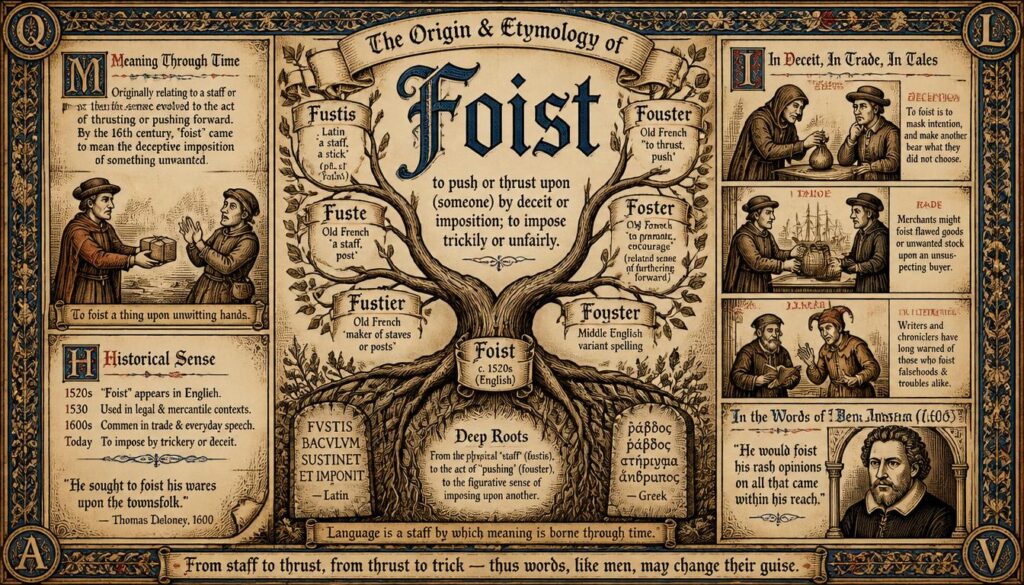
The foist etymology is particularly interesting because the modern meaning developed from an older sense involving deception and sleight of hand.
The word is associated with an obsolete Dutch form, vuisten, connected with vuyst, meaning “fist.” Historical explanations connect the word with the practice of concealing or manipulating something in the hand.
This is where the old association with dice and cheating becomes important. A dishonest player could secretly palm a die and introduce another one into play. Over time, the idea of secretly inserting something developed into broader meanings involving deception and then imposing something on another person.
Historical dictionaries place the first known English use around the late 16th century, circa 1587.
So the modern sense of “force something unwanted onto someone” didn’t simply appear from nowhere. It grew out of an older idea of secretly putting something into a situation through sleight of hand.
That history gives the word a rather clever little backstory.
Historical Meaning of Foist
The historical development can be understood as a chain:
hand → concealment → secretly introduce → deceptive insertion → impose something on someone
The early association with dice cheating is especially useful for understanding why deception became part of the word’s character.
Someone secretly manipulating a die was not openly announcing what they were doing. They were using their hand and stealth to change the situation.
Later, the meaning broadened beyond literal objects and games. A person could “foist” something onto another person without physically hiding it in their hand at all.
Language does this constantly. A concrete action becomes an abstract metaphor, and centuries later we use the metaphor without thinking about its original physical image.
Common Mistakes When Using Foist
One common mistake is treating foist as though it simply means “give” or “offer.” It normally has a negative sense of unwanted imposition.
For example, “She foisted me a beautiful gift” sounds unnatural because a gift isn’t necessarily unwanted or deceptive.
Instead, you might say:
She foisted an unwanted responsibility on me.
Another mistake is using it whenever somebody sells something. Selling isn’t automatically foisting. The idea of pressure, unfairness, unwanted acceptance, or deception should fit the context.
A third mistake is forgetting the usual construction. Foist something on someone is the safest pattern for learners.
Foist Example Sentences for Students
If you’re learning English and want easy foist sentence examples, these can help you remember the word:
- The salesman tried to foist an expensive phone plan on me.
- They foisted the extra work on their newest employee.
- The seller tried to foist a fake painting on the buyer.
- She would not allow anyone to foist unwanted responsibilities on her.
- The company was accused of foisting poor-quality goods on consumers.
- He tried to foist his mistake on his colleague.
- The shopkeeper attempted to foist a worthless product on tourists.
- Don’t let anyone foist unnecessary costs on you.
- The organization shouldn’t foist its problems onto volunteers.
- They tried to pass off an imitation as genuine and foist it on customers.
These examples show that the word can describe products, responsibilities, costs, mistakes, and even abstract ideas.
What Does Foist Mean in a Sentence?
When you see what does foist mean in a sentence, look at what is being imposed and who is being made to accept it.
For example:
The company foisted an unwanted service on its customers.
Here, “service” is the thing being imposed, while “customers” are the people expected to accept it.
The sentence does not necessarily tell us exactly how the company did it. It might have used pressure, confusing information, hidden terms, or some other method. The word simply tells us that the service was pushed onto customers in an unwelcome way.
This is why context matters. The surrounding sentence often tells you whether the word emphasizes deception, pressure, or simply an unwanted burden.
How to Remember the Foist Word Meaning
A simple memory trick is to connect foist with the phrase:
“Push something unwanted onto someone.”
Picture a salesperson holding a box nobody wants and somehow sliding it into your hands while smiling as if they have done you a favor. That’s the basic emotional picture of foist.
Then remember its historical connection with secretly manipulating a die by hand. That gives you an additional mental hook: foist = sneak something in or push something onto someone.
Once you remember those two images, the word becomes much easier to recognize.
Foist Antonym

There is no single perfect foist antonym in every situation because the opposite depends on what aspect of the word you mean.
Possible opposites include:
- Offer — present something for someone to accept voluntarily.
- Allow — let someone make their own choice.
- Accept — willingly receive something.
- Choose — make a free decision.
- Consent — agree voluntarily.
- Withdraw — remove something instead of imposing it.
- Respect — allow another person’s wishes or boundaries to stand.
For example, if someone voluntarily chooses a product after receiving clear information, that is very different from having an inferior product foisted on them.
Final Thoughts on Foist Meaning
The foist meaning becomes simple once you see the idea behind it: something unwanted is being pushed, imposed, or deceptively passed onto another person. It can involve a product, responsibility, expense, belief, excuse, or almost anything else that someone tries to make another person accept.
Remember the most useful pattern: foist something on someone or foist something upon someone. The related forms are foisted, foisting, and foists, while useful nearby words include impose, force, thrust, palm off, and pass off.
Its history makes the word even more memorable. What began with ideas connected to the hand, concealment, and deceptive dice-playing eventually developed into the modern sense of imposing something on another person. A tiny verb, but quite a journey.
If you came across foist while reading, writing, studying, or solving a word puzzle, hopefully its meaning now feels much less slippery. And if you have a funny example of someone trying to foist an unwanted product, task, or excuse on you, share it—real-life examples are often the quickest way to make a new word stick.