
Sometimes a single word can walk into a conversation wearing a completely different outfit than you expected. Gnarly is one of those words. You may hear someone say, “That wave was gnarly,” and wonder whether they are praising it, complaining about it, or doing both at the same time.
The interesting thing about gnarly meaning is that it depends heavily on context. The word can describe something extremely difficult, dangerous, unpleasant, rough, or impressive. It has a strange little personality of its own, which is probably why it has stayed popular in casual English for so long.
If you have searched what does gnarly mean, you are not alone. Many learners first meet the word in movies, social media posts, gaming conversations, or comments about surfing and extreme sports. And honestly, its meaning can feel a bit slippery at first.
Gnarly Meaning in Simple English
In simple English, gnarly can mean very difficult, rough, dangerous, unpleasant, or impressively extreme. The intended meaning changes according to the sentence.
For example, if someone says, “That was a gnarly accident,” they usually mean the accident was severe or disturbing. If a surfer says, “That wave was gnarly,” the speaker may mean the wave was extremely powerful and challenging, but also exciting.
So, gnarly meaning is not limited to one exact definition. It is an informal word that often carries a strong emotional reaction.
You can think of it as a word for something that makes you stop and say, “Whoa, that was intense.” Pretty useful, right?
What Does Gnarly Mean?
So, what does gnarly mean when you see it in everyday conversation?
Most commonly, it describes something that is extreme, difficult, rough, dangerous, or intense. Sometimes it can even mean something impressive or cool, especially in surfing, skateboarding, snowboarding, and similar communities.
Consider these examples:
- “That mountain trail was gnarly.” — The trail was very difficult or dangerous.
- “He had a gnarly cut on his arm.” — The cut looked severe or unpleasant.
- “That was a gnarly skateboard trick.” — The trick was extremely difficult or impressive.
- “The traffic was gnarly this morning.” — The traffic was unusually bad or chaotic.
- “We got some gnarly waves today.” — The waves were powerful, rough, and exciting.
The same word can therefore have a negative or positive flavor. Context does most of the heavy lifting here.
Is Gnarly a Positive or Negative Word?

This is where the word gets a little weird.
Gnarly can be positive, negative, or somewhere in the middle. There isn’t one permanent emotional direction attached to it.
When talking about an injury, accident, storm, or difficult situation, it often sounds negative. For example, “That was a gnarly crash” suggests something serious or frightening.
But when talking about a skateboard trick or a huge wave, gnarly may express admiration. Someone saying “That trick was gnarly!” could actually be giving a big compliment.
So don’t automatically translate gnarly as “bad.” Sometimes “bad” is exactly the opposite of what the speaker intends.
Gnarly Meaning in Slang
In slang, gnarly is commonly used to describe something extreme or intense. It is especially associated with informal American English and conversations involving adventure, sports, or unexpected experiences.
A person might say:
- “That roller coaster was gnarly.”
- “The storm last night was gnarly.”
- “She pulled off a gnarly trick.”
- “That exam was gnarly.”
- “The waves are getting gnarly.”
Here, the word adds emotion rather than providing a precise measurement. It tells you that the experience was far from ordinary.
That casual quality is important. You probably wouldn’t use gnarly in a formal academic report unless you were discussing the word itself.
Where Did the Word Gnarly Come From?
The original word gnarly is connected to the word gnarl, which refers to a knot or rough, twisted part of wood. Something gnarly, in its older literal sense, could therefore be twisted, rough, or knotty.
Over time, the slang sense developed in a different direction. Surfing culture played an important role in popularizing the word as a way to describe waves and situations that were challenging, dangerous, or spectacular.
Eventually, the expression moved far beyond beaches. Skateboarders, snowboarders, bikers, teenagers, gamers, and everyday speakers began using it for all kinds of extreme experiences.
Language does this sometimes. A word starts with a physical object and somehow ends up describing your terrible Monday morning.
Gnarly Meaning in Surfing
Surfing is one of the places where gnarly has a particularly recognizable meaning.
A surfer might describe a wave as gnarly when it is huge, powerful, rough, unpredictable, or difficult to ride. It can communicate danger and excitement at the same time.
For example:
“Those waves were absolutely gnarly today.”
The speaker isn’t necessarily saying the waves were bad. They might actually be thrilled by them.
This is why translating slang word-for-word can create confusion. The emotional meaning matters just as much as the dictionary definition.
Gnarly Meaning in Skateboarding and Extreme Sports
In skateboarding, snowboarding, mountain biking, and similar activities, gnarly often refers to something difficult, risky, or impressive.
Someone might watch a skateboarder land a complicated trick and say:
“That was gnarly!”
In this situation, it usually expresses admiration. The trick looked intense and probably required considerable skill.
Likewise, a snowboarder could describe a steep run as gnarly because it was technically challenging or dangerous.
The word has become almost a small verbal reaction to extreme experiences.
Gnarly Meaning in Everyday Conversation
You don’t need to be a surfer or skateboarder to use gnarly. Modern informal English uses it in many ordinary situations.
Someone might call a long workday “gnarly,” a complicated computer problem “gnarly,” or an unusually difficult exam “gnarly.”
For example:
- “That was a gnarly meeting.”
- “The traffic jam was gnarly.”
- “Fixing that old computer was gnarly.”
- “The weather became pretty gnarly.”
- “That puzzle is gnarly.”
In these examples, the exact meaning depends on what happened. Usually, the speaker means something was unusually difficult, intense, messy, or extreme.
What Does Gnarly Mean in Texting?
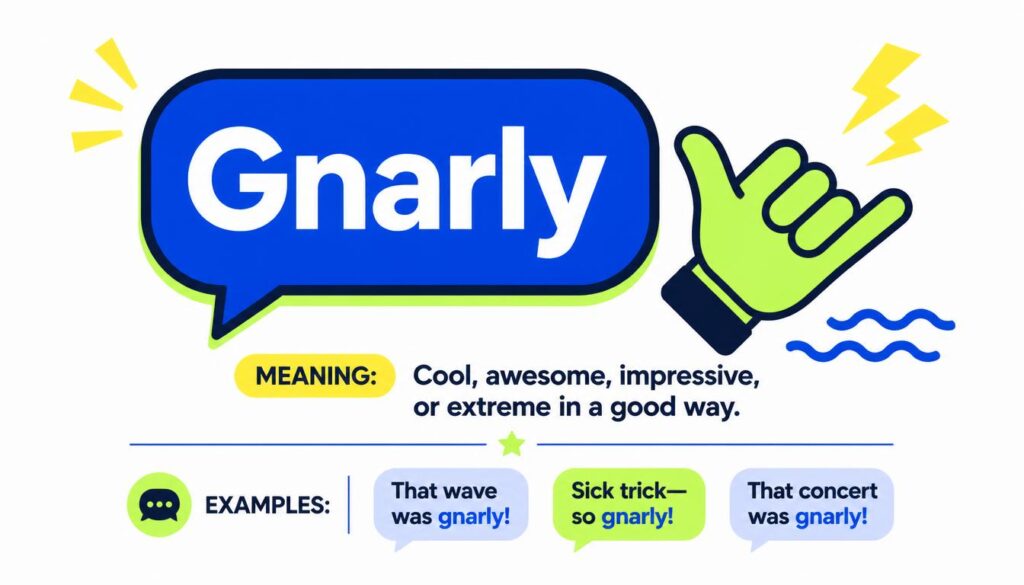
In texting and online conversations, gnarly is usually used casually and emotionally.
If a friend sends you a video of an impressive stunt, you might reply:
“That was gnarly!”
If they tell you about a terrible accident, you might say:
“Wow, that’s gnarly.”
Notice how the same word works in both situations. The surrounding conversation tells you whether the speaker is impressed or disturbed.
That flexibility is one reason slang can be tricky for English learners. The dictionary gives you the pieces, but real conversation tells you which piece is being used.
Gnarly Meaning in Social Media
On social media, gnarly often appears in captions, comments, memes, sports videos, and informal posts.
Someone might caption an extreme skiing video:
“Absolutely gnarly conditions.”
A person sharing a picture of a damaged car could write:
“That crash was gnarly.”
A gaming player might describe an especially difficult level as:
“This boss fight is gnarly.”
The tone is normally casual. It is more expressive than simply saying “difficult” or “bad.”
Is “Narly” the Same as “Gnarly”?
People sometimes search for narly meaning when they have heard the word spoken and aren’t sure how it is spelled.
In standard English, the common spelling is gnarly, with a silent “g.” The pronunciation usually sounds roughly like “nar-lee.”
Because the first letter is not pronounced, people occasionally spell it as “narly” when writing what they heard.
So if you searched narly meaning, you were probably looking for gnarly meaning.
The spelling “narly” can appear informally, but gnarly is the standard dictionary spelling.
What Does Narly Mean?
If you’re asking what does narly mean, the answer is generally connected to the same slang word gnarly.
The difference is mostly spelling. In standard written English, use gnarly.
For example:
Standard: “That was a gnarly accident.”
Less standard/informal spelling:
“That was a narly accident.”
The pronunciation can make the spelling confusing because the “g” in gnarly is silent.
What About “Narley Meaning”?
You may also come across the spelling narley while searching online. This is another nonstandard spelling that people sometimes use because it sounds like the spoken word.
The standard form remains gnarly.
So if your search was narley meaning, you’re most likely looking for the same word and its slang uses.
English spelling can be wonderfully unhelpful sometimes. The word says “gnarly,” but the pronunciation basically says, “Nope, we’re skipping that g.”
Examples of Gnarly in Sentences
Seeing the word in different situations makes its meaning much easier to understand.
- “That was a gnarly storm last night.”
The storm was severe or intense. - “He took a gnarly fall while skiing.”
The fall was serious or frightening. - “She landed a gnarly skateboard trick.”
The trick was difficult and impressive. - “The road gets gnarly after heavy rain.”
The road becomes rough or difficult to travel. - “That final level was gnarly.”
The level was extremely difficult. - “The waves looked gnarly from the shore.”
The waves appeared powerful, rough, or dangerous. - “I had a gnarly headache yesterday.”
The headache was particularly severe. - “That was one gnarly hike.”
The hike was challenging, rough, or exhausting.
Each sentence gives the word a slightly different shade, but the central idea remains intensity.
Gnarly vs. Awesome

These words can overlap, but they are not exactly the same.
Awesome generally expresses strong approval or admiration. Gnarly focuses more on intensity, difficulty, roughness, or extremeness.
For example:
“That trick was awesome.”
This mainly says the speaker liked the trick.
“That trick was gnarly.”
This suggests the trick was extreme, difficult, risky, or intense, with admiration often implied.
So gnarly carries more of an edge. There is usually some sense that the thing wasn’t ordinary.
Gnarly vs. Terrible
These two can also overlap in certain contexts, but gnarly isn’t simply a synonym for terrible.
If someone says:
“The accident was terrible.”
They are clearly describing something negative.
If they say:
“The accident was gnarly.”
They are emphasizing how severe, shocking, graphic, or intense it was.
On the other hand, “gnarly” can be positive when describing a stunt or adventure. That’s why context is absolutely essential.
How to Understand Gnarly From Context
When you see gnarly, ask yourself three quick questions.
First, what is being described? A wave, injury, trick, road, storm, exam, or something else?
Second, what happened to it? Was it difficult, dangerous, impressive, rough, or unpleasant?
Third, what is the speaker’s emotional reaction? Are they excited, shocked, amused, or complaining?
These clues usually reveal the intended meaning quickly.
For instance, “gnarly wave” in a surfing video probably carries excitement and danger. “Gnarly injury” is much more likely to carry a negative or disturbing meaning.
Can Gnarly Be Used in Formal English?
Generally, gnarly is informal.
It works naturally in conversations, text messages, social media posts, casual articles, and entertainment writing. In formal writing, a more precise word is usually better.
Instead of:
“The weather conditions were gnarly.”
A formal report might say:
“The weather conditions were severe.”
Instead of:
“The procedure was gnarly.”
A professional document might say:
“The procedure was highly complex.”
The informal word has personality, while the formal alternatives provide greater precision.
Common Mistakes With Gnarly
One common mistake is assuming that gnarly always means “bad.” That’s not true.
Another mistake is assuming it always means “cool.” That isn’t correct either.
A third mistake is spelling it as “narly” or “narley” in formal writing. Those forms may reflect how people hear the word, but gnarly is the standard spelling.
Finally, don’t use it everywhere just because you’ve learned it. Slang sounds natural when it fits the situation, but strange when forced into every sentence. English has enough strange words already, honestly.
How Native Speakers Use Gnarly Naturally
Native speakers often use gnarly when they want to make a description feel more vivid.
Compare these:
“The mountain road was difficult.”
and
“The mountain road was gnarly.”
The second sentence feels more conversational and emotional. You can almost imagine potholes, sharp turns, bad weather, and someone gripping the steering wheel a little too tightly.
That’s the special job of slang. It doesn’t always add technical information; sometimes it adds attitude.
A Quick Guide to Gnarly Meaning
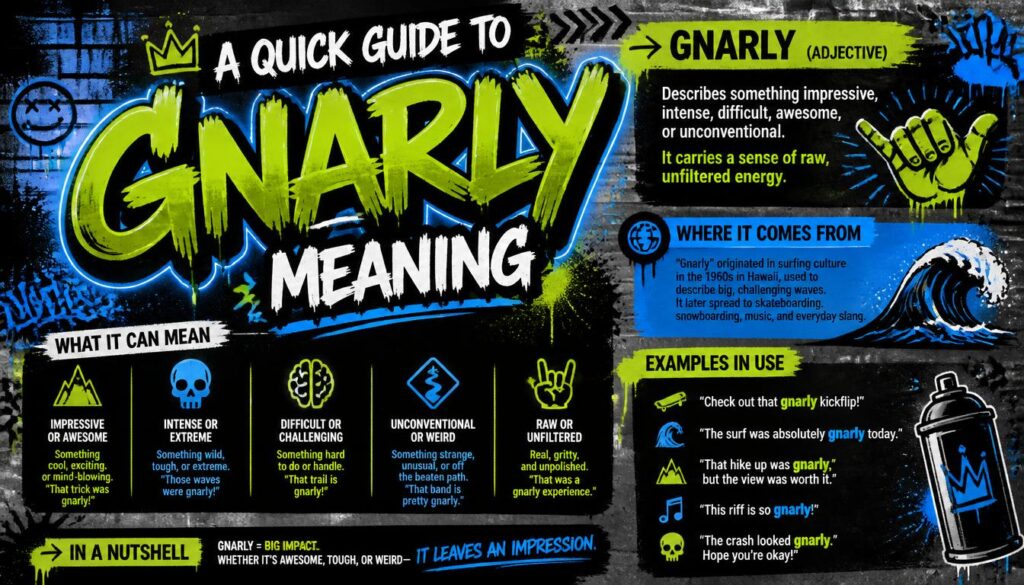
If you’re trying to remember the word quickly, this simple guide can help:
- Gnarly wave — powerful, rough, or dangerous wave
- Gnarly accident — severe or disturbing accident
- Gnarly trick — difficult, risky, or impressive trick
- Gnarly road — rough or challenging road
- Gnarly weather — severe or unpleasant weather
- Gnarly exam — extremely difficult exam
- Gnarly experience — intense or extreme experience
- Gnarly injury — severe or unpleasant injury
The common thread is intensity.
Frequently Asked Qeustions
gnarly meaning
“Gnarly” means rough, twisted, or uneven when describing something physical. In US slang, it can also mean something extreme, dangerous, exciting, difficult, or complicated.
what does gnarly mean
“Gnarly” usually means rough and twisted, but it is also commonly used as slang for something extreme, dangerous, exciting, or difficult.
Read moore: https://ytmeaning.com/foist-meaning/
narly meaning
“Narly” is usually a misspelling of “gnarly.” The correct spelling is gnarly, which can mean rough and twisted or, in slang, extreme, exciting, or difficult.
narley meaning
“Narley” is generally an incorrect spelling of “gnarly.” The word “gnarly” is used for something rough, twisted, extreme, dangerous, or difficult.
Final Thoughts on Gnarly Meaning
The easiest way to remember gnarly meaning is to think of the word as describing something that is extreme, rough, difficult, dangerous, unpleasant, or impressively intense.
Its exact emotional meaning depends on context. A gnarly accident is probably something disturbing, while a gnarly skateboard trick might be a compliment. The word can swing between negative and positive without changing its spelling.
If you searched what does gnarly mean, now you have the main idea: it is informal slang used for things that feel unusually intense or extreme.
And if you came across narly meaning, what does narly mean, or narley meaning, remember that these are usually attempts to spell or search for gnarly, whose standard spelling includes the silent “g.”
Language is full of these little traps. Sometimes the strangest-looking word turns out to be the one people casually throw around every day. Gnarly is a perfect example: rough in origin, flexible in meaning, and still very much alive in modern informal English.
