

There are some English words that look simple until you try to explain them to somebody else. Aloof is one of those words. You may have heard someone say, “He is a little aloof,” or “She seemed aloof at dinner,” and understood the general feeling without being completely sure what the word was doing there.
At its heart, the aloof meaning is about distance. But not always the distance you can measure with a ruler. More often, it is emotional distance, social distance, or a feeling that someone is standing apart from the people around them. A person can be sitting right beside you and still seem strangely far away. Thats where this word becomes useful.
According to Cambridge Dictionary, aloof describes someone who is not friendly or willing to participate, and it can also describe someone who deliberately remains uninvolved. Cambridge Dictionary So, when people ask what does aloof mean, the easiest answer is: someone who seems distant, detached, reserved, or not interested in connecting with others.
But there is more to it than simply calling somebody “cold.” Sometimes an aloof person is shy. Sometimes they are protecting themselves. Sometimes they genuinely don’t care. And occasionally, yes, they may simply think they are too important to join the conversation. English is funny like that.
Aloof Meaning in Simple English
The simplest aloof definition is “distant and not very friendly or involved.”
Imagine you walk into a room where ten classmates are laughing together. Nine people smile and say hello. One person looks at you, gives a tiny nod, and returns to their phone without saying anything. You might describe that person as aloof.
The word can suggest several shades of behavior:
- Emotionally distant they don’t easily show feelings.
- Reserved they keep personal thoughts to themselves.
- Detached they seem separated from what is happening.
- Standoffish they don’t appear eager to interact.
- Indifferent they may seem as if they simply don’t care.
- Unresponsive they give little reaction or engagement.
- Unapproachable other people may feel nervous about starting a conversation.
- Haughty in some situations, their distance can suggest superiority.
- Unsympathetic their manner may appear lacking in warmth.
The important little detail is that aloof does not always mean rude. Someone could be quiet, shy, tired, anxious, thoughtful, or simply private. The outside behavior may look the same, while the reason underneath it is completely different.
That distinction matters alot when describing real people.
Aloof Meaning and Pronunciation
The word aloof is usually pronounced uh-LOOF, written phonetically as /əˈluːf/. The second syllable gets the stronger emphasis.
It is generally used as an adjective, although historical usage also gives it an adverbial role. You might say:
- “He seems aloof.”
- “She has an aloof demeanor.”
- “The manager remained aloof during the argument.”
- “The actor appeared somewhat aloofly in the interview.”
In ordinary modern English, however, aloof as an adjective is much more common and natural.
The pronunciation itself is pleasantly simple. There is no dramatic linguistic obstacle hiding in the bushes. Just “uh-LOOF.”
The Origin of Aloof Is Surprisingly Nautical

The aloof etymology is one of the nicest parts of this word because its history begins not with personality, but with sailing.
The word goes back to the 16th century and originally referred to being to windward. Etymonline connects it with Middle English loof, related to nautical terminology for the windward side of a ship. In sailing commands, the idea was connected with keeping the ship’s head toward the wind and staying clear of danger. Etymology Online+1
Over time, the physical idea of being apart developed into the figurative idea of staying apart from other people.
That is actually a beautiful semantic journey: a ship keeps away from a dangerous shore, and eventually a person “keeps away” socially or emotionally.
By around the 17th century, aloof had developed its modern adjectival use. So when we say someone is aloof today, we are unknowingly carrying a little piece of old sailing language into an office meeting, family dinner, or awkward party.
Language does this all the time. It quietly drags history behind it.
What Does It Mean When Someone Is Aloof?
When someone is described as aloof, it usually means their behavior creates a sense of separation.
Maybe they rarely start conversations. Maybe they answer questions briefly. Maybe they don’t join group jokes or activities. Perhaps they keep their emotions carefully behind a locked door, metaphorically speaking.
An aloof attitude can look like this:
- A coworker eats lunch alone every day and rarely talks.
- A friend responds to emotional messages with very short replies.
- Someone at a gathering watches everyone but doesn’t participate.
- A person avoids discussing their feelings.
- A manager remains noticeably detached from the team.
- Someone appears uninterested when others are celebrating.
- A classmate seems distant even when people try to include them.
Still, behavior isn’t always a perfect window into personality. A person who looks socially aloof might simply be exhausted. A quiet student might be shy rather than arrogant. Someone who doesn’t talk at a party may be uncomfortable in crowds.
So, aloof behavior describes what we observe, not necessarily what we know about someone’s heart.
Is Aloof a Negative Word?
Usually, aloof carries a mildly negative or disapproving feeling, although context can soften it.
Calling somebody aloof can suggest that they are cold, distant, unfriendly, or unwilling to connect. Cambridge’s examples and synonym lists place it near words such as distant, detached, standoffish, unapproachable, and unresponsive. Cambridge Dictionary
But the word isn’t automatically an insult.
Consider these two sentences:
- “The new student was aloof because she was shy.”
- “The executive was aloof and treated everyone as though they were beneath him.”
The first sentence is sympathetic. The second suggests haughtiness, snobbery, and perhaps a superior attitude.
That is why tone matters. Aloof can describe someone without condemning them, but it often hints that their distance is noticeable and perhaps uncomfortable for others.
Aloof vs Distant: What’s the Difference?
Aloof and distant overlap heavily, but they are not perfect twins.
Distant is broader. Someone can be physically distant, geographically distant, emotionally distant, or socially distant.
For example, “My brother lives in another country, so he is distant from us” could simply describe physical separation.
Aloof, however, usually carries a stronger social or emotional flavor. It suggests a person’s manner makes them seem separate, detached, or unwilling to engage.
Think of it this way:
Distant tells you there is space.
Aloof often tells you the person seems to be maintaining that space.
That tiny difference is useful when you’re choosing words for writing.
Aloof vs Reserved: They Are Not Quite the Same
A reserved person may simply be private. They don’t necessarily want to share every thought, and they may prefer listening over talking.
An aloof person, by contrast, can appear less interested in connecting.
Someone can be reserved and still wonderfully warm.
For example, your quiet grandmother may rarely talk about herself but always remember your favorite food. She is reserved, perhaps, but hardly aloof.
On the other hand, someone who barely acknowledges anyone and gives the impression that conversation is beneath them might be described as aloof.
So reserved can be neutral or even positive. Aloof more often suggests a lack of warmth.
Aloof vs Indifferent

The difference between aloof and indifferent is another important one.
Indifferent means not caring, or having little interest or concern.
Aloof means appearing distant or detached.
A person might be aloof without being indifferent. They may care deeply but simply struggle to express it.
Likewise, someone can be indifferent while acting perfectly friendly. They might smile, chat and joke, but privately have no real interest in the matter.
In short:
- Aloof = “I seem emotionally or socially far away.”
- Indifferent = “I don’t particularly care.”
The two sometimes travel together, but they aren’t the same passenger.
Aloof vs Standoffish
Standoffish is usually more informal and often more obviously negative.
If you call somebody standoffish, you’re saying they seem unfriendly and reluctant to interact. Aloof can sound slightly more polished or descriptive.
Compare:
“She was standoffish at the party.”
“She maintained an aloof manner throughout the evening.”
Both describe distance, but the second sentence sounds like it wandered in wearing a suit.
Standoffish behavior may feel actively resistant, while an aloof demeanor can simply feel cool, detached, or remote.
Aloof vs Haughty and Snobbish
This distinction is especially useful.
Someone who is haughty behaves as if they are superior to other people.
Someone who is snobbish may judge people according to social status, wealth, education, taste, or other perceived differences.
Someone who is aloof may appear superior, but superiority isn’t required.
A person could be aloof because they are shy.
They could be aloof because they’re private.
They could be aloof because they are distracted.
Or, yes, they could be aloof because they believe everyone else is beneath them.
The word itself doesn’t tell us which explanation is true. Context has to do that work.
Aloof Meaning in Relationships
When people search for what does aloof mean in a relationship, the question usually has more emotional weight.
If a partner becomes emotionally distant, rarely communicates, avoids affection, or seems uninterested in spending time together, someone might describe them as emotionally aloof.
For example:
- “Lately, he has been emotionally aloof.”
- “She seemed distant and aloof after their disagreement.”
- “His aloof manner made it difficult for her to know what he was feeling.”
But labeling a partner “aloof” should not become a shortcut for understanding them. People withdraw for many reasons. Stress, exhaustion, conflict, grief, fear, or a need for personal space can all look like emotional coldness from the outside.
A useful conversation might therefore sound less like, “Why are you so aloof?” and more like, “I’ve noticed you’ve seemed distant lately. Is something bothering you?”
The second sentence opens a door. The first may slam one.
Examples of Aloof Behavior in Everyday Life
You don’t need a dramatic movie character to understand the word. Ordinary life supplies plenty of examples.
- At a family dinner, everyone is laughing while one person quietly watches and gives almost no reaction. Their aloof demeanor is noticeable.
- A new employee answers politely but avoids every social conversation. They may seem socially aloof.
- A student sits alone, speaks very little, and rarely joins classmates. Their behavior might be reserved or aloof.
- A wealthy guest refuses to speak with anyone outside their social circle. Here, aloofness may suggest snobbery.
- A normally affectionate friend suddenly becomes distant after an argument. Their aloof behavior may reflect hurt rather than indifference.
- A coach who remains emotionally detached while players celebrate might be described as aloof.
- An actor playing a mysterious character may intentionally use an aloof attitude to create distance.
Notice how context keeps changing the meaning. That’s the real trick with this word.
Aloof in a Sentence: Natural Examples
If you’re learning how to use aloof in a sentence, try placing it near words describing manner, behavior, or emotional distance.
- “He appeared aloof during the meeting.”
- “She seemed aloof at first, but later became very friendly.”
- “The professor had an aloof manner that intimidated some students.”
- “I thought he was arrogant, but he was actually shy and reserved.”
- “She kept herself aloof from the family argument.”
- “His cool, distant demeanor was mistaken for aloofness.”
- “The manager seemed socially aloof but was surprisingly kind in private.”
- “The character is portrayed as elegant, mysterious, and slightly aloof.”
That last example shows why writers like the word. It can create a mood with very little effort.
Common Synonyms for Aloof
An aloof synonym depends on exactly what you want to express.
Useful choices include:
- Distant — physically or emotionally far away.
- Detached — not emotionally involved.
- Reserved — private and not openly expressive.
- Standoffish — unfriendly or reluctant to interact.
- Remote — difficult to connect with.
- Unapproachable — difficult or intimidating to approach.
- Cold — lacking warmth or affection.
- Indifferent — showing little care or concern.
- Unresponsive — giving little reaction.
- Unsympathetic — showing little understanding or compassion.
- Haughty — behaving as if superior.
- Supercilious — showing an arrogant sense of superiority.
- Snobbish — overly concerned with status or social distinctions.
The best synonym is not always the strongest synonym. If a person is merely quiet, calling them snobbish would be unfair. Words carry judgment, even when we don’t notice it.
Aloof Meaning and Its Opposites
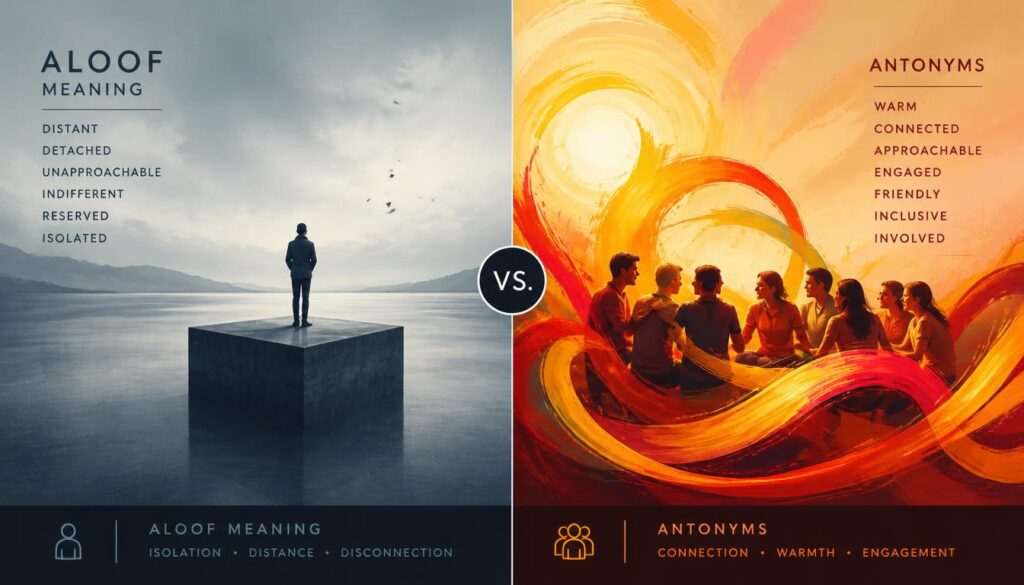
The clearest aloof antonym is probably friendly, but there are several useful opposites.
You could describe the opposite of aloof as:
- Warm
- Open
- Outgoing
- Friendly
- Approachable
- Sociable
- Gregarious
- Affectionate
- Connected
- Engaged
- Welcoming
Imagine two people entering the same room.
One gives short answers, avoids eye contact, and stays apart from the group. They may seem aloof.
The other smiles, introduces themselves, asks questions, and makes everyone feel comfortable. They seem warm and approachable.
That contrast is what makes the meaning of aloof so clear.
Aloofness Meaning: The Noun Form
The noun aloofness refers to the quality or behavior of seeming distant, detached, or uninvolved. Cambridge defines it as behavior showing that someone is not friendly, willing to participate, or interested in becoming involved. Cambridge Dictionary
For example:
- “Her aloofness made it difficult to become friends.”
- “His reputation for aloofness followed him into the new workplace.”
- “There was a strange aloofness in the way she answered.”
- “His polite aloofness was mistaken for arrogance.”
The word can describe a temporary mood or a long-standing personality trait.
Is Being Aloof Always a Bad Thing?
Not necessarily.
There are moments when distance is healthy. A person doesn’t have to participate in every argument, reveal every feeling, or become friends with everyone they meet.
Sometimes remaining aloof from a conflict is actually wise. If two coworkers are arguing over something petty, refusing to get dragged into the drama can be sensible rather than cold.
There is also a difference between having boundaries and refusing human connection.
Healthy boundaries say, “I need some space.”
A harmful kind of aloofness can communicate, “You are not worth my attention.”
Same distance. Very different message.
This is why understanding the aloof meaning requires more than memorizing a synonym. You have to notice intention, context, tone, and relationship.
A Small Cultural Note About Social Warmth
Different cultures and families have very different ideas about what counts as warm behavior.
In some families, affection is loud: people interrupt each other, offer food repeatedly, hug freely, and ask personal questions within minutes of meeting. In other families, affection may be quieter. A parent might show love by fixing something around the house, preparing tea, or remembering a tiny detail from your childhood.
The quieter person isn’t automatically aloof.
Even across workplaces and communities, eye contact, personal space, conversation style, and emotional expression can vary. What seems distant in one social setting might be perfectly ordinary in another.
So when using the word to describe someone from a different cultural background, a little caution is good. Language should describe people, not accidentally put them in a box.
How to Describe an Aloof Person Without Being Unfair
If you’re writing a character, message, essay, or social description, don’t stop at “He is aloof.”
Give the reader evidence.
Instead of:
“He was aloof.”
Try something more revealing:
“He stood near the window throughout dinner, answering questions politely but never offering one of his own.”
Now we can see the aloofness.
You can also explain the reason when you know it:
“She appeared aloof at first, although her silence came more from shyness than arrogance.”
This is much more human. It allows personality to have layers instead of turning one adjective into a complete biography.
Creative Ways to Remember the Meaning of Aloof
If vocabulary refuses to stay inside your brain unless you give it a strange little story, here’s one.
Picture a person standing at the edge of a crowded room. Everyone else is in the middle, laughing and talking. This person has quietly moved two steps backward, as if an invisible line surrounds them.
They are aloof.
Now imagine that same person isn’t rude at all. They’re simply nervous.
Still aloof.
Now imagine they are looking at everyone as if they own the building.
Still aloof, but now perhaps haughty too.
Finally, imagine they don’t care about the conversation because they are absorbed in something else.
That leans toward indifferent.
One word, several shades. Thats why vocabulary becomes interesting when you stop treating definitions like prison cells.
Quick Guide: What Does Aloof Mean?
If you’re in a hurry and someone asks you what does aloof mean, remember this:
Aloof = noticeably distant, detached, reserved, or uninvolved, especially in a social or emotional situation.
It often suggests a lack of warmth, but it doesn’t automatically prove that someone is unfriendly or uncaring.
An aloof person might be:
- Shy
- Private
- Emotionally distant
- Socially withdrawn
- Uninterested
- Reserved
- Unfriendly
- Haughty
- Snobbish
- Simply tired or uncomfortable
The surrounding situation tells you which meaning fits best.
Final Thoughts on Aloof Meaning
The word aloof is a small word carrying a surprisingly large suitcase.
It can describe the quiet classmate who doesn’t know how to join a conversation, the executive who seems above everyone, the friend who has emotionally pulled away, or the character in a novel who keeps everyone guessing. Its central idea is always some form of distance, but the reason for that distance can change dramatically.
Its history makes the word even more memorable. What began as a nautical expression connected with keeping a ship toward the wind eventually developed into a word for people who keep themselves apart. Etymology Online
So the next time you hear someone called aloof, pause before deciding what kind of person they are. They may be cold and distant, yes. Or they may be reserved, shy, thoughtful, overwhelmed, or simply comfortable standing a little outside the crowd.
And perhaps thats the most useful lesson hidden inside the word: distance is something we can observe, but the reason behind it is something we usually have to ask about.
In language, as in life, the space between two people doesn’t always tell us why the space is there.
If you’d like, I can also turn this into a more SEO-focused 2,000–2,500 word version with a meta title, meta description, FAQ section, and keyword-rich headings while keeping the same natural, human style.