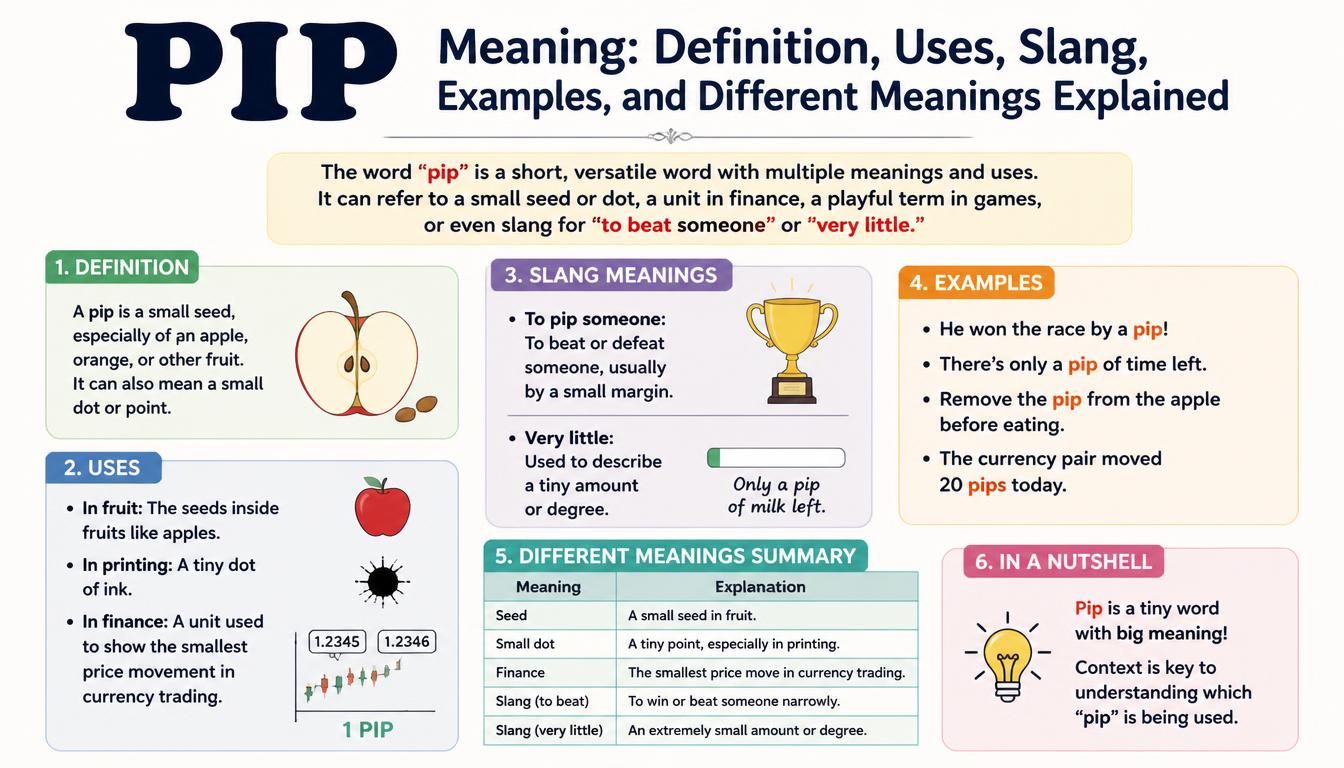

A tiny word can sometimes carry a surprisingly large suitcase of meanings. Pip is one of those words. You may see it in a dictionary, hear someone in Britain say “I’ll pip you,” notice little pips on a die, find an apple full of pips, or hear a short electronic pip sound from a machine. Same spelling, very different jobs language does like to make things slightly confusing for no good reason.
So, what exactly is the pip meaning? The answer depends heavily on the sentence and situation. Pip can be a noun, a verb, an informal British expression, a term connected with birds and eggs, a small mark on dice or playing cards, a fruit seed, or even a word for a short high-pitched sound.
This guide explains the pip definition, its major meanings, pronunciation, examples, British English uses, related phrases, and a little of its interesting word history. If you searched for what does pip mean, you’ve landed in the right place because there isn’t just one answer.
Pip Meaning at a Glance
The simplest way to understand pip is to look at its different uses rather than trying to squeeze everything into one definition. In ordinary English, pip may refer to a small seed, dot, sound, bird-related condition, or a narrow victory.
Here are the major meanings:
- Pip as a noun: a small seed inside certain fruits, especially an apple.
- Pip as a mark: a small dot or spot representing a numerical value on dice, dominoes, or cards.
- Pip as a verb: to break through an eggshell while hatching.
- Pip in British English: to narrowly defeat someone or beat them by a small margin.
- Pip as slang: something excellent, impressive, or unusually good.
- Give someone the pip: a British expression meaning to cause irritation, annoyance, or frustration.
- Pip as a sound: a short, high-pitched tone or electronic signal.
- Pip as a bird disease: an old term associated with a disorder affecting a bird’s tongue.
That is why the meaning of pip cannot really be explained with just one sentence. Context does the heavy lifting here.
Pip as a Noun
When pip is a noun, it can describe several small things. One familiar meaning is a fruit seed, especially the seed of an apple or another fleshy fruit. If someone says, “Remove the apple pips,” they simply mean the small seeds inside the fruit.
The word can also describe a tiny dot, spot, speck, or mark. This meaning becomes especially clear when talking about dice and dominoes. A standard die has dots showing its numerical value, and those dots are called pips. Six dots means six, five dots means five, and so on. Tiny marks, doing very serious mathematical work — rather dramatic for little spots.
Examples of Pip as a Noun
- “There was an apple pip stuck between my teeth.”
- “The dice landed with four pips showing.”
- “Count the pips on the domino.”
- “The card had several small pips printed on it.”
So, when someone asks what is a pip, remember that a pip can literally be a small seed or a small mark, depending on what you’re talking about.
Pip Meaning on Dice, Dominoes, and Playing Cards
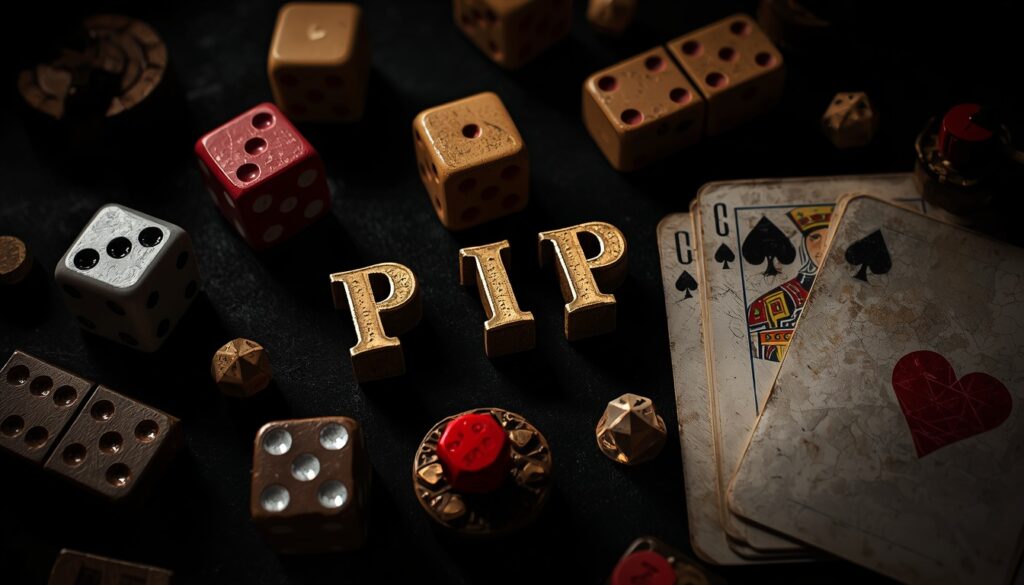
One of the most practical meanings of pip appears in games. The little dots on dice are known as dice pips. Each pip represents one unit of numerical value.
The same general idea applies to domino pips. The spots on each half of a domino show its number. In playing cards, pips can refer to the symbols or marks representing the suit and value, particularly in traditional card terminology.
For example, a six-sided die displaying six has six pips. You don’t normally call them “six little black dots” unless you’re trying to make the explanation unnecessarily long, which English sometimes does anyway.
This sense gives us phrases such as pip on dice, pips on dice, pip on dominoes, and pip playing cards.
Pip Meaning as a Fruit Seed
If you hear someone talking about apple pips, they are talking about the small seeds found inside an apple. More broadly, a pip fruit seed is a small seed contained within certain fleshy fruits.
Apples are the most familiar example, but the word can appear in discussions involving other fruits as well. The related word pippin is also connected historically with this family of usage and is especially familiar in names of apple varieties.
For example:
“Be careful when eating the apple; it still has a few pips.”
Here, pip meaning fruit is very straightforward: it means a seed.
It is also worth remembering that the same word can suddenly change meaning when the subject changes. “Apple pip” and “pip someone in a race” have nothing to do with each other, despite sharing exactly the same spelling.
Pip Meaning as a Verb: Hatching From an Egg
One of the more charming uses of pip is connected with birds and eggs. When a chick begins breaking through its eggshell, the egg is said to pip or the chick is pipping.
The expression egg pipping meaning therefore relates to the early stage of hatching. A chick uses its egg tooth or other specialized structure to create a small opening in the shell. That first little crack can eventually become the opening through which the bird emerges.
You might read:
- “The eggs are starting to pip.”
- “The first chick pipped this morning.”
- “We could hear the chicks pipping inside the eggs.”
- “The bird finally pipped through the shell.”
Here, pipping does not mean making a noise. It refers to the physical process of breaking the shell.
There is something almost poetic about it: a tiny creature inside a sealed shell makes the first crack in its own little world, then slowly works its way out.
Pip Bird Disease Meaning
There is another, much older meaning of pip connected with birds. Historically, pip bird disease referred to a supposed or described ailment involving a bird’s tongue, sometimes characterized by a scale on the tongue, crust, or abnormal appearance on its surface.
Older dictionaries may describe pip as a bird disorder or bird ailment, particularly involving the tongue. Some historical descriptions connect the word with respiratory or other nonspecific problems in birds.
Modern veterinary medicine does not necessarily use “pip” as a precise diagnosis for a particular disease, so this meaning should be treated as a historical or traditional definition rather than a modern veterinary label.
In other words, if an old book says that a bird “has the pip,” it may not be using the expression in the same way a modern veterinarian would describe an illness.
Pip Meaning in British English
Now things get more interesting. In British English, pip can function as a verb meaning to narrowly defeat someone.
To pip someone means to beat them by a small margin. It often appears in sports, competitions, races, elections, or other situations where the result is close.
For example:
- “She pipped her rival in the final.”
- “The team was pipped at the last minute.”
- “He pipped his opponent by one point.”
- “The runner pipped the favorite at the finish line.”
This is the pip meaning British speakers may use when describing a close victory.
Imagine two runners moving almost shoulder-to-shoulder for the entire race. One crosses the finish line a fraction ahead. That person has pipped the other runner.
So pipped meaning British can essentially be understood as “narrowly beat” or “narrowly defeated.”
Pip Meaning in Sports and Competition
The sports use deserves its own mention because it appears quite naturally in newspapers and commentary. If a headline says that one player pipped another, it usually means the winner succeeded by a very small margin.
You might see language such as:
- “The defending champion was pipped in the final.”
- “The young athlete pipped her teammate for first place.”
- “They were pipped to the title after a dramatic finish.”
The phrase pip meaning in sports is therefore connected to a close victory rather than an easy win.
There is a little drama built into the word itself. Saying “won” is factual; saying someone “pipped” another person makes you imagine the finish line, the scoreboard, and that tiny painful difference between first and second.
Pip Meaning in Slang: Something Excellent
Another informal use of pip describes a person or thing that is particularly good, impressive, charming, or excellent.
The phrase a real pip can be used affectionately or approvingly. Depending on context, it can suggest that someone or something is a gem, beauty, wonder, or genuinely delightful thing.
Related expressions include:
- “What a pip!”
- “She’s a real pip.”
- “That little car is a pip.”
- “The new restaurant is a pip.”
The exact emotional shade can vary by speaker and region. Words such as peach, gem, marvel, beauty, dream, and pippin can sometimes convey a similar positive feeling.
This is one reason pip slang meaning can be confusing to learners. A dictionary definition alone may not communicate whether the word sounds humorous, old-fashioned, affectionate, or enthusiastic.
Give Someone the Pip Meaning
If someone says, “That gives me the pip,” they aren’t talking about fruit seeds or dice.
The British expression give someone the pip means to cause annoyance, irritation, frustration, displeasure, or exasperation.
For example:
- “His constant complaining gives me the pip.”
- “That noise really gives me the pip.”
- “Waiting for hours gives me the pip.”
In this context, the word is close to annoyance or irritation. It can have a slightly old-fashioned or distinctly British flavor, which is perhaps why it sounds amusing to modern ears.
The expression isn’t normally intended as a serious medical statement. It is an idiomatic way of saying something is getting on your nerves.
Pip Meaning as a Short High-Pitched Sound
A completely different pip meaning refers to a short, high-pitched sound.
A pip sound may be heard from electronic equipment, phones, timers, radios, computers, or other devices. It can act as a signal, alert, or simple audio marker.
For instance:
- “The machine made a short pip.”
- “Listen for the final pip before entering the number.”
- “The timer gives a high-pitched pip when it finishes.”
In this sense, related words include beep, tone, chirp, and peep, although these words are not always exact substitutes.
A pip is generally brief and distinct — less “music” and more “pay attention, something just happened.”
Pip Pronunciation and Grammar
The pip pronunciation is simple: it is generally pronounced like “pip,” with a short vowel sound, rhyming approximately with “sip” and “tip.”
Grammatically, pip can be both a noun and a verb.
As a noun:
- “The apple has a pip.”
- “The die shows five pips.”
As a verb:
- “The chick will pip.”
- “She pipped her competitor.”
The past tense is pipped, while the present participle is pipping.
So:
pip → pipped → pipping
This distinction matters because pipped meaning depends on the context. “The chick pipped the shell” and “She pipped her opponent” use the same verb but describe entirely different actions.
Pip in a Sentence
Seeing the word in context is often the quickest way to understand it. Here are examples covering its major senses:
- “I found an apple pip in my lunch.”
- “The die showed three pips.”
- “The chicks are pipping their eggs.”
- “She pipped her closest rival by one point.”
- “That little restaurant is a real pip.”
- “The constant buzzing gives me the pip.”
- “A short pip sounded from the machine.”
Notice how the surrounding words almost immediately reveal the intended meaning. That’s the secret with polysemous words: context is the translator hiding in plain sight.
Pip Synonyms and Related Words
The best synonym depends entirely on which pip definition you’re using.
For a small mark:
- dot
- spot
- speck
- fleck
- blip
- patch
For a fruit seed:
- seed
For annoyance:
- irritation
- frustration
- exasperation
- displeasure
- grief
For a short sound:
- beep
- tone
- chirp
- peep
For something excellent:
- gem
- beauty
- peach
- marvel
- wonder
- pippin
For a narrow victory:
- beat
- defeat
- outscore
- edge out
- narrowly beat
Using a synonym without considering the context can make a sentence sound strange, so it is better to understand the exact sense first.
Read more: https://ytmeaning.com/belled/
Pip Word History and Etymology
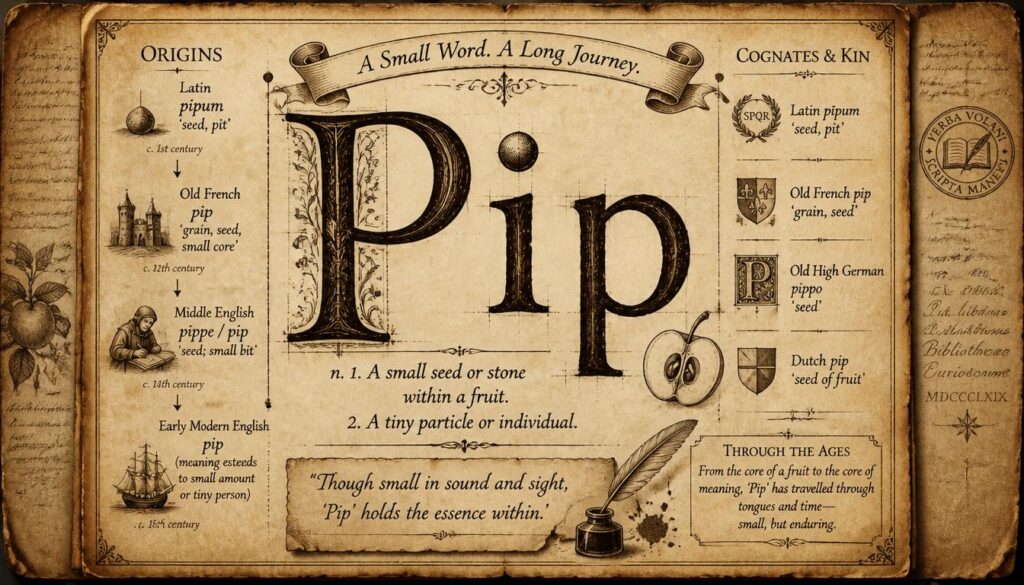
The etymology of pip is particularly interesting because different historical senses have developed around the word, and dictionaries record several histories and uses.
Historical forms include Middle English pippe, while related forms have been connected with words from languages such as Middle Dutch and Old High German. Some historical discussions also connect bird-related usage with forms associated with Vulgar Latin, Latin, and Greek.
The precise origins of individual senses can be complicated, and not every modern meaning necessarily comes from one single historical source. Some forms may also have an imitative word origin, especially where a sound or action is involved.
Dictionary records give different dates for different senses, including historical references from periods such as the 15th century, as well as later recorded uses in the 16th, 18th, 19th, and 20th centuries.
This is a good reminder that words rarely arrive in English wearing a neat name tag saying, “I mean exactly this.” They travel, change, borrow, split into meanings, and sometimes end up doing five jobs at once.
Is Pip a British Word?
Not exclusively, but several uses of pip are strongly associated with British English or British usage.
The meaning “narrowly defeat” is particularly recognizable in British English, as is the expression give someone the pip. Some informal uses meaning an excellent person or thing may also sound more British or old-fashioned depending on the speaker.
However, meanings involving pips on dice, fruit pips, and egg pipping are much more broadly understandable.
So if you’re learning English, don’t assume every use of pip is slang. Sometimes it is simply a perfectly ordinary technical or descriptive noun.
Different Meanings of Pip: A Quick Comparison
| Context | Meaning of Pip |
|---|---|
| Fruit | A small seed |
| Dice | A dot showing numerical value |
| Dominoes | A spot representing a number |
| Playing cards | A small suit/value marking |
| Eggs | To break through the shell |
| Birds | Historical term for a bird ailment |
| British sports | To narrowly defeat |
| British slang | Something excellent or impressive |
| British expression | Annoyance or irritation |
| Electronics | A short, high-pitched tone |
This table shows why searching only for pip dictionary meaning can sometimes leave people wondering which definition actually applies.
Frequently Asked Questions About Pip Meaning
What does pip mean in English?
Pip has several meanings in English, including a fruit seed, a small dot on dice or cards, a hatching action, a narrow victory, an annoyance, and a short sound.
What does pip mean in British English?
In British English, to pip someone means to narrowly beat or defeat them, often by a very small margin. “She pipped her rival” means she just managed to beat her.
What does pip mean in slang?
Informally, pip can describe someone or something excellent, charming, or impressive. “A real pip” is a positive expression, though it can sound somewhat old-fashioned.
What does pipping mean for eggs?
Pipping is the process in which a chick begins breaking through its eggshell. When an egg is “pipping,” the developing bird is making an opening in the shell.
What does pip mean on dice?
A pip on a die is one of the small dots used to show its numerical value. A die showing four has four pips.
What is a pip in an apple?
An apple pip is simply an apple seed. The term is commonly used in British English and other varieties of English.
What does “give me the pip” mean?
“Give me the pip” is an informal British expression meaning to annoy, irritate, frustrate, or bother someone.
Is pip a noun or a verb?
It can be both a noun and a verb. As a noun it can mean a seed or small mark; as a verb it can mean breaking through an eggshell or narrowly defeating someone.
Final Thoughts on the Pip Meaning
The most useful thing to remember about pip meaning is that there isn’t one universal definition. It is a wonderfully flexible English word whose meaning changes according to context.
A pip can sit quietly inside an apple, appear as a dot on a die, mark a card, signal the beginning of a chick’s escape from an eggshell, describe a narrow sporting victory, express irritation, praise something excellent, or arrive through a speaker as a tiny high-pitched tone.
And that’s perhaps what makes language so interesting. One three-letter word can move from a kitchen table to a bird’s nest, from a football scoreboard to a British conversation, without changing a single letter.
So the next time you come across pip, don’t immediately ask, “Which definition is correct?” Ask something slightly better: “What is happening around the word?” The surrounding sentence will usually tell you whether you’re looking at a seed, a mark, a sound, a victory, a bird, or something else entirely.
If you’ve encountered pip in a sentence that still seems confusing, share the sentence or phrase — the context can usually reveal its exact meaning in seconds.