
Sometimes a single word looks so ordinary that you almost walk past it without asking what it really means. Belled is one of those words. It is only six letters long, begins with B, ends with D, and seems at first glance like a simple form of the familiar word “bell.”
But there is a little more hiding inside it, especially when the word appears in an old-fashioned description, a dictionary entry, or a piece of heraldry. It can feel slightly unusual at first, but thats exactly what makes it interesting.
If you have searched for belled meaning, you are probably trying to answer one of a few questions: what does belled mean, is it a verb or an adjective, what is the past tense of “bell,” or what does belled in heraldry mean? The good news is that these questions are closely connected.
In everyday English, belled can be the past form of the verb bell, while in heraldic language it can describe something that is having bells, particularly bells attached around an animal’s neck.
This guide explains the belled definition in plain English, gives useful examples, explores its grammatical forms, and looks at why you might encounter the word in descriptions of animals and heraldic designs. So, lets unpack this tiny word without making it sound like a dusty dictionary has been dropped on the table.
What Does Belled Mean?
The simplest answer to what does belled mean is: having bells attached to something, or having been fitted with bells. The exact meaning depends on how the word is being used in a sentence.
As a verb, belled is the simple past tense and past participle of bell. The verb bell can mean to attach a bell to something, especially an animal, or in some contexts to make a sound resembling a bell. As an adjective, particularly in heraldry, belled describes something that has bells associated with it.
For example, you might read a sentence such as, “The goat was belled before it was taken into the hills.” Here, belled tells us that a bell was attached to the goat. It is a very practical use of the word, though it sounds a little old-fashioned now in ordinary conversation.
The meaning of belled therefore changes slightly with context, but the central idea remains connected to a bell. Something described as belled is either fitted with a bell or has the characteristic of being equipped with bells. Thats the little thread connecting its different dictionary senses.
Belled Definition in English
A straightforward belled definition in English is “fitted or equipped with bells.” In a more specialized heraldry meaning, it can describe an animal represented with bells, especially bells around its neck.
The word is derived from bell plus the ending -ed. This is a common English word-building pattern. When an action is completed, the past-tense or past-participle form often receives an -ed ending. So we get bell → belled. Simple enough, although the double “l” can make the spelling look a little odd if you’re staring at it for too long.
In dictionary-style definitions, you may see belled identified as both an adjective and a verb. That isn’t contradictory. English frequently allows past participles to function as adjectives, and belled is a nice example of that overlap.
The word can therefore describe an action:
The shepherd belled the sheep.
Or a resulting condition:
The belled sheep moved through the field.
In the first sentence, belled is a verb. In the second, it describes the sheep, so it behaves adjectivally. Same word, slightly different grammatical job.
Belled as a Verb

When people ask is belled a verb, the answer is yes. Belled as a verb is the past tense and past participle form of bell when bell is being used as a verb.
The verb bell can refer to putting a bell on an animal. Historically and practically, bells have been attached to livestock so their location could be heard even when the animals were difficult to see. A bell might make it easier for a shepherd or farmer to locate an animal in a field, woodland, or hilly area.
Consider these examples:
- The farmer belled the goat before letting it wander outside.
- The shepherd belled several sheep so they could be located more easily.
- The old cow was belled because it often wandered away from the herd.
- They belled the animal before taking it into the mountains.
In each sentence, belled describes an action that happened in the past. So if your question is belled past tense, this is one of its main grammatical roles.
Its present form is bell, its simple past is belled, and its past participle is also belled. English has plenty of verbs that work this way, and this one is pleasantly uncomplicated.
Belled as an Adjective
The phrase belled as an adjective may sound more complicated than it really is. An adjective describes a noun, and belled can describe an object or animal that has bells attached to it.
For example:
A belled goat crossed the narrow path.
Here, belled gives us additional information about the goat. It tells us that the goat has a bell attached to it.
You could also say:
The village was filled with the sound of belled animals.
In this example, the word helps describe the animals rather than naming an action someone performed. Thats why dictionaries can identify belled adjective usage separately from its verb usage.
The adjective form is especially useful in historical writing, descriptions of livestock, poetry, and heraldic language. Modern speakers may more naturally say “an animal wearing a bell” or “an animal with a bell,” but belled is shorter and sometimes much more elegant.
The Past Tense of Bell
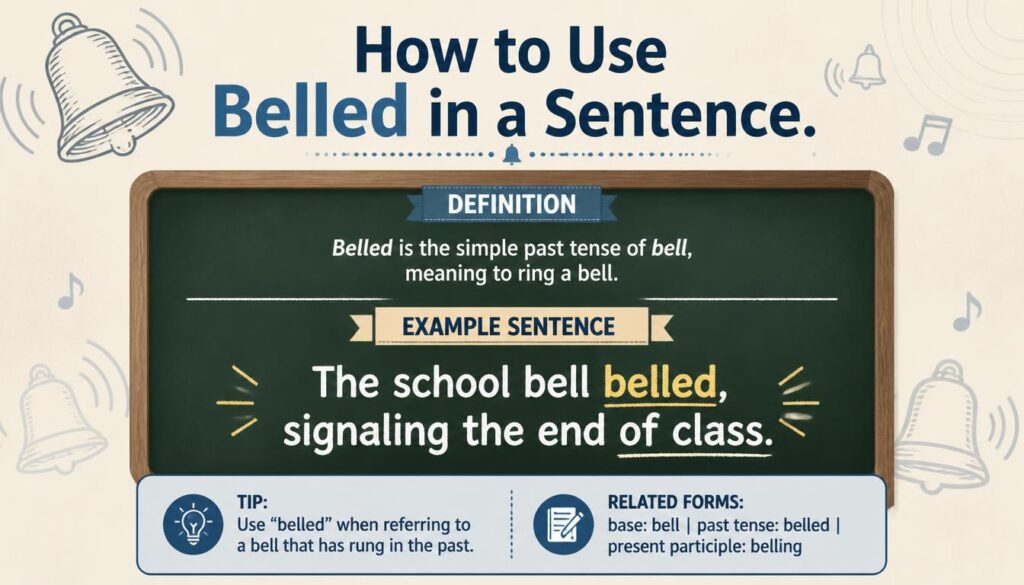
If you’re searching for the past tense of bell, the answer is belled.
The basic forms are:
- Present: bell
- Simple past: belled
- Past participle: belled
- Present participle: belling
So the past form of bell is belled, and the past participle of bell is also belled. This follows the regular English pattern of adding -ed, although spelling rules require the final consonant to be doubled.
For example:
Present: They bell the goat.
Past: They belled the goat yesterday.
Past participle: The goat had been belled before the journey.
The word can therefore fit naturally into several grammatical constructions. Once you see the pattern, the mystery rather quickly disappears, which is probably a good thing for a six-letter word.
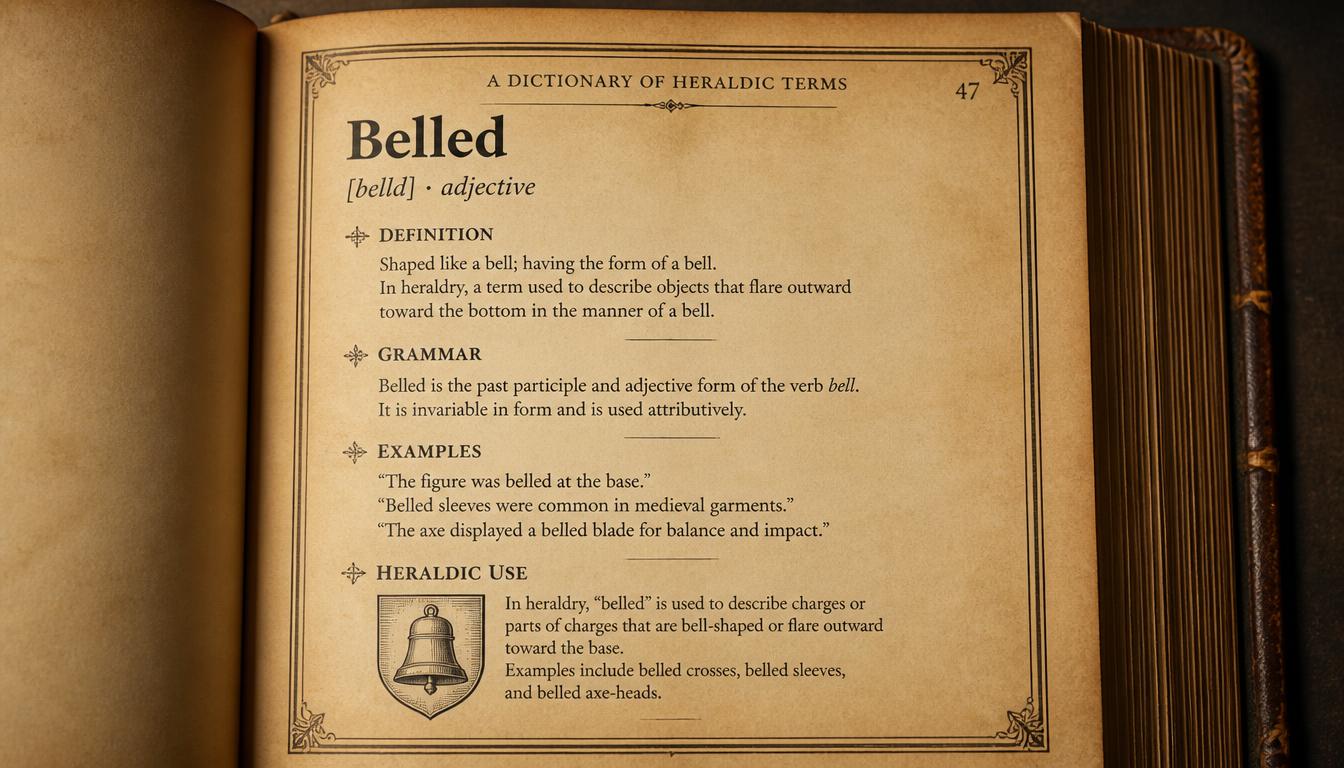
Belled in Heraldry
One of the most interesting uses of the word appears in heraldry. If you are researching belled in heraldry, you may find the term used to describe an animal that is shown with bells.
In heraldic descriptions, small details matter. The position, color, shape, posture, and accessories of an animal can all contribute to a formal description of a coat of arms or emblem. A bell attached to an animal is therefore not just random decoration; it can be part of the precise description of the image.
The heraldic meaning of belled can be understood simply as “having bells.” When a heraldic animal is described as belled, the intended image may include bells around the animal’s neck.
Imagine a goat or other animal represented in a coat of arms, with tiny bells hanging around its neck. A heraldic description might use the term belled rather than spending several words explaining that the animal is wearing bells.
This is where belled definition heraldry becomes particularly useful. Outside heraldry, you might rarely encounter the word, but in formal descriptions it can be wonderfully efficient. One compact adjective carries a very specific visual instruction.
What Does Belled Mean in Heraldry?
So, what does belled mean in heraldry?
It generally means that an animal or figure is depicted with bells, commonly bells around the neck of an animal. The word describes the presence of those bells as part of the heraldic design.
For instance, a description might refer to an animal as “belled,” meaning the animal has bells attached to it. You don’t need to interpret the word as meaning “making a bell sound” in this context. The focus is on the visible feature.
This specialized meaning is one reason dictionary searches for belled meaning and definition sometimes produce a result that looks different from the ordinary verb definition. Dictionaries frequently combine everyday grammar with specialized fields, and heraldry has developed its own vocabulary over centuries.
If you encounter the word in an old book, coat-of-arms description, or historical text, therefore, don’t assume it is a typo. It may be deliberately using this older and more precise vocabulary.
Read more: https://ytmeaning.com/gts-meaning-2/
Having Bells Around the Neck of an Animal
The phrase having bells around the neck captures the most recognizable heraldic sense of belled. Historically, bells have been used with animals for practical reasons.
A shepherd might hear the bells of sheep moving somewhere beyond a hill. A farmer could identify the location of livestock by sound. In some cultural traditions, animals wearing bells also became familiar parts of rural landscapes, where the sound itself almost became part of the scenery.
Picture a quiet hillside in the early morning. You can’t see the animals yet, but you hear a faint ringing moving through the grass. Somewhere beyond the trees, a herd is wandering. Thats the everyday world behind the dictionary word belled.
This is why bells around an animal’s neck are more than a strange dictionary example. They reflect an old practical relationship between people, animals, landscape, and sound.
How to Use Belled in a Sentence
Learning a word becomes much easier when you see it doing actual work. Here are several examples of how to use belled naturally.
- The farmer belled the young goat before releasing it.
- The old sheep was belled so its movements could be heard.
- We could hear the belled animals somewhere beyond the fence.
- The shepherd belled the lead animal before sunset.
- A belled goat appeared in the old illustration.
- The heraldic animal was shown belled in the traditional design.
- They found a belled animal wandering near the edge of the village.
- The sound of belled livestock carried across the valley.
Notice that some sentences use belled as an action and others use it as a description. This little distinction is useful when you’re trying to understand the belled grammatical meaning, not just memorize a one-line definition.
Belled Used in a Sentence: Everyday Examples
If you are specifically searching for belled used in a sentence, context is your best teacher. Consider this short example:
“Before the animals were taken into the forest, the shepherd belled them.”
Here, belled is clearly a verb because it tells us what the shepherd did.
Now compare:
“The belled animals disappeared among the trees.”
Here, belled acts more like an adjective because it describes the animals.
Another example:
“The heraldic figure showed a belled animal standing proudly on the shield.”
This example brings us into the specialized world of heraldry, where having bells is part of the visual description.
The grammar isn’t frightening once you stop looking at the word by itself. Put it into a sentence and its role usually becomes obvious.
Belled Word Meaning and Word Formation
The belled word meaning becomes even clearer when you look at how the word is formed. At its heart is the noun bell, a familiar object that produces a ringing sound. English then uses bell as a verb, and the past form becomes belled.
You can think of the structure like this:
B + E + L + L + E + D = BELLED
That makes belled a six-letter word. It starts with B and ends with D, which makes it potentially interesting for crossword puzzles, spelling games, and word-solving searches.
It also starts with BE and ends with ED, matching searches such as “words starting with BE and ending with D.” It begins with B and ends in D as well, which explains why some people encounter the word while searching for unusual word patterns.
Word games can make even a normal dictionary term suddenly look mysterious. One moment you’re looking for a six-letter answer, and the next you’re wondering why belled is even a word. English does that sometimes.
Is Belled a Six-Letter Word?
Yes, belled is a six-letter word.
Its letters are:
B – E – L – L – E – D
It starts with B, contains two Ls, and ends with D. It is also a regular inflected form of the verb bell, rather than a completely unrelated word.
For people searching for six-letter words starting with B, belled may appear as a possible answer. Likewise, someone looking for six-letter words ending with D could encounter it.
The spelling is worth noticing because bell becomes belled, not “beled.” The final consonant is doubled before the -ed ending. Thats a tiny spelling detail, but it’s the kind of detail that saves you from losing a word puzzle over one annoying letter.
Belled Unscramble and Word Games
The phrase belled unscramble usually relates to word-game searches rather than the dictionary meaning itself. If you’re trying to unscramble the letters B, E, L, L, E, and D, BELLED is a valid six-letter word.
The word also belongs to a larger group of terms connected with bell, including bell, belling, and various compound words. Some dictionary-related searches may also place visually or alphabetically similar terms nearby.
However, it is important not to confuse similar words with true synonyms. Belle, for example, is a different word, usually referring to a beautiful or socially prominent woman, while belled is connected to bell. They look related because of spelling, but their meanings are not the same.
That distinction matters when you’re researching belled synonyms. A word being close in spelling does not automatically make it a semantic neighbor. Dictionaries can be strange little neighborhoods.
Belled Synonyms and Similar Words
Finding exact belled synonyms can be tricky because the word’s meaning depends on whether it is functioning as a verb or adjective.
Depending on context, useful descriptive alternatives may include:
- fitted with bells
- equipped with bells
- wearing bells
- carrying bells
- having bells
- adorned with bells
These are often phrases rather than one-word synonyms, but they communicate the same basic idea.
For the verb sense, “fitted with a bell” can often replace belled. For example:
The goat was belled.
could become:
The goat was fitted with a bell.
The second version is more conversational, while the first is compact and somewhat more literary or specialized. Neither is automatically better; it depends on the style of the writing.
Bell Meaning and the Connection to Belled

To understand the bell meaning behind belled, it helps to begin with the root word itself.
A bell is a hollow object that produces a ringing sound when struck or moved. Bells appear in homes, schools, churches, clocks, vehicles, ceremonies, and many other settings. They can be tiny enough to hang around an animal’s neck or enormous enough to dominate a tower.
When bell becomes a verb, the meaning shifts from the object to an action associated with it. To bell an animal is to put a bell on it. From there, the past form becomes belled.
So the semantic relationship is straightforward:
bell → verb → belled
And in descriptive use:
belled → adjective → having bells
That simple relationship explains most of what you need to know about the English word belled.
Belled Definition Compared With Bell
It can be helpful to put bell and belled side by side.
| Word | Basic role | Meaning |
|---|---|---|
| Bell | Noun | A hollow object that makes a ringing sound |
| Bell | Verb | To attach a bell to something, especially an animal |
| Belled | Past tense | Having attached a bell |
| Belled | Past participle | Having had a bell attached |
| Belled | Adjective | Having or being fitted with bells |
This comparison makes the definition of belled much easier to understand. It isn’t an entirely separate word that happens to resemble bell. It is closely connected grammatically and semantically.
Why the Word Belled Sounds Unusual Today
One reason people search for what is the meaning of belled is that the word isn’t especially common in casual modern conversation.
Most people today would probably say:
“The goat has a bell around its neck.”
rather than:
“The goat is belled.”
The second sentence is perfectly understandable, but it has a more specialized, literary, historical, or rural flavor. Language changes according to where and how people use it, and some perfectly legitimate words simply become less common in everyday speech.
You may therefore encounter belled more often in dictionaries, historical writing, poetry, farming descriptions, or heraldry than in an ordinary text message. It isn’t incorrect; it is simply less familiar.
A Quick Guide to Belled Grammar
For anyone searching belled verb definition or belled adjective definition, this quick guide brings everything together.
As a verb:
Belled means that someone attached a bell or bells to something, commonly an animal.
As a past tense:
Belled describes an action that happened in the past.
As a past participle:
Belled can be used with helping verbs such as “has,” “have,” “had,” or “been.”
As an adjective:
Belled describes something that has bells attached to it.
In heraldry:
Belled describes an animal or figure represented with bells, particularly around the neck.
Once these four pieces are separated, the belled meaning is actually quite tidy. The word only seems complicated when all its uses are thrown together.
A Few Things Belled Does Not Mean
Because belled resembles several other words, confusion is easy.
It does not normally mean “beautiful,” despite its similarity to belle. It does not simply mean “noisy,” even though bells make noise. And it should not automatically be interpreted as “bell-shaped” unless the surrounding context specifically supports that meaning.
Likewise, terms such as belled out, belledom, or bell-cow belong to broader bell-related terminology and should not be treated as direct synonyms of belled. They may appear in related dictionary searches, but their meanings are different.
This is an important point when researching a word online: related results are not always definitions. Search engines sometimes place neighboring terms beside the word you’re actually studying, and that can make a tiny vocabulary question feel much bigger than it is.
Belled Meaning in Simple English
If you need the belled meaning in English in the simplest possible form, remember this:
Belled means fitted with a bell or bells, or it is the past tense and past participle of the verb “bell.”
When used in heraldry, it commonly means having bells, especially an animal shown with bells around its neck.
For example:
“The belled goat walked through the meadow.”
This means the goat had a bell or bells attached to it.
And:
“The farmer belled the goat.”
This means the farmer put a bell on the goat.
That’s really the heart of the word. Everything else is context, grammar, and a little bit of historical vocabulary.
Frequently Asked questions
belled meaning
“Belled” means having bells attached, especially around an animal’s neck. It can also be the past tense and past participle of the verb “bell.”
belled
“Belled” is the past form of “bell” and can describe something fitted or decorated with bells. In heraldry, it may refer to an animal shown with bells.
belled definition
The definition of “belled” is having bells, particularly around the neck of an animal. It is also the simple past tense and past participle of “bell.”
what does belled mean
“Belled” means provided with or wearing bells, especially in a traditional or heraldic context. As a verb, it means the action of putting or fitting a bell on something.
belleds
“Belleds” is not the standard form of the word; “belled” is normally used. It refers to something having bells or to the past form of “bell.”
Final Thoughts on the Belled Meaning
The word belled is a small example of how surprisingly deep ordinary English can become. Six letters can carry a grammatical history, a practical rural meaning, a specialized heraldic sense, and even a little word-game usefulness.
It begins as bell, becomes a verb, takes the regular past ending, and then can also work as an adjective. Not bad for such a short word.
If you came here searching for belled meaning, the key idea to take away is that belled generally means having a bell or bells attached, while grammatically it is the past tense and past participle of “bell.”
In heraldry, the term can specifically describe an animal represented with bells, often bells around the neck of an animal.
And perhaps the nicest thing about unusual words like this is that they remind us language isn’t just a collection of definitions. Words carry traces of old customs, farming practices, art, symbolism, and ways people once described the world.
A bell on an animal wasn’t merely decoration; it could help someone find that animal across a hillside. In a heraldic image, those same bells could become part of a carefully described emblem.
So the next time you see belled tucked inside an old sentence, a dictionary entry, or a heraldic description, you don’t have to stop and wonder. You know what the little word is doing there. It’s ringing, in its own quiet dictionary kind of way.