


Sometimes a person is not failing, not struggling, and not even doing anything obviously wrong. Everything looks fine from the outside. Yet somewhere inside, they have stopped asking, “Can I do better?”
That quiet stopping point is often where complacent begins. It can feel like comfort, but comfort and complacency are not quite the same thing, and that little difference matters more than it first appears.
If you have searched for complacent meaning, you are probably trying to understand a word that describes a particular kind of satisfaction.
A complacent person may feel pleased with their abilities, achievements, or current situation and, because everything seems okay, they may see little reason to put in extra effort. Nothing dramatic has to happen. Sometimes complacency arrives softly, almost politely, while ambition leaves the room.
What Does Complacent Mean?
The simplest complacent definition is: too satisfied with yourself or your situation, so you do not feel a strong need to improve, work harder, or notice possible problems. The word is usually negative because it suggests that someone’s satisfaction has gone a little too far.
For example, imagine an employee who has performed well for several years. They know their job, receive decent results, and rarely receive complaints.
Eventually, they stop learning new skills because they believe they already know enough. Their confidence is not necessarily bad, but their lack of curiosity can become a complacent attitude. They’re comfortable, perhaps a little too comfortable.
So, when people ask, what does complacent mean, the answer is not simply “happy” or “satisfied.” A person can be satisfied and still ambitious. Someone who is complacent usually has less motivation, less urgency, or less willingness to make an improvement.
Complacent Meaning in Simple English
In simple English, complacent means being overly satisfied with yourself or your current situation and therefore not trying hard enough to improve. You may think, “Everything is fine, so why bother?”
That thought can be harmless in some situations, but it becomes a problem when there are obvious opportunities, challenges, or risks that deserve attention.
A student who gets good grades and then stops studying because they think they are naturally smart may become complacent.
A business owner who enjoys strong sales and ignores changing customer needs can do the same thing, and the market usually doesn’t send a polite warning first.
Think of it this way:
Complacent: “I am doing well enough, so I don’t need to try harder.”
Motivated: “I am doing well, but I can still improve.”
That tiny shift in thinking separates healthy contentment from unhealthy self-satisfaction.
What Is the Difference Between Complacent and Confident?
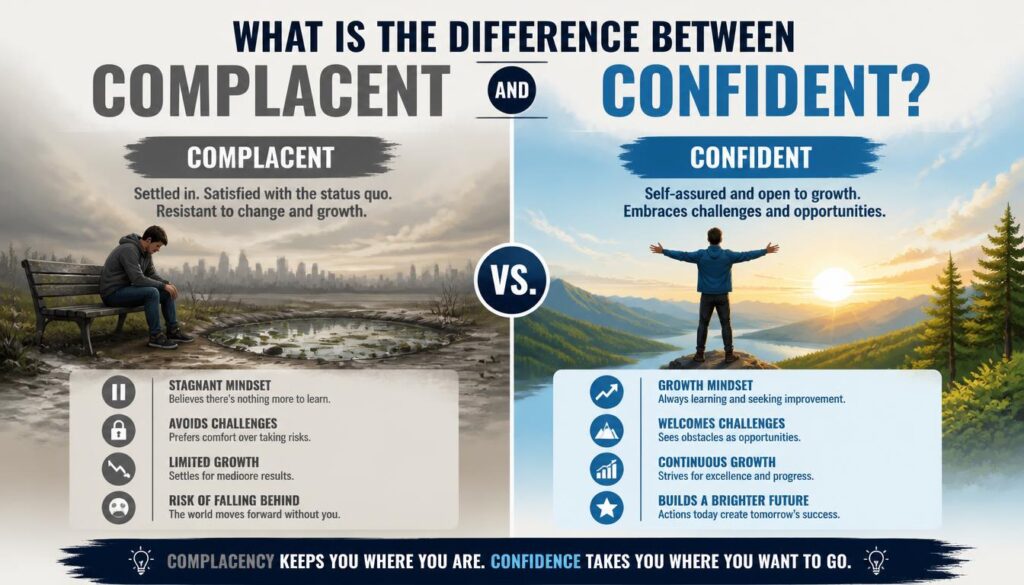
Confidence and complacency can look almost identical from a distance, but they behave very differently when circumstances change. A confident person believes in their abilities while remaining willing to learn. A complacent person may believe they already know enough.
For instance, a confident freelancer might say, “My clients are happy, and I have strong skills, but I should learn the new tools appearing in my industry.” A complacent freelancer might say, “My clients have always been happy, so I don’t need to learn anything new.” Both feel secure. Only one is actively protecting future progress.
Confidence says, “I can handle this.” Complacency whispers, “I don’t really need to pay attention.”
That is why overconfidence can sometimes lead to complacency. When success continues for a long time, people can begin taking that success for granted, which isn’t always wise.
Complacent vs. Content
This is another useful distinction when learning the meaning of complacent. Being content is generally positive. It means you appreciate what you have and experience a sense of satisfaction or contentment. You don’t constantly feel that life must become bigger, richer, or more impressive before you can enjoy it.
Complacency is different because it involves a lack of concern about improvement or potential problems. You can be content with your life and still be hardworking. You can enjoy your achievements and still have ambition.
A person might say, “I’m happy with my career, but I’d love to improve my communication skills.” That’s contentment with curiosity. Someone else might say, “My career is fine, so I don’t need to learn anything else.” That’s where a complacent mindset may be developing.
Common Signs of a Complacent Person
A complacent person doesn’t always look lazy. In fact, they may work quite hard, especially when they have become comfortable with an old routine. The important clue is often their attitude toward change, challenge, and improvement.
Some common signs include:
- Feeling that current success is enough and refusing to push further.
- Showing a lack of motivation to develop new abilities.
- Ignoring small problems because they have not caused serious damage yet.
- Becoming overly comfortable with familiar routines.
- Assuming previous success guarantees future success.
- Avoiding challenges because the current situation feels secure.
- Rejecting useful feedback or treating it as unnecessary.
- Showing little interest in learning or experimenting.
- Believing that extra effort will not make much difference.
- Taking positive results for granted.
None of these signs alone proves that someone is complacent. Everyone has slow periods, tired days, or moments when they simply need a break. The concern comes when the pattern becomes normal and the person stops noticing that their performance or potential is slowly shrinking.
Complacent Attitude in Everyday Life
A complacent attitude can appear in places people don’t usually associate with the word. It can happen in a career, business, education, relationships, personal development, or even ordinary daily habits.
Imagine a student who once studied every evening. Their grades improve, they become proud of the achievement, and then they decide that studying is no longer necessary.
At first, nothing happens. Their old knowledge carries them forward. Months later, however, the material becomes harder and their results begin dropping. The problem wasn’t a sudden loss of ability; it was a gradual loss of effort.
The same pattern can appear in business. A company may have excellent products, loyal customers, and strong market performance.
If leadership assumes those advantages will last forever, competitors can catch up. Markets change. Customer expectations change. Technology changes. Remaining alert is part of staying successful, even when success feels very comfortable.
Examples of Complacent Behavior
Real-world examples make this word much easier to understand because complacent behavior is usually about actions, not just feelings.
- An employee stops learning because they have already received a promotion.
- A student stops preparing seriously after getting several good grades.
- A business owner refuses to update an outdated strategy because it worked before.
- A person ignores warning signs in their finances because everything currently feels secure.
- A team keeps using an inefficient process simply because “that’s how we’ve always done it.”
- Someone receives constructive feedback but decides there is no reason to change.
- A successful athlete stops training seriously after winning several competitions.
- A freelancer depends entirely on old skills while the industry moves forward.
- A manager assumes their customers will remain loyal without improving the service.
- Someone becomes so comfortable in a relationship that they stop putting meaningful effort into it.
These examples show why complacency can be dangerous without being dramatic. It is often the absence of action when action is needed.
Complacent in a Sentence
Seeing complacent in a sentence can help you understand how naturally the adjective works.
- After years of success, the company became complacent about its competitors.
- She refused to become complacent after achieving her first major goal.
- The team looked confident, but their relaxed performance made the coach worry they were becoming complacent.
- He had become complacent about his financial security and stopped planning for unexpected expenses.
- Good results are useful, but they should never make us complacent.
- The manager warned employees not to become complacent about results.
- Her self-satisfied attitude made it difficult for her to accept constructive feedback.
- The athlete stayed focused because she knew that previous achievement did not guarantee another victory.
Notice that the word often appears with situations involving success, security, performance, or responsibility. It describes a mindset that has become too comfortable with the present.
Complacent Synonyms and Related Words
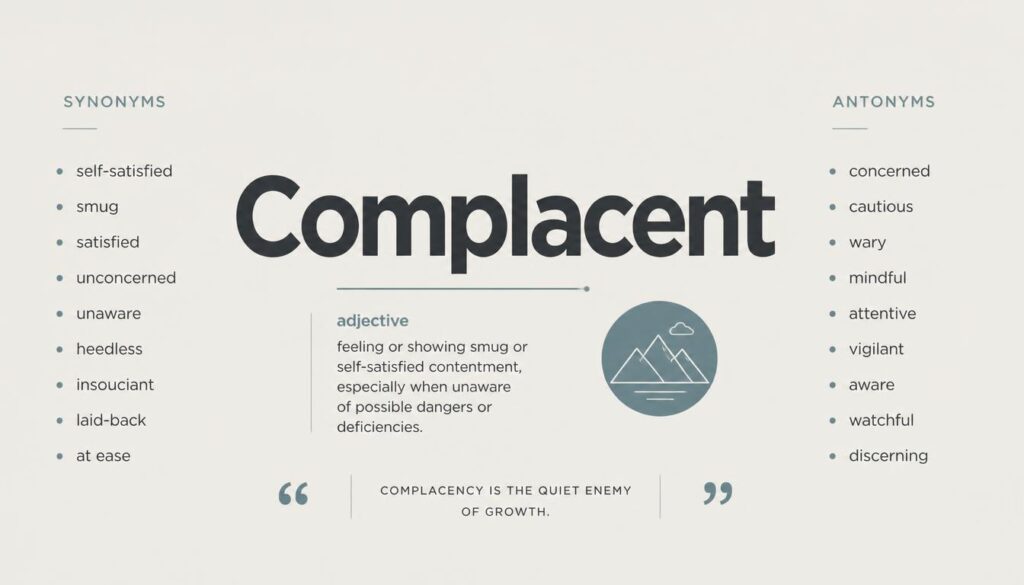
When looking for a complacent synonym, context matters because not every similar word carries exactly the same meaning. Self-satisfied, self-contented, and overconfident can be useful alternatives, while words such as smug may sound stronger or more judgmental.
Useful related words include:
- Self-satisfied pleased with yourself, sometimes excessively.
- Self-contented feeling satisfied with your current state.
- Overconfident having more confidence than the situation reasonably supports.
- Smug overly pleased with yourself in a way that may seem annoying or superior.
- Unconcerned not worried about something.
- Careless failing to give enough attention to possible problems.
- Passive not taking active steps when action might be useful.
- Content satisfied with what you have, usually without the negative meaning of complacent.
- Secure feeling safe or confident about your situation.
So, if someone asks for a complacent synonym, “self-satisfied” is often a strong choice, but it shouldn’t automatically replace the word in every sentence.
Complacent Antonym: Words With the Opposite Meaning
Understanding a complacent antonym can make the definition clearer. The opposite of complacency is not simply unhappiness. In many contexts, it is a willingness to stay alert, improve, learn, and respond to change.
Some useful antonyms include:
- Ambitious
- Motivated
- Driven
- Hardworking
- Proactive
- Vigilant
- Alert
- Determined
- Self-critical
- Improvement-oriented
A proactive person does not necessarily dislike their current situation. They simply understand that today’s success may require tomorrow’s effort too. That mindset is particularly valuable in careers and businesses where circumstances can change quickly.
What Is Complacency Meaning?
The complacency meaning is closely connected to the adjective complacent. Complacency is the noun form describing a state of being too satisfied or too comfortable, especially when more effort, awareness, or improvement is needed.
For example, “The team’s complacency affected its performance” means that the team’s excessive comfort or satisfaction contributed to weaker results.
The word often describes a slow mental shift. First comes success. Then comfort. Then the belief that success will continue automatically. Finally, people stop questioning their habits. That’s why complacency can be difficult to notice while it is happening.
It doesn’t usually arrive wearing a sign saying, “You are now becoming complacent.” It just starts making reasonable excuses sound very convincing.
Complacency in Work, Business, and Career
The workplace is one of the clearest places to see the consequences of complacency. An employee who has mastered a role may stop developing.
A manager may assume the same strategy will keep producing the same results. A business may rely on a successful product while competitors introduce better alternatives.
This doesn’t mean everyone needs to live in a state of permanent stress. That would be exhausting, and honestly, not very productive either. The goal is awareness, not anxiety.
Healthy professionals can enjoy achievement while still asking useful questions: What has changed? What could be improved? What risks am I overlooking? Which new skills could make my work stronger?
Those questions protect against the lack of motivation that often accompanies complacency.
How to Avoid Becoming Too Complacent
The easiest way to avoid complacency is not to reject comfort altogether. Instead, keep a small habit of reflection. Every few weeks or months, ask yourself whether your current routine is still helping you move forward.
You might review your goals, seek honest feedback, learn a new skill, examine your recent performance, or deliberately take on a manageable challenge. Even small changes can restore curiosity.
Another useful practice is separating confidence from certainty. You can believe strongly in your abilities while accepting that there is always something you don’t know yet. That attitude keeps progress alive without turning your life into an endless competition.
Complacently: The Adverb Form
Complacently is the adverb form of the word. It describes doing something in an overly satisfied or self-assured way, often without enough concern for improvement or danger.
For example:
- He sat complacently while the rest of the team prepared for the upcoming challenge.
- The company responded complacently to early warnings from customers.
- She smiled complacently, believing the difficult part was already over.
The relationship is simple:
Complacent → adjective
Complacency → noun
Complacently → adverb
Once you understand this word family, many sentences become much easier to interpret.
Is Being Complacent Always Bad?
Not every moment of relaxation should be labelled complacent. Human beings need rest, stability, and contentment. Constantly chasing improvement can become unhealthy in its own way, because a person may never allow themselves to appreciate an achievement.
The problem begins when satisfaction prevents necessary action.
Imagine someone who has worked hard for years and finally takes a peaceful weekend away from work. That’s rest. If they permanently stop caring about responsibilities while ignoring obvious problems, that’s closer to complacency.
The difference is intention and awareness. Rest can restore motivation. Complacency often removes the desire to act at all.
A Simple Way to Remember Complacent Meaning
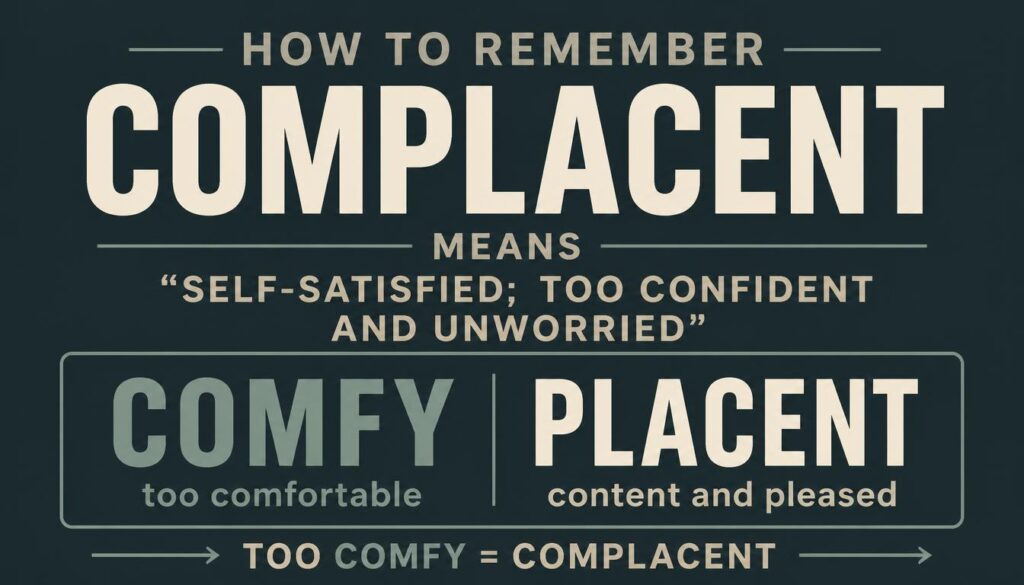
If you keep forgetting the definition, remember this sentence:
“I am doing fine, so I don’t need to try anymore.”
That is the heart of complacent meaning.
A person who is simply satisfied says, “I’m grateful for what I have.” A complacent person may say, “What I have is enough, and there is no reason to pay attention to anything else.”
The first statement expresses contentment. The second can suggest a lack of ambition, awareness, or willingness to improve.
Frequently Asked Questions
complacent meaning
Complacent means feeling too satisfied with yourself or your situation, so you no longer feel the need to work harder or improve.
complacent
Complacent describes someone who is overly satisfied with their abilities, success, or situation and becomes less motivated to improve.
complecent
Complecent is a common misspelling of complacent. The correct spelling is complacent, meaning overly satisfied with yourself or your situation.
complacement
Complacement is not the standard English word for this meaning. The correct word is usually complacency, which means a state of being overly satisfied and unconcerned.
complicent
Complicent is a common spelling mistake for complacent. The correct spelling is complacent, meaning self-satisfied or too comfortable with your current situation.
Read more: https://ytmeaning.com/poignant-meaning/
Final Thoughts on Complacent Meaning
The word complacent describes more than being happy with yourself. It points to excessive satisfaction, especially when that satisfaction creates a lack of effort, reduces motivation, or makes someone ignore risks and opportunities for improvement.
Knowing the difference between confidence and complacency is especially useful in real life. You can be proud of your success, comfortable with your situation, and genuinely pleased with your achievement without stopping your growth. In fact, the healthiest kind of confidence often says, “I’m proud of how far I’ve come, but I’m still willing to learn.”
So the next time you hear someone say, “Don’t become complacent,” they usually aren’t telling you to be unhappy. They’re reminding you not to let comfort become an excuse for standing still.
And perhaps that’s the most practical lesson hidden inside this small word: enjoy your success, but don’t let yesterday’s success convince you that tomorrow requires no effort. Stay curious, stay aware, and leave a little room for improvement, because progress often begins right where complacency ends.