

There are some words that seem to arrive at a conversation wearing a tiny French hat, and touché is one of them. You may hear it after a clever comeback, during a friendly disagreement,
or when somebody makes a surprisingly accurate point and you suddenly realize, well, they got you there. It is short, stylish, slightly dramatic, and somehow says a whole paragraph without actually saying one.
The interesting thing about touché meaning is that it began with a literal hit. In fencing, a fencer can use touché to acknowledge that an opponent has successfully made a touch or hit.
From there, the expression wandered out of the fencing piste and into everyday conversation, where it became a graceful way of admitting that someone has made a valid point, a clever argument, or even a sharp accusation.
Merriam-Webster defines it as an interjection used to acknowledge a fencing hit or the success or appropriateness of an argument, accusation, or witty point. MMerriam-Webster
So when someone says “Touché!” after you make a good argument, they usually are not angry. Quite the opposite, actually. They are giving you a tiny verbal medal for landing the better point, even if they still plan to disagree with you five minutes later.
What Is the Touché Meaning in Simple English?
The simplest answer to what does touché mean is: “You made a good point,” “You got me there,” or “I admit that was a clever argument.” It can also mean something closer to “fair point” or “I have to concede that one.”
The word is a French interjection, but English speakers commonly use it as a conversational expression. M Merriam-Webster
Imagine two friends arguing about who is always late.
One says, “You complain that I’m late, but you were twenty minutes late yesterday.”
The other pauses and says, “Touché.”
That one word means, more or less, “Fair enough. You caught me with that one.” There is a little surrender inside it, but not necessarily a complete surrender.
The person may still have another argument waiting in the pocket, which is why touché can make a debate feel playful rather than hostile.
In everyday English, the figurative meaning of touché is therefore much more common than the literal fencing meaning. You don’t need a sword, a mask, or an unusually dramatic ballroom for it to work.
Touché Meaning in Fencing: Where It Started
To really understand touché in fencing, it helps to imagine the original situation rather than memorizing a dictionary definition. Two fencers face each other, move carefully, and try to land a legal touch on the opponent. When a hit has been made, touché acknowledges that contact.
The French word touché is the past participle of toucher, meaning “to touch,” and its deeper history reaches into Old French. Merriam-Webster traces it to French toucher and Old French tuchier. M Merriam-Webster Etymonline likewise connects the fencing expression with French touché and the older verb touchier. E Etymology Online
There is a pleasing little logic here: a fencer has literally been “touched,” so touché acknowledges the hit. English then borrowed that physical idea and turned it into something wonderfully verbal. A sharp sentence became a kind of imaginary sword, and suddenly your brother’s sarcastic observation at dinner could count as a fencing victory, sort of.
Touché Meaning in Conversation

The touché meaning in conversation is usually less dramatic than its fencing background, though people sometimes say it with a very dramatic face, which is half the fun. It acknowledges that another person has made a successful argument, witty point, or accurate response.
For example:
- “You said I spend too much money on coffee, but you’ve bought four video games this month.”
- “Touché.”
Here, touché means, “Yes, your argument works against me.”
It can also be used after an accusation that is difficult to deny. Suppose somebody says, “You always tell everyone to be patient, but you sent three messages asking why I hadn’t replied yet.”
A sheepish “Touché” works beautifully. It admits the contradiction without requiring a long speech about human inconsistency, which honestly is useful because humans already produce enough long speeches.
The expression can also acknowledge a clever comeback. If someone responds to your joke with a better joke, saying “Touché!” tells them that their verbal return landed successfully. It is not exactly “you’re right about everything.” It is more like “That particular point was excellent, and I can’t pretend it wasn’t.”
Touché Pronunciation: How Do You Say It?
The usual touché pronunciation in English is approximately “too-SHAY”, with the stress on the second syllable. Merriam-Webster gives the pronunciation as tü-ˈshā. M Merriam-Webster
If you are wondering how to pronounce touché, think of the ending as the “shay” sound in shay, rather than pronouncing the word like the English word touch. The accent mark over the final é is not there merely for decoration, though it does look rather fancy sitting there.
You will sometimes see people write touche without the accent, especially in casual typing. The accented form, touché, is the standard French spelling and makes the pronunciation easier to recognize. In texting, however, “touche” is widely understandable, so nobody needs to panic because their keyboard has lost its French manners.
Touché Meaning vs. “You’re Right”
These expressions overlap, but they are not identical, and this small difference is where the word becomes interesting. Saying “you’re right” usually means you accept the other person’s position as correct. Saying “touché” often means you acknowledge that they have landed a strong point, even if you still disagree with their overall conclusion.
Consider this exchange:
- “You say we should save money, but you just ordered an expensive dinner.”
- “Touché. We should still save money, though.”
The second speaker admits the valid point but doesn’t necessarily surrender the entire debate. That is why touché is such a useful debate expression. It can be a concession without becoming a total defeat.
It also carries a tone of respect. Even in a disagreement, saying “touché” can signal, “I noticed that was clever.” A good argument deserves acknowledgment, and sometimes a little humility makes a disagreement much more human.
Touché Meaning After an Argument: 10 Ready-to-Use Examples
If you’re looking for a natural touché example, the easiest method is to place it immediately after somebody makes a point that successfully challenges what you just said. These examples show how flexible it can be:
- “You told me to stop procrastinating, but you haven’t finished your own project. Touché.”
- “You say I talk too much, yet you’ve been telling this story for twenty minutes. Touché.”
- “I was going to criticize your cooking, but you reminded me I once burned toast. Touché.”
- “You called me stubborn, which is exactly what a stubborn person would say. Touché.”
- “You say I spend too much time online, but you’re reading this conversation too. Touché.”
- “I accused you of being late, then realized I arrived after you. Touché.”
- “You made the stronger argument there. Touché.”
- “I don’t completely agree, but that is a very fair point. Touché.”
- “That comeback was annoyingly good. Touché.”
- “Alright, you caught me with that one. Touché.”
Notice that most of these examples are playful rather than formal. You probably would not say “touché” in a serious legal proceeding merely because someone made an argument you liked. It belongs especially well in informal verbal exchanges, friendly debates, teasing, and light disagreements.
When Should You Say Touché?
Knowing when to use touché is more important than knowing its dictionary definition. Use it when someone makes a point that genuinely lands, especially when the point exposes a weakness, contradiction, or amusing flaw in what you have just said.
It works nicely in situations such as:
- A friend gives you a clever comeback.
- Someone points out an obvious contradiction in your argument.
- A colleague makes a surprisingly strong counterargument.
- Someone responds to your accusation with an equally convincing observation.
- A family member catches you doing exactly what you criticized them for doing.
- Someone wins a playful debate with a witty remark.
- A person challenges your reasoning in a way you cannot easily dismiss.
- Somebody makes a humorous observation that is uncomfortably accurate.
The key is sincerity. If the other person has not made a good point, saying “touché” can sound sarcastic or forced. And if the discussion is deeply emotional, the word can occasionally come across as treating a serious issue like a game, so context matters alot.
Read more….https://ytmeaning.com/godspeed-meaning/
Touché Meaning in Friendly Disagreements
One of the nicest uses of touché is between people who already have a comfortable relationship. Friends, siblings, couples, and colleagues may use it as a miniature peace treaty.
Picture two siblings arguing about who ate the last slice of cake. One accuses the other, and the accused replies, “Interesting accusation from the person who hid the empty cake box in their bedroom.”
“Touché.”
Nobody has called a lawyer. Nobody has stormed out. The argument has simply taken a funny turn, and one person has admitted that the counterargument landed.
That is the charm of the expression. It turns concession into something lighter. Instead of saying, “Your counterargument has successfully demonstrated a weakness in my position,” which would sound like a meeting nobody wanted to attend, you say one small French word and move on.
Touché Meaning When Someone Makes a Witty Point
Sometimes a person isn’t technically winning an argument; they’re simply being clever. In those moments, touché can acknowledge a witty point or clever remark.
For instance, you might tell your friend, “You need to stop buying books when you haven’t read the ones you own.”
They could look at your overflowing collection and reply, “You’re saying this while standing beside your three unread novels?”
“Touché.”
The response doesn’t necessarily mean the friend has proved that buying books is good. It means the remark successfully turned the criticism back toward you. It was a little verbal boomerang, and it came home faster than expected.
This is also why the word works so well in humor. A clever comeback does not have to destroy the other person’s argument completely. It only needs to hit the right spot.
Touché Meaning for Messages, Captions, and Social Conversations
Because touché is short, it fits naturally into texts, comments, captions, and casual online conversations. It can even be more expressive than a long reply, especially when both people already understand the context.
Some adaptable responses include:
- “Okay, touché 😂”
- “Touché, I walked into that one.”
- “Touché. I honestly had no comeback.”
- “Fair point. Touché.”
- “Touché, but I’m still not changing my mind.”
- “Well played. Touché.”
- “Touché! You got me there.”
- “I hate that you’re right. Touché.”
- “Touché, that was actually a good one.”
- “Alright, alright… touché.”
The last few are especially useful when you want the conversation to stay warm. The word itself can be playful, but the sentence around it controls the mood.
Is Touché French?
Yes, touché is French. More precisely, the English interjection comes from French touché, the past participle of toucher, “to touch.” Merriam-Webster traces the word through French to Old French tuchier. M Merriam-Webster
Its history is a nice example of how languages borrow expressions and then give them new lives. The literal idea of being touched or hit in fencing became an expression for acknowledging a successful verbal hit.
Etymonline records the fencing use in English from 1902 and the broader, non-fencing use for admitting a valid point by 1907. E Etymology Online
There is an interesting dating detail here: Merriam-Webster lists 1897 as the first known English use, while Etymonline gives 1902 for the fencing interjection.
M Merriam-Webster+1 That difference is a good reminder that dictionary dates can vary depending on what evidence and sense of the word a source is tracking.
So if you see “touché 1897” in a search result, it is not necessarily a mistake; Merriam-Webster does indeed document that date.
Touché Etymology and Word Origin
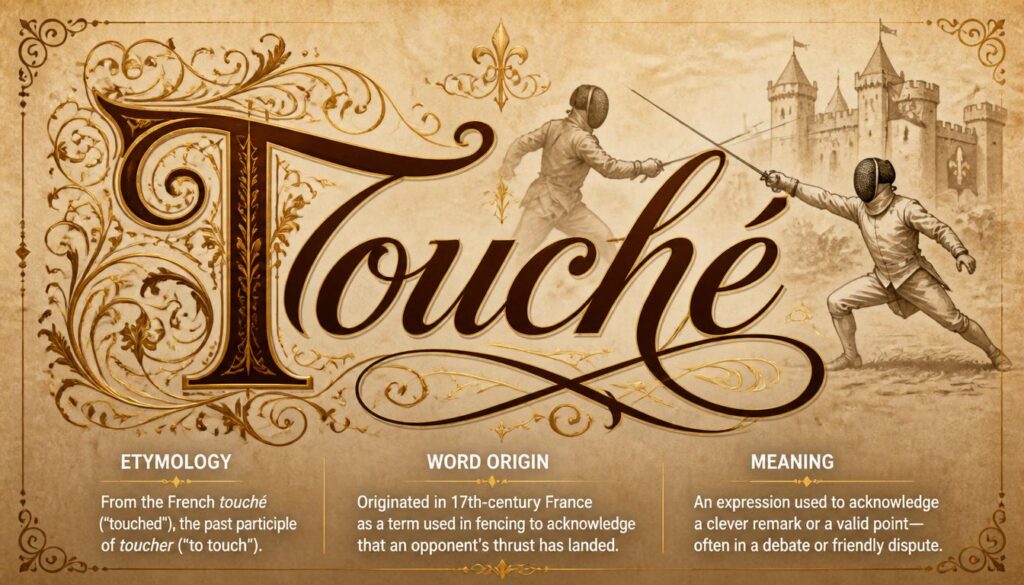
The touché etymology becomes especially satisfying when you follow the word backward. The modern French verb is toucher, and Merriam-Webster traces touché to that verb and ultimately to Old French tuchier. M Merriam-Webster
Etymonline similarly connects touché with French toucher and Old French touchier, while its entry for touch traces the broader family further back through Old French and Vulgar Latin. E Etymology Online+1
The important idea isn’t that you need to memorize a medieval vocabulary tree. It’s that the modern conversational sense still preserves the original metaphor: a good argument can “hit” you. Language does this all the time, turning physical actions into mental ones, but touché does it with unusually elegant economy.
Touché vs. Touche: Does the Accent Matter?
You may encounter both touché and touche online. The accented version is the proper French spelling, and it signals the pronunciation too-SHAY. The unaccented version is often just a keyboard-friendly form used in casual English writing.
If you are writing something polished, use touché. If you’re typing quickly in a group chat and write “touche lol,” nobody is likely to organize a grammar tribunal about it.
The accent also helps distinguish the expression visually from unrelated uses of the letters touche. In a search engine, however, people commonly type touche meaning, touche definition, or what does touche mean, and they are generally looking for the same expression.
Common Mistakes When Using Touché
The first mistake is using it simply to mean “I agree.” That is a little too broad. Touché usually acknowledges that the other person has made a successful point against you, rather than merely stating that you share their opinion.
Another mistake is using it after every disagreement. If someone says something you strongly reject, “touché” may accidentally suggest that you concede their point. The expression works best when there really is something worth acknowledging.
A third mistake is assuming it must be sarcastic. It can be sarcastic, yes, but it doesn’t have to be. A sincere “touché” can be a graceful acknowledgment that someone made a better point.
And finally, don’t feel obligated to perform a French accent. The word is borrowed into English, and saying it naturally is perfectly fine. Language is communication, not an audition for a Parisian theatre company.
10 Touché-Style Responses for Everyday Communication
If you like the spirit of touché but don’t want to repeat the same word, these alternatives can help you express the same general idea:
- “Fair point.”
- “You got me there.”
- “Okay, that’s a good one.”
- “I can’t argue with that.”
- “I’ll give you that.”
- “That’s actually a valid point.”
- “Well played.”
- “You make a convincing case.”
- “I walked right into that one.”
- “Alright, I’ll concede that.”
These alternatives are useful because tone matters. “Fair point” is straightforward, “well played” is playful, and “I’ll concede that” sounds more formal. Touché sits somewhere in the middle, carrying a little wit with it.
Touché Meaning in One Tiny Conversation
Sometimes the easiest definition is a miniature scene.
“Why do you keep telling me to exercise when you haven’t been to the gym in weeks?”
“I’ve been busy.”
“So have I, and yet here I am.”
“Touché.”
That is the entire concept in motion. One person makes an accusation, the other answers with a counterargument, and the first person acknowledges that the response landed. They may continue arguing, but for that particular moment, the point belongs to the other person.
That is touché meaning without the dictionary sitting on the table. It is a verbal point acknowledged as successful.
A Quick Guide to Using Touché Naturally
If you’re still wondering how to use touché, remember this simple pattern: someone makes a strong point → you recognize it → you say “touché.”
You can make it warmer by adding a phrase afterward: “Touché, I hadn’t thought of that.” You can make it humorous with an emoji: “Touché 😂.” Or you can keep it wonderfully minimal: “Touché.”
Don’t use it merely because someone has spoken. The other person’s remark should have some force, cleverness, or relevance. Otherwise the little word loses its fencing sword, and it becomes just decoration.
The best usage often has a tiny moment of surprise inside it. You thought you had the upper hand, then someone turned your own reasoning around and handed it back to you. Touché.
Frequently asked Questions
touche
“Touché” is a French word used to acknowledge that someone has made a good point, clever remark, or successful argument.
touche meaning
The meaning of “touché” is essentially “you have made a valid point” or “I admit you got me.”
what does touche mean
“Touché” means acknowledging that another person has made a strong, accurate, or witty point in a conversation.
spelling of touche
The correct spelling is touché, with an accent on the final é. “Touche” without the accent is commonly used when the accent is unavailable.
what does touché mean
“Touché” means “well said” or “you got me there,” especially when responding to a clever argument or comeback.
Final Thoughts on the Meaning of Touché
The beauty of touché is that it makes disagreement a little less ugly. It gives people a way to admit, “You got that point,” without requiring either person to surrender their entire position. In a world where conversations can become unnecessarily competitive, that tiny acknowledgment can be surprisingly generous.
At its literal root, the expression belongs to fencing, where it acknowledges a successful hit. In modern conversation, it has become a figurative fencing expression for recognizing a successful argument, accusation,
witty point, or clever comeback. Merriam-Webster describes precisely this range, while its etymology traces the word to French toucher and Old French tuchier. M Merriam-Webster
So the next time somebody catches you with an unexpectedly good argument, you don’t need a twenty-minute explanation about concession and counterargument. Just smile, raise an imaginary sword, and say “Touché.”
And if you are the person who made the better point, enjoy your tiny victory but don’t get too comfortable. The next verbal touch might already be coming your way.