

There are some words in Scripture that seem to whisper rather than speak. Selah is one of them. You read a Psalm, follow the thought, feel the poet moving from fear toward trust or from grief toward praise and suddenly there it is: Selah. Then the poem carries on, almost as if somebody in the ancient room has quietly asked everyone to breathe.
That little word has fascinated readers for centuries. If you have ever wondered, what does Selah mean in the Bible?, you are asking a question that scholars themselves cannot answer with complete certainty.
The word appears 71 times in the Psalms and three times in Habakkuk 3, making 74 occurrences in the Hebrew Bible, yet Scripture never pauses to define it for us.
And maybe, rather wonderfully, the mystery is part of its charm.
The simplest explanation is that Selah probably has something to do with music, worship, pausing, emphasis, or a change in the way a passage was performed.
But that does not mean we can confidently translate it as merely “pause.” Ancient interpreters and modern scholars have proposed several possibilities, and the evidence points in more than one direction.
So, let’s slow down a little yes, rather like Selah itself and explore the meaning of Selah, its Hebrew background, its place in the Bible, and why this tiny word can still speak so beautifully to modern readers.
What Does Selah Mean in the Bible?
The honest answer to what does Selah mean is: we do not know the exact meaning.
That may sound unsatisfying, especially when somebody asks for a neat one-line Selah definition, but it is actually the most trustworthy answer.
Biblical translations and study notes commonly acknowledge that the Hebrew word has an uncertain meaning and may have functioned as a musical or liturgical direction.
Selah is written in Hebrew as סֶלָה and is primarily found in poetic and worship material. It appears throughout the Psalms, where it often occurs at a striking moment in the poem.
It also appears three times in Habakkuk 3, a prayer or hymn-like passage filled with imagery of God’s power, judgment, mercy, and salvation.
This placement matters.
Imagine someone reading a Psalm aloud in an ancient worship setting. The words have been building: trouble is described, enemies are named, God is praised, or a cry for mercy rises.
Then comes Selah. Something changes. Perhaps the instruments continue while the singers stop. Perhaps the musicians alter the accompaniment. Perhaps the congregation is expected to absorb what was just spoken.
We cannot reconstruct the exact performance, but the location of the word strongly suggests that it had a job to do.
And its job may have been bigger than simply saying “be quiet.”
The Biblical Meaning of Selah: Why the Pause Matters
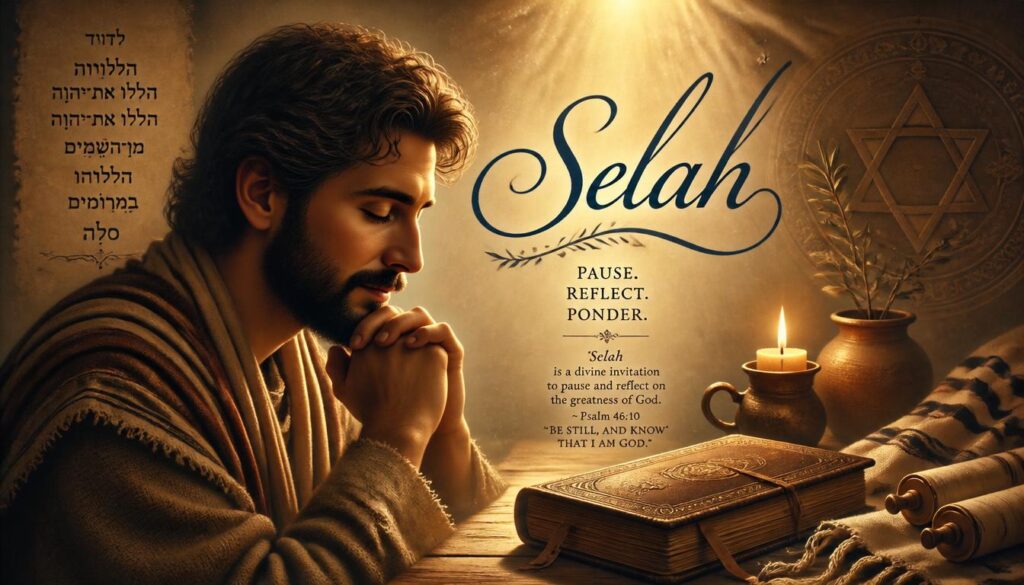
One popular explanation gives Selah the sense of a pause, and this has become especially meaningful in devotional writing.
But there is an important distinction here. Saying “Selah means pause” can be a useful spiritual application, yet it is stronger than the surviving linguistic evidence allows if presented as a definite dictionary translation. The exact lexical meaning remains debated among scholars.
Still, look at what happens in the text.
In Psalm 3, for example, the psalmist describes people saying there is no salvation for him in God. Then comes Selah. Immediately afterward, the speaker declares that God is his shield and the one who lifts his head.
That is a fascinating literary moment.
Fear.
Selah.
Trust.
Even if we cannot prove that ancient worshippers literally stopped singing there, the word sits at a point where the reader naturally wants to stop and notice the movement.
The emotional effect is almost impossible to miss.
A modern reader might therefore use Selah and reflection as a spiritual practice: read the sentence, breathe, and allow it to settle before rushing onward. That is an application rather than a proven ancient translation, but it fits the way many people experience the Psalms today.
Sometimes Scripture doesn’t need more speed. It needs a moment to land.
Selah in the Bible: Where Does It Appear?
Selah in the Bible is concentrated in the poetic material of the Psalter, with three appearances in Habakkuk 3. Traditional counts give 71 occurrences in 39 Psalms and three occurrences in Habakkuk 3.
You will encounter it in well-known passages including Psalm 3, Psalm 4, Psalm 32, Psalm 46, Psalm 62, Psalm 77, Psalm 89, and Psalm 143. It is not sprinkled randomly through biblical prose, which is one reason researchers pay close attention to its poetic and musical setting.
Some of the most interesting examples are:
- Psalm 3 Selah appears three times, around themes of enemies, God’s protection, answered prayer, and salvation.
- Psalm 4 the word appears in a passage involving fear, righteousness, trust, and quiet reflection.
- Psalm 46 Selah appears after declarations about God as refuge and strength, giving the famous Psalm an almost built-in breathing space.
- Psalm 77 Selah appears in a deeply emotional poem about remembering God during distress. The placement helps mark movements within the poem.
- Habakkuk 3 Selah appears three times in a powerful prayer that moves through divine majesty, judgment, mercy, and ultimately faith.
The pattern is important. Selah in Psalms does not appear to have one simplistic emotional function. Sometimes the surrounding words are joyful, sometimes fearful, sometimes intense. That variety makes a single English translation difficult.
Is Selah a Musical Term?
Probably, or at least a musical/liturgical interpretation has substantial historical support.
The Psalms were not originally created as modern silent reading material. Many are associated with singers, musicians, instruments, or worship leaders. The headings themselves preserve clues about performance, although the precise ancient musical system is no longer available to us in full.
This is where the phrase Selah musical meaning becomes especially interesting.
One possibility is that Selah instructed musicians to insert an instrumental interlude. Another possibility is that it indicated a change in musical intensity, rhythm, pitch, or vocal delivery.
Some proposals connect the term with the idea of raising the voice or lifting the musical sound. These suggestions have different linguistic foundations, and none can be established as the final answer.
The ancient Greek translators offer another fascinating clue.
The Septuagint, often abbreviated LXX, rendered Selah with the Greek word diapsalma in many places. That Greek term has traditionally been associated with a musical break or interlude.
However, the correspondence is not perfectly consistent: the LXX sometimes places diapsalma where the Hebrew text does not have Selah, and sometimes omits it where the Hebrew has Selah.
So even the ancient translation tradition doesn’t hand us a tidy answer tied with a ribbon.
It gives us a clue.
Selah as a Literary Term, Not Only a Musical One
Here is where the discussion gets more intriguing.
If Selah was only a musical instruction, it might seem irrelevant to someone reading the Psalms silently today. But many readers and scholars notice that its placement can also correspond to literary structure, transitions, and changes in thematic movement.
That does not necessarily mean the original writer thought of Selah as a literary device in the modern academic sense. Ancient Hebrew poetry did not come with our modern terminology of “paragraph transitions” and “thematic markers.” Still, the word clearly interacts with the structure of the poems.
In Psalm 77, for instance, Selah occurs at points that help distinguish major movements in the poem. One scholarly discussion notes that the three occurrences mark section endings and a transition between different poetic structures.
That is quite revealing.
A Selah literary meaning could therefore be discussed as a marker that tells the audience, in effect, “Notice what has just happened here.”
Maybe the music changed because the theme changed.
Maybe the theme feels more prominent because the music changed.
Those two possibilities are not enemies. They may actually explain each other.
The literary interpretation and the musical interpretation can sit at the same table, which is often a better approach than forcing one to leave the room.
Selah Meaning in Hebrew: What About the Root?
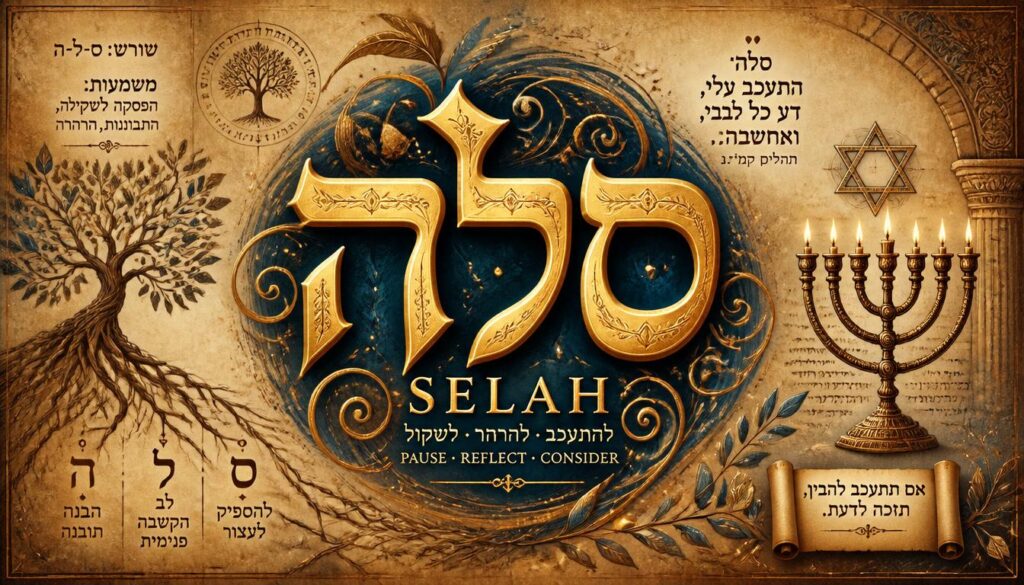
One of the trickiest parts of understanding the Hebrew word Selah is etymology.
Several possible connections have been proposed. One well-known suggestion connects it with the Hebrew root salal, associated with lifting up, raising, or exalting. From that proposal, some interpreters have imagined Selah as an instruction to lift the voice or increase the musical sound.
Other theories connect it with pausing, suspending, or musical interruption. There have also been historical interpretations involving ideas such as “forever,” although that reading does not fit comfortably in every occurrence.
This is where good biblical study needs a little restraint.
It is tempting to find a Hebrew root, discover an attractive definition, and announce that the mystery is solved. Ancient languages rarely behave so politely.
A possible root is not automatically the proven lexical meaning of a word. Linguistic context, literary context, ancient translations, manuscript evidence, and usage all matter.
So when someone says, “Selah definitely means lift up,” or “Selah definitely means stop,” a careful reader should raise one eyebrow, kindly.
Selah and the Septuagint: What Is Diapsalma?
The Septuagint provides one of the earliest major translation witnesses to the Hebrew Bible. Its translators rendered Selah with diapsalma, a Greek term whose precise force has itself been discussed by scholars.
The traditional association is with an instrumental interlude or musical break. But because the placement of diapsalma in the LXX does not always match the Hebrew placement of Selah, it is better treated as evidence for how ancient translators understood or interpreted the word rather than as a perfect dictionary definition.
This distinction is small but important.
The Selah Septuagint connection tells us that ancient translators were already trying to make sense of an unusual Hebrew term. In other words, the mystery isn’t a modern problem created by twenty-first-century readers.
Ancient readers had questions too.
The Greek translation tradition preserves their attempt.
And that makes the study of diapsalma surprisingly valuable. It reminds us that biblical interpretation has always involved listening carefully to old languages, old manuscripts, and old communities of readers.
What Does Selah Mean in Psalm 3?
Psalm 3 is one of the best places to see why the word continues to fascinate people.
The Psalm begins in distress. Enemies appear to be multiplying, and the speaker hears people claiming that God will not save him. Selah occurs after that statement. Then the poem turns toward confidence: God is described as a shield, glory, and the one who lifts the speaker’s head.
Later, Selah appears again after the psalmist speaks about lying down, sleeping, and waking because the Lord sustains him.
The pattern creates a striking emotional rhythm:
Crisis.
Selah.
Confidence.
Fear.
Selah.
Rest.
And finally, a declaration of salvation.
We should not pretend this proves exactly how the original musicians performed the Psalm. It does, however, show why Selah Psalm 3 has become so meaningful in devotional interpretation.
The word occurs where the reader is naturally invited to notice a change.
That makes Psalm 3 a beautiful example of how Selah and prayer can be connected today. A person may read the words of fear, stop for a moment, then read the words of trust. The pause becomes a bridge between what the heart feels and what faith says.
Why Is Selah Used in the Psalms?
There probably isn’t one answer that explains every occurrence.
The safest explanation is that Selah was some kind of performance, liturgical, or structural marker whose exact ancient function has been lost. Scholars have suggested an instrumental interlude, a pause, a change in musical delivery, a signal to raise the sound, or a marker of textual transition.
Notice the word suggested.
That word is important.
Biblical scholarship sometimes looks less like finding a key and more like holding several old keys in your hand, wondering which one might fit a lock that has been closed for two thousand years.
And that uncertainty doesn’t weaken Scripture. If anything, it teaches us something about reading ancient texts responsibly.
The Selah interpretation should respect what the evidence can actually support.
Selah and Worship: More Than Just Silence
For modern worshippers, Selah and worship can carry a beautifully practical meaning even when the ancient technical definition remains uncertain.
A pause in worship can create room for gratitude.
A musical interlude can give words time to settle.
A change in volume can make a declaration feel suddenly enormous.
And silence real silence, not the uncomfortable kind where somebody checks their phone after four seconds—can help a person recognize what has just been said.
This is why the traditional idea of Selah and reflection has endured so strongly.
You don’t have to claim that Selah literally means “pause and reflect” to use the word as an invitation to pause and reflect.
There is a difference between translation and application.
Good devotional practice knows the difference.
Read more////////https://ytmeaning.com/otoe-meaning/
Selah, Lament, Judgment, and Redemption
One reason Selah feels spiritually rich is that it does not appear only in happy songs.
The Psalms contain praise, but they also contain grief, anger, fear, confession, loneliness, questions, and desperate appeals for rescue. Biblical poetry is not embarrassed by complicated emotions.
That matters because a pause is especially meaningful when the sentence before it hurts.
Consider the broad movement of many Psalms: the speaker cries out, remembers God’s character, wrestles with danger, and eventually finds a way toward trust. Selah sometimes appears amid these movements, creating a kind of textual breathing room.
The result is not sentimental religion.
It is faith that has room for lament.
In Habakkuk 3, the same word appears inside a prayer that includes God’s wrath, mercy, power, judgment, and salvation. The chapter eventually reaches a remarkable expression of joy and trust even in circumstances where crops and livestock fail.
That context makes the word feel larger than a simple musical cue.
Whether ancient musicians played louder, stopped briefly, changed rhythm, or did something we can no longer reconstruct, the surrounding poetry keeps pushing us toward attention.
What Does Selah Mean Spiritually Today?
If you ask, “What does Selah mean for my life?” the answer can be personal without pretending to be a translation.
For many Christians and other Bible readers, Selah has become a symbol of sacred attention.
It can mean:
- Stop rushing long enough to hear what you just read.
- Let a promise become more than a sentence on a page.
- Sit with difficult emotions instead of immediately escaping them.
- Remember God’s character before reacting to your circumstances.
- Allow praise to become more than background noise.
- Make room for prayer after reading Scripture.
- Notice the transition between fear and trust.
- Give gratitude a little breathing space.
- Let silence become part of worship.
- Remember that not every meaningful moment needs another sentence.
That last one might be the hardest.
We live in a world where every empty space gets filled almost immediately. A notification arrives. A video starts. Someone sends another message. We move, scroll, answer, repeat.
Selah—whatever its original technical meaning has become a compelling reminder that attention itself can be an act of devotion.
Selah Meaning in Ancient Hebrew Poetry
The Hebrew poetry of the Psalms works differently from much modern poetry. It often relies on parallel lines, repetition, contrast, imagery, rhythm, and carefully shaped movements of thought.
That makes a term such as Selah especially interesting.
The word can appear at the edge of a poetic unit, but it can also occur in places that complicate a simple “end of stanza” explanation. Historical discussions note that Selah sometimes occurs within broader poetic structures rather than always functioning as a neat closing marker.
So, from a literary context, Selah may have helped listeners experience the architecture of a poem.
Think of it like the rests in a piece of music. A rest isn’t merely “nothing.” It is part of the composition.
The silence has shape.
The silence has timing.
The silence changes what comes next.
That may be one reason the word has survived so powerfully, even though its precise ancient instructions have slipped beyond us.
Ancient Evidence and the Limits of What We Know
People sometimes mention Qumran, the Dead Sea Scrolls context, ancient psalm fragments, or other Jewish writings when discussing Selah. These sources are valuable because they give researchers glimpses into how biblical and related Jewish texts circulated in antiquity.
Some Dead Sea Scrolls materials contain the term or related textual phenomena, but these examples do not magically settle the meaning.
Modern reference works note occurrences in certain Qumran manuscripts and observe that they seem to have literary, liturgical, or musical relevance, without providing a definitive decoding of the word.
There are also discussions of later Jewish liturgical usage and ancient interpretive traditions. Some rabbinic traditions associated Selah with ideas such as “forever,” while historical commentators proposed other explanations. Yet these interpretations do not fit every biblical occurrence equally well.
This is a useful lesson in biblical scholarship.
An ancient interpretation is important evidence, but it is not automatically the original meaning.
A modern interpretation may be spiritually beautiful, but it is not automatically the ancient lexical meaning either.
The most trustworthy conclusion is sometimes the least flashy one: we know quite a lot about where Selah occurs and how ancient traditions interpreted it, but we do not know its precise original meaning with certainty.
Is Selah the Same as “Pause”?
Not exactly.
Does Selah mean pause? It may involve a pause, and “pause” is one of the most common ways people explain it today. But the Hebrew evidence does not let us say with absolute confidence that the word itself simply means “pause.”
A better explanation is that Selah may have functioned as a musical, liturgical, or structural instruction, perhaps involving an interruption, interlude, emphasis, change in performance, or some form of vocal or instrumental direction.
That broader description is less catchy, admittedly.
But it’s more responsible.
And honestly, the uncertainty makes the word more interesting, not less.
The Mystery of Selah Is Part of Its Beauty
There is a strange tenderness in a word whose exact definition has been lost.
The ancient singers knew what to do with it.
The ancient translators tried to explain it.
Later interpreters wrestled with it.
Modern readers still stop when they see it.
And perhaps that is enough to teach us something.
The mystery of Selah is not an invitation to invent a meaning and declare it fact. It is an invitation to read slowly, compare interpretations, notice context, and accept that some corners of ancient Scripture remain genuinely difficult.
In a culture that often rewards certainty, that kind of humility is valuable.
Sometimes “we aren’t completely sure” is not a failure of knowledge.
Sometimes it is the beginning of deeper attention.
How to Use Selah in Personal Prayer and Reflection
You don’t need an ancient harp in your living room to practice the spirit of Selah.
Try reading a short Psalm slowly. When you encounter the word, stop. Don’t immediately search for a commentary. Sit with the sentence before it. Ask what emotion is present. Is the writer afraid? Thankful? Angry? Hopeful? Exhausted?
Then ask what changes afterward.
You might discover that the most meaningful part isn’t the definition you eventually find in a dictionary. It is the way the Psalm’s movement becomes visible when you stop racing through it.
A simple personal rhythm could look like this:
- Read the passage once for understanding.
- Read it again more slowly.
- Notice where Selah appears.
- Ask what has just been emphasized.
- Sit quietly for a minute or two.
- Turn the thought into a short prayer.
- Continue reading and notice what changes.
That practice is an application, not an archaeological reconstruction of ancient worship. Still, it can be a deeply useful way to engage Scripture.
A Simple Answer to “What Is the Meaning of Selah?”
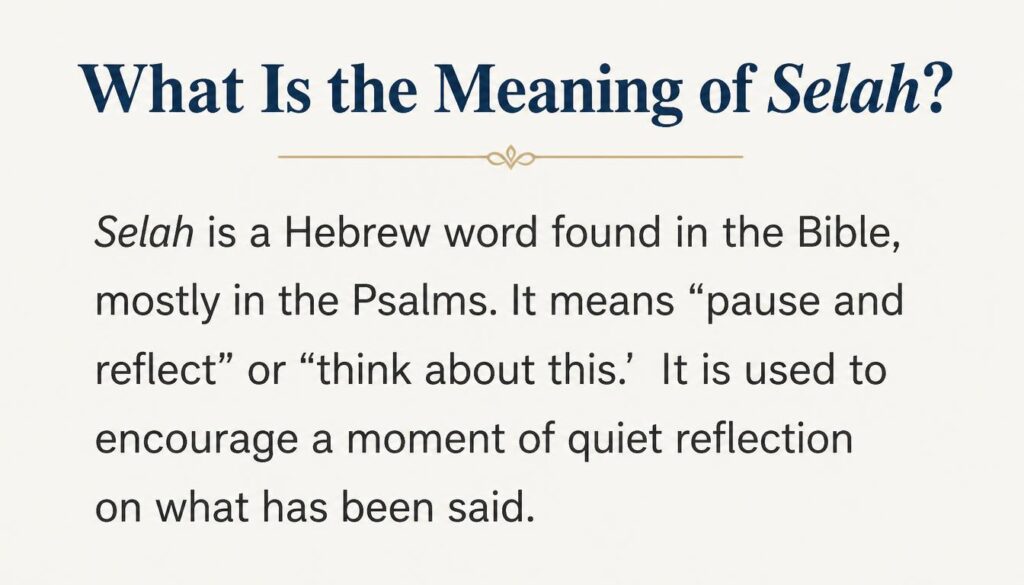
If you need the short version, here it is.
Selah is a Hebrew word found 71 times in the Psalms and three times in Habakkuk 3. Its exact meaning is uncertain. It is widely understood as some kind of musical or liturgical term, possibly connected with a pause, instrumental interlude, change in musical performance, emphasis, or another instruction for worship.
The Septuagint translates it with diapsalma, which has traditionally been understood in connection with a musical break or interlude, although the Greek evidence does not map perfectly onto every Hebrew occurrence.
The proposed connection with salal, meaning to lift or raise, is another important theory, but it should be presented as a proposal rather than a settled fact.
So the most accurate definition is not “Selah definitely means pause.”
It is:
Selah is an ancient, uncertain Hebrew term associated with the performance and structure of biblical poetry, especially the Psalms, whose precise meaning has been debated since antiquity.
And then comes the lovely modern application: pause anyway.
Frequently Asked questions
selah meaning
Selah is a Hebrew word found mainly in the Psalms. Its exact meaning is uncertain, but it is often understood as a pause, musical instruction, or a marker for reflection.
what does selah mean
Selah may mean “pause” or “stop and reflect.” It appears in biblical poetry to draw attention to an important thought, theme, or transition.
selah meaning in bible
In the Bible, Selah appears frequently in the Psalms and three times in Habakkuk. While its precise meaning is debated, it is commonly associated with pausing, reflection, or a musical/literary emphasis.
what does selah mean in the bible
In the Bible, Selah is generally understood as a word that invites a pause or reflection on what has just been said. Some scholars also view it as a musical or literary term.
selah meaning in the bible
The meaning of Selah in the Bible is not completely certain. It may refer to a musical pause or highlight an important spiritual and literary theme in the passage.
Final Thoughts on the Meaning of Selah
The word Selah has survived thousands of years without giving up all its secrets, which is rather impressive for three little Hebrew letters translated into an English word.
It appears in songs of fear and songs of praise. It sits beside declarations of God’s protection, pleas for mercy, descriptions of judgment, and moments of renewed trust.
In Psalm 3, it falls between despair and confidence. In Habakkuk 3, it accompanies a prayer filled with awe, divine power, mercy, and ultimately faith.
We may never know precisely whether ancient musicians stopped, played an interlude, changed the rhythm, raised their voices, or followed some instruction now lost to history.
But we can know this: Selah makes us pay attention.
It reminds us that the Psalms were not merely information. They were poetry, prayer, music, memory, grief, celebration and worship all tangled together in beautiful human language.
So the next time you read Selah in Scripture, don’t rush past it.
Take a breath.
Read the words again.
Notice what comes before and after.
Let the question remain a question for a little while.
And perhaps that is one of the most fitting ways to encounter Selah meaning not by forcing the ancient mystery to become smaller, but by allowing it to make us slower, quieter, and more attentive.
In a noisy world, that is a pretty meaningful gift from one very old word.