There are some words that seem to wear a little costume of their own. Masque is one of them. You see it on a page of English literature and, for a second, it can feel mysterious almost like a locked theatre door with music happening somewhere behind it. But once the door opens, the word becomes wonderfully vivid.
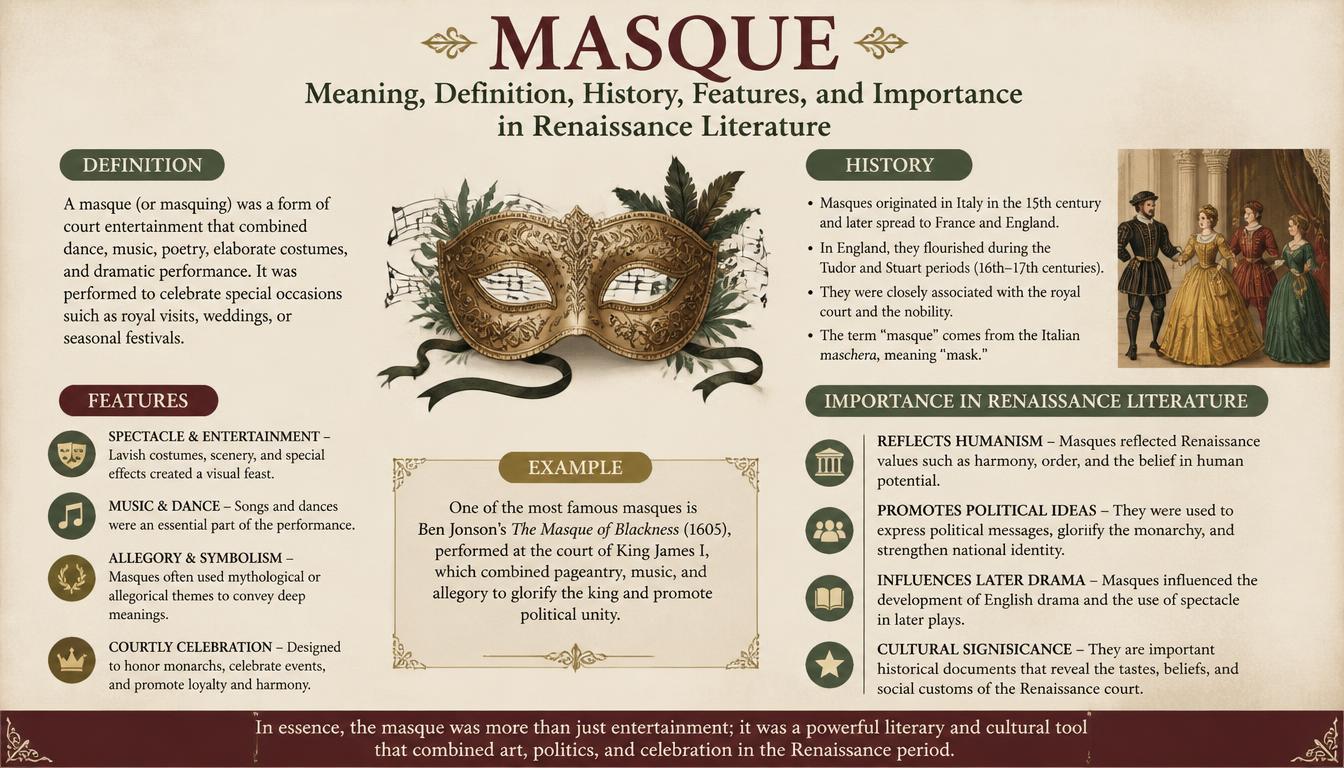
A masque was a form of theatrical entertainment, especially associated with the royal court, in which poetry, music, singing, dancing, costumes, scenery, mythology, and elaborate spectacle could all meet in one glittering performance.
The simplest masque meaning is therefore a kind of elaborate court entertainment or theatrical performance, particularly popular in Renaissance England during the late 16th and especially the 17th century.
It wasn’t quite a modern play, and it wasn’t merely a dance show either. It lived somewhere between drama, poetry, pageant, music and fantasy which is maybe why the form still feels rather unusual today.
If you’ve ever wondered what is a masque, or searched for the masque definition because the word appeared in a poem, drama, textbook, or examination question, this guide will make the idea much less foggy.
And yes, there are masks involved sometimes, but the word’s history is more interesting than simply saying “a masked party.” That’s where things get a bit more fun.
| Term | Short Meaning |
|---|---|
| Masque Meaning | An elaborate theatrical performance combining poetry, music, singing, dancing, costumes, and spectacle, especially popular in Renaissance England. |
Masque Meaning in Simple Words
In plain English, a masque was a spectacular performance designed mainly for celebration and entertainment, often at a royal court. It could include poetry, singing and dancing, along with costumes, music, scenery and allegorical characters.
The performers might represent gods, virtues, seasons, nations, planets, mythical creatures, or idealized versions of the king and queen.
So, if someone asks, “What does masque mean in literature?”, a useful answer is this: a masque is a form of dramatic and musical entertainment that developed in England and became especially important in the Renaissance and early modern period.
The word is also sometimes confused with masquerade, and there is a family resemblance, certainly. But a masque was not simply a room full of people wearing masks and having a grand evening.
It was usually a planned artistic spectacle, with a literary text and carefully designed performance elements. The distinction matters, otherwise the whole history gets squeezed into a rather tiny box.
A helpful one-line masque definition would be:
A masque is an elaborate theatrical entertainment combining poetry, music, singing, dancing, costume, scenery and allegory, especially associated with the English royal court of the Renaissance and early modern period.
The form is documented in surviving works and manuscripts, including Ben Jonson’s The Masque of Queens, performed at Whitehall in 1609.
The British Library catalogue records the work as an entertainment for Queen Anne and her ladies, showing just how closely the form was connected with royalty and court culture.
Masque Meaning in Renaissance England
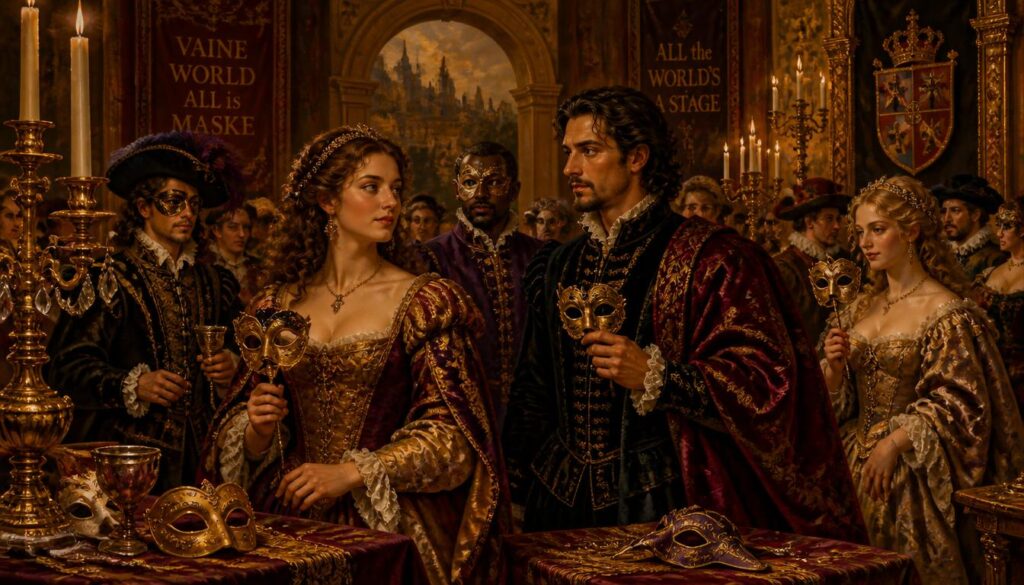
The English masque flourished in a world where entertainment and politics were not always strangers to each other. During the Renaissance, a royal celebration could be artistic, ceremonial, political and social at the same time, all wearing the same fancy hat, so to speak.
The earliest English examples developed from courtly and festive traditions, and the form became increasingly elaborate. By the reign of James I, the court masque had become a major vehicle for royal display. Wealthy patrons could spend extraordinary amounts on costumes, stage machinery, scenery, music and performers.
This is one reason the Renaissance masque should not be treated as “just another kind of play.” A normal drama could depend heavily on dialogue and plot, while a masque placed enormous importance on visual spectacle. A performance might be designed around an entrance, a transformation, a procession, a dance, or a symbolic revelation.
The royal court was therefore not simply the place where people watched. It was part of the meaning. The presence of the king, queen, monarch, and nobility could turn a performance into a public statement about order, harmony, wealth and power.
The Poetry Foundation notes that Ben Jonson became particularly associated with masques and worked with Inigo Jones, whose contributions to architecture, stage design and visual spectacle helped establish the form at the court of James I.
The Main Features of a Masque
A masque could have many ingredients, and not every surviving work uses them in exactly the same proportions. Still, several features appear again and again, like familiar instruments in an old orchestra.
- Poetry: Verse was often used for speeches, songs, descriptions, invocations and allegorical statements. The language could be elevated, ornate and highly symbolic, sometimes intentionally grand.
- Music: Instrumental music helped create the atmosphere and gave the performance its ceremonial character. It wasn’t background noise; music was part of the structure.
- Singing: Songs could introduce characters, celebrate an event, mark a transformation, or express the central idea of the masque.
- Dancing: Dance was especially important in the movement and spectacle of the performance. The human body itself became part of the visual design.
- Costumes: Performers might appear as gods, spirits, virtues, monsters, exotic figures or mythological characters. Clothing wasn’t merely decoration; it communicated meaning.
- Scenery: Elaborate scenery could transform a hall or stage into a forest, palace, heaven, underworld or imaginary kingdom.
- Allegory: Characters and events frequently represented larger ideas such as virtue, peace, wisdom, harmony or royal authority.
- Mythology: Classical gods and legendary figures supplied a ready-made symbolic vocabulary for the performance.
- Spectacle: The overall visual impact mattered enormously. A masque was meant to be seen, and sometimes seen with considerable astonishment.
- Participation: In some court masques, members of the court themselves appeared in the performance, which made the boundary between audience and performer rather interesting.
This mixture of theatre, music, poetry, dance, and visual design is what gives the masque its special identity. Remove one element and it might still survive; remove the entire mixture, though, and you’ve probably wandered into another genre.
Why Were Masques So Popular at the Royal Court?
The answer is partly entertainment, but entertainment alone doesn’t explain their importance. A court masque could flatter a monarch, celebrate a marriage, commemorate an occasion, display wealth, and present a political idea—all in one evening.
Imagine a royal audience watching a magnificent procession of gods and virtues. The characters speak about harmony and order, chaos is defeated, and the final image suggests that the world has been restored to balance. It isn’t hard to see how such a story could quietly point toward the monarch sitting among the spectators.
That political dimension became particularly significant under James I. Thomas Campion’s career illustrates the point: his masques were written for royal occasions, including weddings, and the Poetry Foundation describes the masque as a highly politicized form of entertainment that could reinforce the king’s role and status.
So the masque performance was often doing two jobs. It entertained people, yes, but it could also create an image of political stability, royal magnificence and social hierarchy. A pretty scene could carry a serious message underneath it, which is a very Renaissance habit.
Masque and the Idea of Allegory
One of the most important things to understand about masque literature is allegory.
Allegory means that a character, action, object, or story can stand for a larger concept. Instead of simply presenting a person named “Peace,” a masque might literally personify Peace as a beautiful figure entering the stage. Virtue could become a character. Discord might be defeated by Harmony. Winter might give way to Spring.
This made the form particularly suitable for royal celebrations. A wedding could become a symbolic union of harmony and prosperity. A monarch could be associated with wisdom, justice or peace. A festival could become a miniature picture of a perfect society.
The result is sometimes wonderfully strange to a modern reader. Why is a goddess suddenly talking about political order? Why are mythological creatures dancing in front of a king? Why does a river appear as a character?
Because the masque isn’t always asking you to believe the literal story. It is asking you to read the iconography, the symbols and the allegory behind the spectacle. Once you begin looking for those layers, the form becomes considerably more interesting.
The Importance of Ben Jonson
When discussing the history of the masque, it is almost impossible to avoid Ben Jonson. He became one of the major English writers associated with the form, particularly during the reign of James I.
His The Masque of Blackness, first performed in 1605, is among the best-known examples. Jonson also wrote The Masque of Queens, while his collaborations with designer Inigo Jones helped establish a sophisticated relationship between literary writing and stage spectacle.
Jonson’s importance also reveals something about the genre itself. The writer was only one part of the machinery. A successful masque could require poets, composers, musicians, dancers, actors, designers, architects, costume makers and technicians. In other words, it was something closer to a large-scale artistic production than a poet quietly reading verses in a corner.
And the spectacle could be astonishing for its time. Machinery, painted scenery, costumes and carefully arranged entrances were used to create an experience that ordinary theatre could not easily reproduce.
Inigo Jones and the Visual Side of the Masque
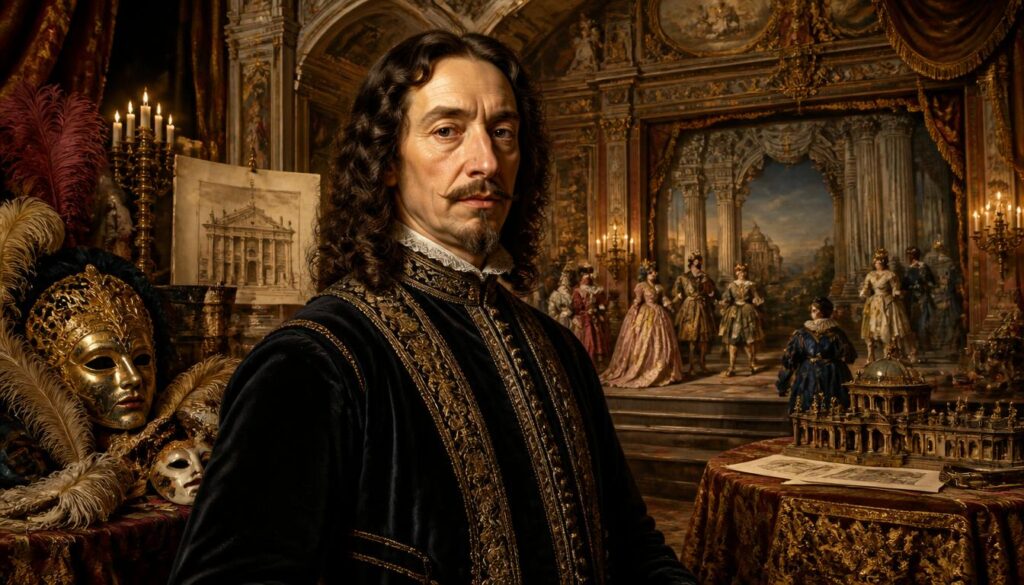
If Jonson supplied much of the literary power, Inigo Jones became enormously important to the visual language of the English court masque.
Jones was an architect and designer, and his work helped transform the stage into something more spatial and theatrical. The scenery could open, change, reveal, or transport the audience into another imagined world.
This is crucial to understanding masque theatre. Reading the printed text alone can sometimes make the form seem oddly incomplete. A masque was not designed only for the page. Its full effect depended upon performance, music, movement, costume and visual staging.
Samuel Daniel’s account of Tethys’ Festival even emphasizes the importance of spectacle and architectural invention in the masque, illustrating how the visual design could sometimes outweigh the verse in the live event.
So when studying a masque, don’t only ask, “What does this character say?” Also ask, “What would the audience have seen?”
That second question opens a much bigger door.
Masque vs. Drama: Are They the Same Thing?
Not quite.
A masque and a conventional play can both contain dialogue, characters, poetry and dramatic action, but their purposes and structures can differ considerably.
A play usually depends on sustained dramatic action. Characters develop through scenes, conflicts and dialogue. A masque may have a much thinner plot because the spectacle, symbolism, ceremony and celebration are doing much of the work.
A masque can therefore feel less like a modern movie and more like a carefully constructed dream. One moment you’re looking at a dark forest, then suddenly gods appear, music begins, dancers enter, and a symbolic figure announces the arrival of peace. It can be wonderfully excessive.
There is also a connection between masque and opera, since both forms combine literary language, music, staging and spectacle. They are not identical, however. The masque belongs particularly to the courtly and festive culture of early modern England, while opera developed into a distinct musical-theatrical tradition.
Masque and Music, Singing, and Dancing
A common mistake is to imagine the masque as primarily spoken drama with a little decoration added afterward. Historically, music, singing and dancing were central to many performances.
John Milton’s A Maske Presented at Ludlow Castle, better known as Comus, gives us a useful example. It was performed in 1634 and involved Milton’s poetry, music by Henry Lawes, singing, dancing and allegorical scenery.
The Poetry Foundation describes the work as a dramatic entertainment with songs, dance, scenery and a strong allegorical structure.
That combination is worth remembering because it explains why the masque sits awkwardly inside modern categories. It is poetry, but also performance. It is drama, but also music. It is literature, but also spectacle.
Perhaps the easiest way to say it is: a masque liked having several artistic personalities at once.
Masque Meaning in Literature
When the term appears in English literature, it usually points toward this historical form rather than simply a person wearing a mask.
The word can appear in literary criticism, historical writing, poetry, drama and discussions of Renaissance theatre. A textbook might say that a particular work has “masque-like” qualities, meaning it contains elements such as spectacle, allegory, music, symbolic characters or elaborate pageantry.
The form also influenced later writers. Its ideas of fantasy, transformation, mythological symbolism and theatrical spectacle continued to echo beyond the period when the traditional court masque was at its height.
Even when the exact genre disappeared, the artistic ingredients didn’t vanish. They migrated, as artistic ingredients tend to do, into other forms of drama, music, pageantry and performance.
The Antimasque: When Chaos Walks Onto the Stage
One especially fascinating feature of some masques is the antimasque.
The antimasque could introduce disorder, grotesque characters, comic figures, monsters or chaotic energy before the main masque restored harmony. Think of it as the theatrical world getting its hair completely messy before someone arrives with a comb.
This contrast made the final appearance of order feel more powerful. Chaos could be followed by beauty; darkness could yield to light; disorder could be replaced by harmony.
In Milton’s Comus, for example, the performance includes an unruly dance associated with Comus and his followers before the concluding triumph.
The antimasque therefore isn’t merely comic relief. It can help establish the central symbolic argument of the entire performance.
Masque and Royal Power
The relationship between masque and royalism deserves special attention.
A monarch could appear as the centre of an artistic universe in which divine figures, virtues, mythical beings and allegorical forces seemed to confirm the ruler’s importance. This was an age when public ceremony carried enormous political weight.
The masque provided an especially attractive method because it allowed politics to hide inside fantasy. A king did not necessarily need to stand up and deliver a political speech. Instead, the stage could present a universe in which harmony, justice and prosperity were symbolically associated with his rule.
This is why scholars often discuss political content, imperial iconography, court culture and royal ideology when studying masques. The glitter wasn’t empty. Sometimes the glitter was the argument.
Masque Meaning and the Word “Masquerade”
Here is where confusion often happens.
Masque and masquerade are related words, but they are not interchangeable in every context.
A masquerade generally refers to a gathering, event or situation involving disguises or masks. A masque, in the literary-historical sense, refers to a particular kind of theatrical entertainment.
So if somebody says, “They attended a masquerade,” you might picture people dressed in elaborate costumes and hiding their identities.
If somebody says, “Ben Jonson wrote a masque,” you should think of Renaissance court entertainment, poetry, music, dancing, allegory, scenery and royal spectacle.
The difference is small in spelling but pretty large in literary history.
Masque in the 16th and 17th Centuries
The 16th-century masque developed from earlier European and English traditions of festive performance, but the form became especially sophisticated in the 17th century.
The reign of James I is particularly important because court masques became a major form of royal entertainment. The British Library preserves records of masques connected with James I and Queen Anne, including Jonson’s 1607 masque at Theobalds and The Masque of Queens.
During this period, the genre became increasingly elaborate. Designers experimented with perspective scenery, stage machinery, costumes and architectural effects. Writers developed richer allegories, while composers and musicians expanded the musical side.
It was, in a way, a perfect genre for an age fascinated by ceremony, hierarchy, mythology and visual magnificence.
Masque Meaning Through a Modern Lens
For modern readers, the most useful way to understand the masque tradition is to imagine it as a grand multimedia event before the term “multimedia” existed.
There was no modern cinema, no digital projection, no computer-generated imagery. Yet the creators still wanted transformation, wonder and visual surprise. They used painted scenery, machinery, costumes, music, human movement and poetry instead.
And because the audience often belonged to the court, the event could be both entertainment and social theatre. Who appeared, who performed, who sat where, who was praised, and what ideas were celebrated could all carry meaning.
That makes the masque valuable not only to students of literature but also to anyone interested in English history, theatre, politics, art history and Renaissance culture.
Read more….https://ytmeaning.com/og-mean-in-chat/
Famous Examples of English Masques
A few titles are particularly useful if you’re studying the genre:
- The Masque of Blackness by Ben Jonson one of the most famous early Jacobean court masques, performed in 1605 and closely associated with the court of James I.
- The Masque of Queens by Ben Jonson performed at Whitehall in 1609 for Queen Anne and her ladies, and preserved in the British Library’s Royal manuscripts.
- The Masque of Hymen by Ben Jonson associated with marriage celebrations and the courtly culture surrounding royal entertainment.
- Comus, or A Maske Presented at Ludlow Castle, by John Milton performed in 1634 and notable for combining poetry, music, singing, dancing and allegory.
- The Memorable Masque by George Chapman performed before King James in 1613 and featuring songs, dances and allegorical characters.
These examples show that the masque wasn’t the private invention of one writer. It was a collaborative artistic tradition with many variations.
Why Masques Still Matter Today
At first glance, a 17th-century masque can seem like a dusty literary curiosity. But it actually has plenty to tell us about modern entertainment.
Think about today’s award shows, opening ceremonies, music performances, theatrical concerts, fantasy productions and large public spectacles. They often combine music, costumes, choreography, lighting, symbolism, celebrity, ceremony and political messaging.
The technology is wildly different, obviously. The artistic instinct isn’t.
A masque asked: How can we make an audience feel that ordinary reality has temporarily disappeared?
Modern performance keeps asking the same question.
The answer used to involve painted clouds, dancers, gods and stage machinery. Today it might involve projection screens, digital effects, choreography and enormous sets. Different machinery, same itch for spectacle.
How to Remember the Masque Definition for Exams
If you’re a student, don’t try to memorize twenty disconnected facts. Keep one mental picture.
Imagine a royal court in Renaissance England. The lights or candles, more accurately are low. Music begins. Elaborately dressed figures enter. Someone sings.
Dancers move across the stage. A mythological goddess appears. A symbolic conflict takes place. The scenery changes. The king and queen are praised. Everything ends in harmony.
That’s a masque.
For a short-answer question, you can write that a masque is an elaborate form of courtly theatrical entertainment combining poetry, music, singing, dancing, costume, scenery and allegory, especially popular in England during the Renaissance and early modern period.
Then, if you have space, mention Ben Jonson and Inigo Jones. Those two names can quickly demonstrate that you understand the literary and visual sides of the form.
Common Misunderstandings About Masques
A few misconceptions are worth clearing away before we close.
- A masque is not simply a masquerade. The historical literary genre has a specific theatrical meaning.
- Masques were not only about masks. Costumes and disguise could matter, but the genre was much broader.
- A masque is not exactly the same as a play. It often placed greater emphasis on spectacle, music, dance and allegory.
- Masques were not purely entertainment. They could communicate ideas about monarchy, politics, social order and royal authority.
- Masques were not only literary texts. Their full meaning depended heavily on live performance and visual staging.
- Masques were not exclusively written by Ben Jonson. Jonson was exceptionally important, but writers such as Milton, Daniel, Chapman and Campion also contributed to the tradition.
- The form was not frozen in one style. Different masques could emphasize poetry, music, scenery, dance or allegory in different ways.
These distinctions make the masque definition much more accurate, and frankly much more interesting too.
A Quick Masque Meaning Cheat Sheet
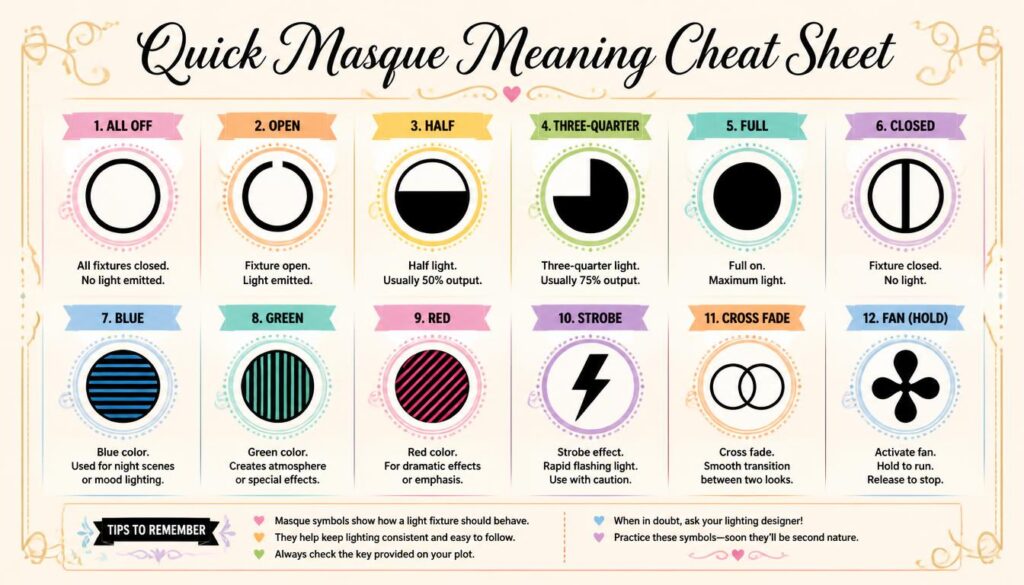
If you need the idea quickly, keep these points nearby:
- Masque meaning: an elaborate theatrical entertainment.
- Origin/context: strongly associated with early modern England and Renaissance court culture.
- Main setting: the royal court, though masques could also be performed elsewhere.
- Major elements: poetry, music, singing, dancing, costume, scenery and spectacle.
- Common themes: mythology, allegory, harmony, virtue, celebration and royal authority.
- Important writers: Ben Jonson, John Milton, Samuel Daniel, George Chapman and Thomas Campion.
- Important designer: Inigo Jones.
- Historical peak: particularly the late 16th and 17th centuries, with the Jacobean court especially significant.
- Related forms: drama, pageant, opera, masquerade and court entertainment.
- Literary importance: it shows how literature, performance, politics and visual art could operate together.
How to Explain Masque Meaning in Your Own Words
If you’re explaining the term to someone who has never heard it, don’t begin with a stiff dictionary sentence. Tell them to imagine a royal celebration transformed into theatre.
A king or queen is watching. Musicians begin. Poets have prepared elaborate speeches and songs. Dancers enter in extraordinary costumes. Mythological figures appear.
The scenery changes. The performance presents a symbolic story about peace, virtue, marriage, power or harmony. The audience isn’t just watching a story they’re watching a carefully designed world.
That is the heart of the English masque.
And perhaps that’s the most memorable way to understand it: a masque was a celebration that decided, for one evening, to become a piece of art.
Frequently Asked questions
masque
A masque is a type of theatrical entertainment that combines poetry, music, singing, dancing, costumes, and dramatic spectacle. It was especially popular in the royal courts of Renaissance England.
masque meaning
The masque meaning refers to an elaborate theatrical performance, often presented as court entertainment. It usually included music, dance, poetry, mythology, and allegorical characters.
masque in literature
A masque in literature is a dramatic and musical form that uses poetry, symbolism, mythology, and spectacle. It became an important genre in English Renaissance and 17th-century literature.
what is masque in literature
A masque in literature is a form of theatrical entertainment in which poetry, music, dancing, costumes, and scenery are combined. It was commonly performed for royalty and the nobility in early modern England.
Conclusion: The Masque Was More Than a Mask
The real beauty of the masque meaning is that the word points to much more than a costume or disguise. It opens onto an entire period of Renaissance theatre, court culture, poetry, music, dance, mythology and political symbolism.
From the glittering royal performances associated with Ben Jonson and Inigo Jones to Milton’s Comus, the masque demonstrates how flexible early modern performance could be.
It could entertain a king and queen, celebrate a wedding, flatter a monarch, explore moral ideas, display wealth and create an imaginary universe all in one performance.
And that is why the genre still deserves attention. The masque reminds us that literature has never really lived only on the page. Sometimes a poem wants music. Sometimes a story wants dancers.
Sometimes politics wants a costume and a magnificent entrance. And sometimes, rather delightfully, a whole royal court decides that ordinary reality is simply not dramatic enough.
So, when you next encounter the word masque in literature, don’t think only of a hidden face. Think of a stage bursting into colour,
poetry floating over music, dancers crossing a royal hall, mythology stepping into politics, and an audience watching spectacle become meaning. That’s the masque old fashioned, yes, but not nearly as quiet as the word might first suggest.