
There are some words that seem to arrive quietly and then suddenly they’re everywhere. OG is one of those words. You may see someone write “She’s an OG,” hear a rapper call somebody an OG, or notice a friend describing an old game, song, or pair of sneakers as “the OG.” And if you’ve ever paused and thought, wait, what does OG mean exactly, you’re certainly not the only one.
At first glance, OG looks like two ordinary letters that somehow got promoted to a very important job. In modern conversation, though, OG meaning can carry ideas of originality, experience, authenticity, respect, and old-school credibility.
The interesting part is that its history is much more specific than the casual way we use it today, and that history is tied to American street and hip-hop culture.
Today, somebody can be called an OG without having anything to do with gangs at all. A longtime teacher, an early employee at a company, a legendary gamer, or even your grandmother who has been making the same perfect recipe for forty years might jokingly earn the title. Language does this sort of wandering all the time, and OG has wandered quite a long way.
OG Meaning: The Simple Definition
The most common modern OG meaning is “Original Gangster,” but that literal expansion doesn’t tell the whole story anymore. In everyday slang, OG often describes someone who is original, authentic, highly respected, experienced, or old-school. Dictionary.com describes the modern slang use as referring to a person or thing considered genuine and classic, while also documenting its earlier gang-related meaning.
So if somebody says, “My dad is an OG,” they probably aren’t saying their father belongs to a street gang. They might simply mean, “My dad has been around forever, knows what he’s doing, and deserves respect.” It is basically a tiny two-letter badge of credibility, which is pretty impressive for such a small word.
In another sentence, “That’s the OG version” usually means the original version, especially when later versions, remakes, updates, or imitations exist. A person can be an OG, but so can a product, song, style, recipe, game, website, or idea.
What Is the OG Full Form?
The traditional OG full form is Original Gangster. The expression developed within gang culture in Los Angeles and later moved into broader American slang and hip-hop language. Dictionary.com traces the abbreviation to the 1970s and connects its early use with the Crips, while noting that the term eventually developed a much broader meaning.
The word “original” is especially important here. In its earlier cultural context, being an OG could communicate that someone was an early member, an elder, or someone who had been around and earned a certain level of standing. Over time, the gangster part became less literal for many speakers, while the ideas of authenticity and seniority stayed behind.
That is how slang sometimes survives. The original setting changes, but a little piece of the old meaning refuses to leave the house.
OG Meaning in Chat and Texting
When people search for OG meaning in chat, they are usually looking for the simple modern interpretation: a respected original, veteran, or authentic person.
Imagine your friend sends you a message saying:
- “Bro, you’re an OG.”
- “She’s been here since day one. Total OG.”
- “That’s the OG PlayStation.”
- “My uncle is the OG of our family BBQ.”
- “OG fans remember this song.”
In these examples, OG is generally a compliment. It suggests that the person or thing has history, credibility, or a special original status. The exact shade of meaning depends on the conversation, though, and sometimes it is used just for fun.
If someone says, “You’re an OG for remembering that,” they may simply be praising your memory or your knowledge of something from an earlier era. You don’t need a leather jacket and a dramatic entrance, thankfully.
OG Full Form in Chat: Does It Always Mean Original Gangster?
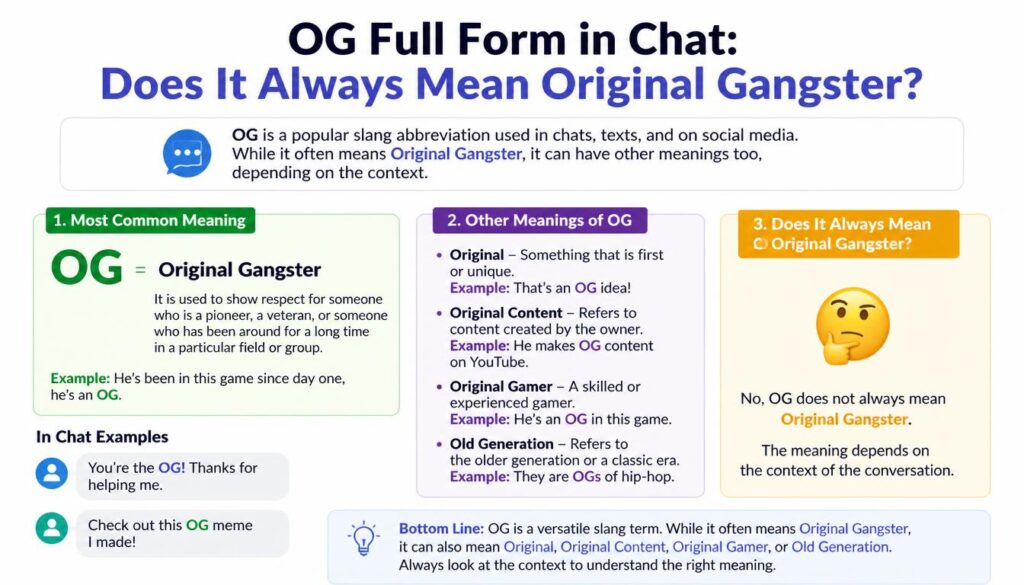
No. The OG full form in chat is commonly given as “Original Gangster,” but people often use OG without thinking about that literal expansion at all.
For many younger internet users, OG has become almost synonymous with original, classic, longtime, authentic, or respected. A person might say “OG fans” to mean fans who have been following something since its early days. Someone might call a particular recipe the “OG recipe” because it is the first or traditional version.
This distinction matters because using the full phrase “Original Gangster” can sound much stronger than simply using “OG.” The abbreviation has developed its own life, and in ordinary conversation it often feels more casual than the original phrase.
So if you see “OG” in a text, don’t immediately assume the person is discussing gang culture. Context is doing a lot of work here, as it usually does with slang.
How OG Became a Word of Respect
The history of OG is closely connected with Los Angeles gang culture during the 1970s. According to Dictionary.com’s account, the term developed among the Crips and was associated with the idea of being original or among the early members. As the term evolved, OG could refer to an elder or respected veteran within a group.
That idea of earned respect became one of the most durable parts of the word. A veteran has knowledge because they have been through things. An originator has credibility because they were there before everyone else. A pioneer has status because they helped create the road other people are now walking on.
This is why modern OG usage can feel flattering even when it has nothing to do with its original environment. Calling someone an OG often says, “You were here before this became popular, and people still respect what you brought to it.” That’s a pretty meaningful compliment hiding inside two letters.
OG and Hip-Hop Culture
The word became strongly associated with hip-hop slang and rap culture as it moved beyond its earlier street context. One especially important moment was Ice-T’s 1991 album O.G. Original Gangster, which helped popularize the expression for a much wider audience. Dictionary.com notes that the album was a major example of OG entering commercial rap culture.
Ice-T, whose real name is Tracy Lauren Marrow, had already established himself as an important voice in Los Angeles rap. His use of the term helped make OG recognizable beyond the communities where it had originated. From there, the word continued travelling through music, movies, television, sports, gaming, and eventually internet culture.
It’s a good example of how music can act like a linguistic railway station. A word arrives from one community, picks up new passengers, and ends up somewhere nobody originally expected.
OG Meaning in Social Media
On social media, OG meaning is usually connected to authenticity or longevity.
You may see phrases such as:
- OG fan — someone who has followed something for a long time.
- Real OG — someone considered genuinely respected or authentic.
- OG creator — an early or influential creator in a particular online space.
- OG account — an older, established account, sometimes especially desirable because of its age.
- OG style — the original or classic style of something.
- OG version — the first or traditional version.
Social media has made the word even more flexible. Someone can be an OG because they joined a community early, created influential content, helped establish a trend, or simply understands the culture before it became mainstream. In other words, seniority plus credibility is often the secret sauce.
OG as a Compliment
Calling somebody an OG is usually a positive thing, particularly when the speaker means that person is respected or authentic.
Consider a basketball coach who has been teaching for thirty years. A former student might say, “Coach is an OG.” The speaker could mean that the coach has seen every possible situation, helped generations of players, and still knows exactly what they’re talking about.
A chef who has protected a family recipe for decades could also be called an OG. So could the friend who introduced everyone to a particular music artist before that artist became famous.
In this sense, OG is not really about age alone. It is more about earned status. You don’t become an OG merely by being old; you become one by having history, influence, knowledge, originality, or respect attached to that history.
Funny and Casual Uses of OG
The modern internet loves taking serious words and turning them into jokes, and OG is no exception.
Someone might say, “My grandma is the OG of online shopping,” because she somehow knows every coupon trick in existence. Another person could call their oldest pair of sneakers “the OGs,” even if they are held together mostly by hope and one suspicious shoelace.
You might even see a person describe themselves jokingly as an OG because they remember using a technology that younger people have only seen in museums.
These playful uses work because the core idea remains recognizable: this person or thing has been around, knows the old ways, or represents the original version. The gangster meaning has become distant enough in many contexts that OG can now be affectionate or humorous.
OG vs. Original
Although OG and “original” overlap, they are not always interchangeable.
If you say, “This is the original design,” you are making a fairly straightforward factual statement. You mean it came first.
If you say, “This is the OG design,” you’re adding attitude. You may mean it was the original, but you could also be suggesting that it is the classic, beloved, respected version.
That little difference is what makes slang fun. OG does not merely identify something as first; it can give that thing a little history and prestige. The word comes with a wink, more or less.
OG, O.G., and OGs: Are They Different?
Not really, although formatting can vary.
You may encounter:
- OG
- O.G.
- O.G.’s
- OGs
- real OG
- original OG
- triple OG
The pronunciation is generally “oh-jee.” Dictionary.com lists the slang pronunciation that way and treats O.G. and OG as variants.
The plural form is normally OGs, meaning more than one OG. For example, “Those rappers are OGs” means those rappers are respected veterans or influential originals.
The punctuation is mostly a style choice in modern informal writing. You don’t need to lose sleep over whether those periods belong there, honestly.
Read more: https://ytmeaning.com/luffy-meaning/
What Does OG Mean in Different Situations?
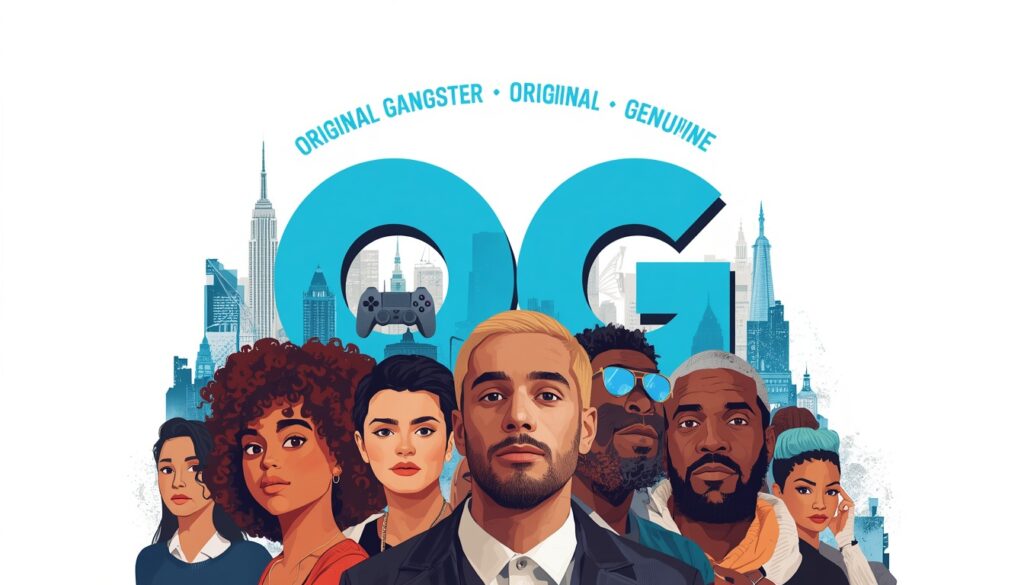
The surrounding words can completely change the flavor of OG.
If someone says “He’s an OG,” they probably mean he is a respected veteran or original member.
If someone says “That’s the OG,” they may mean it is the original or classic version.
If someone says “OG fans know,” they are talking about longtime fans.
If someone says “She’s an OG at coding,” they probably mean she has deep experience and serious credibility.
If someone says “Give me the OG recipe,” they want the original or traditional version.
And if somebody simply texts “OG!” after you help them out, they may be giving you a playful compliment. Context, again, is the quiet boss of slang.
OG Meaning in Gaming
Gaming culture has embraced OG especially strongly. Players often call longtime gamers, early players, classic titles, or original versions of games “OG.”
For example, an older player might say, “I’m an OG Minecraft player,” meaning they were playing during an earlier period of the game’s history. A player might also call an older map, character skin, weapon, or game mechanic “OG” because it belongs to the original era.
In gaming, the term can sometimes carry a little nostalgia too. Being an OG is not just about having arrived early; it can mean remembering the version of a game before twenty updates, fourteen currencies, and approximately seven thousand menus appeared.
OG Meaning in Music and Entertainment
In music, OG can refer to an influential artist, an early contributor, a classic song, or an original style.
A longtime fan might call an artist an OG because that artist helped shape a genre. Likewise, a song can be described as an OG track when listeners associate it with an earlier, foundational period.
The term is especially common in hip-hop because of its historical connection to rap culture. Ice-T’s O.G. Original Gangster, released in 1991, is one of the most recognizable cultural touchpoints in the word’s journey into mainstream usage.
Still, you’ll hear it far beyond rap. Pop music, sports, television fandoms, fashion communities, and online creators all borrow it now.
OG Does Not Always Mean “Old”
This is an important little distinction.
An OG can be older, but old does not automatically mean OG.
Imagine someone joins a community at age sixty but contributes very little. Meanwhile, another person joined at age twenty, helped build the community, taught newcomers, and has been respected for years. The second person is much more likely to be called an OG.
So the word is about history plus recognition, not simply the number of birthdays someone has collected.
That is why calling somebody an OG can feel more meaningful than calling them “old-school.” It implies that their experience actually counts for something.
OG and Authenticity
Another major modern meaning of OG is authentic.
If someone says, “That restaurant is OG,” they might mean it has kept its original character instead of changing itself to chase trends. If a musician is called an OG, the speaker may be saying the artist remains genuine and connected to their roots.
This meaning has become especially common online, where people are constantly sorting things into “real” and “fake,” “classic” and “new,” “original” and “copy.”
OG sits comfortably on the authentic side of that argument. It says, in effect, “This one has the receipts.” Well, not always literal receipts, but you get the idea.
OG vs. Veteran, Pioneer, and Legend
These words overlap, but each has a slightly different personality.
A veteran is someone with substantial experience.
A pioneer is someone who helps establish something new.
A legend is someone famous or extraordinarily accomplished.
An originator is someone who created or introduced something.
An OG can be any of these, but the word also carries an informal sense of respect and old-school credibility. It sounds less like a formal award and more like something a community says about somebody because everybody already knows their reputation.
That informality is part of its charm, really.
The Scientific “Og” Is Something Completely Different
Here is where the two letters take an unexpected detour.
In chemistry, Og is the official chemical symbol for oganesson, a synthetic chemical element with atomic number 118. This scientific Og has absolutely nothing to do with “Original Gangster.”
Dictionary.com separately lists Og as the chemical symbol for oganesson.
So capitalization and context matter. If you see “OG” in a text message, slang is probably the likely interpretation. If you see “Og” in a chemistry lesson, you are almost certainly dealing with the element.
Same letters, completely different neighborhood.
Common Examples of OG in Sentences
Here are some natural ways the term appears in everyday conversation:
- “My older brother is the OG gamer in our family.”
- “She’s been working here since the beginning, so she’s an OG.”
- “I prefer the OG version of the movie.”
- “Those are the OG sneakers.”
- “He’s an OG in the local music scene.”
- “Only the OG fans remember that.”
- “My grandmother is the OG baker around here.”
- “That restaurant is an OG spot in the neighborhood.”
- “She taught me everything. She’s a real OG.”
- “Bring back the OG design!”
Notice how none of these necessarily involve the literal phrase “Original Gangster.” The modern word has become much broader, and thats why context is so important.
How to Use OG Without Sounding Forced
Slang can sound wonderfully natural when it belongs in the conversation and strangely awkward when someone has clearly just learned it five minutes ago.
Use OG when you’re talking about someone or something that has genuine history, authenticity, influence, or old-school appeal. Saying “My grandfather is an OG at gardening” can sound warm and funny. Saying “My office chair is an OG” might work if the chair has somehow survived three office renovations.
Avoid forcing it into formal writing unless the subject specifically involves slang or popular culture. You probably wouldn’t write, “The OG director submitted the annual financial report.” Well, you could, but your manager may wonder what happened to the English language.
Is OG a Positive or Negative Word?
In contemporary casual usage, OG is usually positive. It often expresses admiration, respect, affection, or nostalgia.
However, the historical association with gang culture means the term has a more complicated background than some other internet slang. The phrase originally developed in a specific cultural environment, and its history should not simply be erased because modern users employ it casually.
That doesn’t mean everyday uses are automatically offensive. It means context and awareness matter. Language carries history even when speakers are using it lightly.
Why OG Became So Popular
There is something satisfying about a word that can communicate several ideas at once.
“OG” can mean original. It can mean experienced. It can mean respected. It can mean authentic. It can mean classic. It can even carry a playful sense of nostalgia.
That efficiency is probably one reason slang like this survives. Instead of saying, “This person has been involved since the early days, has considerable experience, and is respected by the community,” you can simply say, “She’s an OG.”
Two letters did all that work and didn’t even ask for a coffee break.
How to Understand OG When You See It Online
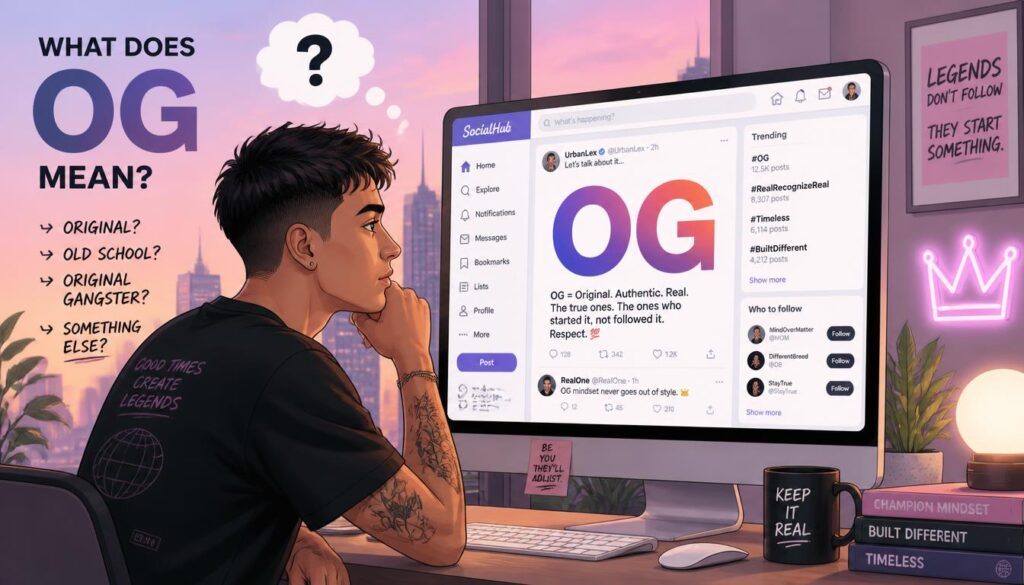
If you’re unsure what OG means in a particular post or message, look at three things.
First, who or what is being called OG? If it’s a person, the meaning probably involves respect, experience, or longevity.
Second, what is the surrounding topic? Gaming, music, fashion, social media, and sports frequently use OG to mean classic or longtime.
Third, is the speaker being serious or playful? Someone may call their dog “the OG of sleeping all day,” which obviously isn’t a historical title from a secret canine organization.
Usually, the intended meaning becomes obvious once you look at the full sentence.
Final Thoughts on OG Meaning
The story of OG meaning is really a story about how language travels. What began as a term connected to a particular cultural and historical setting in Los Angeles developed through hip-hop and popular culture into a widely understood piece of slang. Dictionary.com traces the term to the 1970s and identifies Ice-T’s 1991 O.G. Original Gangster as a major force in its popularization.
Today, when somebody says “She’s an OG,” the speaker may simply be giving a person their flowers. They’re saying this person has been around, knows their stuff, has authenticity, or earned respect over time. When “OG” describes an object, it often means the original or classic version.
So, if you were wondering what does OG mean, the shortest answer is: OG traditionally means “Original Gangster,” but in modern slang it commonly means an original, authentic, longtime, experienced, or highly respected person or thing.
And perhaps that is why the word has lasted. Trends come and go, new versions replace old ones, and yesterday’s internet slang becomes tomorrow’s forgotten phrase. But every generation still seems to have its originals, its pioneers, its veterans — the people who were there before the crowd arrived.
Those are the OGs. And yes, sometimes being the original really does count for something.