

Have you ever received a message that simply says “TTYL” and wondered what those four letters were trying to say? It looks tiny, almost like a password somebody forgot to explain, but its meaning is actually very simple.
TTYL stands for “Talk to You Later.” It is a common texting abbreviation used when someone wants to end a conversation for now while suggesting that they will communicate again later. It can feel casual, friendly, and sometimes even a little warmer than a plain “bye.”
You may see TTYL in text messaging, social media chats, online communication, gaming conversations, and other forms of informal communication. The interesting part is that the meaning stays the same, while the feeling can change depending on who sends it and how the conversation was going.
So, if you have been searching for TTYL meaning, what does TTYL mean, or what does TTYL stand for, the short answer is: Talk to You Later. But there is a little more to this popular piece of internet slang than its four letters suggest.
What Does TTYL Mean?
TTYL means “Talk to You Later.” It is an initialism made from the first letters of the words in the phrase. Instead of typing the complete sentence, people use TTYL as quick shorthand.
For example, a friend might write, “I have to finish my homework, TTYL.” They are not necessarily ending the friendship or disappearing into the internet fog. They simply mean, “I have to go now, but we can talk later.”
The TTYL abbreviation is generally informal. It belongs to the world of chat slang, texting, and casual digital conversations, where people often shorten words to save time or make messages feel relaxed.
Sometimes TTYL appears in capital letters, while other people write it as “ttyl.” Both forms carry the same basic TTYL slang meaning.
TTYL Meaning in English
The TTYL meaning in English is simply “Talk to You Later.” It is an informal way of saying that the speaker plans or expects to communicate with the other person again at a later time.
Think of it as a digital version of saying, “Okay, I’ll talk to you later.” The abbreviated version is much quicker, which is probably why it fits so naturally into texting.
For example:
- “My battery is almost dead, ttyl!”
- “I need to get ready for work. TTYL.”
- “Great talking with you, ttyl!”
- “I’m heading out now, ttyl.”
The exact wording around TTYL can change, but the basic talk to you later meaning remains unchanged.
TTYL Full Form and TTYL Definition
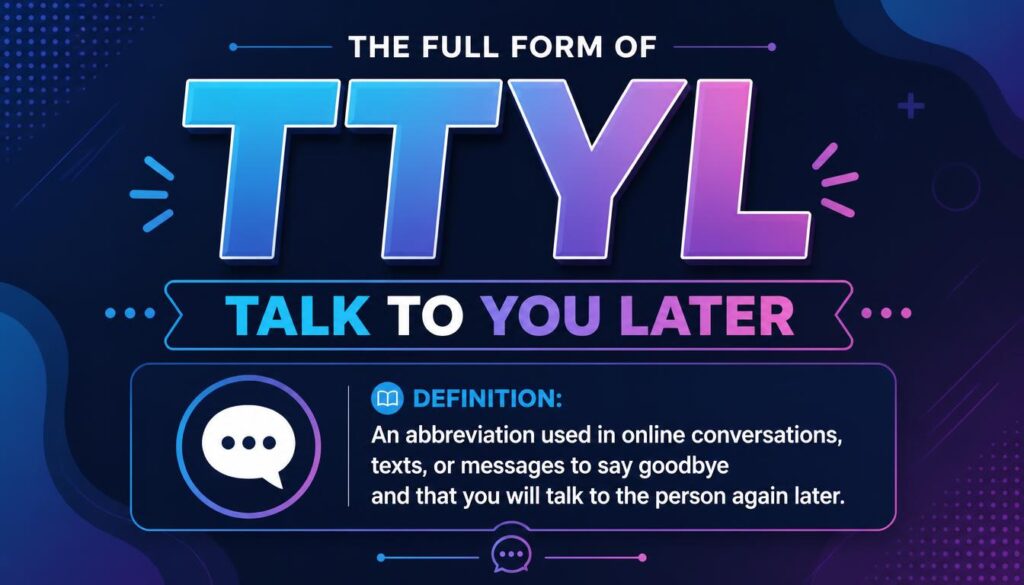
The TTYL full form is Talk to You Later.
A simple TTYL definition would be: an informal internet and texting abbreviation used to tell someone that you intend to speak with them again later.
It is technically an initialism, because each letter is normally pronounced separately rather than being spoken as one word. In everyday writing, however, many people casually call it an acronym, and you may see both descriptions online.
The important thing for normal conversation is not the technical label. It is knowing what the four letters are communicating. TTYL usually signals that the conversation is ending temporarily, not permanently.
TTYL in Texting: How Is It Used?
TTYL in texting is usually used near the end of a conversation. Someone may be busy, tired, going somewhere, losing internet access, or simply ready to put their phone down for a while.
For instance, imagine two friends chatting:
- Friend A: “Are you still coming over tonight?”
- Friend B: “Yeah, probably around 8.”
- Friend A: “Cool. I have to help my brother now. TTYL.”
Here, TTYL is basically a quick goodbye with an open door for another conversation.
It can also be used after a longer conversation when neither person needs to keep chatting right now. The phrase has a relaxed quality, which makes it especially common in casual texting language.
TTYL in Chat and Online Communication
In TTYL in chat, the abbreviation can work almost like a conversational exit sign. Someone might type it before leaving a group chat, an online game, a social media conversation, or a private message.
You could see something like:
- “The match is starting, TTYL.”
- “I gotta go eat, ttyl.”
- “Thanks for helping me with that, TTYL!”
- “I’m going offline now. TTYL.”
The context usually makes the intention obvious.
This is one reason internet slang became so useful. Online communication often moves quickly, and typing a long sentence for every little goodbye can feel unnecessarily formal. TTYL gives the same basic idea in a few characters, which is pretty handy.
TTYL Slang Meaning and Tone
The TTYL slang meaning is straightforward, but its tone can depend heavily on the conversation.
In a friendly conversation, “TTYL!” may sound cheerful and casual. Between close friends, “ttyl” can be almost effortless, like tossing a quick goodbye over your shoulder while walking out the door.
But context matters.
If someone sends only “TTYL.” after a serious conversation, you might read it differently than “Okayyy, ttyl 😂.” The punctuation, surrounding words, emojis, and relationship between the people can all affect the emotional tone.
TTYL itself does not automatically mean someone is annoyed, excited, sad, or uninterested. Those feelings have to come from the surrounding conversation. That small distinction is easy to miss when reading short text slang.
When to Use TTYL
There are plenty of situations where how to use TTYL is almost effortless. It works best when the conversation is casual and the people involved are comfortable with texting abbreviations.
You can use TTYL when:
- You need to leave a conversation temporarily.
- You expect to talk with the person again.
- You are ending a friendly text conversation.
- You are leaving an online chat.
- You are stepping away from social media.
- You need a quick and informal goodbye.
- You want your message to sound relaxed rather than formal.
- You are chatting with friends or people who regularly use internet slang.
A message such as “I’m heading into a meeting, TTYL” feels perfectly natural in many casual settings.
There is one little thing worth remembering, though: not everybody enjoys abbreviations. Some people understand them immediately, while others may wonder what on earth the letters are doing there.
TTYL Examples in Everyday Messages
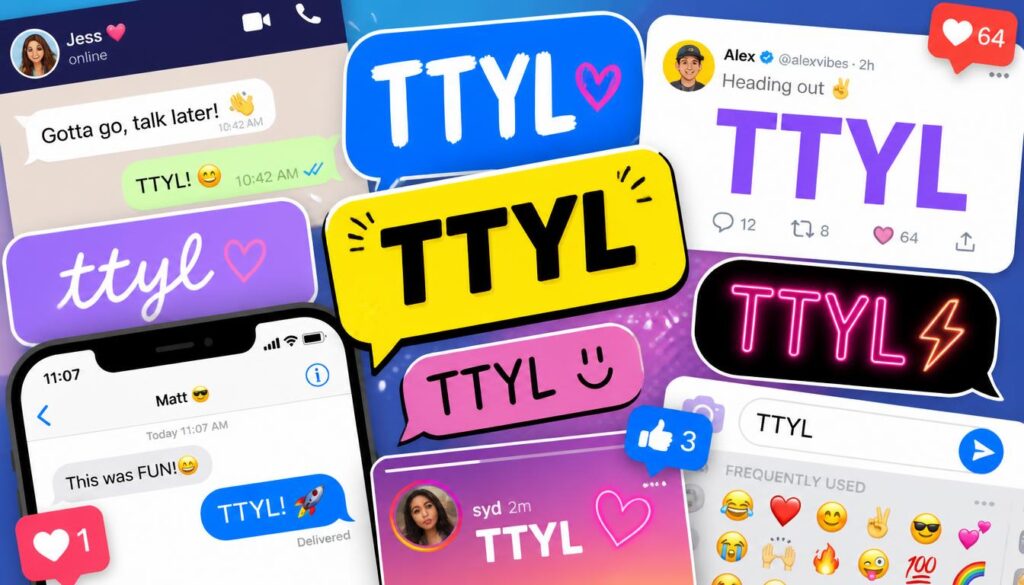
Seeing TTYL examples makes the meaning easier to understand because the abbreviation can appear in many slightly different situations.
- “I have to cook dinner now, TTYL!”
- “My phone is dying, ttyl.”
- “I’ll tell you the rest tomorrow. TTYL.”
- “Gotta run, TTYL!”
- “It was nice chatting with you. TTYL.”
- “I’m going to sleep now, ttyl.”
- “The teacher just walked in. TTYL 😂”
- “I need to finish this project first, TTYL.”
- “Catch you later, ttyl!”
- “I’m leaving for work now. TTYL.”
Notice that the abbreviation does not need to appear at the beginning or end of every message in exactly the same way. Natural texting is flexible like that.
TTYL in a Sentence
If you want a simple TTYL in a sentence example, consider: “I have an appointment in a few minutes, so TTYL.”
Another example is: “I’m going to grab some lunch, ttyl.”
In both cases, TTYL tells the other person that the conversation is being paused or ended for the moment. It doesn’t necessarily establish an exact time for the next conversation, either.
That is an important part of the expression. “Later” is deliberately vague. It could mean later that evening, tomorrow, or simply the next time the two people happen to communicate.
TTYL Abbreviation vs. Saying Goodbye
There is a subtle difference between TTYL and a simple “bye,” although the distinction isn’t rigid.
“Bye” can be completely final for the moment. TTYL adds the idea of another conversation happening later. It feels a little like saying, “Okay, I’m leaving now, but this conversation isn’t really finished.”
Compare these:
“Bye.”
“TTYL.”
The first one simply ends the conversation. The second carries an expectation—or at least a suggestion—of talking again later.
Of course, people sometimes use TTYL casually without making a serious promise to return at a particular time. Language on the internet is wonderfully loose sometimes.
Common Texting Abbreviations Similar to TTYL
TTYL belongs to a much larger family of internet abbreviations and texting abbreviations. People have been shortening common expressions in digital conversations for decades, creating a vocabulary that can look strange to someone seeing it for the first time.
Some related examples include:
- AFK — Away From Keyboard
- OMG — Oh My God
- ROFL — Rolling On the Floor Laughing
- RIP — Rest in Peace
- TTFN — Ta-Ta For Now
- CU l8r — See You Later
- b4 — Before
- 🙂 — A smile emoticon
These expressions are not all interchangeable with TTYL. They simply show how online slang and digital shorthand developed around quick communication.
TTYL specifically focuses on talking again later, while AFK usually tells others that someone is temporarily away from their device or keyboard.
Is TTYL Formal or Informal?
TTYL is informal. It is most appropriate for friends, family members, casual online conversations, and other situations where relaxed language is expected.
It is generally not the best choice for formal letters, official documents, academic writing, or serious professional messages. Writing “TTYL” to an employer after a formal interview, for example, could create a tone mismatch that is probably not worth the gamble.
In professional communication, a phrase such as “I’ll speak with you later” or “I’ll follow up soon” is usually clearer and more appropriate.
That does not mean every workplace bans casual language. Modern workplaces can be surprisingly relaxed, especially in instant messaging. The relationship and communication culture matter.
TTYL in Email and Professional Communication
Using TTYL in email depends heavily on the relationship between the sender and recipient.
Among close colleagues who already communicate casually, an abbreviation might occasionally appear in an informal internal message. Still, TTYL is primarily associated with informal communication, rather than polished business writing.
For an employer, client, customer, teacher, or unfamiliar professional contact, it is safer to write the complete phrase. Instead of:
“Thanks for the update, TTYL.”
you might write:
“Thanks for the update. I’ll speak with you later.”
The second version is clearer and doesn’t rely on the reader knowing a particular piece of digital slang.
What Does TTYL Stand for in Different Contexts?
The answer to what does TTYL stand for does not normally change across texting and chat. It means Talk to You Later.
What changes is the context.
A friend might use TTYL after making weekend plans. A gamer might use it before leaving a multiplayer session. Someone on social media might use it while ending a direct-message conversation.
In each case, the abbreviation points toward another conversation at some later time.
The surrounding message gives it personality. That’s where the fun little differences appear.
How to Reply to TTYL
If someone sends you “TTYL,” you do not need a complicated response. A simple “TTYL!” works perfectly well.
Other natural replies include:
- “Sure, ttyl!”
- “Okay, talk later!”
- “Catch you later!”
- “Yep, ttyl!”
- “Sounds good!”
- “Talk soon!”
- “See you later!”
The best reply depends on the relationship and the mood of the conversation. If someone is rushing to work, “Talk later!” is enough. If you’re joking around with a close friend, an emoji or playful response can fit better.
Read more: https://ytmeaning.com/aja-meaning/
Is TTYL Still Used Today?
TTYL remains recognizable as a piece of texting slang, although the popularity of individual abbreviations can change over time. Internet language moves quickly, and expressions that once seemed unavoidable can eventually feel old-fashioned or less common.
Still, TTYL has an advantage because its meaning is intuitive once explained. “Talk to you later” is such a common phrase that the abbreviation continues to make sense in many forms of digital communication.
People may write it as TTYL, ttyl, or occasionally mix it naturally into a longer message. The lowercase version can feel especially casual, while capital letters may simply reflect personal typing habits.
TTYL Meaning: Quick Answer
If you only came here looking for the shortest possible explanation, here it is:
TTYL = Talk to You Later.
It is an informal text abbreviation used in messages and online conversations when someone is leaving for now but expects or suggests talking again later.
TTYL meaning in texting: Talk to You Later.
TTYL full form: Talk to You Later.
TTYL definition: An informal initialism used to end a conversation temporarily.
TTYL slang meaning: A casual way of saying you will talk with someone later.
Frequently asked Questions
ttyl meaning
TTYL means “Talk to You Later.” It is a common informal abbreviation used in texting and online conversations when someone plans to talk again later.
ttyl
TTYL is a popular texting abbreviation for “Talk to You Later.” It is usually used as a casual way to end a conversation temporarily.
what does ttyl mean
TTYL means “Talk to You Later,” a casual phrase commonly used in text messages, chats, and social media conversations to say goodbye for now.
ttyl meaning in text
In text messages, TTYL means “Talk to You Later.” It tells the other person that the conversation is ending for now but may continue later.
ttyl mean
TTYL means “Talk to You Later.” It is an informal internet and texting abbreviation used when saying goodbye temporarily.
Final Thoughts on TTYL Meaning
The TTYL meaning may fit into just four letters, but it represents something very ordinary and human: ending one conversation without making it feel completely finished.
That is probably why abbreviations like this survive in digital language. They are small, but they carry familiar pieces of everyday speech. TTYL saves typing, keeps the tone casual, and gives a conversation a soft little “see you again” rather than a hard stop.
So the next time somebody writes “TTYL,” you won’t need to stare at the screen wondering whether you’ve accidentally entered a secret internet language club. They simply mean “Talk to You Later.”
And if you have a favorite texting abbreviation, or one that confused you the first time you saw it, share it with others. Sometimes the strangest-looking four letters have the most ordinary meaning once somebody finally explains them.