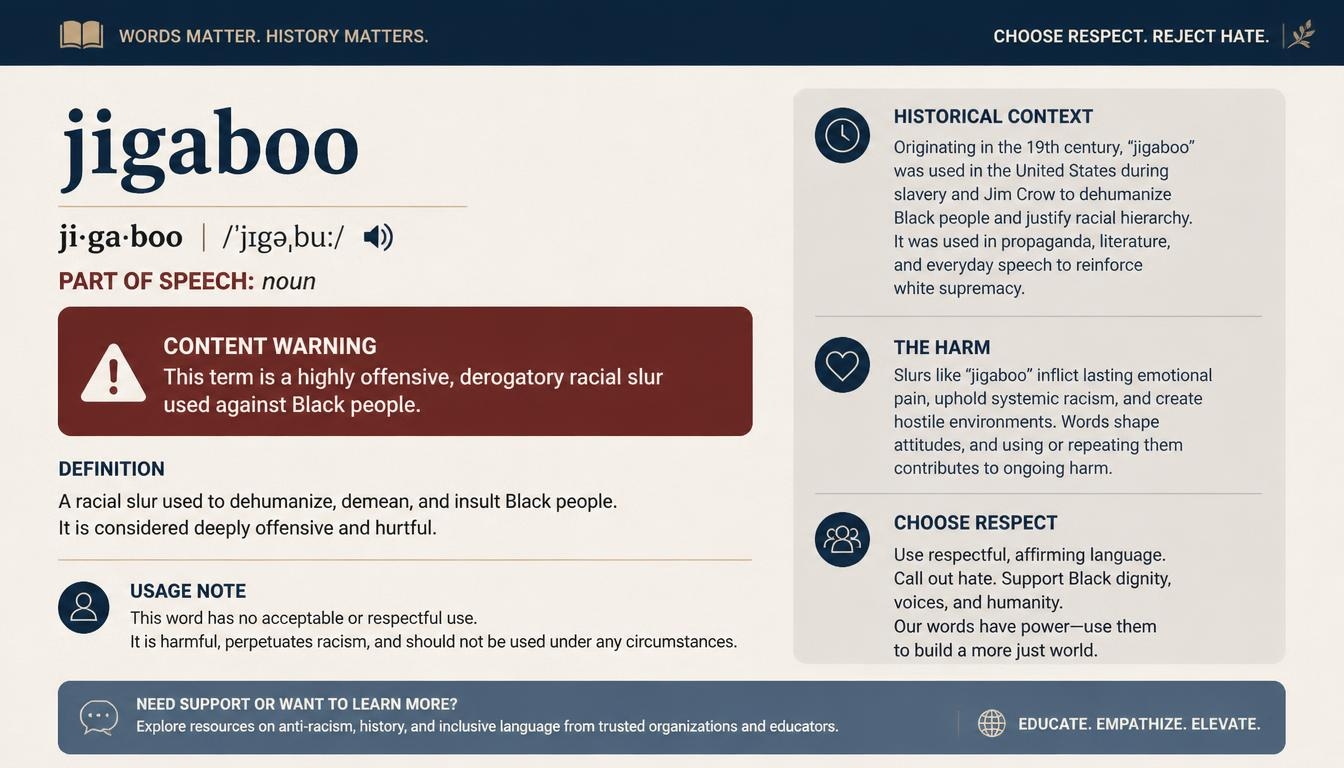

If you are searching for the jigaboo meaning, the short answer is simple: it is an offensive racial slur aimed at Black people. Dictionaries label it as derogatory and contemptuous, and it has no neutral or affectionate use.
People usually run into the word in an old film, a book from another era, a history lesson, or an online argument. Wanting to understand it is reasonable. This article explains what it means, where it likely came from, and how to handle it when it comes up.
What Does Jigaboo Mean?
According to standard references such as Merriam-Webster, jigaboo is a noun, and its plural is jigaboos. It is marked “offensive,” meaning it is used to insult, demean, or dehumanize a Black person.
The dictionary label tells you the word is not a mild insult or an outdated bit of slang. It is classed as a slur, a word whose purpose in use is contempt based on race.
Dictionaries include such words to document the language, not to approve of it. A definition helps readers recognize and understand hateful language, particularly in historical sources.
Jigaboo Pronunciation and Grammar
For anyone looking at the pronunciation, the dictionary transcription is ˈjigəˌbü. It has three syllables, with the stress on the first.
As a noun, it appears in singular and plural forms. It is not an adjective with a neutral sense, and it has no respectful alternative meaning. Knowing how to say a slur is useful only for recognizing it when you hear it. It is not a reason to say it.
Jigaboo Etymology and Word History
The etymology is only partly settled. Merriam-Webster gives it as jig (a term that had already been used as a slur) plus -aboo, as in bugaboo. The ending likely lent the word a mocking, sing-song quality.
The word appears in American English in the early twentieth century, a period of intense racial hostility in the United States. Insulting nicknames were a routine part of that hostility. Many such words were built from caricature and mockery, and this one follows the pattern.
Some word histories are murky, and this is one of them. Scholars generally agree on the broad outline: it is an American coinage of the Jim Crow era, created to demean. The exact first coiner and the precise route of its development are not firmly established.
Why Jigaboo Is Considered a Racial Slur
A slur is more than a rude word. It carries a history of oppression, and every use calls that history back. Words like this were used alongside segregation, discrimination, and violence, so they were part of a system as well as an insult.
That is why intent matters less than people expect. Even if a speaker claims to be joking or quoting, the word carries its past with it. Many Black Americans hear it as a direct reminder of dehumanization.
The term also became tied to ugly stereotypes about skin tone, hair, and facial features. Because of that, it has been used to rank Black people against one another as well as to attack them from outside.
Jigaboo in Culture and History
The word turns up in historical documents, older literature, and early popular entertainment, usually in contexts that reflect the racism of their time. Students and researchers meet it in those sources.
It is also known from Spike Lee’s 1988 film School Daze, which used the phrase “jigaboos” in a scene about colorism within Black college communities. The film did so critically, to expose prejudice about shade and hair texture, not to endorse it. This shows how the same word can appear in a work that is examining racism instead of repeating it.
Context therefore matters when you meet the term. A history textbook quoting a source, a film exposing bigotry, and a person throwing it as an insult are very different situations, even though the word is the same.
Related Terms and Language Sensitivity
The word belongs to a wider family of derogatory expressions for Black people, many of which are now widely recognized as unacceptable. Some are still used as insults, and some have faded into mostly historical use.
If you are studying language, you will see these terms grouped under headings such as “racial insults,” “ethnic slurs,” or “offensive vocabulary.” Linguists study them to understand how prejudice is encoded in speech and how the meaning of words shifts over time.
Language sensitivity is not about avoiding every uncomfortable topic. It is about knowing which words injure people and choosing not to use them as weapons.
How to Respond If You Encounter the Word
If you read it in a historical text, treat it as evidence of the attitudes of its period. Read the source critically and don’t assume the word is acceptable because it appears in print.
If someone uses it as an insult, you can name it plainly. Saying “that’s a racial slur and it’s not okay” is enough. You do not need a lecture, and in a workplace or school you can report it through the proper channels.
If you are teaching or writing about it, state clearly that it is offensive, give the definition and history, and avoid using it more than necessary. A dictionary-style treatment, with context and a clear warning, is the standard approach.
Frequently Asked Questions About the Word
Is it ever acceptable to say it?
In ordinary conversation, no. Referring to it as a term, as in “the word is considered a slur,” is different from using it about a person.
Is it still in dictionaries?
Yes, with an “offensive” label. Dictionaries record words that exist, including harmful ones, so readers can understand them.
Does it have more than one meaning?
The standard dictionary sense is a single one: an offensive term for a Black person.
Can the origin excuse the use?
No. Even where the exact origin is debated, what matters is how the word functioned and the harm it did.
Read aRticul: https://ytmeaning.com/vabbing/
Final Thoughts
The jigaboo meaning is clear in practice: it is a racial slur with roots in early twentieth-century America, built to demean Black people. Understanding it helps you spot hateful language, read history with open eyes, and respond when someone uses it.
Knowing what a word means is not permission to use it. The most useful thing the dictionary entry gives you is the label that sits right beside the definition: offensive.
If you’d like, I can write the baby-girl wishes article you described as a separate piece under an appropriate title, such as “Baby Girl Congratulations Messages.”