
Have you ever looked at a pair of jeans online and noticed measurements such as 30-inch inseam, 32-inch inseam, or 34-inch inseam? You might know your waist size perfectly but still wonder why the trousers look too short or too long after wearing them. Well, there’s another important measurement that often makes all the difference: the inseam.
Understanding the inseam meaning can make shopping for pants, jeans, and trousers much easier. It tells you how long the inside part of a pant leg is, helping you choose clothing that fits your body rather than simply relying on general size labels.
Whether you’re shopping for men’s clothing, women’s fashion, or getting a garment tailored, knowing this measurement is surprisingly useful. Let’s explore what an inseam means, where to find it, how to measure it, and why it matters when choosing the right pair of pants.
What Does Inseam Mean?
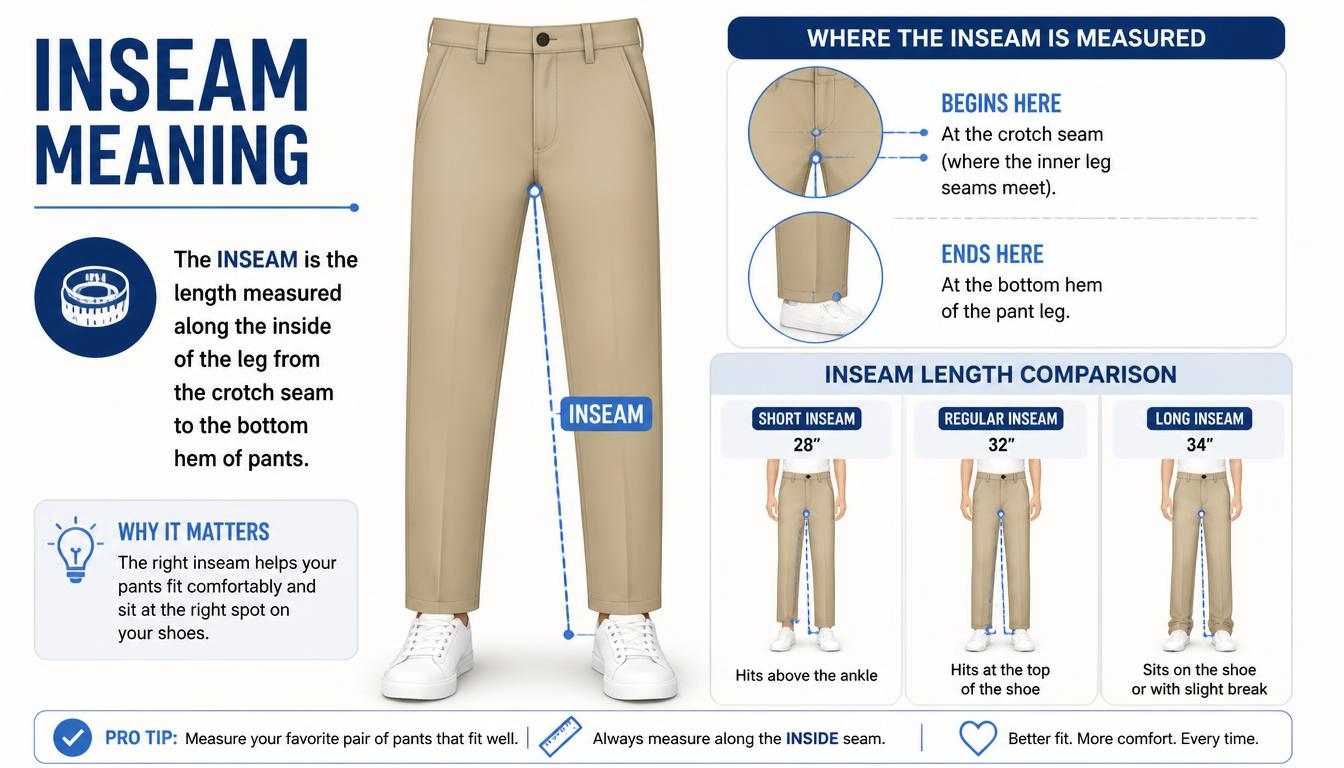
The word inseam refers to the length of the seam running along the inside of a pair of pants, starting from the crotch area and continuing down to the bottom of the pant leg.
In simple English, it measures the inside leg length of trousers or jeans. This measurement helps determine how far the pants extend down your legs and where they sit around your ankles.
For example, if a pair of jeans has a 32-inch inseam, the inside seam measures approximately 32 inches from the crotch seam to the bottom hem.
The inseam definition is particularly important in clothing because two people can have the same waist measurement but completely different leg lengths.
Here are a few things to understand about this term:
- It measures the inner seam of pants or trousers.
- It usually begins where the two pant legs meet at the crotch.
- It continues down to the bottom edge of the leg.
- It is commonly measured in inches or centimeters.
- It helps determine the overall length and fit of clothing.
In other words, the inseam is one of those small clothing details that can make a surprisingly big difference.
Inseam Meaning in English and Pronunciation
If you’re learning English, understanding the word’s pronunciation and usage can help you recognize it when shopping or reading clothing descriptions.
The word inseam is a noun, commonly used in American English, especially in fashion, tailoring, and apparel sizing.
Inseam pronunciation: /ˈɪn.siːm/
It sounds like “IN-seem,” with the emphasis on the first syllable.
In British English, the same measurement is commonly called the inside leg measurement or simply the inside leg.
Different languages also have their own expressions for this measurement:
- English (US): Inseam
- English (UK): Inside leg
- Spanish: Entrepierna
- Portuguese: Medida da parte interna da perna
- Traditional Chinese: 褲管內縫長度
- Simplified Chinese: 裤管内缝长度
Although the terminology changes between countries, the basic idea remains the same: measuring the length along the inner side of a garment’s leg.
What Is an Inseam in Pants?
When someone asks, “What is an inseam in pants?” they’re referring to the inner stitching that connects the fabric along the inside of each leg.
Imagine turning your trousers inside out. You’ll notice stitching running from the crotch down toward each ankle. That stitching is the inseam.
It is an important part of the garment’s construction because it helps create the shape of the pant legs while providing information about their length.
The pants inseam is especially useful when comparing different clothing sizes. For instance, a pair of trousers with a 30-inch inseam will generally be shorter than one with a 34-inch inseam, even if both have the same waist measurement.
You may encounter this measurement when buying:
- Casual pants
- Formal trousers
- Denim jeans
- Chinos
- Dress pants
- Joggers
- Workwear
- Athletic pants
Fashion retailers frequently include inseam information in their product descriptions and size charts because customers have different body proportions.
Where Is the Inseam on Jeans and Pants?
Finding the inseam is actually pretty simple once you know where to look.
Take a pair of jeans and lay them flat on a clean surface. Look for the point where the two legs connect near the crotch. From there, follow the stitching down the inside of one leg until you reach the bottom hem.
That’s the inseam.
The inseam on jeans is usually easy to identify because denim stitching is often visible along the inner pant leg.
Here are some simple ways to recognize it:
- Find the crotch seam where both legs meet.
- Look for the stitching running down the inner leg.
- Follow that seam toward the ankle.
- Stop at the bottom edge of the jeans.
- The distance between these points is the inseam length.
One thing worth remembering is that the inseam is different from the outside seam. Both measurements describe the length of pants, but they follow different paths.
How to Measure Inseam Correctly
Knowing the definition is helpful, but learning how to measure inseam is even more practical.
You don’t need expensive equipment or professional tailoring experience. A flexible measuring tape and a pair of well-fitting pants are usually enough.
There are two common ways to measure your inseam.
Method 1: Measure an Existing Pair of Pants
This is probably the easiest method if you already own trousers that fit comfortably.
Follow these steps:
- Choose a pair of pants with your preferred length.
- Place them flat on a table or another smooth surface.
- Smooth out wrinkles without stretching the fabric.
- Locate the crotch seam.
- Place the beginning of your measuring tape at the crotch seam.
- Follow the inside leg seam toward the bottom hem.
- Record the measurement in inches or centimeters.
For example, if the tape shows 32 inches, your pants have a 32-inch inseam.
Make sure you’re following the actual seam rather than measuring diagonally across the fabric. Even a small mistake can affect the result.
Method 2: Measure Your Body Directly
If you want to know how to measure your inseam without using existing pants, you can measure your inside leg.
Ask someone to help if possible because measuring alone can be slightly awkward.
- Stand upright with your feet comfortably apart.
- Wear lightweight clothing or fitted shorts.
- Place the end of a measuring tape at the top of your inner leg, near the crotch.
- Run the tape down the inside of your leg.
- Stop around the ankle or the point where you want your trousers to end.
- Write down the measurement.
For greater accuracy, you can use a book placed gently between your legs to mark the starting point. Avoid pressing it uncomfortably against your body.
Remember that the measurement you want may depend on the type of pants you’re purchasing. Dress trousers, jeans, and athletic pants don’t always have identical fitting preferences.
What Do 30-Inch, 32-Inch, and 34-Inch Inseams Mean?
Clothing retailers often display inseam measurements using numbers such as 30, 32, and 34.
These numbers represent the length of the inside leg seam in inches.
Understanding these measurements makes online shopping much less confusing.
| Inseam size | Measurement in cm | General description |
|---|---|---|
| 30 inches | 76.2 cm | Shorter inside leg |
| 32 inches | 81.3 cm | Medium inside leg |
| 34 inches | 86.4 cm | Longer inside leg |
| 36 inches | 91.4 cm | Extra-long inside leg |
| 37 inches | 94 cm | Longer inside leg |
| 39 inches | 99.1 cm | Very long inside leg |
These are garment measurement examples, not universal body-size categories.
What Does a 30-Inch Inseam Mean?
A 30-inch inseam means the inside seam of the pants measures approximately 30 inches from the crotch to the bottom hem.
It is commonly available in many clothing size ranges and may suit people who prefer a shorter pant length.
However, the correct size depends on your body proportions and the style of trousers.
What Does a 32-Inch Inseam Mean?
A 32-inch inseam means the inside leg seam measures 32 inches, or approximately 81.3 centimeters.
You’ll frequently see this measurement in men’s jeans, casual trousers, and other everyday clothing.
It is a common retail option, but it shouldn’t automatically be considered the ideal length for everyone.
What Does a 34-Inch Inseam Mean?
A 34-inch inseam represents an inside seam measuring approximately 86.4 centimeters.
This length is often available for people who need longer trousers or prefer additional fabric around the ankle.
If 32-inch pants feel slightly short, trying a 34-inch option might be worthwhile.
Average Inseam Length: Is There a Standard Size?
One question people often ask is whether there’s an average inseam length.
The truth is that there isn’t one universal measurement that works for everybody. Leg proportions vary according to height, body structure, personal preference, and clothing style.
However, clothing retailers commonly stock certain measurements to accommodate different customers.
For example:
- 28–30 inches: Common shorter-length options.
- 30–32 inches: Frequently available everyday options.
- 32–34 inches: Common medium-to-long options.
- 34–36 inches: Longer options.
- 36 inches and above: Extended-length options.
These ranges are general shopping examples, not official medical or population averages.
Men’s Inseam Length
Men’s clothing retailers often provide several inseam options for the same waist size.
A man with a 34-inch waist might find trousers in 30-inch, 32-inch, and 34-inch inseams.
This gives customers more flexibility because waist size and leg length are separate measurements.
Women’s Inseam Length
Women’s clothing also comes in different inseam lengths, although the available measurements can vary considerably between brands and styles.
Some retailers offer petite, regular, tall, and extended-length options.
For example, a petite pair of jeans may have a shorter inseam, while tall collections generally offer longer pant legs.
The important thing is to check the actual garment measurements instead of assuming that a particular size label guarantees a certain length.
Inseam vs Outseam: What’s the Difference?
The difference between inseam and outseam is quite straightforward, but these terms are sometimes confused.
Both measurements describe the length of a pair of pants, although they follow different sides of the garment.
Inseam: Measures from the crotch area down the inside of the leg to the bottom hem.
Outseam: Measures along the outside of the pant leg, generally from the top of the waistband to the bottom hem.
Here’s a simple comparison:
| Feature | Inseam | Outseam |
|---|---|---|
| Measurement location | Inside leg | Outside leg |
| Starting point | Crotch seam | Top of waistband |
| Ending point | Bottom hem | Bottom hem |
| Main purpose | Inner leg length | Overall outer length |
| Common use | Pants and jeans sizing | Garment construction and tailoring |
For example, if you’re checking whether jeans will be long enough for your legs, the inseam is usually more useful.
If you’re checking the overall length of trousers from the waistband to the bottom, the outseam gives you that information.
Is Inseam the Same as Leg Length?
Not exactly. Although these expressions are closely related, they don’t always mean precisely the same thing.
Leg length can refer to different measurements depending on the context. It might describe the length of your actual leg, a clothing measurement, or the distance from your hip to your ankle.
The inseam specifically refers to the inner leg measurement of a garment or the corresponding inside-leg measurement of the wearer.
For instance, two people may have the same overall height but different proportions. One person may have longer legs and a shorter upper body, while another has shorter legs and a longer torso.
That’s why choosing pants based only on height isn’t always reliable.
How Does Inseam Affect Pants Fitting?
A proper inseam measurement can make an ordinary pair of trousers look much better.
Even expensive jeans may look uncomfortable or poorly fitted if their length doesn’t match your body proportions.
Here’s how different inseam lengths can affect your appearance and comfort.
Pants That Are Too Short
If the inseam is too short, the bottom of the trousers may sit higher than expected.
Depending on the style, this can create a cropped appearance or expose more of your ankle than you intended.
This isn’t always a problem because some fashion styles deliberately use shorter pant lengths.
Pants That Are Too Long
When trousers have an excessively long inseam, extra fabric may gather around your ankles.
This is sometimes called stacking or bunching, depending on the amount of fabric and the garment’s design.
Some people enjoy this relaxed look, while others prefer a cleaner finish.
Pants With the Right Inseam
A suitable inseam allows your trousers to fall naturally without uncomfortable pulling or excessive fabric.
The exact appearance depends on the cut, shoes, fabric, and personal style.
For a more formal look, people often prefer trousers with a cleaner break near the shoe. Casual jeans may be worn slightly longer or shorter.
Inseam Measurement Meaning on Clothing Size Charts
When shopping online, you may notice that a product has two numbers, such as 32 × 32 or 34 × 30.
These numbers usually represent waist size and inseam length, respectively.
For example:
32 × 30
- First number: 32-inch waist.
- Second number: 30-inch inseam.
34 × 32
- First number: 34-inch waist.
- Second number: 32-inch inseam.
This system makes it easier to compare clothing sizes and choose trousers according to your body measurements.
However, different fashion retailers may use slightly different sizing systems. Always check the individual size chart before ordering.
What Is the Difference Between Inseam and Pants Length?
This is another common question, especially when buying jeans from online stores.
The term pants length can refer to the overall length of trousers, while inseam specifically describes the measurement along the inside leg seam.
Some retailers use the word length without explaining whether they mean inseam or outseam.
That’s why it’s important to read the product description carefully.
If a size chart lists waist, hip, and inseam measurements, you’ll know exactly which dimensions are being provided.
If it only says length, look for a measurement guide or contact the retailer before purchasing.
Does Inseam Measurement Differ Between Jeans and Trousers?
Yes, the measurement method is generally the same, but the preferred finished length can differ according to garment style.
A pair of slim-fit jeans may sit differently from loose-fit trousers, even when both have an identical inseam.
Here are some examples:
- Jeans: Often available in multiple inseam lengths, including regular and tall options.
- Formal trousers: May be tailored to create a specific break above the shoes.
- Chinos: Often worn with a clean ankle finish or a slight turn-up.
- Joggers: Frequently have elasticated cuffs that change how the length appears.
- Wide-leg pants: May require extra attention to the relationship between inseam, footwear, and overall drape.
Fabric stretch, rise, and cut can also affect how a garment feels when worn.
An identical inseam measurement doesn’t guarantee an identical fit across different clothing items.
Common Inseam Measurement Mistakes to Avoid
Measuring your inside leg sounds easy, but a few small mistakes can lead to the wrong clothing size.
Watch out for these common problems:
- Starting at the wrong point: Always begin at the crotch seam when measuring an existing garment.
- Measuring the outside seam: This gives you the outseam, not the inseam.
- Using wrinkled trousers: Wrinkles can distort your measurement.
- Pulling the measuring tape too tightly: Keep the tape aligned with the seam without stretching the fabric.
- Ignoring the size chart: Different brands can have different sizing standards.
- Choosing based only on height: Your body proportions matter just as much.
- Forgetting the shoe style: The length you prefer may change depending on the footwear.
A little extra attention during measurement can save you the inconvenience of returns and alterations.
Inseam in Sewing, Tailoring, and Garment Construction
The inseam isn’t just a shopping measurement. It’s also an important part of sewing and professional garment construction.
Tailors use it when creating, shortening, or adjusting trousers to achieve the desired leg length.
During sewing, the inner leg seams connect the fabric panels that form the pant legs. Their construction influences the garment’s shape, durability, and comfort.
The inseam is also relevant when modifying existing clothes.
For example, if your jeans are too long, a tailor may shorten the bottom hem while preserving the original style. If the garment needs a more significant adjustment, the tailor may need to consider the leg shape and seam construction.
Other clothing measurements, such as waist, knee, and overall garment length, can also influence the final result.
A good tailor considers these measurements together rather than treating the inseam as an isolated number.
Frequently Asked Questions About Inseam Meaning
What does inseam mean in simple words?
Inseam means the length of the inside seam of pants, measured from the crotch area to the bottom of the leg. It helps determine how long trousers or jeans will be.
What is an inseam on jeans?
The inseam on jeans is the stitching running along the inner side of each leg. Its measurement begins where the legs meet at the crotch and ends at the bottom hem.
How do you measure your inseam at home?
You can measure your inseam using a flexible measuring tape. Start at the top of your inner leg, near the crotch, and measure down to your preferred ankle position. Alternatively, measure a pair of well-fitting trousers along the inside seam.
What is a good inseam length?
A good inseam length depends on your body proportions, clothing style, and preferred fit. Common retail options include 30, 32, and 34 inches, but these are not universal recommendations.
Is a 32-inch inseam considered long?
A 32-inch inseam is a commonly available clothing length. Whether it feels short, average, or long depends on the wearer’s leg proportions and the style of trousers.
What does 34 × 32 mean in pants?
It usually means the pants have a 34-inch waist and a 32-inch inseam. The first number represents waist size, while the second indicates the inside leg length.
Can two people with the same height have different inseams?
Yes. People can have the same overall height but different leg and torso proportions. This is why measuring your inside leg is often more useful than choosing pants based only on height.
Does inseam include the waistband?
No. The inseam measures the inner leg seam from the crotch to the bottom hem. It does not include the waistband or the outside length of the trousers.
What is the UK term for inseam?
In British English, inseam is commonly called the inside leg measurement or simply inside leg.
What is the difference between inseam and rise?
Inseam measures the inner leg length from the crotch to the bottom hem. Rise measures the distance from the crotch seam to the top of the waistband, depending on whether you’re measuring the front or back rise.
Can I change the inseam of my pants?
Yes. A tailor can usually shorten trousers by adjusting the bottom hem. Lengthening them depends on whether sufficient extra fabric is available inside the original hem.
Do women’s and men’s inseam measurements use the same method?
Yes. The basic measurement method is the same for both. However, the available clothing sizes and preferred pant lengths can vary between brands and garment styles.
inseam length meaning
Inseam length refers to the measurement from the crotch seam to the bottom of the ankle or hem of a pair of pants. It helps determine how long pants or jeans will be when worn.
inseam
Inseam is the inner seam of pants that runs from the crotch down to the bottom of the leg. It is also used to describe the measurement of this seam.
inseam meaning
Inseam means the inside leg measurement, usually measured from the crotch area to the bottom of the pants. It helps people choose the correct trouser, jeans, or pants length.
meaning of inseam
The meaning of inseam is the length of the inner leg seam in clothing, especially trousers and jeans. It indicates how much fabric covers the inside of the leg.
inseam length meaning in english
In English, inseam length means the distance from the crotch seam to the bottom hem of trousers. It is commonly used in clothing size charts to describe leg length.
Read ARticul: https://ytmeaning.com/ts-meaning/
How to Choose the Right Inseam When Shopping Online
Before ordering a new pair of jeans or trousers, take a moment to check the measurement information.
A few simple steps can help you avoid purchasing the wrong size.
- Measure a pair of pants that already fits you comfortably.
- Compare its inseam with the retailer’s size chart.
- Check whether the measurements are listed in inches or centimeters.
- Consider whether the pants are slim, regular, relaxed, or wide-leg.
- Read customer reviews for information about sizing and length.
- Check the store’s return and exchange policy.
If you’re between two inseam sizes, consider how you want the pants to fall around your shoes.
For example, someone who prefers ankle-length jeans may choose a shorter option, while someone who likes a little extra fabric may prefer a longer inseam.
Final Thoughts on Inseam Meaning
Understanding inseam meaning is a small but useful step toward making better clothing choices. It explains how the inside leg of pants is measured and why that measurement matters when selecting jeans, trousers, and other clothing items.
Once you understand the difference between inseam, outseam, waist size, and overall garment length, clothing size charts become much easier to read.
The next time you see a 30-inch, 32-inch, or 34-inch inseam on a fashion retailer’s website, you’ll know exactly what those numbers represent.
And remember, the best-fitting trousers aren’t necessarily the ones with the most popular size. They’re the ones that feel comfortable, look natural, and suit your own proportions.
If this guide helped you understand the term, share it with someone who often struggles with clothing measurements. You can also leave a comment sharing your usual inseam length or your favourite trick for finding perfectly fitting jeans. Sometimes, the smallest measurements make the biggest difference!
Fix the inseam measurement wordingRemove repetitive inseam explanations