
Have you ever read a message where one word instantly grabbed your attention? Maybe someone typed “NOW”, added several emojis, repeated a letter like “soooo”, or used extra punctuation like “Really?!”. These small writing choices are examples of emphasis in text.
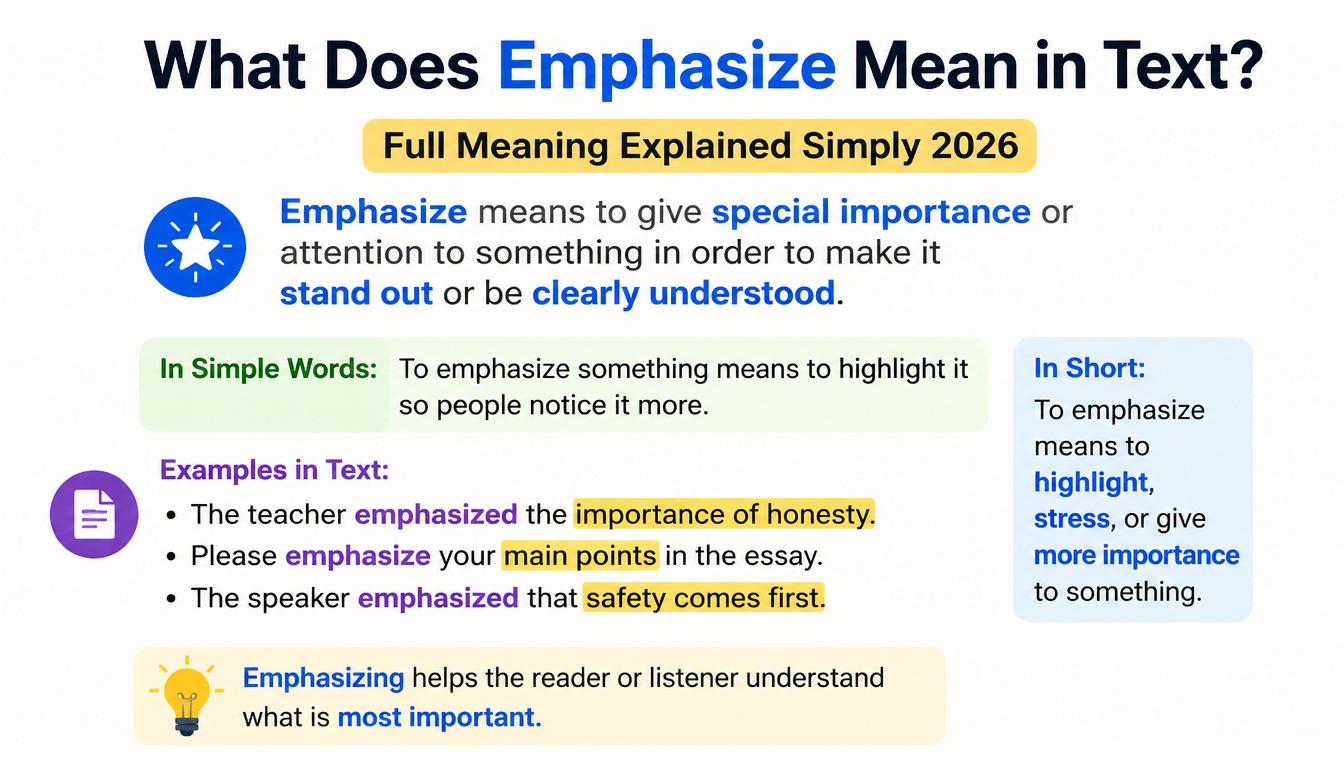
If you are searching for What Does Emphasize Mean in Text? Full Meaning Explained Simply 2026, the meaning is straightforward: to emphasize in text means to make a word, phrase, or idea stand out so the reader notices its importance, emotion, or intended tone.
In everyday conversations, people use their voice, facial expressions, and body language to show feelings. But in digital communication, those signals are missing. Because of this, people use capital letters, emojis, punctuation, repetition, bold formatting, and word choices to express the same emotions through written messages.
This guide explains the meaning of emphasize in text, how people use it, examples from real conversations, and how to use emphasis effectively without creating confusion.
What Does Emphasize Mean in Text?
Emphasize means to give special importance, attention, or strength to a specific word, phrase, or idea in a message.
In texting, emphasis helps the reader understand what matters most. It can show:
- Strong feelings
- Excitement
- Urgency
- Surprise
- Humor
- Frustration
- Importance
For example:
Normal message:
I like this movie.
Emphasized message:
I really like this movie!
The second sentence places more importance on the feeling behind the statement.
Another example:
Please call me.
Compared with:
Please call me NOW.
The second version communicates urgency because the word “NOW” receives stronger attention.
Simply put, emphasis makes written words feel closer to spoken conversation.
Why Is Emphasis Important in Digital Communication?
Digital communication lacks voice tone and facial expressions, so emphasis helps replace those missing emotional signals.
When people talk in person, they naturally stress certain words. For example:
“I didn’t say he stole the money.”
Depending on which word receives stress, the meaning changes:
- I didn’t say he stole the money.
- I didn’t say he stole the money.
- I didn’t say he stole the money.
Text messages do not have natural speech stress, so writers use visual methods to guide interpretation.
Without emphasis, messages can sometimes feel:
- Cold
- Unclear
- Emotionless
- Confusing
With proper emphasis, messages become:
- More expressive
- Easier to understand
- More personal
- More memorable
How People Emphasize Words in Text
There are many ways people create emphasis in messages. Different methods create different emotional effects.
1. Using Capital Letters (ALL CAPS)
One of the most recognizable forms of text emphasis is writing words in uppercase letters.
Example:
I CAN’T BELIEVE IT!
This usually communicates:
- Excitement
- Shock
- Anger
- Urgency
However, capitalization should be used carefully.
Compare:
Please send the file TODAY.
and
PLEASE SEND THE FILE TODAY!!!
The first sounds like a reminder. The second may feel aggressive.
In online communication, writing an entire sentence in capital letters is often interpreted as shouting.
2. Repeating Words or Letters
Repetition is another common way to increase emotional impact.
Examples:
No way!
No wayyy!
Nooooo way!
The repeated letters make the message feel more emotional and closer to spoken expression.
People commonly use this style when expressing:
- Excitement
- Surprise
- Happiness
- Disbelief
Examples:
- “Soooo cute!”
- “Yessss!”
- “Waittt, what?”
This type of emphasis is especially common in casual texting and social media conversations.
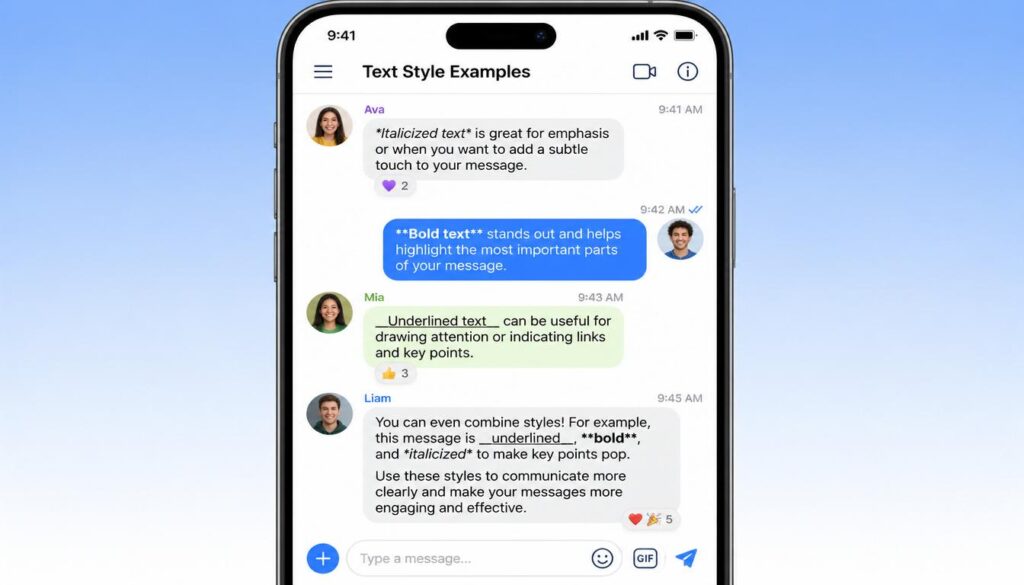
3. Bold Text and Italics
Some platforms support formatting options that allow users to visually highlight words.
Examples:
- Important update
- Really important
- Absolutely necessary
Bold text creates strong visual emphasis, while italics usually add subtle stress.
This method is common in:
- Articles
- Emails
- Online communities
- Workplace messaging platforms
Unlike ALL CAPS, formatting usually feels more professional and controlled.
4. Emojis as Emotional Emphasis
Emojis enhance emotional meaning in digital communication.
Since text alone cannot show facial expressions, emojis help communicate feelings.
Examples:
Without emoji:
I’m happy for you.
With emoji:
I’m so happy for you 🎉❤️
The second message feels warmer because the emojis reinforce the emotion.
Common emotional emojis include:
| Emoji | Meaning |
|---|---|
| 😍 | Strong appreciation or excitement |
| 😂 | Humor or laughter |
| 🔥 | Something impressive or exciting |
| 😱 | Shock or surprise |
| ❤️ | Affection or support |
| 🎉 | Celebration |
Emojis are not just decorations; they can change how a reader interprets the message.
5. Punctuation for Emphasis
Punctuation marks are powerful tools for adding emotion and tone.
Exclamation Marks (!)
Example:
That is amazing!
More intense:
That is amazing!!!
The extra punctuation increases excitement.
Question Marks (?)
Example:
Really?
Stronger:
REALLY?!
This can show disbelief, surprise, or confusion.
Ellipses (…)
Example:
I guess…
This creates a pause and may suggest uncertainty, disappointment, or hesitation.
Examples of Emphasizing Text Messages
Understanding examples makes the concept easier.
Example 1: Excitement
Normal:
I got tickets.
Emphasized:
I GOT TICKETS!!! 🎉🔥
The capitalization and emojis show excitement.
Example 2: Urgency
Normal:
Call me later.
Emphasized:
Please call me ASAP.
The phrase “ASAP” creates urgency.
Example 3: Surprise
Normal:
You did that?
Emphasized:
You did WHAT?!
The capitalization shows disbelief.
Example 4: Humor
Normal:
You’re funny.
Emphasized:
You’re such a genius 😂
The emoji changes the tone and shows playful sarcasm.
Emphasize Meaning in Different Online Platforms
Different platforms have their own communication styles. The way people emphasize messages changes depending on where they are writing.
Text Messaging
Traditional texting usually depends on:
- Capital letters
- Emojis
- Repeated words
- Extra punctuation
Example:
I miss you sooo much ❤️
Casual conversations often use emotional emphasis because people want messages to feel personal.
Social Media
Social media platforms rely heavily on visual and emotional communication.
Users often emphasize posts through:
- Emojis
- Hashtags
- Capitalized words
- Repeated punctuation
Example:
BEST DAY EVER!!! 🌅✨
Social media emphasis helps posts attract attention quickly.
Chat Apps
Messaging apps such as WhatsApp, Discord, and Messenger combine text formatting with emojis.
Users may use:
- Bold text
- Italics
- Reactions
- Stickers
- GIFs
Example:
Meeting starts at 9 AM
The bold text immediately highlights important information.
Emphasize vs Similar Words
Many words are related to emphasize, but they do not have exactly the same meaning.
| Word | Meaning |
|---|---|
| Emphasize | Give importance or attention to something |
| Highlight | Make something visually noticeable |
| Stress | Give extra importance, often verbally |
| Bold | Use stronger text formatting |
| Underline | Mark text visually |
Emphasize is the broadest term because it includes both visual methods and emotional meaning.
For example, bold text is one way to emphasize, but choosing a stronger word can also create emphasis.
Why People Use Emphasis in Text Messages
People emphasize messages for several reasons:
To Express Feelings
Text lacks natural emotion, so emphasis helps show:
- Happiness
- Anger
- Excitement
- Love
- Surprise
To Make Information Important
Example:
Remember to bring your ID CARD.
The emphasis tells the reader that this detail matters.
To Create Humor
Example:
Wow, you’re a REAL genius 😂
The emphasis can create playful sarcasm.
To Avoid Misunderstanding
A simple message may be interpreted incorrectly.
Example:
Fine.
This could sound annoyed.
But:
Fine 😊
The emoji changes the tone.
The Psychology Behind Emphasizing Words in Text
Emphasis works because the human brain naturally pays attention to things that stand out.
When a reader sees a word written differently, such as in bold, capital letters, or with extra punctuation, the brain recognizes it as important information.
This is why a message like:
Please remember the meeting tomorrow.
feels different from:
Please remember the IMPORTANT meeting tomorrow.
The second message guides the reader’s attention toward a specific word.
In digital communication, emphasis helps solve a major problem: written messages do not include the natural signals found in face-to-face conversations.
These missing signals include:
- Voice volume
- Speaking speed
- Facial expressions
- Hand movements
- Emotional tone
Because of this, people create their own digital signals through text choices.
Emphasis and Tone in Written Communication
Tone refers to the feeling or attitude behind a message.
A sentence can have completely different meanings depending on how it is emphasized.
Example:
Great.
This could mean:
- Genuine happiness
- Bored agreement
- Sarcasm
- Disappointment
Adding emphasis changes interpretation:
GREAT!!
This sounds excited.
Great…
This sounds uncertain or disappointed.
Great.
This may feel serious or firm.
This is why tone and context are extremely important in text conversations.
Digital Communication and Nonverbal Cues
In traditional conversations, people rely heavily on nonverbal communication.
For example:
Someone saying “Nice job” with a smile feels positive.
Someone saying “Nice job” with an angry voice may feel sarcastic.
Text removes these signals, so users create alternatives:
- Emojis replace facial expressions
- Punctuation replaces voice changes
- Formatting replaces vocal stress
- Word repetition replaces emotional intensity
This makes emphasis an essential part of modern online conversation.
Platform-Specific Ways to Emphasize Text
Different platforms provide different tools for creating emphasis.
WhatsApp allows users to format messages using simple text styles.
Common options include:
- Bold text for important information
- Italic text for subtle emphasis
- Strikethrough for corrections or jokes
- Monospace text for technical information
Examples:
Don’t forget the appointment.
Meeting changed to 3 PM
Users also rely heavily on emojis and voice-note alternatives to communicate emotion.
Discord
Discord conversations often use:
- Markdown formatting
- Emojis
- Reactions
- GIFs
- Memes
Examples:
IMPORTANT: Server rules updated
Discord communities frequently use emphasis because conversations move quickly and important messages can easily get missed.
Instagram emphasis is mostly visual.
Users create emphasis through:
- Capitalized captions
- Emojis
- Hashtags
- Line breaks
Example:
THIS VIEW IS AMAZING 🌅✨
The goal is often to attract attention while expressing personality.
Slack and Workplace Chats
Professional platforms require more careful emphasis.
Good example:
Action required: Please review the document by Friday.
Poor example:
PLEASE READ THIS NOW!!!!!
Workplace communication usually benefits from clear formatting rather than aggressive capitalization.
Email Communication
Emails require a balanced approach.
Appropriate emphasis:
- Bold important deadlines
- Use clear headings
- Highlight key information
Avoid:
- Excessive capital letters
- Multiple exclamation marks
- Emotional exaggeration
Example:
Professional:
Please submit the report by Monday, July 25.
Less professional:
PLEASE SEND THE REPORT MONDAY!!!
Cultural Impact of Emphasizing Words Online
Emphasis has become a major part of internet culture.
People use emphasis not only to communicate information but also to show personality.
Online communities have developed unique ways of expressing emotion.
Examples include:
Extended Letters
Yessssss!
Often shows excitement.
Lowercase Style
Some users intentionally write everything in lowercase to create a casual or relaxed tone.
Example:
i can’t believe this happened
Tone Indicators
Some online communities use tone indicators to avoid confusion.
Examples:
- /j = joking
- /s = sarcasm
- /gen = genuine
These tools help readers understand the intended meaning.
Common Mistakes When Using Emphasis
Although emphasis is useful, incorrect usage can create problems.
1. Overusing Capital Letters
Writing everything in uppercase can feel like shouting.
Example:
I NEED YOU TO ANSWER RIGHT NOW
may sound aggressive.
Better:
I need your answer by today, please.
2. Too Many Exclamation Marks
Example:
Thank you!!!!!!!!!!!!!!!!!!!!
This may appear unnatural or overly dramatic.
Usually, one or two exclamation marks are enough.
3. Excessive Emoji Use
Emojis can improve tone, but too many may make messages confusing.
Example:
Thank you ❤️🔥😂🎉😍✨💯
The reader may not know the intended emotion.
4. Ignoring Context
The same emphasis method may work with friends but fail professionally.
Example:
Friend:
YOU WON!!! 🎉
Work email:
YOU WON!!!
The second one may seem inappropriate.
5. Using Sarcasm Without Clear Signals
Sarcasm is difficult in text because readers cannot hear your voice.
Example:
You’re really helpful.
This could be sincere or sarcastic.
Adding context helps:
You’re really helpful 😂
How to Emphasize Effectively
Good emphasis is about balance. The goal is to make communication clearer, not louder.
Follow these tips:
Choose the Most Important Word
Do not emphasize everything.
Example:
Instead of:
THIS IS REALLY VERY IMPORTANT PLEASE READ NOW
Try:
This is very important, please read it today.
Match Your Audience
Consider who receives your message.
Friends may understand:
OMG THIS IS AMAZING!!!
A manager may prefer:
This is an important update.
Use One or Two Methods Together
Combining too many techniques reduces impact.
Good:
I am so excited 🎉
Too much:
I AM SOOOO EXCITED!!!!!!!!!!!! 🔥🔥🔥🔥🔥
Read the Message Before Sending
Reading your message aloud helps you notice how it sounds emotionally.
Ask yourself:
- Does it sound friendly?
- Does it sound too aggressive?
- Could someone misunderstand it?
When Not to Use Strong Emphasis
There are situations where subtle communication works better.
Avoid strong emphasis when writing:
- Formal emails
- Business messages
- Academic communication
- Customer service responses
- Professional requests
Instead of:
THIS MUST BE DONE TODAY!!!
Use:
This needs to be completed today.
The meaning remains clear without sounding demanding.
Emphasize Meaning in Writing and SEO Content

The concept of emphasis is also important beyond texting.
Writers use emphasis to improve readability by:
- Highlighting important information
- Creating visual hierarchy
- Guiding reader attention
- Making key points easier to remember
For example, online articles use:
- Bold keywords
- Short paragraphs
- Headings
- Lists
- Tables
These techniques help readers quickly find useful information.
Featured Snippet Answer
What does emphasize mean in text?
To emphasize in text means to make a word, phrase, or idea stand out so the reader notices its importance, emotion, or meaning. People use capitalization, emojis, punctuation, repetition, and formatting to create emphasis in digital conversations.
Frequently Asked Questions (FAQs)
What does emphasize mean in a text message?
Emphasize in a text message means giving extra importance or attention to certain words or ideas. People use methods like bold formatting, capital letters, emojis, and punctuation to show emotions, urgency, or a specific tone.
Are emojis considered a form of emphasis?
Yes, emojis are a form of emphasis because they add emotional meaning to written messages. They help communicate feelings like happiness, excitement, humor, surprise, or affection when facial expressions and voice tone are unavailable.
Does using ALL CAPS mean someone is angry?
Not always. ALL CAPS can show anger, but it can also express excitement, urgency, or strong emotion. The meaning depends on the conversation context, the relationship between people, and the specific words being emphasized.
How can I emphasize text without sounding rude?
Use emphasis carefully by choosing important words, using simple formatting, and matching the tone to your audience. Bold text, selective punctuation, or a friendly emoji often works better than excessive capital letters or repeated exclamation marks.
Final Thoughts
Emphasizing words in text is one of the most important tools in modern digital communication.
Since online conversations do not include voice tone, facial expressions, or body language, people use emphasis to express feelings and make their messages clearer.
Whether someone writes “I REALLY love this”, adds a laughing emoji, or highlights an important deadline in bold, the purpose is the same: helping the reader understand what matters most.
Used correctly, emphasis adds emotion, personality, and clarity to messages. Used excessively, it can create confusion or make communication feel aggressive.
The best approach is simple: emphasize what matters, keep it natural, and always consider your audience.
Meta Description
What Does Emphasize Mean in Text? Learn the full meaning, examples, texting methods, emojis, tone, and ways to use emphasis correctly in 2026.