
The internet changed the way people shop in a rather quiet way. One day, people were walking into stores, touching products, asking questions, and carrying shopping bags home. Then online stores arrived, and suddenly a customer could sit on a sofa at midnight, order a pair of shoes, and wait for a delivery truck to do the walking for them. This simple shift is where the idea of e-tail becomes important.
The e-tail meaning is quite straightforward: e-tail refers to retail conducted electronically, especially through the Internet. In other words, when a business sells products directly to customers through an online store or another digital marketplace, it is participating in online retail.
The word may look slightly strange at first. It is not a completely different kind of retail, though. Think of it as e- + retail. The little “e-” points toward electronic or Internet-based activity, while “retail” keeps its ordinary meaning. Put them together and you get a compact word for selling things online.
E-Tail Meaning in Simple Words
The simplest e-tail definition is “the selling of products to consumers through the Internet.” It can include a small online shop operated by one person, a specialized online retailer, or a huge international e-commerce company handling millions of orders.
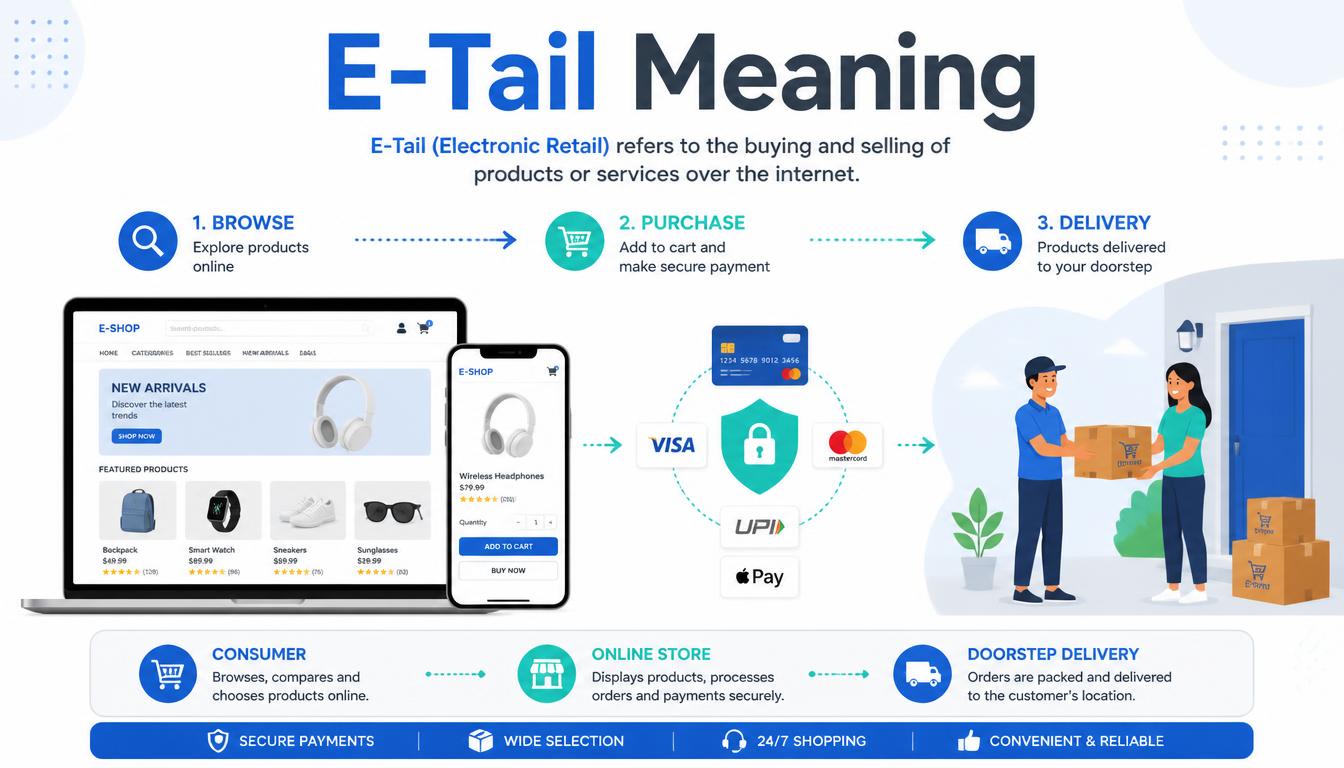
So, what is e-tail? Imagine a customer visits an online store, chooses a product, adds it to a cart, pays digitally, and receives the product through delivery. That entire retail transaction is an example of e-tail.
The important part is that the retail activity happens through an electronic channel. The customer doesn’t necessarily need to visit a physical shop, and the seller doesn’t necessarily need a traditional storefront.
You can therefore think of it like this:
E-tail → e- + retail → online retail → selling products through the Internet
This little chain explains the word better than a complicated business textbook sometimes does.
What Does E-Tail Mean in Business?
In business language, what does e-tail mean beyond simply “selling online”? It describes a model in which a retail business uses digital channels to present products, receive orders, process customer transactions, and often arrange delivery.
An e-tail business may sell clothing, electronics, books, furniture, beauty products, software, household goods, or almost anything else that can be purchased through a digital storefront.
A business doesn’t have to be enormous to qualify. A person selling handmade garments through their own website can be an e-tailer. A large retail company with a sophisticated online store can also be an e-tailer. The scale changes, but the basic idea doesn’t.
E-Tail Meaning and the Origin of the Word
The word e-tail is a blend word formed from “e-” and “retail.” The “e-” element became widely associated with electronic and Internet activity as digital businesses began developing.
Its word history is connected with the rapid growth of commercial activity on the Web during the 1990s. Dictionary references commonly identify 1995 in discussions of the first known use of “e-tail,” although terminology from the early Internet era was still developing and different sources may describe the history slightly differently.
The construction itself is easy to understand. “Electronic” becomes “e-,” while “retail” remains recognizable. Rather clever, really, because the reader can almost guess the meaning before looking it up.
The related words e-tailing and e-tailer developed around the same concept. E-tailing refers to the activity of selling through digital channels, while an e-tailer is the business or retailer doing that selling.
E-Tailing Meaning: What Is E-Tailing?
E-tailing means the practice or process of conducting retail sales through electronic channels, especially the Internet.
For example, when an online store displays products, accepts an order, processes payment, and sends the purchased item to the customer, that activity can be described as e-tailing.
The distinction is small but useful:
- E-tail refers to the concept or type of retail.
- E-tailing refers to the activity of selling through online channels.
- E-tailer refers to the seller or business.
- Online retail describes the broader business activity in familiar language.
These words often overlap in everyday writing, and honestly, most readers won’t complain if someone uses “online retail” instead of “e-tail.” But understanding the difference helps when reading business, marketing, or technology material.
What Is an E-Tailer?
An e-tailer is a retailer that sells products through an online channel.
It could be a company operating a dedicated online store, a retailer using an online marketplace, or a traditional business that has expanded its physical retail operation onto the Internet.
For instance, a clothing company may have a physical shop in a city while also operating an online store. Its website allows customers to browse garments, select sizes, make payments, and place orders without entering the physical store.
That company is participating in e-tailing, and it can be described as an e-tailer.
How an E-Tail Business Usually Works
An e-tail business can look simple from the customer’s side, but several moving parts are working behind the screen.
A customer visits an online store and searches through available products. Product pages provide photographs, descriptions, prices, sizes, specifications, reviews, or other information needed for a purchase.
Once the customer decides to buy, the order moves into the seller’s system. Payment may be processed electronically, and the order is then prepared for shipment.
Behind that one innocent-looking “Buy Now” button can be inventory management, payment processing, customer support, packaging, delivery, returns, marketing, and technology.
This is why successful online retail business isn’t simply about putting products on a website. The whole customer journey needs to function properly.
E-Tail vs Retail: What Is the Difference?
The easiest way to understand e-tail vs retail is to look at where the transaction takes place.
Traditional retail commonly involves a physical location where customers visit, examine products, interact with staff, and purchase goods.
E-tail, on the other hand, mainly uses digital channels. The customer interacts with a website, application, marketplace, or another online system.
A simple example makes it clearer. Suppose you visit a physical shoe shop, choose sneakers, pay at the counter, and walk out wearing them. That’s traditional retail.
Now imagine choosing the same type of shoes from an online store, paying digitally, and receiving them at home two days later. That’s e-tail.
Both involve retail. The major difference is the selling channel.
E-Tail vs E-Commerce
People often use e-tail vs e-commerce as if the two terms mean exactly the same thing, but there is a useful distinction.
E-commerce is the broader concept of buying and selling through electronic systems. It can include business-to-consumer sales, business-to-business transactions, digital services, online marketplaces, subscriptions, and other electronic transactions.
E-tail is narrower. It focuses particularly on retail sales to consumers through digital channels.
So, e-tail can be considered part of the larger e-commerce world.
Think of e-commerce as the large umbrella and e-tail as one section underneath it. The umbrella is pretty big, and e-tail is one very busy corner.
Online Retail and Electronic Retailing
Online retail and electronic retailing are closely connected with e-tail.
Online retail generally refers to selling products through websites, applications, and digital marketplaces. Electronic retailing has a similar meaning, although it can sound more formal or business-oriented.
A modern online retailer might use:
- A company website
- A mobile shopping application
- An online marketplace
- Digital payment systems
- Email marketing
- Search engines
- Social media
- Online advertising
- Customer relationship platforms
Together, these technologies create an Internet-based business capable of serving customers far beyond the physical location of a traditional shop.
Examples of E-Tail in Everyday Life
You probably interact with e-tail more often than you realize.
Imagine ordering a jacket from an online fashion store. You select the color and size, enter your delivery details, pay online, and receive the package at home. That’s e-tail.
Buying headphones from an online electronics retailer is also e-tail.
Ordering books from an Internet bookstore, purchasing household products from an online marketplace, or buying garments directly from a clothing company’s website can all fall under online selling and e-tailing.
The strange thing is that consumers rarely stop and think, “I am now participating in electronic retailing.” They just click, pay, and wait for the parcel.
E-Tail Business Models
Not every e-tail business operates in exactly the same way.
Some companies manufacture their own products and sell them directly through their websites. Others purchase products from manufacturers or wholesalers and resell them online.
Some businesses operate marketplaces where different sellers list their products. In that case, the platform may facilitate the transaction while independent retailers actually supply the products.
There are also businesses that combine physical stores with digital channels. These companies can offer customers several ways to shop, including visiting a store, ordering online, or buying online and collecting an item from a physical location.
The business model changes, but the common thread remains digital retail activity.
Why E-Tail Became So Important
The biggest advantage of online retail is convenience.
Customers can search for products without travelling to several stores. They can compare prices, read reviews, check product information, and place orders from almost anywhere with Internet access.
For businesses, the Internet can also expand their potential market. A small retailer with a good website isn’t limited to customers who happen to live nearby.
Of course, reaching a larger audience doesn’t automatically mean making more money. Competition is intense, customer expectations are high, and delivery or return problems can quickly turn a happy buyer into an unhappy one.
Still, the ability to sell beyond a physical location has changed the retail industry in a major way.
E-Tail and Online Shopping
Online shopping is the customer-facing side of the experience, while e-tail describes the retail activity behind it.
When people search for products online, compare options, read reviews, place orders, and make payments, they are participating in the broader digital shopping ecosystem.
For retailers, this creates opportunities to understand customer preferences through legitimate business data, improve product pages, personalize shopping experiences, and make purchasing easier.
The modern shopper may never see the warehouse, customer-service office, or inventory system. They simply see the website and expect everything behind it to work smoothly.
E-Tail Companies and Retail Giants
Large e-commerce giants have made e-tail familiar to billions of consumers.
Companies such as Amazon helped normalize the idea that customers could browse enormous product catalogs from home and receive purchases at their doorstep. Fashion-focused businesses such as ASOS also demonstrate how specialized online retail can serve customers across geographic boundaries.
But e-tail isn’t only about giant companies.
A small family-owned shop can launch an online store and begin selling to customers in other cities. A specialist retailer can serve a narrow audience that might be too small for a physical location. A new entrepreneur can build a product brand around a digital storefront.
That’s one of the interesting things about digital commerce: the same basic concept can work at very different scales.
Benefits of an Online Retail Business
An online retail business can provide several advantages to both sellers and customers.
Broader reach: A website can make products visible to customers outside the retailer’s immediate geographic area.
Convenience: Customers can shop without travelling to a physical store.
Product variety: Digital stores can sometimes display a much larger catalog than a small physical shop can hold.
Flexible shopping: People can place orders at times that suit them, including outside normal store hours.
Digital marketing: Retailers can promote products through search engines, social platforms, email, content, and paid advertising.
Customer information: With appropriate privacy practices, businesses can analyze sales and website behavior to improve the shopping experience.
Of course, these benefits come with responsibilities. Security, privacy, accurate product information, reliable delivery, and responsive customer service all matter.
Read more: https://ytmeaning.com/bittersweet-meaning/
Challenges of E-Tailing
E-tail may look effortless from the customer’s screen, but operating an e-commerce business can be demanding.
Competition is one major challenge. A customer can often compare several retailers within minutes, so businesses need competitive products, pricing, service, and presentation.
Shipping can also become complicated. Delays, damaged packages, incorrect addresses, and returns are part of real-world retail, even when the storefront is entirely digital.
Trust is another big issue. Customers need confidence that the retailer will deliver what was promised and handle their payment information responsibly.
Then there is technology. A slow website, broken checkout page, confusing navigation, or inaccurate stock information can quietly push customers toward another retailer.
E-Tail, Digital Commerce, and the Internet
The relationship between e-tail, digital commerce, and the Internet is quite direct.
The Internet provides the infrastructure through which online stores reach customers. Digital commerce provides the broader environment for electronic transactions. E-tail focuses specifically on retail sales conducted through these digital channels.
This makes e-tail one important part of the larger transformation from traditional commerce toward increasingly connected forms of buying and selling.
The terminology can sound technical, but the experience itself is wonderfully ordinary: someone wants something, finds it online, pays for it, and receives it.
Is E-Tail the Same as Online Selling?
Not always in the broadest possible sense.
Online selling is a general phrase that can describe selling products or services through the Internet. E-tail is more specifically connected with retailing products to consumers.
For example, a company selling office software subscriptions online is participating in digital commerce, but calling that activity e-tail may not be the clearest choice.
A retailer selling shoes, electronics, furniture, or clothing directly to consumers through an online store is a much more obvious example of e-tail.
The words overlap, but context decides which term sounds most accurate.
How to Remember the E-Tail Definition
If you keep forgetting the meaning, use one tiny mental trick:
E = electronic
Tail = retail
Put them together and you get e-tail.
It basically points toward retail business conducted through electronic or Internet-based channels.
Then remember the family of related words:
- E-tail: online retail
- E-tailing: the activity of online retailing
- E-tailer: the online retailer
- E-commerce: the broader world of electronic buying and selling
Once you see that relationship, the terminology stops looking complicated.
How to Use “E-Tail” in a Sentence
Understanding the definition is one thing; knowing how to use the word naturally is another.
You might say that a company “expanded its e-tail operations” when describing its move into online retail.
You could write that “the growth of e-tail has changed consumer shopping habits.”
A business report might discuss “competition within the e-tail industry.”
And a marketing article could refer to “strategies for growing an e-tail business.”
In casual conversation, however, online retail is often more natural because many people are familiar with that phrase and may find “e-tail” slightly business-jargony.
Frequetnly Asked questions
etail meaning
Etail meaning refers to retail business conducted online through the Internet. It is another term for selling products or services through digital channels.
etail
Etail is the practice of selling goods or services online instead of through a traditional physical store. It is commonly associated with e-commerce and online retail.
e-tail
E-tail is a shortened form of electronic retail, describing retail transactions carried out over the Internet. Businesses that sell products online are often part of the e-tail industry.
Final Thoughts on E-Tail Meaning
The e-tail meaning is ultimately much simpler than the word first makes it seem. E-tail is retail conducted through electronic channels, especially the Internet. It is the digital side of selling products to consumers, connecting businesses with shoppers through online stores, marketplaces, and other digital platforms.
From a tiny online shop selling a handful of handmade products to a global e-commerce retailer processing enormous numbers of online orders, the scale can vary dramatically. The underlying idea stays the same: products are offered, purchased, and sold through a digital retail environment.
The related terms are useful too. E-tailing describes the activity, an e-tailer is the seller, and online retail is the more familiar everyday expression for much of the same activity.
So, whenever you see e-tail, think of a traditional retail shop stepping through the Internet door. The shelves may now be digital, the checkout may be a button, and the shopping bag may arrive in a delivery van, but the basic retail relationship is still there.