
A single word can sometimes carry more baggage than a very old suitcase. Capote is one of those words. At first glance, it looks like a simple piece of clothing, but its history stretches into older languages, its use appears in bullfighting, and its capitalized form points toward the famous American writer Truman Capote.
So, what does capote mean? The answer depends a little on where you meet the word. As a capote noun, it can describe a long, usually hooded cloak, cape, or overcoat. In another setting, especially Spanish bullfighting, a capote is the large colorful cape used by a matador. Then there is Capote, with a capital C, the surname of the celebrated writer Truman Capote.
Understanding these meanings makes the word much less mysterious, honestly.
Capote Meaning in Simple English
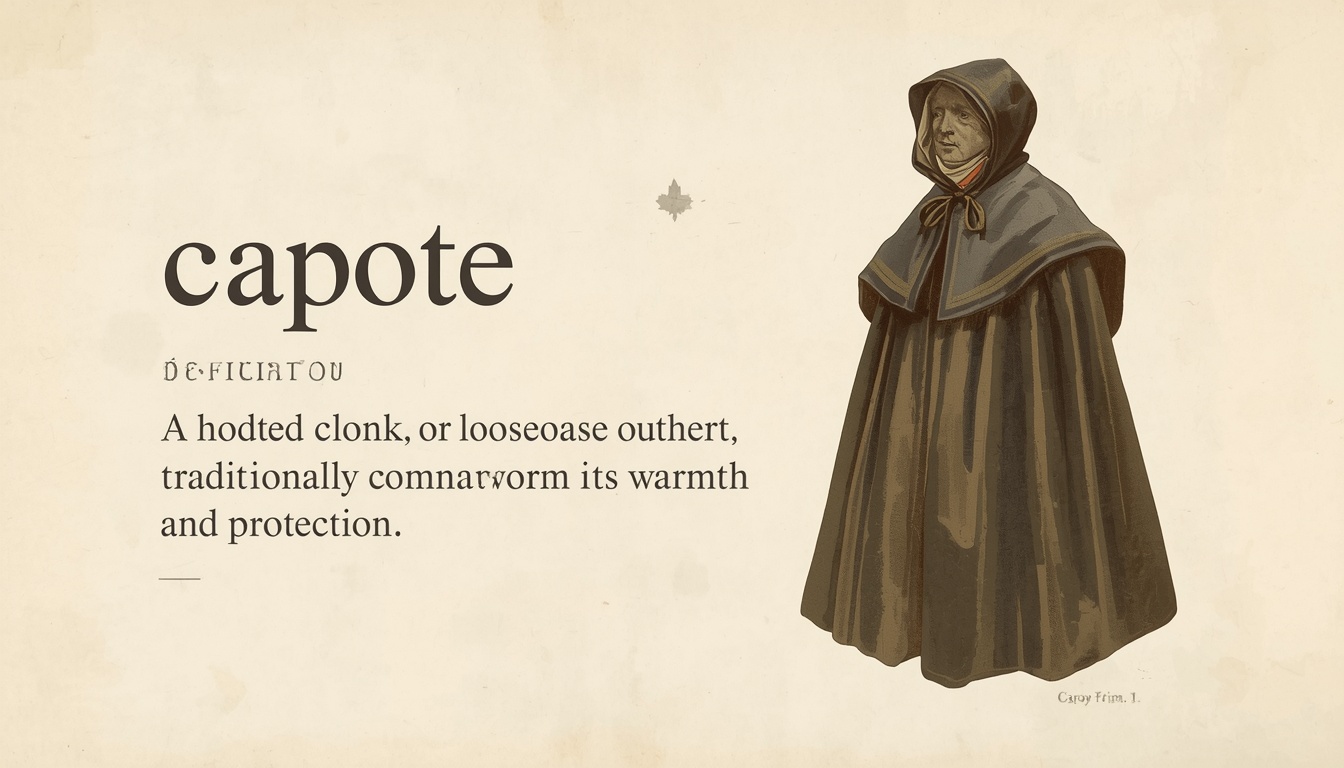
The most basic capote meaning is a type of long outer garment, usually a hooded cloak or hooded overcoat. It is designed to cover much of the body and provide protection from cold, wind, or unpleasant weather.
A capote may resemble a cloak, but it can also look more like a long coat. The exact appearance has varied according to period, region, and purpose. In older descriptions, it could be a practical garment worn by travelers or people working outdoors.
In simple words, a capote definition could be given as:
- A long, often hooded cloak or overcoat.
- A protective piece of outerwear worn over other clothing.
- In bullfighting, a large cape used by a bullfighter.
- With a capital letter, Capote can refer to Truman Capote, the American writer.
That is why searching for the meaning of capote may produce several apparently different answers. They are connected by the same word, but their contexts are different.
What Is a Capote?
So, what is a capote when the word refers to clothing?
Traditionally, it is a substantial outer garment that may have a hood and a loose, flowing shape. Think of something between a cloak, a cape, and a long protective coat. It isn’t necessarily the fitted sort of overcoat people wear today.
The garment version of the word is especially interesting because clothing once had to work much harder than simply looking fashionable. A traveler’s capote clothing could protect against cold air, rain, wind, and rough outdoor conditions.
A few useful characteristics include:
- A long cloak-like garment.
- A hood or hood-like covering in many versions.
- Loose construction rather than a tight modern fit.
- Use as practical outerwear.
- Protection from cold or harsh weather.
- A design suitable for travelers and outdoor use.
- Similarities to a long overcoat or cape.
So when someone asks, “What does capote mean?” in a clothing context, the safest short answer is: a long, usually hooded cloak or overcoat.
Capote Meaning as a Clothing Garment
The clothing sense of capote is perhaps the oldest-looking meaning to modern readers because it belongs to a world where cloaks and heavy outer garments were ordinary parts of life.
A capote coat could be loose enough to wear over other clothes. Its hood gave additional protection, while the length helped cover the body. Imagine a traveler leaving early in the morning, wrapping a long garment around himself before stepping into cold weather. That is the practical spirit behind the word.
The garment can therefore be understood as a form of protective clothing rather than simply decorative fashion.
This also explains why capote cloak, capote overcoat, and long hooded cloak appear as useful related descriptions. They don’t always mean exactly the same garment, but they help modern readers visualize it.
Capote vs. Cape: Are They the Same?
Capote vs cape is a useful comparison because the two words are related in appearance but shouldn’t automatically be treated as identical.
A cape is generally an outer garment that hangs from the shoulders. It may be short or long and usually doesn’t have sleeves. A capote, by contrast, is often described as a longer and more substantial garment, especially one with a hood.
In other words, a cape can be more open and simple, while a capote may offer greater coverage.
The distinction isn’t perfectly rigid across every historical use, though. Clothing terminology changes over centuries, and old garments rarely respect modern dictionary boxes very politely.
Capote vs. Cloak
The relationship between a capote and a cloak is even closer.
A cloak is a broad category for a loose outer garment worn over other clothes. A capote can be considered a particular kind of cloak or long outer garment, especially when it has a hood.
That means “cloak” can help explain the word without being a perfect replacement in every sentence.
Some useful capote synonyms or near-synonyms include:
- Cloak
- Cape
- Hooded cloak
- Long coat
- Overcoat
- Hooded overcoat
- Outer garment
- Long hooded garment
Still, context matters. A synonym that works for the clothing meaning won’t necessarily work when capote refers to bullfighting.
Capote Pronunciation
The capote pronunciation can look more complicated than it actually is.
In English, it is commonly pronounced approximately as kuh-POHT, with the stress falling on the second syllable. The first part is relatively light, while the second syllable receives the emphasis.
If you’re wondering how to pronounce capote, think:
capote → kuh-POHT
Pronunciation can vary slightly depending on language and accent, particularly when the word is being used in a Spanish or French context.
This is one of those words that looks as if it might demand a dramatic pronunciation, but it doesn’t. Say it naturally and let the context do some of the work.
Capote in Bullfighting
The word takes a completely different visual turn in bullfighting.
A capote in bullfighting is the large cape used by a matador or bullfighter during performances in the arena. It is generally associated with bright pink and yellow coloring, although the exact design can vary.
The bullfighting capote is not simply ordinary clothing. It is a specialized tool used for movements and passes of the bull, helping the bullfighter guide and respond to the animal’s movement.
This gives us an important distinction:
Capote clothing protects a person, while a bullfighting capote is a performance and handling instrument.
The same word therefore describes two very different objects. One belongs to travel and weather; the other belongs to the bullfighting arena.
What Is a Bullfighting Capote?
A bullfighting capote is a large, heavy cape used in the early stages of traditional bullfighting.
Its broad surface allows the bullfighter to make controlled movements that attract and redirect the bull. The colorful fabric creates a striking visual effect as the cape moves through the arena.
People sometimes confuse the capote with the famous red cape associated with bullfighting. But that red cape is generally the muleta, used later in the bullfight by the matador.
The capote is traditionally associated with pink and yellow, making it visually distinct.
So, if you search for capote cape, don’t assume every bullfighting cape is a capote. The specific name depends on the type and stage of the performance.
Why Is a Bullfighting Capote Pink and Yellow?
The familiar pink and yellow cape is one of the strongest visual associations with the word capote.
The colors make the movements of the cape highly visible in the arena. The contrast also creates a dramatic appearance when the fabric sweeps through the air.
An interesting point is that the bull is not attracted to the color in the simplistic way popular culture sometimes suggests. The movement of the cape is far more important to the interaction.
That little detail changes how you understand the scene. The famous image isn’t really about a magical red color; it is about movement, timing, and the relationship between bullfighter and bull.
Capote Etymology and Word History
The capote etymology takes us backward through European languages.
The word is connected with French capote, a term associated with a cape or hooded garment. Its deeper history is linked with the Late Latin cappa, a word associated with a cloak or covering garment.
This history makes sense when you compare the different meanings. The common idea is an outer covering, something placed over the body.
Language often works this way. A word may travel from one language to another, change its shape slightly, pick up new uses, and eventually become associated with people or traditions that weren’t part of its original story.
The origin of capote is therefore closely connected with the history of cloaks, capes, and protective garments.
Capote First Known Use and 1799
The capote first known use in English is commonly given as 1799 in dictionary references such as Merriam-Webster.
That date is useful, but it shouldn’t be interpreted as the exact moment the garment itself was invented. Words often existed in speech, other languages, or earlier written forms before they entered a particular English dictionary record.
The year 1799 tells us about the documented use of the English word, not the birth of the clothing concept.
This distinction is small but important when discussing capote 1799 and its word history.
Capote Meaning and French Connections
The connection with French adds another layer to the story.
French has long contributed clothing vocabulary to English, especially words associated with fashion, garments, and European cultural life. The French capote belongs to this larger linguistic family connected with coverings and cloaks.
The deeper connection with Late Latin cappa is particularly interesting because it shows how a practical object can leave a linguistic footprint that lasts for centuries.
A traveler might have forgotten the exact coat he wore, but the word describing it survived.
Capote as a Word for Travelers
The image of a traveler wearing a long hooded garment is one of the easiest ways to understand the traditional clothing sense.
Before modern waterproof jackets, heated vehicles, and lightweight technical fabrics, outerwear had a much more basic job: keep the weather away from your body.
A long hooded cloak could provide warmth and coverage while leaving enough freedom to walk or travel. The hood was especially useful because it protected the head without requiring a separate hat.
In that sense, the capote belongs to the long human story of making clothes practical before making them fashionable.
Capote Meaning in Historical Clothing
Historical garments are rarely as simple as dictionary illustrations make them appear.
A capote garment could differ in fabric, length, hood design, and construction depending on where and when it was worn. Some versions may have looked closer to a cloak, while others resembled a long coat.
That variation is why descriptions such as long cloak, long overcoat, and hooded overcoat are all useful when explaining the word.
If you’re reading an old novel, historical document, or museum description and encounter “capote,” the surrounding sentence is important. It tells you which version the writer intended.
Capote Meaning vs. Truman Capote
There is another major meaning that needs its own little room.
Capote can also refer to Truman Capote, the famous American writer whose surname became widely recognized in literature and popular culture.
Here, the word isn’t describing a garment at all. It is a biographical name, meaning a person’s surname.
Truman Capote was born in 1924 and died in 1984. He became known as an influential American writer and is particularly associated with works including Breakfast at Tiffany’s and In Cold Blood.
So when you see Capote capitalized, don’t immediately start looking for a coat.
Who Was Truman Capote?
Truman Capote was an American writer known for his distinctive prose, nonfiction, fiction, and highly recognizable public personality.
His name appears in literary discussions, biographies, films, interviews, and cultural history. That makes Truman Capote writer a completely separate search intent from the clothing definition.
The distinction is simple:
- capote can mean a garment.
- capote can refer to a bullfighting cape.
- Capote can be the surname of Truman Capote.
Capitalization and context do a surprising amount of heavy lifting here.
Capote Meaning: Common Confusion Explained
One reason people search for capote word meaning is that online dictionaries, literary references, and bullfighting articles can make the word seem inconsistent.
But there isn’t necessarily a contradiction.
If you’re reading about clothing, capote probably means a cloak or overcoat.
If you’re reading about a Spanish bullfight, it probably means the large cape used by a bullfighter.
If you’re reading about American literature, Capote may refer to Truman Capote.
The surrounding subject is your best clue.
Read more: https://ytmeaning.com/goon-meaning/
Capote Synonyms and Related Words
If you need a capote synonym, choose one according to the intended meaning rather than simply replacing the word everywhere.
For the garment meaning, useful related words include:
- Cloak
- Cape
- Hooded cloak
- Overcoat
- Long coat
- Hooded overcoat
- Outerwear
- Outer garment
For bullfighting, related terms include:
- Bullfighter
- Matador
- Cape
- Bull
- Arena
- Passes
- Bullfighting
For the name, relevant terms include:
- Truman Capote
- American writer
- Author
- Biography
- Literature
- Fiction
- Nonfiction
This is a good example of why context is more useful than memorizing one perfect synonym.
How to Understand Capote in a Sentence
When you encounter the word in real writing, look at the words around it.
For example, if a sentence describes someone putting on a hooded overcoat before walking into cold weather, the clothing meaning is obvious.
If it mentions a matador, a bull, an arena, and colorful fabric, you’re almost certainly dealing with the bullfighting meaning.
If the sentence discusses an American novelist born in 1924, you’re looking at Truman Capote.
This simple context method can save you from a surprising amount of dictionary confusion.
Why the Word Capote Is Interesting
The fascinating thing about capote meaning is not merely that the word has multiple definitions. It is that those definitions reveal different pieces of cultural history.
One meaning takes us toward old clothing and travel. Another enters the highly visual world of bullfighting. The capitalized form takes us into twentieth-century American literature.
Three doors, one spelling.
That is the sort of thing that makes vocabulary worth exploring. A dictionary definition may take only one sentence, but the history behind that sentence can stretch across languages, countries, centuries, and human traditions.
Quick Capote Meaning Guide
If you only need the answer quickly, this short guide should clear things up:
- Capote meaning: A long, usually hooded cloak or overcoat.
- Capote noun: A noun describing a type of outer garment.
- Capote pronunciation: Commonly approximated as “kuh-POHT.”
- Capote clothing: Protective outerwear similar to a cloak or long coat.
- Capote in bullfighting: A large cape used by a bullfighter or matador.
- Bullfighting capote color: Traditionally associated with pink and yellow.
- Capote etymology: Connected through French with the older Late Latin cappa.
- Capote first known use: Commonly dated to 1799 in English dictionary records.
- Capote capitalized: May refer to Truman Capote, the American writer.
Frequently asked questions
capote meaning
Capote means a long, usually hooded cloak or overcoat worn as an outer garment. The word can also refer to a special cape used in bullfighting.
define capote
A capote is a long, loose outer garment, often with a hood, similar to a cloak or overcoat. In bullfighting, it refers to the large cape used by a matador.
capote definition
The capote definition is a long hooded cloak or overcoat used as protective outerwear. In another context, it means the colorful cape used in traditional bullfighting.
what is a capote
A capote is a type of long cloak or hooded overcoat that covers the body for protection from the weather. It can also mean a bullfighter’s cape.
capote cloak
A capote cloak is a long, loose, often hooded garment worn over other clothing. It provides coverage and warmth and is closely related to the traditional cloak.
Final Thoughts on Capote Meaning
The capote definition becomes much easier once you stop trying to force every occurrence of the word into one meaning.
At its heart, the lowercase capote can describe a long cloak, hooded garment, or overcoat. In the world of bullfighting, it becomes the colorful cape handled by a matador. With a capital C, it may point directly to Truman Capote, the American writer.
The word’s journey through French, Late Latin cappa, historical clothing, and bullfighting gives it a richer story than its short spelling suggests. Its recorded English use around 1799 adds another small piece to that history.
So the next time you see “capote,” pause for half a second before reaching for the dictionary. Look at the sentence, notice the subject, and ask what world the writer is talking about.
Sometimes a word is not just a word. Sometimes it is a cloak, sometimes a cape, and sometimes a famous name wearing a capital letter.