
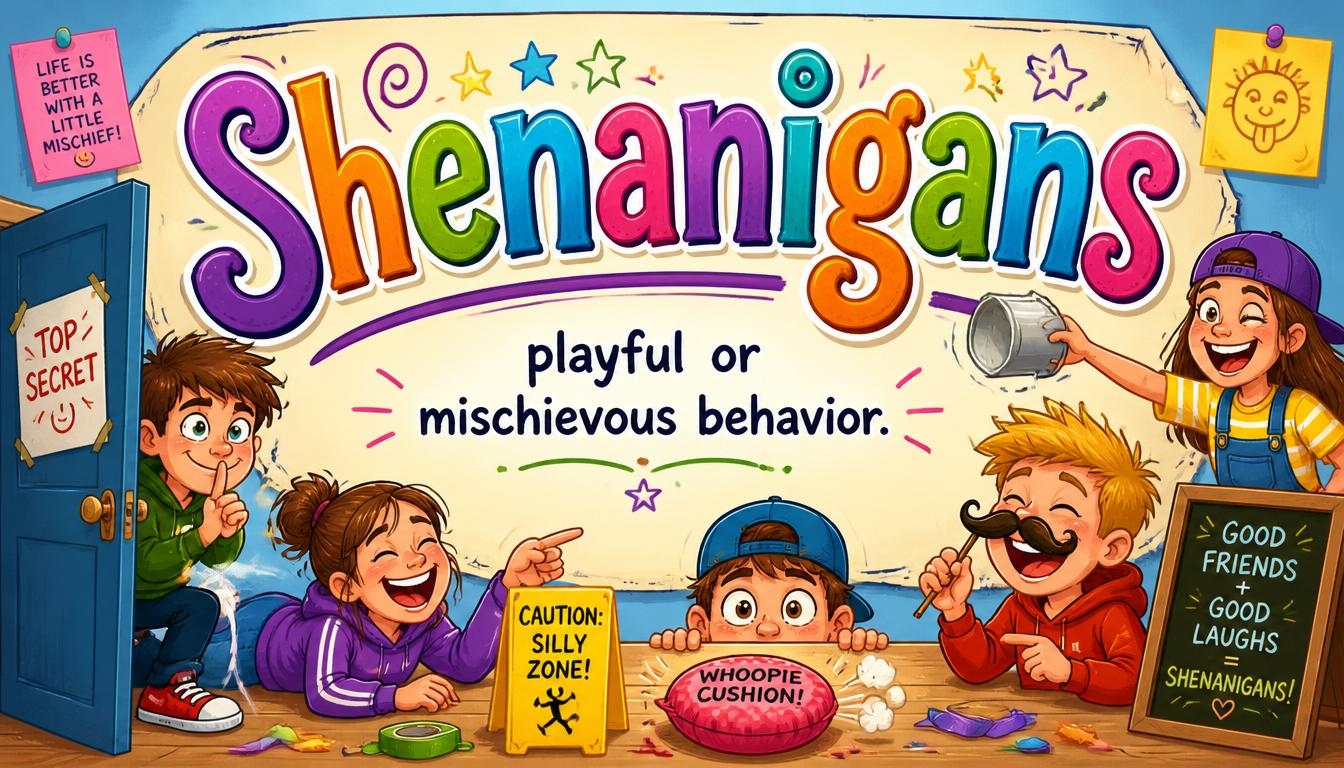

Have you ever watched a group of friends laughing over a silly prank, caught children doing something delightfully naughty, or heard someone complain about suspicious activities happening behind closed doors? There’s a rather interesting word for all these situations: shenanigans. It is one of those expressive English words that can make an ordinary sentence sound playful, humorous, or even a little suspicious.
Understanding the shenanigans meaning is easier when you look at how people use it in everyday conversations. Sometimes, it describes harmless fun, unexpected adventures, and childish mischief. At other times, it points toward dishonesty, questionable practices, or activities that aren’t exactly above board. Quite a range for one little word, isn’t it?
Whether someone mentions schoolyard pranks, political misconduct, financial tricks, or friends getting into trouble during a weekend trip, shenanigans can fit the situation. Let’s explore its meaning, origins, synonyms, examples, and different ways to use it naturally.
What Does Shenanigans Mean?
The word shenanigans refers to mischievous, playful, silly, deceptive, or questionable activities. Its meaning changes according to the situation in which it appears. It can describe innocent fun between friends or serious behavior involving dishonesty and improper conduct.
For example, when children secretly decorate their teacher’s desk with colorful paper, someone might call their actions youthful shenanigans. But when business executives manipulate financial records, the same word can describe something much more serious.
In simple English, shenanigans can mean:
- Mischievous behavior or playful troublemaking.
- Funny or silly activities that create laughter.
- Pranks and unexpected antics.
- Deceptive behavior or dishonest conduct.
- Questionable practices that seem improper.
- Underhanded tricks performed for personal advantage.
The interesting part is that the word doesn’t always communicate whether something is harmless or harmful. You need to understand the surrounding conversation to catch its intended meaning.
Shenanigans Meaning in Different Contexts
One reason this word remains popular is its flexibility. People use it in casual conversations, entertainment writing, workplace discussions, and even political reporting. The same expression can create a completely different impression depending on its context.
1. Shenanigans Meaning as Playful Mischief
In everyday conversations, shenanigans often describes harmless mischief, funny behavior, and spontaneous adventures. Imagine three friends trying to bake a cake, accidentally covering the kitchen in flour, and laughing about the disaster afterward.
Someone might say, “We had some hilarious shenanigans in the kitchen last night!”
Here are a few situations where this meaning fits:
- Friends pulling harmless pranks on one another.
- Children playing silly games after school.
- Siblings hiding each other’s belongings for fun.
- Students engaging in youthful shenanigans on the last day of school.
- Campers creating funny memories during summer camp.
- Friends laughing over unexpected holiday adventures.
- Someone making silly faces during a serious family photograph.
- A group of cousins turning a quiet gathering into a hilarious evening.
These activities are usually associated with mischief, antics, pranks, and high-spirited behavior. They might be slightly annoying, but they’re often remembered with a smile.
2. Shenanigans Meaning as Dishonest or Questionable Behavior
Not every shenanigan is funny. Sometimes the word describes actions that are dishonest, suspicious, or morally questionable.
Consider a company hiding important information from its customers or someone manipulating financial records to avoid responsibility. Such actions can be described as financial shenanigans.
Examples include:
- Corporate executives hiding financial information.
- Politicians making questionable arrangements behind closed doors.
- Employees manipulating reports for personal benefits.
- Businesses using deceptive practices to mislead customers.
- Officials engaging in suspicious local government activities.
- Individuals using dishonest tactics to gain an advantage.
- Organizations avoiding accountability through underhanded practices.
In these situations, shenanigans becomes closely associated with misconduct, deception, dishonesty, and improper conduct.
It is worth remembering that calling something shenanigans doesn’t automatically prove wrongdoing. It can express suspicion, criticism, or disapproval rather than establish that a particular action was illegal.
3. Shenanigans Meaning as Tricks and Underhanded Activities
Historically, the word also referred to a devious trick, particularly one performed for an underhand purpose.
This meaning focuses more on clever deception than ordinary playful behavior. Someone might arrange a situation to confuse another person, manipulate the facts, or achieve something unfairly.
For example:
- A dishonest salesperson making misleading promises.
- Someone creating a clever excuse to escape responsibility.
- A person secretly changing the rules of a competition.
- An individual using manipulation to gain an unfair advantage.
- Someone hiding important details to make another person believe a false story.
- A business engaging in questionable dealings.
- A person using cunning tricks to deceive unsuspecting friends.
These situations involve trickery, scheming, manipulation, and underhanded tricks.
Shenanigan Definition, Pronunciation, and Grammar
If you are learning English, understanding the grammatical details can help you use this word without making awkward sentences.
According to Merriam-Webster, shenanigan is a noun with meanings that include questionable conduct, mischievous activity, and a devious trick.
Here are its basic language details:
- Word: Shenanigan
- Plural: Shenanigans
- Part of speech: Noun
- Pronunciation: shə-ˈna-ni-gən
- Register: Informal and conversational
- Meaning: Mischievous activities, questionable practices, or deceptive tricks.
Although the singular form is shenanigan, people commonly use the plural form when talking about mischievous or questionable activities.
For example:
- Singular: That was quite a shenanigan.
- Plural: The children were getting into all sorts of shenanigans.
- Singular: His little shenanigan surprised everyone.
- Plural: We laughed about their weekend shenanigans.
The plural version is especially common in everyday English, so you’ll probably hear it more frequently in conversations, films, and social media.
Shenanigans Examples in Everyday Sentences
Sometimes a dictionary definition isn’t enough. You want to see how a word behaves in real conversations, and that’s where examples become useful.
Here are some natural shenanigan examples covering humorous, playful, and serious situations.
Funny and Playful Shenanigans
- The children were up to their usual shenanigans during the family picnic.
- My friends always create ridiculous shenanigans whenever we travel together.
- The puppy’s kitchen shenanigans left flour all over the floor.
- We spent the entire evening laughing about our silly holiday adventures.
- Their classroom shenanigans made the last day of school unforgettable.
- My younger brother is famous for his harmless shenanigans.
- The cousins got into all kinds of mischief during summer camp.
- Nobody expected such hilarious shenanigans at Grandma’s birthday party.
- Our weekend plans quickly turned into a series of unexpected antics.
Serious and Questionable Shenanigans
- The newspaper investigated the financial shenanigans involving the company.
- Employees complained about questionable practices within the organization.
- The politician was criticized for his alleged political shenanigans.
- Customers became suspicious of the business’s deceptive behavior.
- The investigation revealed several examples of corporate misconduct.
- Residents demanded answers about the shenanigans happening in local government.
- The manager refused to tolerate dishonest activities in the workplace.
- The organization promised to investigate the reported financial irregularities.
Casual Conversational Shenanigans
- What kind of shenanigans did you get into last night?
- Enough with the shenanigans; let’s finish our work.
- I don’t trust those two together because they’re always planning something silly.
- Stop your shenanigans before someone gets hurt.
- There were plenty of funny shenanigans during our road trip.
- I heard about your weekend adventures, sounds like quite a story!
- Those little shenanigans made everyone laugh.
Shenanigan Synonyms: Other Words With Similar Meanings
If you want to expand your vocabulary, learning shenanigan synonyms is a great place to start. English offers plenty of expressions that describe mischief, trickery, and playful behavior.
However, not every synonym has exactly the same meaning. Some sound humorous, while others suggest dishonesty or wrongdoing.
Words That Mean Mischief and Playfulness
- Mischief: Playful or troublesome behavior, often without serious intentions.
- Antics: Silly, amusing, or attention-seeking actions.
- Pranks: Tricks played on someone for amusement.
- Hijinks: Energetic, silly, and mischievous activities.
- Horseplay: Rough or playful physical behavior.
- Capers: Exciting, unusual, or amusing adventures.
- Tomfoolery: Silly or foolish behavior.
- Nonsense: Behavior or talk that seems ridiculous.
- Foolishness: Actions that show poor judgment.
- Monkey business: Suspicious or mischievous activities.
Words That Mean Deception or Misconduct
- Trickery: The use of tricks to deceive someone.
- Deception: Deliberately making someone believe something untrue.
- Misconduct: Improper or unacceptable behavior.
- Dishonesty: A lack of truthfulness.
- Scheming: Secretly planning something, often for personal advantage.
- Manipulation: Influencing someone or a situation unfairly.
- Fraud: Intentional deception for unlawful or unfair gain.
- Impropriety: Behavior that does not meet accepted standards.
- Wrongdoing: An action that is dishonest or morally wrong.
- Underhandedness: Dishonest behavior intended to achieve an advantage.
The best synonym depends on what you’re trying to communicate. Calling a child’s playful prank misconduct would sound unnecessarily serious, while describing corporate fraud as simple mischief might make the situation sound less important than it is.
Is Shenanigans a Positive or Negative Word?
This is a particularly interesting question because the word can carry both positive and negative meanings.
When used for playful activities, shenanigans usually sounds affectionate, humorous, or mildly critical. Parents might laugh about their children’s antics, and friends might use it to describe their unforgettable adventures.
For example, “I miss the shenanigans we used to get into during college.”
Here, the speaker is probably remembering enjoyable moments rather than serious trouble.
However, when the word appears in discussions about business, politics, or public institutions, its meaning can become negative.
Consider these expressions:
- Political shenanigans.
- Financial shenanigans.
- Corporate shenanigans.
- Government shenanigans.
- Workplace shenanigans.
These phrases often suggest questionable behavior, deceptive practices, or unethical conduct.
So, is shenanigans a positive or negative word? The honest answer is that it depends on the speaker’s intention and the situation.
Word History: Where Did Shenanigan Come From?
The history of shenanigan is almost as mysterious as the behavior it describes. Linguists and etymologists have explored possible explanations for its origin, but its exact beginnings remain uncertain.
According to Merriam-Webster, the earliest known use of the word in print dates to 1854. It first appeared with the meaning of a devious trick, particularly one performed for an underhand purpose.
Over time, its meaning expanded to include questionable practices and playful, high-spirited activities.
Today, the word is used in many different situations, from children making a mess at summer camp to journalists discussing suspicious corporate activities.
A few important historical details include:
- First known use: 1854.
- Historical period: Mid-1800s.
- Original documented meaning: A devious or underhanded trick.
- Modern meanings: Mischievous activity and questionable conduct.
- Etymology: Origin unknown.
The shenanigan word origin is not completely established, so it would be misleading to present one particular theory as proven fact.
Its unusual spelling and lively sound have certainly helped make it memorable in English vocabulary.
Shenanigans in Real-Life Situations
The word becomes even easier to understand when you imagine ordinary situations where people might naturally use it.
Shenanigans Among Friends
Picture a group of old friends meeting after several years. One person starts telling embarrassing stories, another brings up an old prank, and suddenly everyone is laughing about things they thought they had forgotten.
Someone might say, “We haven’t changed at all; the shenanigans are still the same!”
In this context, the word creates a warm sense of nostalgia and friendship.
Shenanigans at School and Summer Camp
School environments are full of opportunities for playful mischief. Students might exchange funny notes, organize harmless surprises, or create unexpected adventures during their final days together.
Similarly, summer camp often brings youthful shenanigans, silly competitions, and memorable group activities.
Of course, there is a difference between harmless pranks and damaging behavior. Vandalism or dangerous horseplay should not be excused simply because someone calls it mischief.
Political and Financial Shenanigans
In news reporting, shenanigans often appears when discussing suspicious actions involving influential people or institutions.
For example, political shenanigans might involve alleged manipulation, questionable arrangements, or activities that undermine public trust.
Financial shenanigans can describe attempts to misrepresent financial information, hide losses, or mislead investors.
In these situations, the word communicates criticism and suspicion, although the facts still need to be established independently.
Difference Between Shenanigan and Shenanigans
Many English learners wonder whether shenanigan and shenanigans mean different things.
They are closely related forms of the same noun. The main difference is grammatical number and how commonly each form appears.
Shenanigan is singular and refers to one trick, mischievous act, or questionable activity.
Example: “That little shenanigan nearly ruined the surprise.”
Shenanigans is plural and refers to multiple activities, tricks, or instances of questionable behavior.
Example: “The children were enjoying their usual weekend shenanigans.”
In everyday conversation, the plural form is much more familiar, particularly when describing general mischief or suspicious activities.
Both forms are correct, but choosing the right one makes your sentence sound more natural.
Common Expressions and Phrases Using Shenanigans
Some expressions using this word appear so frequently in everyday conversations that they’re worth learning individually.
- Funny shenanigans: Amusing and silly activities.
- Political shenanigans: Questionable or suspicious political behavior.
- Financial shenanigans: Dishonest or misleading financial activities.
- Youthful shenanigans: Mischievous activities commonly associated with young people.
- Office shenanigans: Funny or questionable workplace activities.
- Weekend shenanigans: Adventures, pranks, and activities during the weekend.
- Stop the shenanigans: Stop behaving foolishly or engaging in suspicious activities.
- Up to your shenanigans: Getting involved in mischievous or questionable behavior.
- More shenanigans: Additional silly or suspicious activities.
- Harmless shenanigans: Playful activities that do not cause meaningful harm.
These expressions can make your everyday English sound more colorful and expressive, especially when you’re telling stories or describing unusual situations.
How to Use Shenanigans Naturally in Conversation
Learning a new word is one thing; using it naturally is another. The trick is to pay attention to the mood of the conversation.
If you’re talking with friends, shenanigans can add a playful touch to your words. If you’re discussing serious misconduct, it can communicate criticism without sounding overly technical.
Here are a few useful suggestions:
- Use it when describing harmless pranks and silly adventures.
- Try it when recalling funny memories with friends.
- Use it carefully when discussing questionable business practices.
- Avoid using it to minimize genuinely harmful or illegal activities.
- Pay attention to whether the conversation is humorous or serious.
- Remember that the plural form is more common in ordinary conversation.
For example, instead of saying, “We did some silly things during our holiday,” you could say, “Our holiday was full of hilarious shenanigans.”
It adds personality to the sentence without changing its basic meaning.
Frequently Asked Questions About Shenanigans
What does shenanigans mean in simple English?
Shenanigans means silly, mischievous, or questionable activities. It can describe harmless pranks between friends or dishonest actions involving deception.
What is the singular form of shenanigans?
The singular form is shenanigan. For example, “That was an unexpected shenanigan.” The plural form is more commonly used in everyday English.
Is shenanigans a slang word?
Shenanigans is an informal English noun, but it is not simply internet slang. It has a long history in the English language and appears in established dictionaries.
What are the most common shenanigan synonyms?
Common synonyms include mischief, antics, pranks, hijinks, trickery, misconduct, and tomfoolery. The appropriate choice depends on whether you’re describing playful or dishonest behavior.
What does political shenanigans mean?
Political shenanigans refers to suspicious, deceptive, or questionable activities associated with politicians or political institutions. It generally expresses criticism or distrust.
What does financial shenanigans mean?
Financial shenanigans describes questionable or dishonest activities involving money, financial records, accounting, or business transactions.
Is shenanigans a rude word?
No, shenanigans is generally not considered rude or offensive. It is an informal expression that can sound playful, humorous, or mildly critical.
When was shenanigan first used?
Merriam-Webster records 1854 as the first known use of shenanigan in print, originally referring to a devious trick.
How do you pronounce shenanigan?
The pronunciation is shə-ˈna-ni-gən. The word is generally spoken with four syllables: she-na-ni-gan.
Can shenanigans describe harmless fun?
Absolutely! It is frequently used to describe playful mischief, silly adventures, funny pranks, and youthful activities that create happy memories.
Read more;;;;;;;;;;;;https://ytmeaning.com/dds-meaning/
Final Thoughts on Shenanigans Meaning
Language has a wonderful way of turning ordinary experiences into memorable expressions, and shenanigans is a perfect example. One moment it can describe children laughing over a harmless prank, and the next it can refer to questionable financial practices or political misconduct.
The shenanigans meaning ultimately depends on context. It can represent mischief, playful antics, trickery, deception, or improper conduct. Understanding these differences helps you recognize the word in conversations, books, news articles, and everyday English.
So, the next time someone asks what kind of shenanigans you’ve been getting into, remember that they’re probably asking about your mischief or amusing adventures. Just make sure your answer doesn’t involve too much trouble!
English becomes more enjoyable when we discover words that capture life’s funny, surprising, and sometimes questionable moments. And shenanigans certainly has a knack for doing exactly that.