
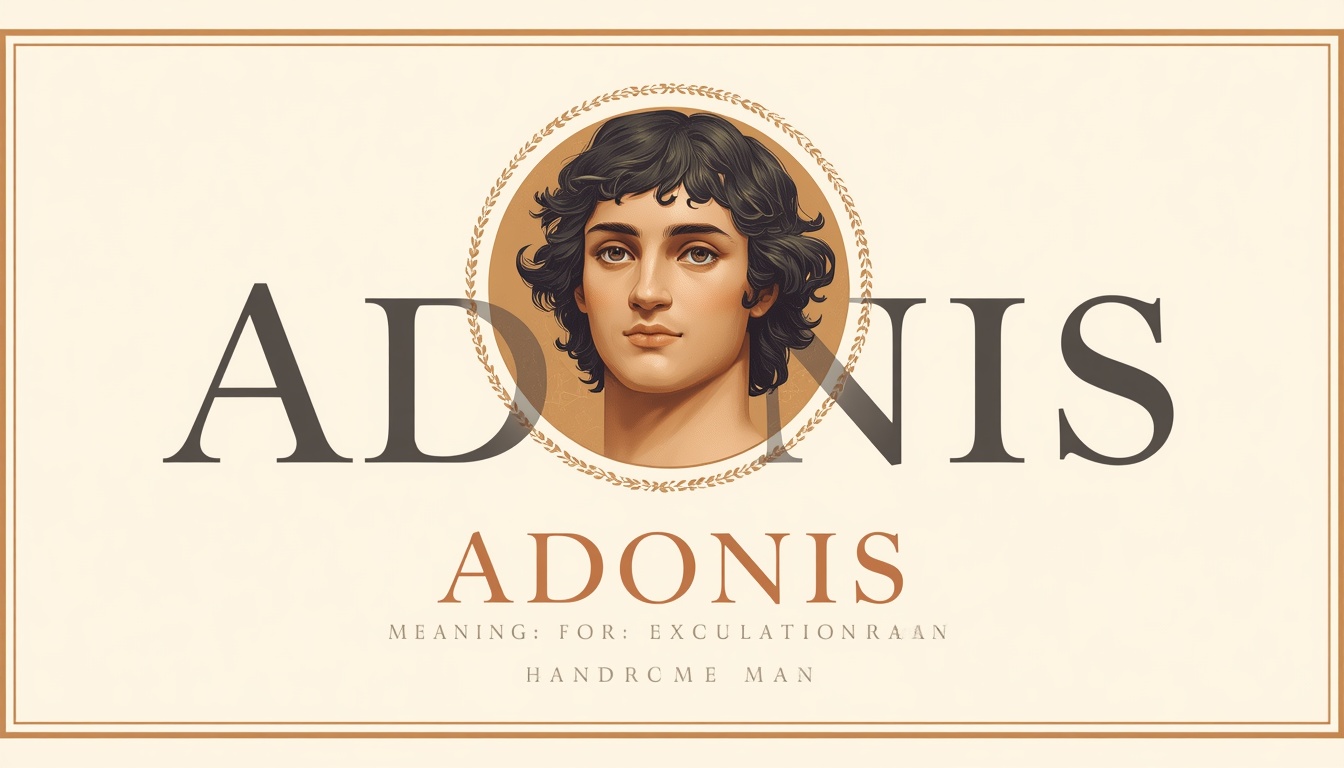

The name Adonis carries a fascinating history that stretches back thousands of years. It is a word associated with extraordinary beauty, youthful charm, attraction, and an unforgettable figure from ancient mythology. When someone describes a man as an Adonis, they are usually referring to someone exceptionally handsome, someone whose appearance seems almost unreal.
But there is much more behind this interesting word than physical attractiveness. Its historical roots, mythological background, romantic symbolism, and modern literary use give it a meaning that goes far beyond a simple compliment.
Understanding Adonis meaning also requires looking at the ancient Greek stories that helped shape its reputation. The myth of Adonis, his relationship with Aphrodite, and the tragic events surrounding his life explain why his name became a lasting symbol of beauty and love.
What Does Adonis Mean?
Adonis generally means an exceptionally handsome, attractive, or beautiful young man. In everyday English, it is often used to describe someone whose physical appearance stands out from everyone around him.
For example, if someone says, “He looks like an Adonis,” they are suggesting that the man is remarkably good-looking. It is a compliment that carries a stronger meaning than simply calling someone handsome.
The word is also connected with Greek mythology, where Adonis was a beautiful young man loved by Aphrodite, the goddess of love and beauty. His legendary appearance became an important part of his identity.
Today, the word can describe:
- A remarkably handsome man.
- Someone with exceptional physical attractiveness.
- A person associated with youthful beauty and charm.
- A symbol of romantic attraction and desire.
- A mythological figure connected with love, beauty, and renewal.
Although the word is most commonly used for men, its cultural meaning also represents the broader human fascination with beauty and attraction.
Adonis Definition and Pronunciation
The word Adonis is a proper noun originating from ancient mythology, but it is also used as a common descriptive term in modern English.
Adonis pronunciation: uh-DON-iss.
It is generally pronounced with emphasis on the middle syllable, making the name easy to recognize in ordinary conversation.
Dictionary-style definition:
Adonis (noun): An exceptionally handsome young man; a person whose appearance is considered extraordinarily attractive.
Here are a few examples showing how it works in sentences:
- Everyone at the event noticed the young Adonis standing near the entrance.
- His friends jokingly called him an Adonis because of his remarkable appearance.
- The actor was described as a modern Adonis in the entertainment magazine.
- In classical mythology, Adonis was associated with extraordinary beauty and romantic love.
The word can sometimes sound playful, particularly when used among friends. However, in literature, poetry, and formal descriptions, it can express admiration for someone’s appearance.
Who Was Adonis in Greek Mythology?
Adonis was a celebrated figure in Greek mythology, remembered for his extraordinary beauty and his romantic connection with Aphrodite.
His story became one of the most recognizable ancient tales about love, desire, mortality, and loss. Unlike some mythological heroes who were famous for their strength or victories in battle, Adonis became famous because of his appearance and the affection he inspired.
According to a widely known version of the myth, Adonis was born to Myrrha, also known in some traditions as Smyrna. His birth was surrounded by unusual and tragic circumstances.
As he grew older, his beauty attracted the attention of Aphrodite, who became deeply attached to him. Their relationship became central to his mythology.
Adonis was also associated with the natural world, particularly seasonal renewal and the cycle of life. His death and symbolic return in some traditions helped connect his story with changing seasons and the temporary nature of beauty.
This is why the meaning of Adonis cannot be understood through appearance alone. His myth represents a combination of attraction, love, vulnerability, and the passing nature of life.
The Story of Adonis and Aphrodite
One of the most famous parts of the Adonis legend is his relationship with Aphrodite, the Greek goddess of love and beauty.
According to the traditional story, Aphrodite became captivated by Adonis because of his remarkable appearance. She cared deeply for him and wanted to protect him from danger.
Adonis, however, enjoyed hunting and spending time outdoors. His interest in hunting eventually became an important part of the tragedy surrounding his life.
Aphrodite reportedly warned him about the dangers of hunting wild animals, especially creatures capable of seriously injuring him. But Adonis continued pursuing his passion.
Their relationship is often interpreted as a story about love that cannot completely protect someone from the uncertainties of life.
It also explains why Adonis became a powerful symbol of romantic attraction. His name represents the kind of beauty that inspires admiration and affection, even when surrounded by sadness.
Why Is Adonis Associated With Beauty?
The association between Adonis and beauty comes primarily from his mythological reputation.
Ancient storytellers presented him as a young man whose appearance was so extraordinary that even a goddess became deeply attracted to him. This description helped establish his name as a symbol of masculine beauty.
Over time, writers, poets, artists, and ordinary speakers began using his name beyond the original mythological setting.
There are several reasons why this association remains strong:
- Youthfulness: Adonis represents the beauty and energy associated with youth.
- Physical attractiveness: His appearance is the most recognizable feature of his legend.
- Romantic appeal: His relationship with Aphrodite connects his name with love and desire.
- Literary symbolism: Writers use Adonis to represent idealized masculine beauty.
- Cultural influence: His story has remained recognizable through art, literature, and popular language.
Interestingly, calling someone an Adonis does not necessarily mean they have a particular body type or appearance. It is a subjective expression of admiration.
Adonis Name Meaning and Historical Origin
The historical origin of the name Adonis is particularly interesting because its roots are generally connected with ancient Near Eastern languages.
Many scholars associate the name with the Semitic word adon, meaning lord or master. This connection is commonly discussed when explaining the historical background of the name.
The Greek form became associated with the mythological Adonis, whose story developed through cultural traditions connecting the ancient Mediterranean and Near Eastern worlds.
Some accounts also connect Adonis with older fertility and seasonal-renewal traditions.
His mythology has similarities with ancient stories involving vegetation, death, and rebirth. However, these traditions developed across different cultures, so they should not all be treated as identical.
The name eventually became established in Greek and Roman literary traditions, giving it a lasting place in Western cultural history.
Today, Adonis is used as a personal name as well as a descriptive English word.
Adonis Meaning in Literature
In Greek literature, Adonis represents much more than an attractive young man. His character provides writers with an opportunity to explore beauty, desire, love, mortality, and emotional suffering.
His myth has inspired different interpretations throughout literary history.
Writers often use the name Adonis when describing a character who possesses exceptional physical attractiveness. In poetry, it can also represent an idealized image of masculine beauty.
The name carries several literary associations:
- Ideal physical appearance.
- Romantic attraction and admiration.
- Youth and innocence.
- The temporary nature of beauty.
- Love accompanied by tragedy.
- The relationship between life, death, and renewal.
Shakespeare also helped popularize the name through his narrative poem Venus and Adonis, published in 1593.
The poem explores the relationship between Venus, the Roman goddess of love, and Adonis. It presents a version of the ancient myth in which Venus desires Adonis, but he does not share her romantic feelings in the same way.
This literary treatment helped preserve the mythological figure for later generations.
Adonis in Greek and Roman Mythology
The story of Adonis is usually discussed within Greek mythology, although its cultural background is more complicated than a single Greek legend.
His character is connected with traditions that developed across the eastern Mediterranean and the ancient Near East.
In Greek accounts, Aphrodite plays a central role in his story. In Roman mythology, Aphrodite’s equivalent is Venus, and Adonis remains an important figure in romantic and artistic storytelling.
The Roman interpretation became particularly influential through poetry and visual art.
Artists frequently portrayed Adonis as a youthful and attractive figure, often alongside Venus or Aphrodite. These representations helped establish his appearance as a familiar image of classical beauty.
The differences between Greek and Roman storytelling are worth remembering. Although the characters often share names or identities across these traditions, individual authors sometimes changed details to suit their own literary purposes.
What Is the Difference Between Adonis and Oedipus?
Adonis and Oedipus are two completely different figures in Greek mythology. Their stories, symbolic meanings, and literary importance should not be confused.
Although both names are associated with ancient Greek storytelling, they represent different ideas.
Adonis is primarily associated with extraordinary beauty, romantic attraction, and the tragic nature of youthful life.
Oedipus, on the other hand, is remembered as a tragic Greek hero whose story explores fate, prophecy, identity, and family relationships.
The distinction is important because searches such as “Adonis meaning Oedipus” can combine two separate mythological topics.
Here is a simple comparison:
| Feature | Adonis | Oedipus |
|---|---|---|
| Mythological identity | Beautiful young man | Tragic Greek hero |
| Main association | Beauty and attraction | Fate and tragedy |
| Important relationship | Aphrodite | Jocasta |
| Father | Cinyras in a common tradition | Laius |
| Famous literary connection | Venus and Adonis | Oedipus Rex |
| Main symbolism | Youth and beauty | Prophecy and destiny |
The two figures are not interchangeable. Understanding their separate stories makes their meanings much easier to recognize.
Who Was Oedipus in Greek Mythology?
Oedipus was a famous figure in ancient Greek mythology, particularly known through the tragedy Oedipus Rex by Sophocles.
He was the son of Laius and Jocasta, the rulers of Thebes. According to the prophecy surrounding his birth, Oedipus would eventually kill his father and marry his mother.
His parents attempted to prevent this terrible prediction from becoming reality. However, events unfolded in a way that eventually fulfilled the oracle’s prophecy.
Oedipus unknowingly killed Laius and later married Jocasta without realizing their family relationship.
His story became one of the most influential examples of Greek tragedy, exploring the complicated relationship between fate and free will.
Other important figures in his mythology include the Sphinx, Antigone, and the people of Thebes.
What Is the Oedipus Complex?
The Oedipus complex is a psychological concept associated with Sigmund Freud and the development of psychoanalysis.
Freud used the name of the Greek mythological figure to describe a proposed stage of childhood psychological development involving unconscious emotional desires and rivalry within family relationships.
In Freud’s original theory, the concept involved a young child’s unconscious attachment to the opposite-sex parent and rivalry with the same-sex parent.
The term later became influential in discussions of psychoanalysis, psychology, and literary interpretation.
However, it is important to understand that the Oedipus complex is a historical psychoanalytic theory, not an established scientific explanation of every child’s emotional development.
The related adjective Oedipal describes something connected with the Oedipus complex or its themes.
The term Oedipean is another less commonly encountered form associated with Oedipus.
These expressions belong to the history of psychology and literary criticism, not to the definition of Adonis.
Adonis Meaning in Modern English
In modern English, Adonis has developed into a familiar expression that can be used in everyday conversations, entertainment writing, and social descriptions.
Someone might call a celebrity an Adonis because of their striking appearance. Another person might use it humorously when describing a friend who spends a lot of time maintaining their appearance.
For example:
- “That model looks like a real Adonis.”
- “He walked into the room looking like an Adonis.”
- “The magazine described the actor as a modern-day Adonis.”
- “Everyone was joking that their new fitness instructor was an Adonis.”
The expression is generally positive, although its meaning depends on context.
Sometimes it is used sincerely, while in other situations it can be playful or slightly exaggerated.
It is also worth noting that the word can suggest an idealized standard of masculine attractiveness rather than a realistic description of someone’s entire personality.
Adonis as a Symbol of Youth and Mortality
One of the deeper interpretations of Adonis comes from the relationship between beauty and mortality.
His mythology reminds readers that physical attractiveness and youth do not last forever. Even someone admired by a goddess cannot escape every danger or uncertainty.
This gives his story a more emotional meaning than a simple description of handsome appearance.
His death is connected with the natural cycle of life in several ancient traditions. The Adonis festivals, especially those associated with mourning and renewal, reflected this symbolic relationship.
The Adonia was an ancient festival associated with Adonis. In some celebrations, women planted quick-growing Adonis gardens in shallow containers. These plants grew rapidly but soon withered, symbolizing the shortness of life.
This tradition offers an interesting interpretation of his name.
Adonis can represent beauty at its brightest, but also the fragile nature of everything that makes life precious.
Adonis Meaning in Art and Popular Culture
The influence of Adonis has continued well beyond ancient mythology.
Renaissance artists rediscovered classical subjects, and the relationship between Venus and Adonis became a popular theme in European painting.
Poets and playwrights also explored the myth from different perspectives.
In modern entertainment, the word is frequently used to describe male celebrities, fictional characters, models, and public figures who are considered exceptionally attractive.
It may appear in:
- Romantic novels and poetry.
- Film and television descriptions.
- Celebrity and entertainment articles.
- Fashion and lifestyle publications.
- Classical paintings and sculptures.
- Everyday compliments and humorous conversations.
The name has also remained popular as a personal name in different parts of the world.
Parents who choose Adonis for a child may appreciate its historical background, distinctive sound, and associations with beauty and classical mythology.
How to Use Adonis in a Sentence
Understanding a word becomes easier when you see how people actually use it.
Adonis is generally used as a noun, especially when describing an exceptionally handsome man.
Here are some natural examples:
- The young actor was considered an Adonis by his fans.
- His handsome appearance reminded people of the legendary Adonis.
- She described the fictional prince as an Adonis with a charming personality.
- The artist painted Adonis as a symbol of youthful beauty.
- His friends called him Adonis whenever he dressed up for an important occasion.
- The ancient story of Adonis continues to inspire modern writers.
- The character was designed to resemble an Adonis from classical mythology.
When using the word, remember that it is usually a compliment. However, the tone can change depending on the speaker and the situation.
Frequently Asked Questions About Adonis Meaning
What does Adonis mean?
Adonis means an exceptionally handsome or attractive young man. The name comes from a mythological figure associated with beauty and Aphrodite.
Is Adonis a Greek name?
Yes, Adonis is the Greek form of a name with older Semitic linguistic connections. It became widely recognized through ancient Greek mythology.
What is Adonis pronunciation?
Adonis is pronounced uh-DON-iss, with the main emphasis on the middle syllable.
Who was Adonis in Greek mythology?
Adonis was a remarkably beautiful young man loved by Aphrodite, the Greek goddess of love and beauty. His tragic story became associated with youth, romance, and mortality.
What does calling someone an Adonis mean?
Calling someone an Adonis means that you consider him exceptionally handsome. It is usually intended as a compliment about his physical appearance.
Was Adonis a god?
Adonis was originally presented as a mythological mortal in many familiar Greek stories. However, he also became associated with divine and fertility-related traditions, particularly through ancient worship and seasonal symbolism.
Who was Adonis in love with?
Adonis is most famously associated with Aphrodite, the Greek goddess of love. His relationship with her is central to his mythology.
What is the difference between Adonis and Oedipus?
Adonis represents exceptional beauty and romantic attraction, while Oedipus is a tragic Greek hero associated with prophecy, fate, and family relationships.
Read ARticul: https://ytmeaning.com/oedipus-meaning/
What does Adonis mean in literature?
In literature, Adonis often represents idealized masculine beauty, youthful attractiveness, romantic desire, and the temporary nature of life.
Is Adonis a compliment?
Yes, describing someone as an Adonis is generally a compliment. It suggests that the person is remarkably handsome or physically attractive.
oedipus meaning
Oedipus was a figure in Greek mythology, the son of King Laius and Queen Jocasta, known for unknowingly killing his father and marrying his mother.
definition of oedipus
Oedipus is defined as a character in Greek mythology whose tragic fate was shaped by an oracle’s prophecy.
oedipus pronunciation
Oedipus is pronounced ED-uh-pus or EE-duh-pus, with the stress on the first syllable.
oedipus definition
Oedipus refers to the legendary Greek king of Thebes whose story became one of the most famous tragedies in Greek literature.
what does oedipus mean
Oedipus refers to a tragic Greek mythological figure associated with fate, prophecy, family relationships, and the famous Oedipus complex.
Conclusion
The meaning of Adonis is much richer than a single dictionary definition. It connects an ordinary English expression with an ancient mythological figure whose beauty, romantic story, and tragic fate have inspired writers and artists for centuries.
From his relationship with Aphrodite to his symbolic connection with youth and mortality, Adonis remains an unforgettable character in classical mythology.
Today, calling someone an Adonis is a way of expressing admiration for exceptional physical attractiveness. Yet the original story reminds us that beauty is only one part of a much larger human experience.
Whether you encounter the word in a novel, a conversation, a poem, or a discussion about Greek mythology, its meaning becomes clearer when you understand its history.
If you have come across the name Adonis in literature or everyday conversation, share your interpretation or favorite use of the word in the comments. After all, some ancient names never really disappear; they simply find new ways to become part of modern language.