

Have you ever noticed a BMW driving down the road and wondered what those three letters actually mean? The familiar badge appears on everything from sporty sedans to powerful SUVs, and for many drivers, it represents much more than a luxury vehicle. It carries a story of German engineering, aviation history, innovation, and a brand identity that has developed over more than a century.
So, what does BMW stand for, and how did a company that originally focused on aircraft engines become one of the world’s most recognized luxury automobile manufacturers? The answer is more interesting than you might expect.
BMW’s roots go back to Bavaria, Germany, where its early engineering work helped establish the foundation for its modern identity. Today, the company produces luxury cars, motorcycles, and electric vehicles for customers around the world.
Whether you’re considering your first BMW, researching its history, or simply curious about the meaning behind its name, understanding the company’s origins makes the brand even more interesting.
What Does BMW Stand For?
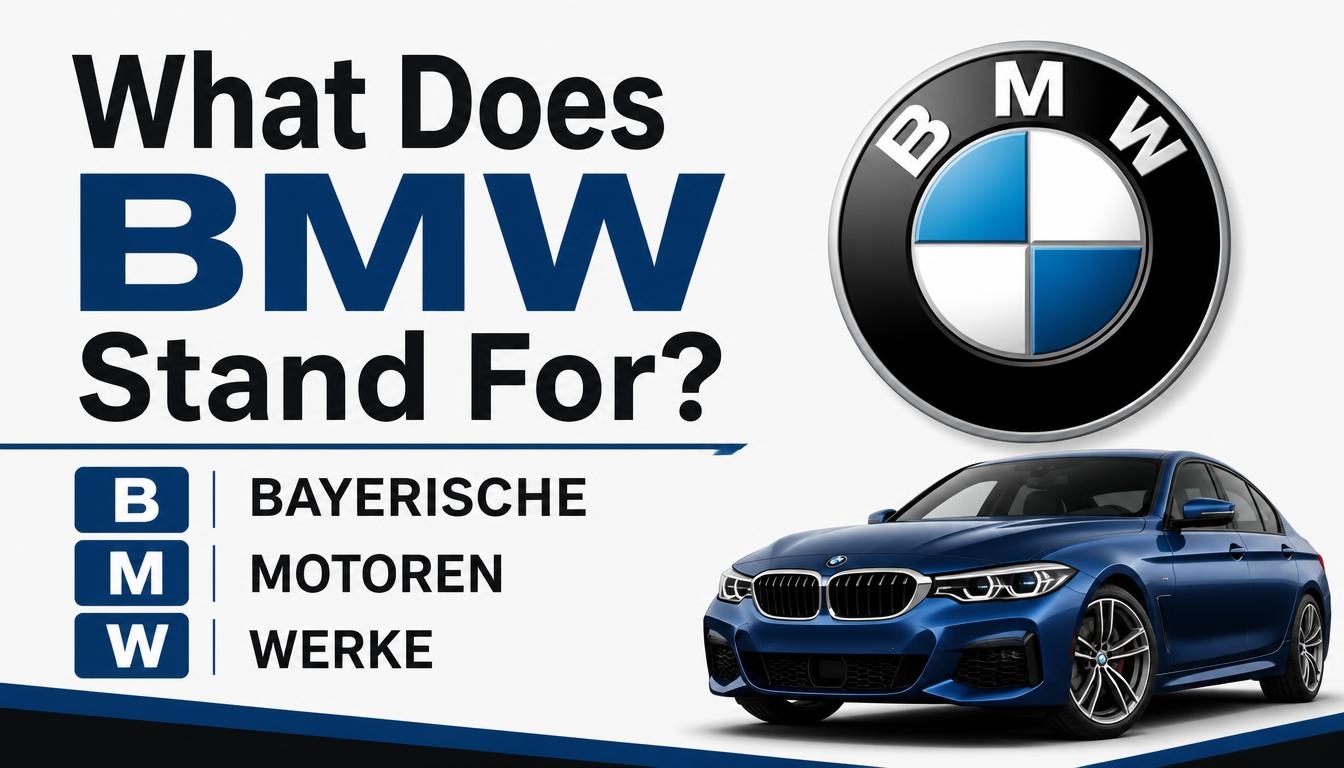
BMW stands for Bayerische Motoren Werke, a German name that translates into Bavarian Motor Works in English.
Each part of the original German name has a particular meaning:
- Bayerische: Refers to Bavaria, the German state where the company originated.
- Motoren: Means motors or engines.
- Werke: Means works or factories.
Put these words together, and you get Bavarian Motor Works, a name that reflects the company’s geographical roots and original engineering business.
When someone searches for what does BMW mean, they’re generally looking for the English translation of these three letters. However, the name also represents the company’s early connection with engine manufacturing, particularly aircraft engines.
BMW wasn’t originally established as a car manufacturer. Its early business focused on developing engines for aircraft, an industry that required precision, technical knowledge, and dependable engineering.
That background eventually helped shape the company’s reputation in motorcycles and automobiles.
What Does BMW Stand For in German?
The official German name is Bayerische Motoren Werke AG. It is pronounced differently from its English translation because German pronunciation follows its own language rules.
For English-speaking drivers, Bavarian Motor Works is the easiest way to understand the name. But the original German wording remains part of BMW’s corporate identity.
You might also notice the letters AG after BMW when reading company documents or business information. AG stands for Aktiengesellschaft, a German legal term describing a stock corporation.
In simple words, BMW AG is the company’s formal corporate name and legal structure.
This distinction is useful because BMW is not just a vehicle badge. It is also the name of a major international business operating across automobile manufacturing, motorcycle production, financial services, and mobility technology.
The company’s German identity remains important even though its vehicles are now manufactured and sold across numerous countries.
BMW Origins: Where Did the Company Begin?
A look at the company’s early beginnings and German engineering heritage.
Bavarian Motor Working: A Visual History of BMW
caranddriver.com
The BMW origins story begins in Bavaria, Germany, particularly in Munich, a city that remains closely connected with the company’s identity.
One important name in its early history is Karl Rapp, an engineer who established Rapp Motorenwerke in 1913. The business focused on producing aircraft engines during a period when aviation technology was developing rapidly.
Aircraft engines required reliable performance and careful engineering. This was an important area of development for German manufacturers, and Rapp Motorenwerke became part of the industrial background from which BMW emerged.
In 1917, the company adopted the name Bayerische Motoren Werke GmbH.
The transformation of the business and its corporate identity helped establish the name that would eventually become famous around the world.
There is also an important historical detail worth understanding: BMW’s official corporate history recognizes 1916 as its founding year, while its familiar BMW name dates from 1917. The early history includes predecessor businesses and corporate changes, which explains why different dates sometimes appear in discussions about its establishment.
Munich remained central to the company’s development, and its connection with Bavaria became an important part of the BMW brand.
BMW History: From Aircraft Engines to Luxury Cars
BMW Model IIIA In-line 6 Engine | National Air and Space Museum
BMW R 32 (1923-1926) Specs, Performance & Photos – autoevolution
The BMW 328.
The BMW history is not simply a story about manufacturing expensive cars. It is a journey through several industries, changing technologies, and different periods of European industrial development.
The company gradually expanded beyond its original aircraft-engine activities and became involved in motorcycle and automobile manufacturing.
Here are some important stages in its development.
1913–1917: The Early Engineering Years
Rapp Motorenwerke was established in 1913 under the leadership of Karl Rapp.
The business concentrated on aircraft engines, and its engineering activities provided an important foundation for BMW’s early development.
In 1917, the company adopted the name Bayerische Motoren Werke, giving the business the recognizable identity it still carries today.
1923: BMW Enters Motorcycle Manufacturing
BMW introduced its first motorcycle, the BMW R32, in 1923.
It featured a horizontally opposed twin-cylinder engine, commonly known as a boxer engine. This design became an important part of BMW motorcycle engineering.
The R32 helped establish the company’s presence in the motorcycle market, opening another direction for its manufacturing business.
1928–1930s: Entering the Automobile Industry
BMW entered automobile manufacturing in 1928 after acquiring Fahrzeugfabrik Eisenach, a German automobile manufacturer.
Its early automobile production began with existing vehicle designs before the company gradually developed its own identity in the car market.
During the 1930s, BMW introduced several notable models, including the BMW 328 sports car, which became recognized for its performance and engineering.
Postwar Years: Rebuilding and Expansion
The Second World War significantly affected BMW’s manufacturing operations.
After the war, the company faced difficult economic and industrial conditions. Rebuilding its production capabilities required considerable effort.
Over time, BMW returned to automobile and motorcycle manufacturing, gradually establishing a stronger position in the international market.
1970s–1990s: Becoming an International Luxury Brand
BMW expanded its model range and developed a stronger reputation for premium automobiles.
Its sedan and sports models became increasingly popular among drivers who wanted a combination of performance, comfort, and sophisticated engineering.
The company’s international presence also grew through new markets, production facilities, and business operations.
2000s to Today: Electric Vehicles and Modern Mobility
In recent decades, BMW has invested heavily in digital technology, electrification, advanced driver assistance, and modern manufacturing.
The introduction of its BMW i vehicle family marked an important step toward electric mobility.
Today, the company continues to develop combustion-engine vehicles, plug-in hybrids, and fully electric models.
What Is the Meaning Behind the BMW Logo?
What Cars Are German? | LeaseLoco
leaseloco.com
The BMW logo is one of the most recognizable automobile symbols in the world. Its circular design, black outer ring, and blue-and-white sections have become closely associated with German automotive engineering.
But what does the BMW logo meaning actually represent?
The blue and white colors are connected to the Bavarian flag and the company’s regional heritage.
Bavaria’s traditional colors are blue and white, which appear in the center of the BMW roundel. The circular design also reflects the company’s historical identity.
There is a popular story that the BMW logo represents an aircraft propeller spinning against the sky. This interpretation became widely known through historical advertising imagery, but it was not the original meaning of the emblem.
The connection with aviation makes the explanation understandable, especially considering BMW’s aircraft-engine background.
However, the blue-and-white design primarily reflects Bavaria rather than being originally created as a propeller illustration.
Why Does the BMW Logo Have Blue and White Colors?
The blue and white colors connect BMW with its Bavarian roots.
They also help distinguish the brand visually from other automobile manufacturers.
Over the years, the BMW roundel has undergone small design updates, including changes to lettering, outlines, and presentation. Despite those adjustments, the recognizable circular identity has remained.
For many enthusiasts, seeing the logo immediately brings to mind German engineering, premium vehicles, and a distinctive driving experience.
What Does BMW AG Mean?
When researching BMW, you may frequently encounter the name BMW AG.
As mentioned earlier, AG stands for Aktiengesellschaft, which is the German legal designation for a stock corporation.
This means BMW AG is the formal corporate identity of the business rather than another automobile model or a separate vehicle brand.
The distinction is particularly important when reading company reports, financial information, corporate announcements, and manufacturing details.
BMW operates as part of the wider BMW Group, which includes different business divisions and brands.
Its major business activities include:
- BMW: Premium automobiles and luxury vehicles.
- BMW Motorrad: Motorcycles and related products.
- BMW Financial Services: Vehicle financing, leasing, and other financial solutions.
- BMW Group: The broader corporate organization responsible for its international operations.
The company operates internationally, but its headquarters remain in Munich, Germany.
Is BMW a German Company?
BMW-Mercedes alliance: the latest news
carmagazine.co.uk
Yes, BMW is a German automobile manufacturer headquartered in Munich, Bavaria, Germany.
Although its vehicles are produced in different parts of the world, the company maintains its German corporate identity and engineering heritage.
BMW’s German background is reflected in its manufacturing standards, vehicle development, engineering philosophy, and brand positioning.
The company is particularly associated with precision engineering, responsive handling, powerful engines, and premium interior design.
However, being a German company does not mean every BMW vehicle is manufactured in Germany.
Like many international automobile manufacturers, BMW uses a global production network to serve different markets efficiently.
Its manufacturing operations extend across Europe, North America, Asia, and other regions.
Where Are BMW Cars Manufactured?
BMW Group Plant Munich Body Shop (04/2026)
Robert Engelhorn Becomes 8th President of BMW Manufacturing; Assumes Leadership of Plant Spartanburg – Greenville.com
BMW Group Werk Leipzig
A common question among potential buyers is where BMW vehicles are actually manufactured.
The answer depends on the model, production requirements, and the market where the vehicle is sold.
BMW has manufacturing facilities in several countries, including Germany, the United States, Mexico, South Africa, India, and China.
These facilities produce different vehicle models and components for regional and international markets.
Some important BMW manufacturing locations include:
- Germany: Important facilities include Munich, Dingolfing, Regensburg, and Leipzig.
- United States: The Spartanburg plant in South Carolina is one of BMW’s major international production facilities.
- Mexico: BMW operates a manufacturing facility in San Luis Potosí.
- South Africa: The Rosslyn facility supports BMW production in the region.
- India: BMW vehicles and certain models are assembled locally for the Indian market.
- China: BMW has manufacturing operations through its local joint venture arrangements.
These locations allow BMW to maintain a broad international production network.
Is BMW Made in the USA?
Yes, BMW manufactures vehicles in the United States.
One of its most important production locations is the BMW Spartanburg plant in South Carolina, near the city of Greer.
25 years ago, BMW opened shop in South Carolina. The economy shifted into overdrive | GMA
goodmorningamerica.com
The facility is particularly important for producing BMW Sports Activity Vehicles, commonly known as SAVs.
These vehicles combine the practicality of an SUV with the driving characteristics and design associated with BMW.
The Spartanburg facility produces several popular models, including:
- BMW X3
- BMW X4
- BMW X5
- BMW X6
- BMW X7
- BMW XM
Production allocations can change over time, so the manufacturing country of a particular vehicle should always be checked using its specific model and vehicle identification information.
Is a BMW X7 Made in America?
Yes, the BMW X7 is manufactured at the Spartanburg plant in South Carolina.
The X7 is one of BMW’s largest luxury SUVs, offering three-row seating, a premium interior, and advanced technology.
The facility also produces other vehicles in BMW’s X family, making it a major part of the company’s American manufacturing operations.
Are All BMW Vehicles Made in Germany?
No. Although BMW originated in Germany, its international production facilities manufacture many vehicles outside the country.
A BMW purchased in the United States, for example, may have been manufactured in Germany, South Carolina, or another production location, depending on the model.
This international manufacturing approach helps the company serve customers across different regions.
Bimmer vs. Beemer: What Is the Difference?
If you spend time around BMW enthusiasts, you might hear the words Bimmer, Beemer, or even Beamer.
These are informal nicknames associated with BMW vehicles, but they are not always used interchangeably.
Understanding the difference is a small detail that can make conversations with BMW fans a little easier.
What Is a Bimmer?
Bimmer is the commonly accepted nickname for BMW cars.
It is frequently used by automobile enthusiasts, online communities, and owners discussing different BMW models.
For example, someone might say, “I’ve owned my Bimmer for five years, and it still drives beautifully.”
The term is informal, but it is widely recognized among BMW car enthusiasts.
What Is a Beemer?
Beemer, sometimes written as Beamer, is traditionally associated with BMW motorcycles.
The nickname developed through motorcycle culture and has been used by riders discussing BMW’s two-wheeled vehicles.
However, some people also use Beemer casually when referring to BMW cars.
Bimmer vs. Beemer: Quick Comparison
| Term | Common meaning |
|---|---|
| Bimmer | BMW cars |
| Beemer | BMW motorcycles |
| Beamer | Alternative spelling of Beemer |
The distinction is not a strict official rule, but it is a useful part of BMW terminology.
If you are talking about a BMW sedan or SUV, Bimmer is generally the more appropriate nickname.
Why Is BMW Known as The Ultimate Driving Machine?
AREA M Custom x Joe Achilles
bmw-m.com
BMW has used the slogan The Ultimate Driving Machine for many years, particularly in its North American marketing.
The phrase reflects the company’s emphasis on the driving experience rather than focusing only on luxury or appearance.
BMW vehicles are often developed with attention to handling, acceleration, steering response, engine performance, and driver engagement.
For enthusiasts, this philosophy is one of the reasons the brand has developed such a loyal following.
The company has also used the marketing phrase BMW Joy to communicate the emotional experience associated with driving its vehicles.
Of course, the driving experience differs between models.
A BMW 3 Series may appeal to someone who wants a sporty everyday sedan, while a BMW X5 or X7 may attract drivers looking for additional passenger space and SUV practicality.
The M Series takes performance further, with vehicles designed around more powerful engines, performance-focused suspension systems, and distinctive styling.
Ultimately, BMW’s brand identity combines luxury, technology, and driving enjoyment.
Popular BMW Models That Define the Brand
BMW’s vehicle lineup has expanded considerably over the years. It now includes compact cars, executive sedans, luxury SUVs, performance vehicles, and electric models.
Some of its best-known model families include:
BMW 1 Series and 2 Series
These models appeal to drivers interested in smaller premium vehicles.
The 2 Series lineup includes different body styles and performance options, making it a versatile part of the BMW range.
BMW 3 Series and 4 Series
The BMW 3 Series has long been associated with sporty executive sedans.
The 4 Series offers a different design direction, including coupe and convertible body styles in selected markets.
BMW 5 Series and 7 Series
These models represent the company’s executive and luxury sedan offerings.
The 5 Series combines comfort and performance, while the 7 Series focuses on a more premium experience with advanced technology and interior features.
BMW X1, X3, X5, and X7
BMW’s X family includes SUVs and Sports Activity Vehicles designed for different passenger and lifestyle requirements.
The BMW X1 offers a compact option, while the X3 and X5 provide additional space.
The X7 sits toward the larger luxury end of the range.
BMW i Models
BMW’s electric vehicle family includes models such as the i4, i5, i7, iX, and iX3 in markets where they are offered.
These vehicles represent the company’s investment in electric mobility, modern battery technology, and digital driving features.
Who Owns BMW and Who Founded the Company?
BMW is a publicly traded German corporation, not a company owned by a single individual.
Its shares are traded on the Frankfurt Stock Exchange, and ownership is distributed among institutional and individual shareholders.
The Quandt family is historically one of BMW’s most significant shareholders, although the company operates through its corporate governance structure and management.
As for its founding history, Karl Rapp played an important role through Rapp Motorenwerke, the predecessor business associated with BMW’s early development.
BMW’s transformation involved several historical business and corporate changes, so it is more accurate to understand its origins as a development from earlier German engineering companies rather than attributing its entire history to one person.
Today, BMW Group operates as a major international automobile and motorcycle manufacturer.
What Makes BMW Different From Other Luxury Car Brands?
BMW competes with several established luxury automobile manufacturers, but its identity has developed around a particular combination of engineering and driving characteristics.
The brand is often compared with Mercedes-Benz and Audi because all three have strong German automotive backgrounds.
However, each company has its own design philosophy and approach to vehicle development.
BMW is particularly associated with:
- Driving performance: Many models emphasize responsive handling and acceleration.
- Engineering: The company has a long history of engine and vehicle development.
- Luxury interiors: Premium materials, comfortable seating, and modern cabin technology are common features.
- Model variety: Customers can choose from sedans, coupes, SUVs, and electric vehicles.
- Technology: BMW continues to develop digital interfaces, driver assistance systems, and electrified powertrains.
Not every BMW is designed for the same type of driver, of course. Some prioritize everyday comfort, while others focus more heavily on performance.
That variety is an important part of the company’s international appeal.
BMW of Murrieta: Exploring BMW Vehicles in Southern California
For drivers in Southern California, BMW of Murrieta is a local dealership name associated with the BMW brand.
People searching for a BMW dealership in Murrieta may be interested in exploring new vehicles, comparing available models, or learning more about financing and ownership options.
The dealership name is also relevant to drivers living around nearby communities such as Corona and Riverside.
If you’re researching a BMW purchase, there are several things worth considering before choosing a vehicle.
Exploring New BMW Vehicles
BMW offers a wide selection of new vehicles, from compact luxury cars to larger SUVs and fully electric models.
A potential buyer might compare the BMW X1, X3, X5, or X7 depending on passenger requirements, driving preferences, and available budget.
Understanding the differences between these vehicles makes the shopping process much easier.
BMW Certified Pre-Owned Vehicles
Another option worth exploring is the BMW Certified Pre-Owned program.
Certified pre-owned vehicles can provide an alternative to purchasing a brand-new BMW, particularly for buyers interested in premium features at a different price point.
Before choosing a vehicle, review its inspection status, vehicle history, warranty coverage, mileage, and available certification benefits.
BMW Financing and Lease Options
Purchasing a luxury vehicle involves more than looking at its advertised price.
Buyers may also want to compare BMW Financial Services, financing arrangements, lease offers, and available dealer incentives.
The most suitable option depends on the purchase price, down payment, loan terms, mileage expectations, and how long you intend to keep the vehicle.
If you’re considering a vehicle from BMW of Murrieta, reviewing the current offers and discussing the available options with the dealership can help you make a more informed decision.
Frequently Asked Questions About BMW
What does BMW stand for in English?
BMW stands for Bayerische Motoren Werke, which translates into Bavarian Motor Works in English. The name reflects the company’s origins in Bavaria, Germany.
What is the full form of BMW in German?
The complete German name is Bayerische Motoren Werke. BMW AG is the company’s formal corporate name, with AG meaning Aktiengesellschaft.
When was BMW founded?
BMW officially recognizes 1916 as its founding year. The company adopted the name Bayerische Motoren Werke in 1917.
Is BMW a German automobile company?
Yes. BMW is a German automobile and motorcycle manufacturer headquartered in Munich, Bavaria.
Who founded BMW?
Karl Rapp played an important role in BMW’s early history through Rapp Motorenwerke, which was established in 1913. BMW’s corporate origins also involve subsequent company restructuring and development.
Why does BMW have a blue and white logo?
The blue and white colors represent Bavaria, the German region where BMW originated. The logo is commonly called the BMW roundel.
Is BMW made in the USA?
Yes. BMW manufactures several vehicles at its Spartanburg production facility in South Carolina, near Greer.
What is the difference between Bimmer and Beemer?
Bimmer generally refers to BMW cars, while Beemer traditionally refers to BMW motorcycles. Both are informal nicknames rather than official product names.
Is BMW considered a luxury car brand?
Yes. BMW is widely recognized as a premium luxury automobile manufacturer, offering vehicles with advanced technology, refined interiors, and performance-focused engineering.
Where is BMW headquartered?
BMW’s headquarters are located in Munich, Bavaria, Germany.
what does bmw stand for
BMW stands for Bayerische Motoren Werke, a German name that translates to Bavarian Motor Works in English.
bmw meaning
BMW means Bavarian Motor Works, reflecting the company’s origins in Bavaria, Germany, and its early focus on engine manufacturing.
what does bmw mean
BMW refers to a German luxury automobile and motorcycle manufacturer known for its engineering, performance, and premium vehicles.
bmw stand for
BMW stands for Bayerische Motoren Werke, the original German company name adopted in 1917.
bmw stands for in english
In English, BMW stands for Bavarian Motor Works, describing the company’s Bavarian roots and history of motor and engine production.
Read ARtoci; https://ytmeaning.com/char-meaning/
Final Thoughts: Understanding the Meaning Behind BMW
So, what does BMW stand for? The answer is Bayerische Motoren Werke, or Bavarian Motor Works, in English.
But those three letters carry a history that goes much further than their translation. From early aircraft-engine development and the engineering work of Karl Rapp to motorcycles, luxury sedans, powerful SUVs, and modern electric vehicles, BMW has experienced a remarkable transformation.
Its Bavarian origins, recognizable blue-and-white logo, and reputation for driving performance have helped establish a distinctive identity in the international automobile industry.
Whether you call it a Bimmer, admire its engineering, or are simply considering a new vehicle from BMW of Murrieta, knowing the story behind the brand adds another layer of appreciation.
A familiar badge can sometimes tell a surprisingly long story, and BMW is certainly one of those brands.