
Have you ever come across the word bomboclat in a comment, meme, or random social media post and wondered what on earth someone was trying to say? It is one of those expressions that looks funny when written down, but its actual meaning carries much more cultural weight than many internet users realise. You might see it under a strange photograph, hear it in a Jamaican conversation, or find it in a viral Twitter post. The context makes a huge difference, honestly.
The bombaclot meaning is connected to Jamaican profanity and everyday expressions in Jamaican Patois. It is generally considered a strong vulgar expression, somewhat comparable in force to the English f-word. However, internet users have given it another life, using it as a reaction to bizarre, surprising, funny, or impressive content.
So, is it simply a funny internet word, or is there something more behind it? Let’s explore its definition, Jamaican roots, pronunciation, cultural background, and modern meme usage without confusing its original meaning with its online interpretation.
What Does Bombaclot Mean?
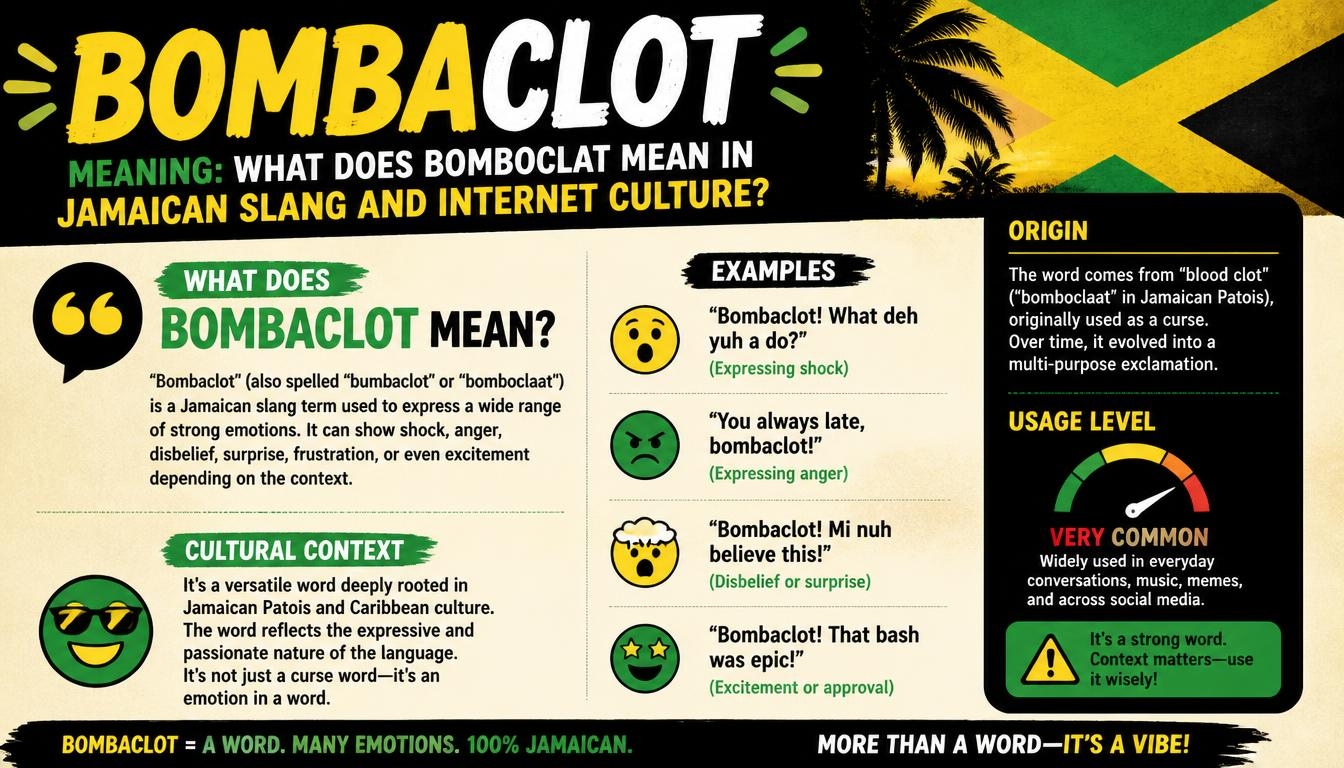
Bombaclot, also commonly written as bomboclat, is a Jamaican vulgar expression used to communicate strong emotions such as anger, frustration, shock, or disbelief. In traditional Jamaican usage, it is a serious swear word rather than a harmless expression.
The term belongs to Jamaican Patois, also known as Jamaican Creole, which developed through the historical interaction of English and West African languages. Its meaning can change depending on the speaker, situation, and tone.
On the internet, however, the expression has developed a different identity. People sometimes use it as a reaction to something unusual, unexpected, hilarious, or visually interesting.
For example:
- Someone sees an unbelievable photograph and comments, “Bomboclat!”
- A friend shares a bizarre video, and another person uses the word to express surprise.
- A social media user posts an unusual picture with the expression as a caption.
It is important to understand that the online interpretation doesn’t erase the original cultural meaning. A word can become popular in memes while remaining offensive in its original language.
Bombaclot Meaning in English
When people search for bombaclot meaning in English, they usually want a simple translation. Unfortunately, there isn’t one perfect English word that captures every possible use.
In Jamaican language and culture, it is a strong profanity that can function similarly to a curse word or an emotional exclamation.
Depending on the situation, its emotional force might communicate:
- Anger or irritation.
- Shock or disbelief.
- Frustration with someone.
- Strong emotional reaction.
- An insult or expression of disgust.
In modern Internet slang, it may also communicate that something is extremely weird, funny, bizarre, impressive, or unexpected.
Think about seeing a video of a cat opening a refrigerator and stealing food like it owns the entire house. Someone might write “Bomboclat!” underneath it as a dramatic reaction.
That internet usage is playful in some communities, but it doesn’t mean the expression is universally acceptable.
Bomboclat, Bomboclaat, and Bumboclaat: Are They Different?
You might have noticed several spellings while researching this expression. The most common variations include bomboclat, bomboclaat, bumboclaat, and bombaclot.
These spellings generally refer to the same Jamaican vulgar expression, although spelling conventions can differ between speakers and online communities.
Here’s a quick explanation:
- Bomboclat: A widely recognised spelling used in internet discussions and memes.
- Bomboclaat: Another common spelling that represents the same expression.
- Bumboclaat: An alternative spelling found in Jamaican speech and informal writing.
- Bombaclot: A variation that appears in online searches and written discussions.
The differences are mostly related to informal transliteration, pronunciation, and spelling preferences.
When searching for the definition, you may encounter all these versions. They shouldn’t automatically be treated as completely separate slang expressions.
The Jamaican Origin and Cultural History of Bombaclot
To understand this word properly, it helps to look beyond social media. Its background comes from Jamaican language and cultural history, not from modern meme creators.
Jamaican Patois is an English-based creole with influences from West African languages and other historical language contacts. It has its own vocabulary, grammar, pronunciation, and expressive traditions.
Bomboclat is associated with the word cloth. Its traditional explanation is connected to menstrual cloth, although explanations of the precise historical development and literal components can vary.
The expression has developed into a vulgar term that carries a strong taboo meaning in Jamaican communities.
It is also worth remembering that Jamaican English and Jamaican Patois are related but not identical. Jamaican speakers may move between different language styles depending on their audience and circumstances.
This is why translating a culturally specific expression word for word can sometimes miss its real emotional meaning.
Why Is Bomboclat Considered a Jamaican Profanity?
The reason bomboclat is considered offensive is its association with bodily references and taboo subjects in Jamaican speech.
Some expressions become powerful swear words because they refer to subjects that a particular culture traditionally considers private, inappropriate, or disrespectful.
In this case, the expression has a vulgar background connected to menstrual cloth and female bodily references.
Its strength also depends on how it is delivered. Saying it jokingly among close friends may create a different reaction from shouting it angrily at someone.
For people unfamiliar with Jamaican culture, the word might look like an amusing combination of letters. But for many native speakers, it is not simply another internet joke.
Understanding this distinction helps prevent accidental disrespect.
Bombaclot Meaning on Social Media
The popularity of bombaclot meaning on social media comes from the way internet communities transform unusual words into reaction expressions.
On platforms such as Twitter (now X), Instagram, and other social networks, users often communicate through short captions, images, memes, and unexpected reactions.
Bomboclat became associated with a viral internet trend in which users posted an image followed by the word, inviting other people to respond with captions or interpretations.
Rather than using a complete sentence, the expression became a kind of attention-grabbing introduction to unusual content.
For example:
- A picture of someone wearing an extremely unusual outfit.
- A photograph showing an unexpected celebrity moment.
- A funny animal picture with a completely unexpected pose.
- An image that makes people stop scrolling and ask what is happening.
In these situations, the expression functions more like a dramatic internet reaction than a conventional sentence.
However, its original meaning remains important, particularly when the content reaches audiences outside the communities that popularised it.
Bomboclat Meaning on Twitter and the Viral Meme Trend
Twitter played an important role in spreading the expression beyond Jamaican-speaking communities.
Around 2019, the word became associated with a popular image-captioning trend. Users would post photographs with the expression, and other users would respond with funny or unexpected captions.
The trend encouraged creativity because almost any unusual photograph could become the starting point for a humorous conversation.
An interesting part of this trend was how quickly people adopted the expression without necessarily understanding its cultural background.
The word became recognisable across different online communities, even among people who had never heard Jamaican Patois before.
The bomboclat meme meaning therefore has two different layers:
- Its traditional meaning as Jamaican profanity.
- Its internet meaning as a caption or reaction to unusual content.
These interpretations are connected, but they are not interchangeable.
Is Bomboclat a Bad Word or an Offensive Expression?
Yes. In its traditional Jamaican usage, bomboclat is considered a strong swear word.
Although internet users sometimes use it casually, it can still sound disrespectful or inappropriate in real conversations.
Whether someone finds it offensive depends on several factors, including their cultural background, relationship with the speaker, and the situation.
Consider these examples:
- With close friends: Someone might use it jokingly in an informal conversation.
- During an argument: It may sound aggressive or insulting.
- In a professional setting: It is generally inappropriate.
- In a public social media post: People may interpret it differently depending on their cultural understanding.
The safest approach is to recognise its vulgar background before using it.
Just because a word becomes popular through memes doesn’t automatically make it suitable for every audience.
How to Pronounce Bomboclat
The pronunciation of bomboclat can vary slightly depending on the speaker and regional accent.
A rough English-friendly pronunciation is:
BOM-buh-klat
The first part sounds similar to “bom,” while the final part resembles “clot” or “clat.”
However, this is only an approximate guide. Jamaican Patois has its own pronunciation patterns, so listening to native Jamaican speakers is a better way to understand the natural sound.
You may also hear variations such as bomboclaat and bumboclaat.
The spelling can look confusing, but the general spoken expression is recognisable across these variations.
How to Use Bomboclat in a Sentence
If you’re learning the expression because you encountered it online, understanding its context is more useful than memorising a few translations.
In Jamaican speech, it can work as a vulgar exclamation or an emotionally charged expression.
On the internet, it is sometimes used as a reaction to unexpected content.
Here are a few examples showing the difference:
- Traditional-style reaction: Someone expresses frustration after an irritating situation.
- Surprise: A person reacts strongly after hearing unexpected news.
- Meme caption: Someone shares a strange photograph and adds the expression.
- Funny reaction: A user responds to an unusual video with a dramatic one-word comment.
- Disbelief: Someone encounters something so unexpected that ordinary words don’t seem enough.
These examples explain the different contexts rather than recommending the expression for everyday communication.
If you’re not familiar with Jamaican language and culture, choosing a neutral alternative is usually better.
Why Did Bomboclat Become Popular Among Young Internet Users?
Internet culture has a funny habit of turning unfamiliar words into viral expressions. Something that starts in one community can suddenly appear in thousands of comments and videos.
Bomboclat became attractive to some internet users because it was short, memorable, expressive, and visually distinctive.
Younger audiences are especially familiar with rapidly changing online vocabulary. One week, a particular expression dominates comment sections; another week, an entirely different phrase takes its place.
This behaviour is sometimes associated with Generation Alpha, although the expression itself has much older cultural roots.
Other examples of popular internet vocabulary include:
- Gyatt: A slang expression popularised through online reactions.
- Skibidi: A term associated with bizarre and humorous internet content.
- Fanum tax: A phrase referring to playfully taking someone else’s food.
- SCO PA TU MANAA: A viral phrase associated with asking people for their opinions about something.
These expressions belong to different cultural and linguistic contexts. They shouldn’t all be treated as having the same meaning or history.
Bomboclat stands out because its original usage involves Jamaican profanity rather than being a word invented specifically for social media.
Is Bomboclat Culturally Insensitive to Use?
This is an important question, especially because the word has spread far beyond Jamaica.
Some internet users may consider it harmless meme slang, while others may feel uncomfortable hearing people use a culturally significant profanity without understanding its background.
The discussion connects with broader conversations about cultural appropriation, cultural awareness, and respectful language.
There is no single reaction shared by every Jamaican person. People have different opinions about how their language is used internationally.
Still, a little awareness can make a big difference.
If you are using Jamaican expressions, try to understand their original meanings rather than copying them simply because they are trending.
Respecting a language also means recognising that words can carry histories and emotional meanings that aren’t obvious from their spelling.
Bombaclot Meaning vs Other Internet Slang
Internet vocabulary changes constantly, and several expressions can appear together in the same comment section.
However, their meanings and origins can be quite different.
| Slang expression | General meaning |
|---|---|
| Bomboclat | Jamaican vulgar expression; also used as internet reaction slang |
| Bop | Can describe a catchy song or, in some slang contexts, an insulting label for a person |
| Borg | An acronym for blackout rage gallon, a party-drink trend |
| Gyatt | Internet slang used as an expression of attraction or surprise |
| Skibidi | Meme-related slang associated with absurd internet humour |
| Fanum tax | Playfully taking some of another person’s food |
It is particularly important not to confuse bombaclot meaning, bop meaning, and borg meaning simply because all three appear in searches about modern slang.
For example, calling a song a bop can be a compliment. Calling someone a bop may be derogatory in certain online communities. Meanwhile, a borg is associated with college party culture and a gallon-sized drink container.
These are separate expressions with separate histories.
Common Misunderstandings About Bomboclat
There are several misconceptions surrounding the word, especially among people who first encounter it through memes.
It is not originally an internet expression.
The word has Jamaican linguistic and cultural roots that existed long before its viral online popularity.
It does not always mean something excellent.
Although internet users sometimes use it to react to impressive content, its traditional meaning is much stronger and more vulgar.
All spelling variations are not necessarily different words.
Bomboclat, bomboclaat, and bumboclaat are commonly used spelling variations of the same expression.
It is not automatically harmless because people use it jokingly.
A meme can make a swear word look funny, but its cultural meaning doesn’t disappear.
It is not exclusive to Generation Alpha.
The expression has a much older history than the current generation of internet slang users.
Understanding these points gives you a more accurate picture than simply learning a viral definition.
Frequently Asked Questions About Bombaclot Meaning
What does bomboclat mean in slang?
In Jamaican slang, bomboclat is a strong vulgar expression used to communicate anger, frustration, shock, or disbelief. Online, it is also used as a reaction to weird, funny, bizarre, or unexpected content.
Is bomboclat a Jamaican swear word?
Yes. It is recognised as a Jamaican profanity associated with Jamaican Patois. It can be considered highly offensive depending on the context and audience.
Is bomboclat offensive?
Yes, in its traditional usage it is a vulgar expression. Although some people use it casually in internet memes, it may offend native speakers or people familiar with its cultural background.
What is the difference between bomboclat and bomboclaat?
They are generally spelling variations of the same Jamaican expression. Differences usually reflect informal writing and pronunciation preferences rather than entirely different meanings.
Why do people use bomboclat on social media?
People use it as a dramatic reaction or meme caption, especially when sharing strange, surprising, funny, or unusual photographs and videos.
What does bomboclat mean on Twitter?
On Twitter and X, the expression became popular through an image-captioning trend. Users posted photographs with the word and invited others to add amusing captions.
What is the origin of bomboclat?
The expression comes from Jamaican language and cultural history. Its traditional explanation connects it with the word cloth and references to menstrual cloth, although its exact historical development is not entirely straightforward.
Is bomboclat the same as bumboclaat?
They are commonly recognised as variations of the same expression. Both are associated with Jamaican profanity.
Can I use bomboclat with my friends?
You might encounter it in informal conversations, but remember that it is a vulgar expression. Whether it is acceptable depends on your friends, their cultural backgrounds, and the situation.
Does bomboclat mean something funny or weird?
In modern internet slang, it can be used to react to something funny, strange, bizarre, or unexpected. This is a more recent online interpretation rather than its original Jamaican meaning.
What Does Bombaclat Mean?
Bombaclat is a Jamaican slang expression considered a strong swear word, often used to express anger, frustration, shock, or disbelief. On social media, it can also describe something weird, funny, or unexpected.
What Does Bombaclat?
Bombaclat is a vulgar expression originating from Jamaican Patois, and its meaning depends on the situation and tone. People also use it online as a dramatic reaction to surprising pictures, videos, or unusual situations.
Bomboclat Meaning
Bomboclat is another common spelling of bombaclat, a Jamaican profanity with a culturally significant vulgar meaning. In internet slang, it has become popular as a meme caption or reaction to something bizarre, funny, or impressive.
Bombaclot
Bombaclot is an alternative spelling of bomboclat, commonly associated with Jamaican slang and profanity. Although it appears frequently in online conversations, its traditional meaning is much stronger than its casual meme usage suggests.
Bomboclaat
Bomboclaat is another spelling variation of the Jamaican vulgar expression bomboclat. It is widely recognised in internet discussions, memes, and social media captions, but it retains its original offensive cultural meaning.
Read ARticul: https://ytmeaning.com/simping-meaning/
How to Understand Jamaican Slang Without Misusing It
Learning slang is not just about collecting unusual words. It is also about understanding the people, communities, and cultural experiences behind them.
When you encounter an unfamiliar expression, look at how native speakers use it in different situations. A dictionary translation might explain the basic meaning, but it won’t always communicate the emotional weight.
For Jamaican expressions, understanding the difference between Jamaican English and Jamaican Patois can also help you recognise why certain words have meanings that aren’t immediately obvious to English speakers.
A few practical tips can help:
- Check the original cultural background of an expression.
- Pay attention to whether native speakers consider it offensive.
- Don’t assume every viral definition is accurate.
- Understand the difference between traditional speech and meme usage.
- Avoid using strong profanity in professional or unfamiliar social settings.
The internet makes language travel quickly, but understanding its meaning takes a little more effort.
Final Thoughts on Bombaclot Meaning
The bombaclot meaning is a fascinating example of how language can travel from a specific cultural community into worldwide internet conversations. What began as a strong Jamaican vulgar expression eventually became recognisable through memes, Twitter captions, and social media reactions.
Its online popularity has introduced many people to Jamaican slang, but the original meaning deserves recognition too. Bomboclat is not simply a funny word for something unusual; it has cultural roots and can be offensive when used without considering the context.
The next time you see someone write “bomboclat” beneath a strange photograph, you’ll understand why they might be using it. More importantly, you’ll know the difference between its traditional Jamaican meaning and its modern internet interpretation.
Language becomes more interesting when we learn not only what words mean, but also where they come from and why people use them.