
Have you ever come across the word poco in a song, a music lesson, or an Italian sentence and wondered what it actually means? It is one of those small words that can quietly change the meaning of an entire expression. Although it has just four letters, poco carries several useful meanings depending on how and where it is used.
The simple poco meaning is little, a little, or somewhat. It comes from the Italian language and is commonly used to describe a small amount, a slight degree, or something that happens gradually. You may also notice it in classical music, where it provides musicians with instructions about tempo, expression, and performance.
For example, when someone says poco a poco, they mean little by little. Similarly, a musical direction such as poco allegro suggests a slight adjustment towards a lively or fast tempo.
In this guide, we’ll explore the poco definition, its pronunciation, Italian roots, English translation, and different musical expressions. By the end, you’ll understand not only what this interesting word means but also how to recognize it in everyday language and music.
What Does Poco Mean?
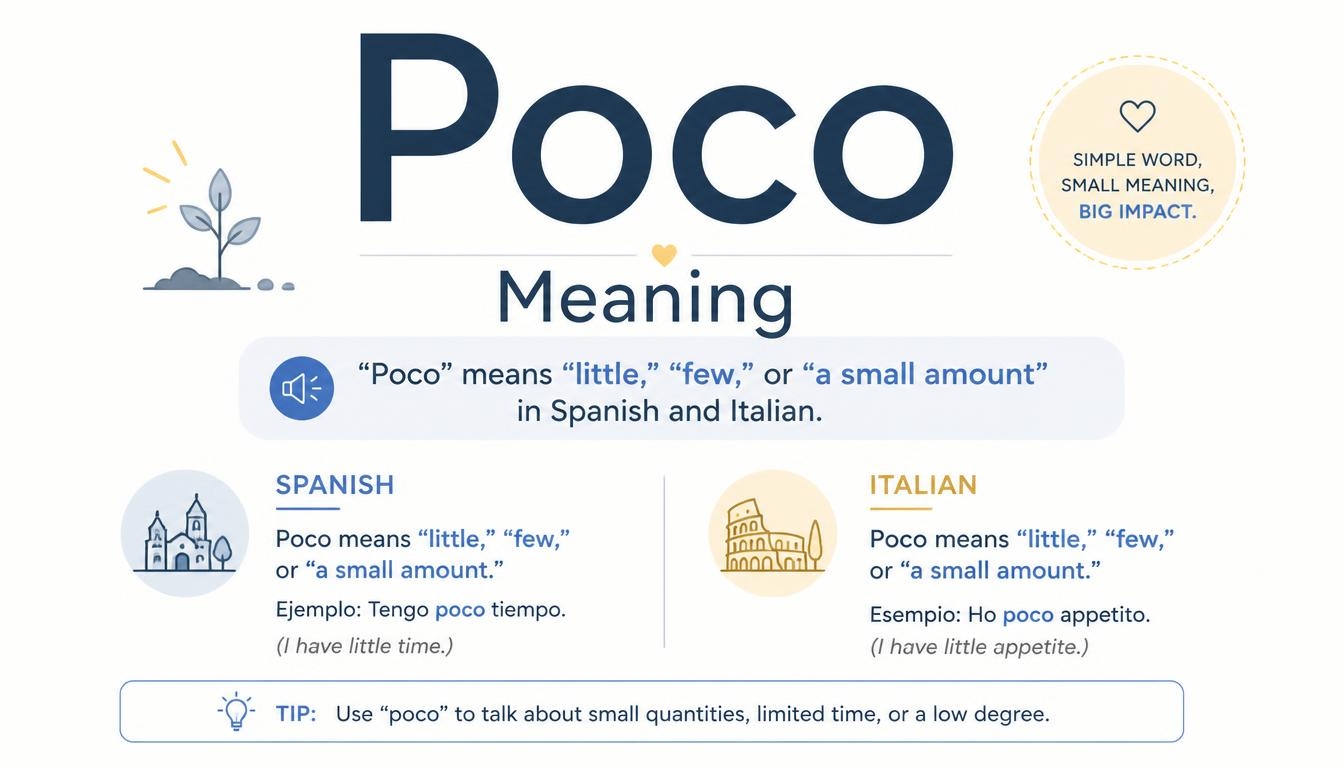
The word poco generally means little, a small amount, or somewhat. It is an Italian word that English speakers often encounter in translations, conversations, and musical instructions.
Its exact meaning depends on the sentence in which it appears. Sometimes it describes quantity, while in other situations it expresses degree or intensity.
Here are a few simple examples:
- Poco zucchero means a little sugar.
- Poco tempo means little time.
- Poco difficile means somewhat difficult.
- Poco interessante means not very interesting.
- Poco caldo means slightly warm.
As you can see, the word doesn’t always describe something physically small. It can also explain how much a particular quality or feeling is present.
In English vocabulary, similar expressions include slightly, somewhat, not much, and to a small degree.
Poco Meaning in English
The poco meaning in English is usually translated as little or a little. However, it can also mean somewhat, slightly, or not much depending on its grammatical position.
The Italian word is particularly useful because it communicates a limited quantity or degree without requiring a long explanation.
Consider these translations:
| Italian expression | English meaning |
|---|---|
| Poco tempo | Little time |
| Poco denaro | Little money |
| Poco zucchero | Little sugar |
| Poco importante | Not very important |
| Un poco | A little |
| Poco interessante | Somewhat uninteresting |
The difference between little and somewhat is worth understanding.
When poco describes an amount, it often means little or not much. When it describes an adjective or characteristic, it can communicate a slight degree.
For example, saying something is poco interessante suggests that it is not particularly interesting.
So, the poco English translation isn’t always one fixed word. The surrounding sentence helps determine the most natural meaning.
Poco Definition and Part of Speech
According to the general dictionary definition, poco is an Italian-derived word used in English, particularly as a musical direction, to indicate a small degree or amount.
In Italian grammar, it can function as different parts of speech depending on its use. It commonly works as an adverb, adjective, or pronoun.
Poco as an Adverb
As an adverb, poco describes the degree or extent of an action or quality.
For example:
- Parla poco means he or she speaks little.
- Mangia poco means he or she eats little.
- Poco alla volta means little by little.
- È poco interessante means it is not very interesting.
In these examples, poco gives additional information about how much something happens or how strongly a quality is expressed.
Poco as an Adjective
The word can also describe a small quantity of something.
For example:
- Poco tempo means little time.
- Poco denaro means little money.
- Poco lavoro means little work.
Italian adjectives normally agree with the noun in gender and number. Related forms include poca, pochi, and poche.
Poco as a Pronoun
Poco can also stand in place of a noun when the quantity is already understood.
For example, someone might say Ne voglio poco, meaning they want little of it.
This flexibility makes the word a useful part of everyday Italian vocabulary.
Poco Meaning in Music
One of the most interesting places to encounter this word is in classical music.
The poco meaning in music is generally a little, slightly, or to a small degree. Composers use it as a musical direction to tell performers how to adjust the speed, intensity, or expression of a passage.
You’ll often see it written above musical notes in a printed score.
For example, a composer might use poco più mosso, which means slightly more movement or a somewhat faster pace.
The instruction is not asking the musician to make a dramatic change. Instead, it suggests a relatively small adjustment.
Some common musical uses include:
- Poco allegro: Somewhat lively or fast.
- Poco adagio: Slightly slow or somewhat leisurely.
- Poco più mosso: A little faster.
- Poco meno mosso: A little slower.
- Poco forte: Slightly louder.
- Poco piano: Slightly softer.
These expressions help musicians understand the intended performance without relying on lengthy written instructions.
It’s a small word, but in music, even a small change in tempo or volume can completely alter the feeling of a passage.
Poco Allegro Meaning
The poco allegro meaning is somewhat lively or a little fast.
To understand this expression properly, it’s helpful to look at both words separately.
- Poco: A little or somewhat.
- Allegro: A lively or fast musical tempo.
When a composer writes poco allegro, the intention is to introduce a relatively small degree of liveliness or speed.
Imagine a pianist playing a calm melody. The composer wants the next section to feel more energetic, but not excessively fast. The marking provides a useful indication of that change.
Allegro itself is a widely recognized musical tempo marking, while poco modifies its degree or character.
Musicians interpret these instructions in the context of the entire composition rather than treating every marking as an exact metronome number.
Poco a Poco Meaning
The poco a poco meaning is little by little or gradually.
This is one of the most recognizable Italian expressions, especially in music and everyday language.
Instead of describing something happening immediately, it communicates a process that develops in small stages.
For example:
- Poco a poco means little by little.
- Poco a poco migliora means gradually getting better.
- Poco a poco più forte means gradually getting louder.
- Poco a poco più veloce means gradually getting faster.
In musical terminology, this expression can instruct performers to make a gradual change rather than an abrupt one.
Imagine a song beginning quietly. As the melody develops, the instruments slowly become louder. A composer might use poco a poco crescendo to communicate this gradual increase in volume.
Outside music, the expression is equally meaningful.
Learning a language, improving a skill, or becoming comfortable with something new often happens poco a poco. Progress may feel small on individual days, but those little improvements can eventually make a noticeable difference.
How to Pronounce Poco
The pronunciation of poco is relatively simple once you understand the Italian sounds.
It is commonly pronounced:
POH-koh
The pronunciation can be broken into two syllables:
- Po: Sounds like poh.
- Co: Sounds like koh.
The stress falls on the first syllable.
In phonetic notation, the Italian pronunciation is approximately /ˈpɔ.ko/ or /ˈpo.ko/, depending on the pronunciation convention.
English speakers sometimes pronounce it differently because they apply English spelling rules. However, the Italian pronunciation keeps both vowel sounds clear and short.
How to Remember the Pronunciation
Try saying the word slowly:
- First, say POH.
- Next, say KOH.
- Finally, combine them: POH-koh.
Repeat it a few times until it feels natural.
You can also listen to a dictionary pronunciation through a reliable language reference to hear the difference between Italian and English speech patterns.
Origin of Poco: Etymology and Word History
The origin of poco can be traced to the Italian language and its historical development from Latin.
The word is related to the Latin adjective paucus, which means few or little.
Over time, the word developed into the Italian form poco, retaining the central idea of a small quantity or limited degree.
This connection is useful because it explains why similar meanings appear in both historical and modern language.
Latin Origin: Paucus
The Latin word paucus referred to a small number or limited quantity.
It was used to communicate that something existed in a lesser amount than expected or required.
The relationship between paucus and Italian poco is an important part of its etymology.
Although the spelling and pronunciation changed through linguistic development, the central idea remained closely connected.
Italian Language Development
In Italian, poco became an everyday word with several grammatical uses.
It can describe quantity, degree, and intensity. Its variations also allow speakers to match it with different nouns.
As Italian musical terminology became widely used in European classical music, words such as poco entered international music vocabulary.
Today, musicians around the world recognize it even if they don’t speak Italian.
First Known Use: 1724
The Merriam-Webster Dictionary records 1724 as the first known use of poco in English musical terminology.
This historical date refers to its documented English usage, rather than the actual beginning of the word in Italian.
The word itself is much older because it developed from earlier Italian and Latin vocabulary.
Its continued presence in modern dictionaries shows how a simple foreign-language expression can become an established part of English music terminology.
Poco in Classical Music and Musical Notation
Italian musical terms have played a major role in the development of classical music notation.
For centuries, composers have used Italian expressions to communicate instructions about speed, volume, character, and performance.
Poco is one of those useful terms because it allows a musician to make a controlled adjustment.
Here are some examples of how it appears in musical notation.
Poco Più Mosso
This expression means slightly more movement or a little faster.
A performer may encounter it when the composer wants the music to gain energy without changing its overall character too dramatically.
Poco Meno Mosso
This means slightly less movement or a little slower.
It can appear when a musical passage needs a calmer or more relaxed feeling.
Poco Forte
The term suggests playing slightly louder.
It gives the performer a direction to increase the volume without necessarily reaching a full forte dynamic.
Poco Piano
This indicates playing slightly softer.
It can be used when the composer wants a gentler sound or a small reduction in volume.
Poco Crescendo
Crescendo means gradually getting louder. Adding poco can indicate that the increase should happen to a limited degree or within a particular musical instruction.
The exact interpretation depends on the notation and surrounding musical passage.
Poco vs. Pochissimo: Understanding the Difference
People who study Italian musical vocabulary may also encounter the word pochissimo.
Although the two words are related, they communicate different degrees.
Poco means little, a little, or somewhat, while pochissimo means very little or extremely slightly.
For example:
- Poco forte: Slightly louder.
- Pochissimo forte: Very slightly louder.
- Poco mosso: A little more movement.
- Pochissimo mosso: Very little additional movement.
The difference is subtle, but it can matter when interpreting a composer’s instructions.
Musicians need to pay attention to these small distinctions because they contribute to the overall balance and character of a composition.
Poco vs. Un Poco: Are They Different?
Both expressions are used in Italian, and their meanings are closely related.
However, un poco literally means a little or one small amount.
For example:
- Un poco di acqua means a little water.
- Un poco di tempo means a little time.
- Un poco più forte means a little louder.
Poco can also communicate a small quantity or degree, but the addition of un creates a slightly different grammatical construction.
In everyday conversation, the two forms are both useful. Their most natural translation depends on the sentence.
Examples of Poco in Everyday Italian
Understanding a new word becomes easier when you see how people actually use it.
Although poco is frequently associated with music, it also appears in ordinary Italian conversations.
Here are some practical examples with their English translations.
- Ho poco tempo. — I have little time.
- Parlo poco italiano. — I speak little Italian.
- Aspetta un poco. — Wait a little.
- Costa poco. — It costs little.
- Sono poco stanco. — I am not very tired.
- C’è poca acqua. — There is little water.
- Ci vuole poco tempo. — It takes little time.
- Manca poco. — There isn’t much left.
Notice how the meaning changes slightly depending on the sentence.
Sometimes poco describes an amount, sometimes it describes an action, and sometimes it communicates that something is almost finished.
These examples make the Italian word poco easier to understand in real-life situations.
Similar Words and Expressions Related to Poco
If you’re building your English or Italian vocabulary, learning similar words can help you recognize different ways to communicate small quantities and degrees.
Some useful English alternatives include:
| Related word | Meaning |
|---|---|
| Little | A small amount |
| Slightly | To a small degree |
| Somewhat | To some extent |
| A bit | A small quantity or degree |
| Barely | Only just |
| Scarcely | Almost not |
| Gradually | Slowly over time |
| Few | A small number |
| Minimally | To a very small extent |
These words are not always interchangeable with poco, but they can express similar ideas in suitable contexts.
Words That Sound Similar to Poco
Some words may sound similar to poco but have completely different meanings.
- Cocoa: A powder or ingredient made from cacao beans.
- Loco: A Spanish word meaning crazy or mad.
- Koko: A name or spelling used in different contexts.
These are examples of sound similarities, not direct translations or linguistic relatives of poco.
Understanding this difference helps avoid confusion when learning unfamiliar vocabulary.
Why Is Poco Common in Music Terminology?
Italian has a long-standing influence on Western classical music.
Many traditional musical instructions are written in Italian because composers and musicians historically adopted Italian vocabulary for communicating tempo and performance directions.
Terms such as allegro, adagio, forte, piano, and crescendo are now recognized internationally.
Poco fits naturally into this system because it modifies existing instructions.
Instead of inventing a completely new direction, a composer can simply add poco to indicate that a change should happen to a small degree.
For example, poco più forte tells a performer to play a little louder.
This approach makes musical notation more concise and expressive.
It also allows musicians to understand the intended character of a passage without needing lengthy explanations.
Frequently Asked Questions About Poco Meaning
What does poco mean?
Poco means little, a little, or somewhat. It is an Italian word used in everyday language and international musical terminology.
What does poco mean in English?
The English translation of poco is usually little or a little. Depending on the context, it can also mean slightly, somewhat, or to a small degree.
Is poco an Italian word?
Yes, poco is an Italian word. It is commonly used to describe a small quantity, limited amount, or slight degree.
What does poco mean in music?
In music, poco means a little or slightly. It modifies musical directions to indicate a small change in speed, volume, or expression.
What does poco allegro mean?
Poco allegro means somewhat lively or a little fast. It combines poco, meaning a little, with allegro, meaning lively or fast.
What does poco a poco mean?
Poco a poco means little by little or gradually. It is used in everyday Italian and musical instructions to describe a gradual change.
How do you pronounce poco?
Poco is pronounced POH-koh, with the stress on the first syllable. Both syllables should be spoken clearly.
Where does the word poco come from?
Poco comes from Italian and is historically related to the Latin word paucus, meaning few or little.
Is poco an adverb?
Poco can function as an adverb in Italian, but it can also work as an adjective or pronoun depending on the sentence.
When was poco first used in English?
According to Merriam-Webster, the first known English use of poco dates to 1724, particularly in musical terminology.
Does poco always mean little?
Not exactly. Its central meaning is connected to a small quantity or degree, but its most natural English translation depends on context. It can mean little, somewhat, or slightly.
What is the difference between poco and pochissimo?
Poco means little or somewhat, while pochissimo means very little or extremely slightly. Pochissimo expresses a smaller degree.
poco meaning
Poco is an Italian word meaning “little,” “a small amount,” or “slightly.” In English, it is also used to express something to a limited degree.
what is poco
Poco is an Italian word commonly used in everyday language and music terminology to indicate a small amount or a slight degree of something.
define poco
Poco is defined as an adverb meaning “somewhat” or “to a slight degree.” It can also describe a small quantity or limited amount.
meaning of poco
The meaning of poco is “little” or “a little.” It comes from the Italian language and is derived from the Latin word paucus, meaning few.
poco meaning in english
In English, poco means “a little,” “slightly,” or “somewhat.” It is often used in musical instructions to indicate a small change in speed, expression, or intensity.
Read ARticul: https://ytmeaning.com/cadence-meaning/
How to Understand and Remember the Word Poco
Learning a word is easier when you connect it with familiar situations instead of memorizing a dictionary definition.
Start by remembering its central meaning: little.
Whenever you see poco in an Italian sentence, think about whether the speaker is describing quantity, degree, or intensity.
For example, if you see poco tempo, you know the person has little time. If you see poco più veloce in a musical score, you understand that the performer should play a little faster.
You can also remember the expression poco a poco, which means little by little. It is a simple way to connect the word with gradual progress.
Another helpful method is to practice reading short Italian expressions aloud. This improves your pronunciation and makes unfamiliar vocabulary feel more natural.
Most importantly, don’t assume that every foreign word has one exact English equivalent. Context is often what makes its meaning clear.
Conclusion
The poco meaning is simple, yet its uses extend across everyday Italian, English dictionary vocabulary, and classical music. At its heart, the word communicates something small, whether that means a little amount, a slight degree, or a gradual adjustment.
Its connection with the Latin word paucus explains its historical roots, while its place in musical terminology shows how a small expression can communicate an important instruction. From poco allegro to poco a poco, it remains a useful word for musicians, language learners, and anyone curious about Italian expressions.
The next time you encounter poco in a sentence or musical composition, you’ll have a much clearer idea of what it means. Sometimes, understanding just one little word makes a surprisingly big difference.