Have you ever seen someone write “watch out for the opps” in a comment, text, rap lyric, or TikTok caption and wondered what on earth they were talking about? The word opp is tiny, but it carries a surprisingly big suitcase of meanings.
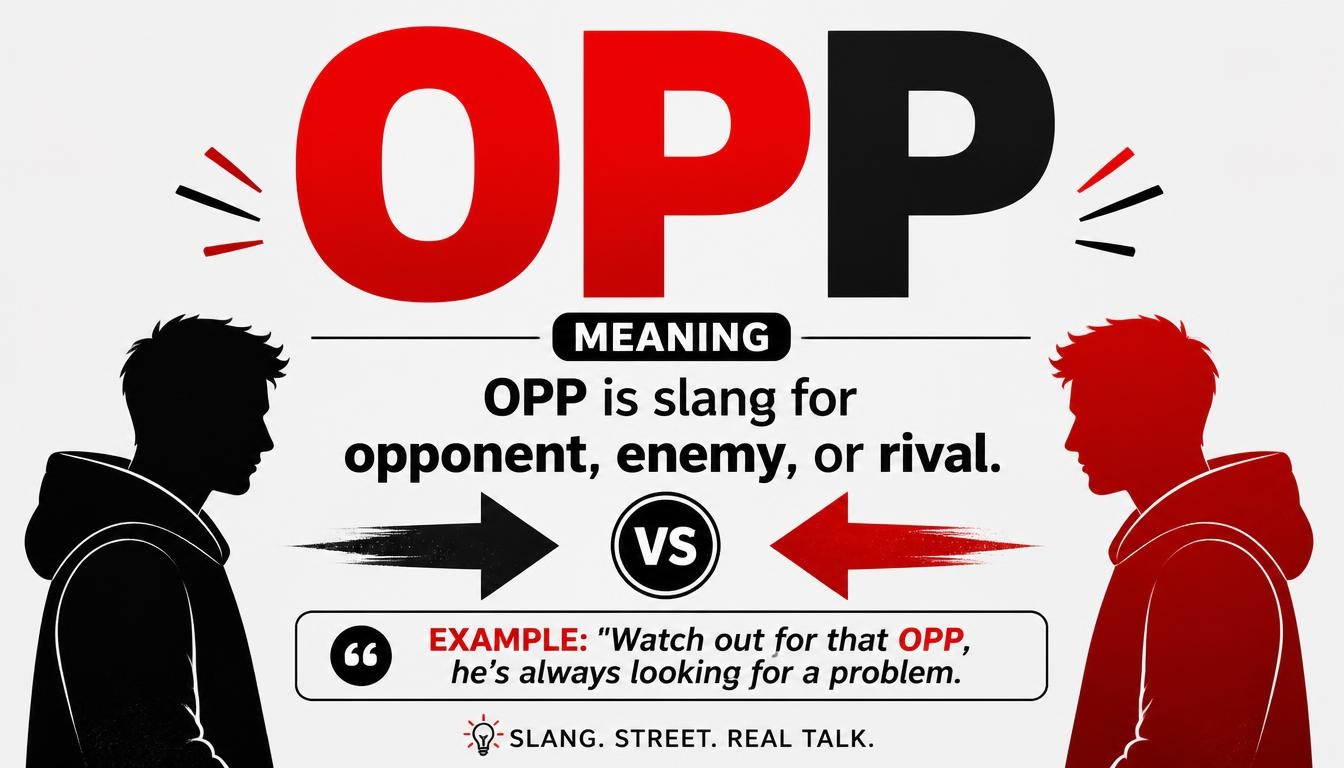
In modern slang, especially online and in hip-hop culture, an opp usually means an opponent, rival, enemy, or someone viewed as being on the opposite side. The plural form, opps, is even more common. But context matters a lot, because OPP can also be an acronym for several completely different things.
So, what does opp mean exactly? Most of the time in casual internet or rap language, it refers to an opposition or rival. Yet in another sentence, OPP could mean the Ontario Provincial Police, an opportunity, Other People’s Property, or even something related to gaming or publishing.
That little three-letter word has travelled quite a distance through language, music, memes, and social media. Let’s unpack it without making the meaning more complicated than it needs to be.
What Does Opp Mean in Slang?
In everyday urban slang, opp is short for “opposition” or “opponent.” It describes someone who is considered a rival, adversary, or enemy. The word doesn’t always mean a literal enemy either; sometimes people use it jokingly for somebody who’s simply against them.
For example, a person might say, “He’s an opp,” when talking about someone who consistently disagrees with them or supports a competing group. The exact level of seriousness depends on the situation, which is kinda important.
The plural opps means multiple opponents or rivals. You might hear expressions such as “the opps,” “watch for the opps,” or “he switched sides and joined the opps.”
In modern communication, especially among younger users, the word can sometimes be exaggerated for humor. Calling your friend an “opp” because they stole the last slice of pizza isn’t exactly the same as using the word in serious street slang.
Opp Meaning in Modern Slang
The modern opp meaning in slang is closely connected with ideas of opposition, rivalry, conflict, and group identity. It can describe a person, group, neighborhood, organization, or even another team.
Someone might call a competing sports team an opp in a playful way. A gamer could jokingly call another player an opp after losing a match. On the more serious side, the term can refer to genuine personal enemies or rival groups.
This flexibility is one reason slang changes so quickly. A word born in one community can suddenly appear everywhere through music, memes, and viral videos, and its tone may change along the way.
That means you should never assume every use of opps represents genuine hostility. Sometimes it’s serious, sometimes it’s dramatic, and sometimes it’s just internet people being internet people.
What Does Opp Mean in Texting?
If someone sends you a message saying, “That guy is my opp,” they probably mean that the person is their opponent or rival.
Similarly, “Who are your opps?” can mean “Who are the people you’re against?” or, in a much lighter conversation, “Who are your rivals?”
Texting slang often removes words from their original context. Because of that, opp meaning in texting can be broad. Friends might use it sarcastically, while somebody discussing a serious conflict may use it literally.
For example:
- “Bro became an opp overnight.”
- “My opp is in the group chat.”
- “Don’t tell the opps.”
- “He’s not my friend, he’s an opp.”
- “The other team are the opps tonight.”
These examples show why context matters. The same word can sound threatening, playful, or completely harmless depending on who says it and why.
What Does Opp Mean on TikTok, Instagram, and Social Media?
On TikTok, Instagram, Twitter, and other platforms, opp has become part of wider social media slang. Users often borrow words from music, gaming, sports, and youth culture, then give them a more humorous or exaggerated meaning.
You might see someone write “my opp” under a video featuring a friend who annoyed them. Another person might use “opps” in a meme about a rival sports team.
This is an example of language evolution in real time. Words move from songs into conversations, then from conversations into memes, and eventually become ordinary internet vocabulary.
The phrase may also appear in viral videos where the original meaning is not especially serious. A teenager calling their best friend an opp because they refused to share snacks is obviously different from a serious reference to rival groups.
So, if you’re wondering what does opp mean on TikTok, the safest answer is: usually an opponent, rival, or person perceived as being against someone, often used casually or humorously.
What Are Opps in Slang?
Opps is simply the plural form of opp.
If one person is an opp, several people can be called the opps. In rap slang and drill slang, the term can have a much stronger meaning, sometimes referring to rival groups or people involved in ongoing conflicts.
In less serious online conversations, however, “opps” may just mean competitors or people on the other side of an argument.
For instance, a gamer might jokingly call the opposing team “the opps.” A fan might call a rival sports team “the opps.” Somebody involved in a genuine conflict could use the same word with a much more serious intention.
The spelling stays the same, but the emotional temperature can change completely. That’s the funny thing about slang: context does half the talking.
Opp Meaning in Rap and Hip-Hop
The word opp has strong connections with hip-hop, rap music, and especially modern drill rap. In these musical contexts, it commonly refers to opponents, rivals, or enemies.
Artists may use the term when describing conflict, rivalry, neighborhood identity, perceived threats, or competition. In some forms of Chicago drill and related street-oriented music, references to opps can be closely connected to real-world rivalries.
That does not mean every appearance of the word in a song describes an actual conflict. Rap frequently uses exaggeration, storytelling, metaphor, character-building, and cultural references.
The surrounding lyrics and the artist’s context therefore matter much more than the word alone. A listener shouldn’t automatically assume that every “opp” reference has exactly the same meaning.
What Does Opp Mean in Hip-Hop Culture?
Within hip-hop culture, an opp can represent somebody who belongs to an opposing group or somebody considered an adversary.
The word can therefore carry ideas of group identity, loyalty, rivalry, and social dynamics. These meanings become especially visible in music where artists describe their surroundings or relationships.
The term is also part of a broader tradition of using shortened words and expressive vocabulary to communicate complicated social relationships quickly. Slang isn’t merely random vocabulary; it can tell people something about community, identity, attitude, and belonging.
Still, hip-hop is not one single culture with one single dictionary. Meanings can differ between artists, cities, generations, and communities, so a definition should always leave room for context.
O.P.P. by Naughty by Nature
One of the most famous uses of OPP in popular culture comes from the 1991 hip-hop song “O.P.P.” by Naughty by Nature.
The song became a major mainstream success and introduced the abbreviation to a huge audience. Its title uses O.P.P. in a different sense from the modern slang meaning of “opp” as an opponent.
This distinction is important because people sometimes assume that the famous song is simply about “opps” in the modern rap sense. It isn’t. The O.P.P. song meaning is connected to a different expansion of the acronym.
The track became a notable part of early-1990s hip-hop and reached the Billboard Hot 100, helping make the abbreviation familiar well beyond the hip-hop audience.
So when someone searches for OPP meaning Naughty by Nature, they’re asking about a particular cultural use of the acronym, not necessarily the modern slang word.
What Does OPP Stand For in the Naughty by Nature Song?
In the Naughty by Nature song, O.P.P. refers to Other People’s Property, with the phrase used as a playful euphemism within the song’s relationship-oriented theme.
The abbreviation became memorable partly because of the song’s catchy presentation and clever use of language. It demonstrated how a short acronym could become a major piece of popular culture.
This is also why searching for O.P.P. acronym song or OPP song meaning can produce results that look very different from searches about modern slang.
One spelling detail is worth noticing too: O.P.P. with periods points toward the famous song and acronym, while opp or opps in modern slang usually refers to an opponent or rival.
What Does Opp Mean in a Song?
If you encounter opp in a song, don’t immediately translate it as “enemy.” That’s often correct in modern rap, but not always.
The surrounding words can reveal whether the artist means an opponent, a rival group, a personal enemy, or something more metaphorical. Some artists also use slang simply because it fits the rhythm and cultural language of the song.
In rap lyrics, an opp may represent competition, rivalry, hostility, or someone belonging to an opposing group. In other genres or contexts, the abbreviation could mean something completely unrelated.
A good rule is simple: read the whole sentence before deciding what the word means. Three letters alone don’t tell the whole story.
Other Meanings of OPP
Although slang is probably the meaning most people are looking for today, OPP has several other definitions.
The abbreviation can mean Ontario Provincial Police, a major law enforcement agency in Canada. In that context, “OPP” has nothing to do with slang or rap.
Another possible meaning is opportunity. In business, education, or casual writing, people may shorten “opportunity” to “opp,” particularly in notes or informal communication.
OPP can also refer to Other People’s Property, as made famous through the Naughty by Nature song.
In relationships, you may encounter interpretations involving Other People’s Partner, particularly in discussions about dating or relationship boundaries.
In gaming communities, OPP can sometimes be used informally for an overpowered player or overpowered character, although these aren’t universal definitions.
And in publishing or collecting, out of print may be abbreviated as OOP rather than OPP, which is worth noting because people sometimes mix the two up.
OPP Meaning in Canada
In Canada, OPP meaning can refer to the Ontario Provincial Police.
The Ontario Provincial Police is a provincial law enforcement organization serving communities and providing policing services across Ontario. If you see “OPP” in a Canadian news report, government context, traffic report, or police announcement, it almost certainly isn’t referring to hip-hop slang.
This is a perfect example of why context matters. A teenager saying “those are my opps” and a Canadian news article mentioning “OPP officers” are using the same letters for entirely different purposes.
Language loves recycling abbreviations, apparently.
Opp Meaning in Gaming
Gaming communities have their own vocabulary, and opp can appear there too.
Most commonly, gamers may use “opp” in the ordinary slang sense of an opponent. Someone on the enemy team can simply be described as an opp.
Some communities may also use OPP to describe an overpowered player or overpowered character, although this isn’t a universal gaming definition. Terms such as “OP” are much more common when gamers mean “overpowered.”
For example, a player might say, “That character is OP,” meaning the character is unusually strong. That’s different from saying, “That player is my opp,” meaning the player is an opponent or rival.
Those two abbreviations look similar, but their meanings are not identical.
Why Do People Say Opps?
People say opps because slang gives them a short way to describe people they see as rivals, opponents, or enemies.
In some communities, the word also helps communicate in-group identity. Saying “the opps” can immediately establish who belongs to the opposing side without explaining a long backstory.
Social media has amplified this usage. A phrase that might once have been limited to a particular local community can now spread through TikTok slang, Instagram captions, rap music, memes, and viral videos.
But there’s another side to this. Internet users sometimes adopt slang without understanding its original cultural context. A serious term can become a joke, a meme, or a playful insult in a completely different setting.
That’s why cultural awareness is useful when using slang borrowed from communities with specific histories.
Opps, Enemies, Rivals, and Opponents: Are They the Same?
Not exactly.
An opponent is generally somebody who competes against you. A rival is someone competing with you repeatedly or strongly. An enemy usually implies a more serious relationship involving hostility.
An opp can overlap with all three meanings, depending on context.
For example, your football team’s opponent can jokingly be called an opp. A business competitor might be described as a rival. In serious street slang, the term can refer to people viewed as genuine enemies or adversaries.
So, opp definition slang is better understood as a range rather than one rigid dictionary sentence.
How Opp Became Part of Youth Slang
Modern youth slang spreads incredibly quickly. A word can appear in a song on Monday, become a meme by Wednesday, and show up in thousands of comments before the week is finished.
The rise of TikTok, Instagram, and other social platforms has accelerated this process. People borrow language from music, gaming, sports, television, and different communities, then reshape it for their own conversations.
The result is contemporary slang that can be understood internationally even when its original cultural meaning was very local.
The story of “opp” is a nice example of this process. It connects older ideas of opposition with modern internet language, while its various acronym meanings continue to exist alongside the slang.
Is Calling Someone an Opp Serious?
Sometimes yes, sometimes absolutely not.
In a serious conversation, calling someone an opp can suggest genuine hostility or a conflict between groups. In a group chat, however, it might simply mean “you disagreed with me, so now you’re my enemy,” said with a laugh.
Tone, relationship, location, and surrounding words all matter.
If someone says, “You didn’t save me any fries, you’re officially an opp,” there is probably no geopolitical crisis happening at the dinner table.
But if the term appears in a discussion involving actual rival groups, threats, or violence, it should be interpreted much more carefully.
How to Understand Opp From Context
When you see opp, ask yourself a few simple questions.
Is the conversation about rap or hip-hop? If so, the word probably means opponent, rival, or enemy.
Is the conversation happening in Canada and mentioning police? It could mean the Ontario Provincial Police.
Is someone discussing Naughty by Nature? Then they’re probably talking about the famous O.P.P. song.
Is the conversation about gaming? The word may refer to an opponent, while “OP” may mean overpowered.
Is someone discussing dating? OPP could potentially refer to Other People’s Partner.
Context is basically the little detective sitting beside the word, quietly solving the mystery for you.
Common Examples of Opp in Conversation
Here are some natural examples showing how the meaning can shift:
- “He’s my opp in the tournament.” — He is my opponent.
- “Those guys are the opps.” — They are viewed as rivals or opponents.
- “My friend called me an opp because I chose the other team.” — A playful use of slang.
- “The song made O.P.P. famous.” — A reference to Naughty by Nature.
- “The OPP issued a statement.” — A reference to Ontario Provincial Police.
- “That player is basically an opp every match.” — A rival or opposing player.
- “Don’t confuse OPP with OP.” — The abbreviations have different common meanings.
- “Who are the opps in this story?” — Who are the opposing people or group?
These examples show why the same three letters can’t be translated correctly without looking at the surrounding conversation.
Opp vs. OP: What Is the Difference?
This is an easy mistake to make.
Opp usually means an opponent, rival, or enemy in slang.
OP, depending on context, can mean original poster, overpowered, or original, among other things.
For example, in a Reddit discussion, “OP” commonly means the original poster. In gaming, “OP” often means overpowered. Meanwhile, “opp” usually points toward an opponent in slang.
Adding one letter can completely change the meaning, which is mildly inconvenient but also kind of fascinating.
Is Opp a Formal Word?
No, opp as slang is not normally appropriate for formal writing.
It belongs more naturally in casual conversation, texting, music, social media, memes, and informal online communities. In a professional email, academic paper, or official report, “opponent,” “competitor,” or “adversary” will usually communicate the idea more clearly.
The acronym OPP, however, can absolutely be formal when it refers to an official organization such as the Ontario Provincial Police.
This distinction is important because slang and formal abbreviations can look identical while functioning very differently.
Cultural Significance of the Word Opp
Words like opp reveal how language carries social information.
Slang can communicate where a phrase came from, which community uses it, what kind of relationship exists between people, and whether a statement is serious or playful.
Its connections to AAVE, hip-hop, rap, drill music, and online youth culture also show how language moves between communities. However, no slang term has one permanent meaning everywhere, and users should avoid treating complex cultural language as a costume or a joke without understanding its context.
The evolution of “opp” is therefore more than a vocabulary story. It is a small example of how popular culture, music, technology, and everyday communication continually reshape language.
Frequently Asked Questions About Opp Meaning
What does opp mean in slang?
Opp usually means an opponent, rival, or enemy in modern slang. The plural form is opps, and the seriousness depends heavily on context.
What does opp mean in texting?
In texting, opp generally means someone considered a rival, opponent, or person on the opposite side. Friends may also use it jokingly.
What does opp mean on TikTok?
On TikTok, opp commonly refers to a rival, opponent, or person someone considers to be against them. It is frequently used humorously in memes and captions.
What does opp mean in rap?
In rap, opp generally refers to an opponent, rival, enemy, or opposing group. In some forms of drill and street-oriented rap, it can carry a much more serious meaning.
What does opp mean in hip-hop?
Within hip-hop slang, opp generally means an opponent, rival, or adversary. Its exact meaning depends on the artist, song, and surrounding context.
What does OPP stand for?
OPP can stand for several things, including Ontario Provincial Police, Other People’s Property, and other context-specific phrases. The famous Naughty by Nature song uses O.P.P. in a different sense from modern “opp” slang.
What are opps in slang?
Opps is the plural of opp. It usually refers to multiple rivals, opponents, enemies, or people perceived to be on the opposing side.
Is opp the same as enemy?
Not always. An opp can be an opponent or rival without being a literal enemy. In serious contexts, however, the word can carry the stronger meaning of adversary or enemy.
Why do people say opps?
People say opps as a quick slang term for rivals or opponents. Social media, rap music, memes, and youth culture have helped spread the expression widely.
What is the difference between opp and opponent?
“Opponent” is the standard English word, while “opp” is informal slang. Opp can sometimes imply a stronger social rivalry than the neutral word opponent, but context decides.
opp meaning slang
In slang, opp usually means an opponent, rival, or enemy. The word is commonly used in rap, texting, social media, and casual conversations.
opp
An opp is someone viewed as being on the opposite side, often a rival or opponent. Depending on the context, it can be serious or used jokingly among friends.
what does opp mean
Opp generally means “opponent” or “opposition” in modern slang. It can describe someone who is considered a rival, adversary, or enemy.
what is an opp
An opp is a person considered to be against you or on the opposing side. The term is especially common in hip-hop, rap, online slang, and youth conversations.
whats an opp
“What’s an opp?” means asking what the slang word opp refers to. Usually, it describes a rival, opponent, or someone perceived as an enemy.
Read ARticul: https://ytmeaning.com/concur-meaning/
Final Thoughts on Opp Meaning
The simplest answer to opp meaning is this: in modern slang, an opp is usually an opponent, rival, or enemy. Opps is the plural form, and the expression appears frequently in rap, hip-hop, drill music, texting, memes, and social media.
But OPP has other lives too. It can refer to the Ontario Provincial Police, Other People’s Property, an opportunity, or several specialized meanings depending on the community using it. The famous O.P.P. by Naughty by Nature is another important cultural use that shouldn’t be confused with today’s opponent-based slang.
Ultimately, the best way to understand the word is to look beyond the three letters. Notice who is speaking, where the word appears, and what surrounds it. A single “opp” in a TikTok joke can mean something wildly different from OPP in a Canadian police report or a rap lyric.
Language keeps moving, bending, borrowing, and occasionally making things confusing for the rest of us. And honestly, that’s part of what makes slang so interesting.
If you have encountered opp in a particular text, song, TikTok, Instagram post, or conversation and the meaning still feels unclear, the surrounding sentence usually holds the answer. Share the phrase and its context, and the intended meaning becomes much easier to spot.