
Have you ever read a sentence like “I concur with your opinion” and paused for a second, wondering why the writer didn’t simply say “I agree”? It happens quite often, because concur is one of those English words that sounds a little formal even when its meaning is actually pretty simple. And yes, it mostly means to agree.
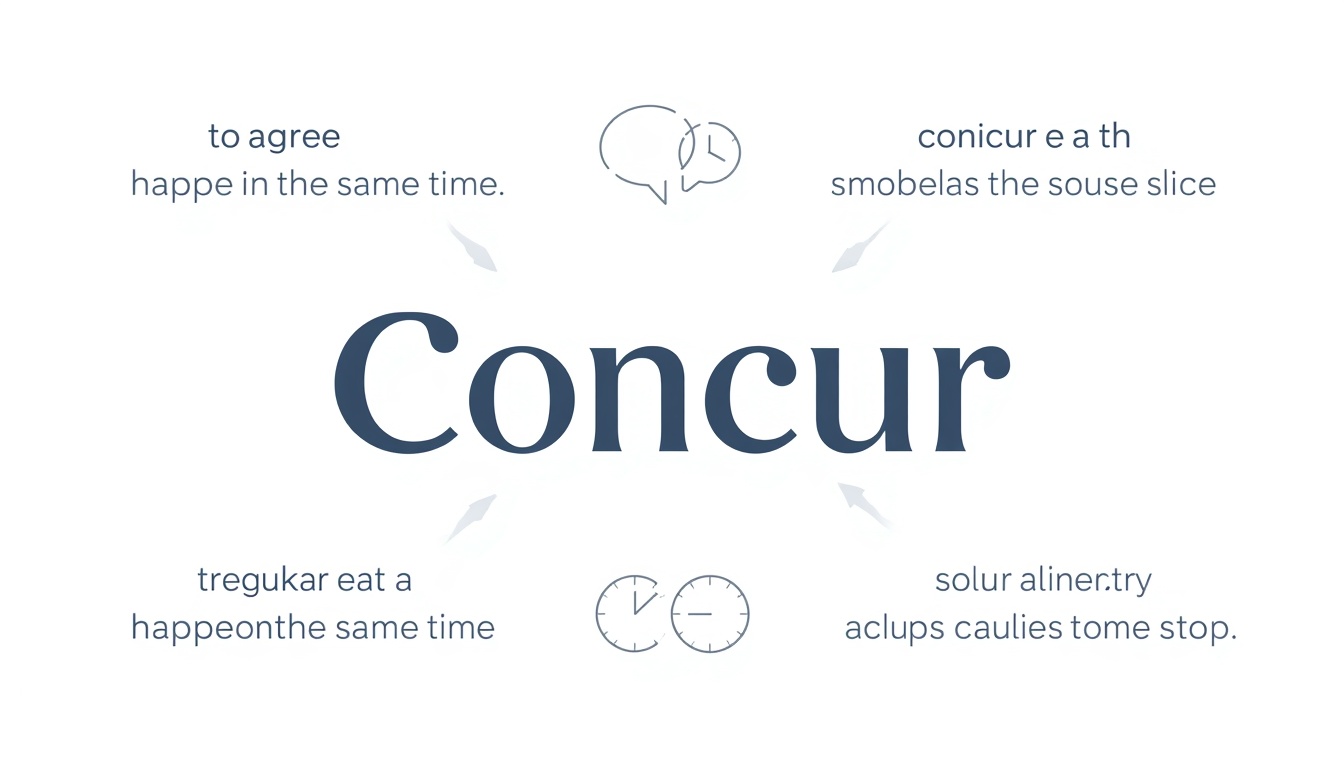
The concur meaning is generally “to agree with someone or to have the same opinion.” It can also describe two things that happen at the same time or coincide, although this second meaning is less common in everyday conversation. So, depending on the sentence, concur can be about people agreeing or events occurring together.
Once you understand these two meanings, the word becomes much less mysterious. It is basically a polished way of saying “I agree,” though English, as usual, likes to give a simple idea a fancy coat sometimes.
What Does Concur Mean?
The most common meaning of concur is to agree with someone or to share the same opinion. When you concur with another person, you are saying that your view is the same as theirs.
For example, if your friend says, “I think this is the best decision,” and you believe the same thing, you can say, “I concur.” It sounds more formal than “I agree,” but the basic idea is almost identical.
The concur definition can therefore be understood as:
- To agree with someone or something
- To have the same opinion
- To be in agreement
- To reach the same conclusion
- To share a similar point of view
In ordinary conversation, people usually say agree instead. Concur appears more often in formal discussions, reports, academic writing, business communication, legal language, and professional settings. It has that slightly serious sound to it, like someone is about to open a folder before giving their opinion.
Concur Definition in Simple English
If you want the definition of concur in very simple English, think of it this way: concur = agree.
When someone says, “I concur with your findings,” they mean, “I agree with your findings.” When a board member says, “I concur with the recommendation,” they are expressing the same opinion as the person who made the recommendation.
The word does not necessarily mean that the person is excited or emotional about the agreement. It simply tells us that their opinion matches another person’s opinion.
A few simple examples make it clearer:
- “I concur with your assessment.”
- “The editor concurred with the writer’s conclusion.”
- “We concur that the proposal needs more research.”
- “The psychologist concurred with the previous findings.”
- “The board members concurred with the report.”
Each sentence communicates agreement. Nothing complicated is hiding underneath the word.
Concur in English: The Main Meaning
In concur in English, the most important sense to remember is agreement between people, opinions, judgments, or conclusions.
You might concur with a person, a statement, an opinion, a report, a decision, or a conclusion. The expression “concur with” is especially common in formal writing.
For example, imagine several researchers studying the same subject. One researcher publishes a conclusion, and another researcher reviews the evidence and reaches the same conclusion. The second researcher might say, “I concur with the authors’ findings.”
That does not simply mean they read the study. It means they agree with its conclusion.
The same thing happens in business. A manager may say, “I concur with the team’s recommendation.” In plain English, that means the manager agrees with what the team has suggested.
Concur With Meaning
The phrase concur with means to agree with someone or something.
This is probably the most useful form to learn because it appears regularly in formal English.
Consider these examples:
- “I concur with your opinion.”
- “She concurred with the committee’s decision.”
- “The doctor concurred with the earlier assessment.”
- “We completely concur with the report.”
- “The members concurred with the proposed changes.”
Here, with connects the person who agrees to the person, idea, or decision being supported.
A small grammar point is worth remembering: we normally say concur with, not “concur to” when we mean agreement. So “I concur with you” is natural, while “I concur to you” is not the normal construction. English has its little traps, and this is one of them.
Concur That Meaning
Another useful structure is concur that, which means to agree that something is true, correct, necessary, or appropriate.
For example:
- “I concur that the evidence is convincing.”
- “The researchers concurred that further studies were necessary.”
- “The board concurred that the policy should be reviewed.”
- “Experts concur that regular practice improves performance.”
In these sentences, the word that introduces the idea or statement being agreed with.
The phrase can sound quite formal, so it is especially suitable for reports, research papers, professional correspondence, and official statements. In a casual text to your friend, “Yeah, I agree” will probably do the job just fine.
Concur Meaning in a Sentence
Seeing concur meaning in a sentence is one of the fastest ways to understand how the word behaves naturally.
- “I concur with your point of view.”
- “The committee concurred with the recommendation.”
- “Several experts concur that the results are reliable.”
- “She completely concurred with her colleague.”
- “The two researchers concurred on the main conclusion.”
- “The judge issued a concurring opinion.”
- “The voters appeared to concur with the mayor’s proposal.”
- “The ethics consultant concurred with the findings.”
Notice that the word works especially well when there is an existing opinion, conclusion, decision, or analysis. Someone is not merely talking; they are agreeing with something already expressed.
Concur Examples in Everyday and Formal English
Although concur is formal, you can still use it in ordinary situations when you want a slightly more polished tone.
Suppose two friends are discussing a movie. One says, “The ending was the strongest part.” The other could reply, “I concur.” It is perfectly grammatical, although it may sound intentionally formal and a little playful between friends.
In professional communication, however, it feels more natural.
- “I concur with the report’s findings.”
- “We concur with the proposed strategy.”
- “The committee concurred with the recommendation.”
- “The researchers concurred that the results were significant.”
- “The editor concurred with the author’s interpretation.”
- “The health workers concurred with the survey results.”
- “The consultant concurred with the analysis.”
So, how to use concur depends largely on the setting. It fits formal language beautifully, while “agree” is usually more relaxed.
Concur Synonym: Words With Similar Meanings
The closest concur synonym is agree. In the sense of sharing an opinion, these two words are very close in meaning.
Other useful alternatives include:
- Agree
- Be in agreement
- Be of the same mind
- See eye to eye
- Share the same opinion
- Have similar views
- Reach the same conclusion
- Agree on a matter
- Express agreement
However, these words are not always interchangeable in every sentence.
For example, “We see eye to eye” sounds conversational and friendly. “We concur” sounds formal and professional. “We reached the same conclusion” focuses more on the result of thinking or analysis.
So the right synonym depends on the mood you want. Words have personalities too, oddly enough.
Concur vs Agree
The difference between concur vs agree is mostly about tone and usage rather than basic meaning.
Agree is extremely common and works almost everywhere. You can say:
“I agree with you.”
Concur is more formal:
“I concur with you.”
Both mean that the speaker has the same opinion, but the second sentence has a more official or professional feeling.
For example, in a casual conversation:
“I agree. That was a good decision.”
In a formal report:
“The committee concurred with the recommendation.”
You could technically replace concurred with agreed in the second sentence, but the formal character of the original would be reduced slightly.
A Second Concur Meaning: Things Happening at the Same Time
There is another concur meaning that is important to know. Concur can also mean that events happen at the same time or coincide.
This usage is less common in everyday speech, but it is a legitimate meaning of the word.
For example:
- “The two events concurred.”
- “Several important developments concurred during the same period.”
- “The celebrations concurred with the national holiday.”
Here, concur is not about two people sharing an opinion. Instead, it describes things occurring together or at the same time.
This is where coincide becomes an important related word.
Concur vs Coincide
The difference between concur vs coincide becomes easier when you look at what is being compared.
When people concur, they usually agree.
When events coincide, they occur at the same time or happen together.
For example:
“I concur with your opinion.”
This means:
“I agree with your opinion.”
But:
“The two events coincided.”
This means:
“The two events happened at the same time.”
The words can overlap in some formal contexts, but they are not simply interchangeable. Remembering agree = concur and happen together = coincide will save you from most confusion.
Concurred Meaning and Past Tense
Concurred is the past tense and past participle of concur.
If someone agreed with an opinion yesterday, you can say they concurred with it.
For example:
- “The manager concurred with the team’s decision.”
- “The researchers concurred with the earlier findings.”
- “The committee concurred that the proposal was practical.”
- “The psychologist concurred with the assessment.”
The spelling changes slightly because the word ends in a consonant-vowel-consonant pattern where the final consonant is doubled before adding -ed.
So:
concur → concurred
Not concured. That little extra “r” is important, even if it feels like English is charging rent for every letter.
Concurring Meaning and Concurring Opinion
The word concurring comes from concur and describes someone who is agreeing.
One especially important expression is concurring opinion. In legal contexts, a judge may agree with the outcome of a case but provide a separate explanation for reaching that result.
That separate explanation can be called a concurring opinion.
Outside legal writing, concurring can simply mean agreeing.
For example:
- “The concurring members supported the recommendation.”
- “She gave a concurring response.”
- “His concurring comments strengthened the argument.”
Again, the central idea remains agreement.
Concurrence Meaning
Concurrence is the noun form associated with concur. It refers to agreement or a state of being in agreement.
For example:
- “The plan was approved with the concurrence of the board.”
- “The decision received broad concurrence.”
- “The committee expressed its concurrence with the recommendation.”
In everyday English, agreement is usually more natural. Concurrence has a formal flavor and appears more often in professional, legal, academic, and institutional contexts.
Concurrent and Concurrency: Related but Different
You may also come across concurrent and concurrency. These words are related to the idea of things occurring together, but they do not simply mean “agree.”
Concurrent generally means happening at the same time.
For example:
- “The company launched two concurrent projects.”
- “The events were held on concurrent dates.”
Concurrency refers to the condition or occurrence of things happening together, especially in technical or specialized contexts.
So the family of words can look confusing:
concur → agree or occur together
concurred → agreed or occurred together in the past
concurring → agreeing or occurring together
concurrence → agreement
concurrent → happening at the same time
concurrency → the state of occurring together
They share a root, but their practical uses are different.
Formal Situations Where Concur Works Best
You will often encounter concur in areas where careful agreement matters.
In research, one scholar might concur with previous findings after examining the same evidence. In healthcare, professionals may concur with an assessment after reviewing a patient’s information.
In business, board members can concur with a proposal, while editors may concur on important editorial matters. Legal professionals may use concur when discussing judgments or opinions.
You may also see the word in academic writing, history, economics, contracts, and formal analysis.
For example:
- “The studies concur with the original hypothesis.”
- “The board concurred with the proposed changes.”
- “The experts concurred that additional research was required.”
- “The editor concurred with the final assessment.”
- “The analysts concurred with the report’s conclusions.”
The common thread is clear: someone has considered an opinion or conclusion and finds that their own view matches it.
How to Remember the Meaning of Concur
A simple memory trick can make the word stick.
Think:
Concur = agree.
Then remember its less common second sense:
Concur = happen together.
So if a sentence involves an opinion, think agree. If it involves events or circumstances occurring together, think coincide.
For example:
“I concur with your opinion.”
Think: I agree.
“The events concurred.”
Think: The events occurred together.
That two-part shortcut covers the main meanings without making vocabulary learning feel like a legal examination, thankfully.
Concur Antonym: What Is the Opposite?
The natural concur antonym is disagree.
If concur means having the same opinion, then disagree means having a different opinion.
Other opposites may include:
- Disagree
- Differ
- Object
- Dissent
- Reject
- Oppose
For example:
“I concur with the proposal.”
Opposite:
“I disagree with the proposal.”
In formal settings, dissent can also be useful when someone openly expresses a different opinion, especially within a group or institution.
How to Use Concur Naturally
The safest structure for learners is concur with + person, opinion, idea, decision, or statement.
Examples include:
- “I concur with you.”
- “I concur with your assessment.”
- “She concurred with the findings.”
- “They concurred with the recommendation.”
- “The researchers concurred with the previous study.”
You can also use concur that + statement:
- “I concur that this approach is effective.”
- “The experts concurred that more research was needed.”
If you are writing something casual, however, ask yourself whether concur sounds natural for the situation. Sometimes “I agree” is warmer, simpler, and much less stiff.
Concur Pronunciation
The word concur is generally pronounced like kuhn-KUR, with the stress on the second syllable.
The pronunciation is not especially difficult, but learners sometimes put equal stress on both syllables. Giving the second syllable stronger emphasis makes the word sound more natural.
The past tense concurred is pronounced similarly, with the ending added naturally rather than creating a completely new sound.
When learning vocabulary, saying the word aloud a few times can help. A word that feels strange in your mouth today may become perfectly ordinary after hearing yourself use it several times.
Common Mistakes With Concur
One common mistake is assuming concur can only be used for people. In its agreement sense, it is generally connected with people agreeing with opinions, findings, decisions, or statements.
Another mistake is using the wrong preposition. For example, concur with is the normal construction when talking about agreement.
It is also easy to confuse concur with concurrent. They look like close relatives because they are, but concurrent usually describes things happening at the same time, while concur commonly means agreeing.
And finally, don’t use concur just because you want your English to sound sophisticated. If “agree” communicates your thought better, use it. Good writing isn’t about wearing the fanciest word in the wardrobe.
Why Concur Sounds More Formal Than Agree
There is nothing inherently more intelligent about saying concur. It simply belongs more comfortably in formal vocabulary.
“I agree with your idea” sounds natural in almost any situation.
“I concur with your proposal” sounds appropriate in a meeting, report, academic discussion, or official response.
That difference is mostly about register. Concur in English is useful because it gives writers another way to express agreement when a more formal tone is appropriate.
Still, clarity should come first. A simple word that everyone understands is often better than a complicated one that makes readers stop and scratch their head.
Quick Guide to Concur Meaning
Here is the whole idea in a compact form:
- Concur meaning: to agree or have the same opinion
- Concur with meaning: agree with someone or something
- Concur that meaning: agree that something is true or correct
- Second meaning: to happen at the same time
- Main synonym: agree
- Event-related synonym: coincide
- Past tense: concurred
- Present participle: concurring
- Noun: concurrence
- Related adjective: concurrent
- Opposite: disagree
- Common formal use: reports, findings, opinions, decisions, research, and professional discussions
Once these pieces are together, concur really isn’t such a difficult word. It just prefers a suit and tie when “agree” is happy wearing a T-shirt.
Frequently ASked Questions
concur
Concur means to agree with someone or to have the same opinion. It is commonly used in formal or professional English.
concur meaning
The concur meaning is to agree, share the same opinion, or reach the same conclusion as another person. It can also mean that events happen at the same time.
i concur
“I concur” means “I agree” or “I have the same opinion.” It is a more formal way to express agreement with someone.
concure
“Concure” is a common misspelling of “concur.” The correct spelling is concur, meaning to agree or have the same opinion.
cocnur
“Cocnur” is an incorrect spelling of “concur.” The correct word is concur, which means to agree with someone or something.
Read more: https://ytmeaning.com/abide-meaning/
Final Thoughts on the Meaning of Concur
The simplest way to remember concur meaning is this: to concur is to agree, especially in formal or professional language. When a researcher concurs with previous findings, a board member concurs with a recommendation, or an expert concurs that a conclusion is sound, each person is saying that their opinion matches another person’s view.
The word has another meaning too, where things concur when they happen at the same time or coincide. That sense is less common, but knowing it gives you a fuller understanding of the word.
If you’re trying to improve your English vocabulary, don’t just memorize the concur definition. Try using the word in a few sentences of your own. Write one about an opinion, one about a formal decision, and one about events occurring together. That’s where a vocabulary word stops being something you recognize and becomes something you actually own.
And perhaps that is the nicest thing about learning words: eventually, the strange-looking ones become familiar little tools. Concur is simply another one of those tools, ready whenever you need to express agreement with a little more formality and precision.